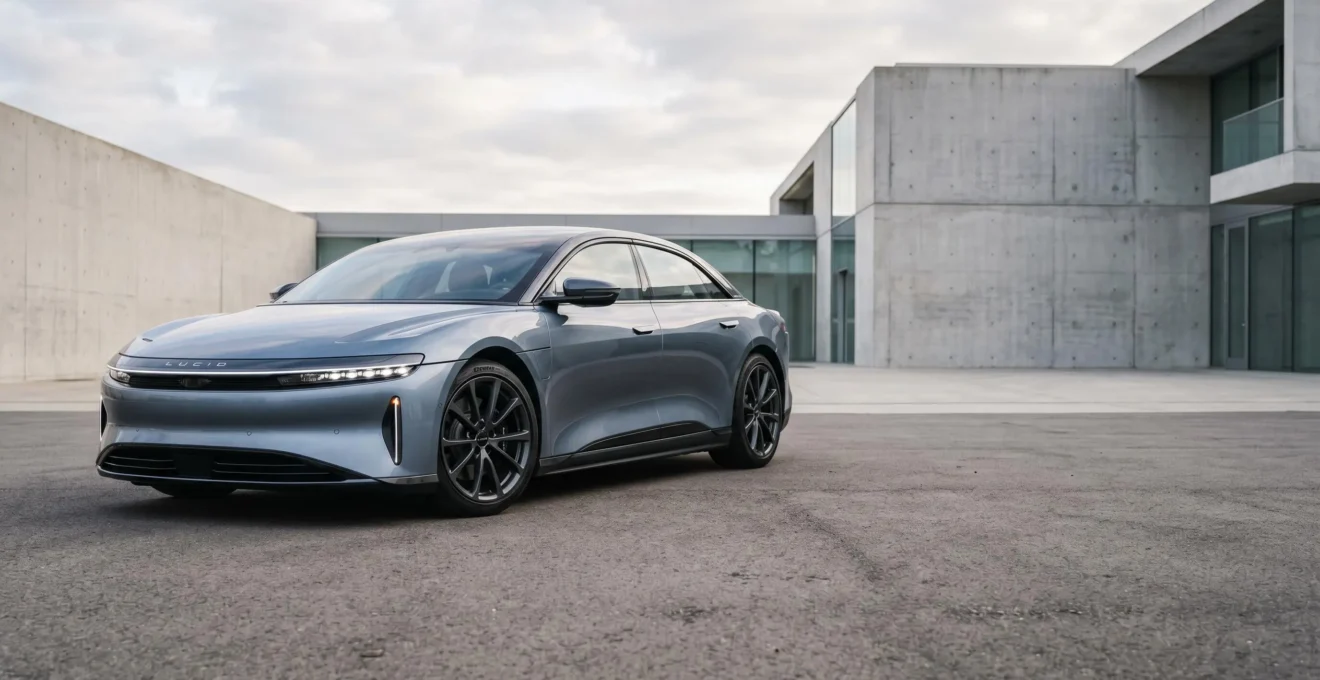
Contrary to popular belief, the 800-volt architecture in cars like the Porsche Taycan isn’t just about faster charging; it’s a complete performance philosophy that re-engineers the vehicle for superior dynamics and endurance.
- Higher voltage allows for thinner, lighter wiring and smaller components, directly reducing the car’s overall weight and improving agility.
- It drastically cuts down on waste heat, enabling the car to deliver sustained peak power for longer without thermal throttling—a critical advantage for spirited driving.
Recommendation: When evaluating a performance EV, look beyond the 0-60 time and assess the voltage architecture. An 800V system is a strong indicator of a car engineered for true, repeatable performance, not just straight-line sprints.
For any performance enthusiast, the electric vehicle transition has been a mixed bag. We’ve been promised face-melting acceleration, and the numbers on paper deliver. A sub-three-second 0-60 mph time is no longer the exclusive domain of hypercars. Yet, for many, something is missing. The initial punch fades, the car feels heavy in the corners, and the thought of a track day is often dismissed due to concerns about overheating and performance degradation. The conversation always seems to circle back to range and charging speed, treating the EV as a commodity to be managed, not a machine to be mastered.
The industry’s answer often seems to be more—more battery, more power. But this just adds more weight, exacerbating the very issues that dull the driving experience. We’ve been told to focus on the charging curve, the kWh, and the miles per charge. But what if the true revolution in performance EVs isn’t about the size of the fuel tank, but the efficiency of the entire engine? What if the key to unlocking a lighter, more agile, and more enduring performance EV lies in a single, often overlooked number: its voltage?
This is where 800-volt architecture enters the chat. Far from being a simple marketing gimmick to sell faster charging, it represents a fundamental shift in engineering philosophy, one born from the crucible of endurance racing. It’s a system-level approach that creates a virtuous cycle of efficiency, impacting everything from wiring weight to thermal management and long-term reliability. It’s the secret sauce that separates a one-trick-pony dragster from a true, all-around driver’s car.
This article will deconstruct the 800V system from an engineer’s perspective. We will move beyond the charger and explore how this technology directly translates into the tangible on-road benefits a true enthusiast craves: lower weight, sustained power delivery, and even smarter long-term value. Prepare to rethink what makes a performance EV truly great.
Summary: Decoding the 800V Advantage for the Performance Driver
- Why 800V Systems Make Cars Lighter and More Agile on British B-Roads?
- How to Charge from 10% to 80% While You Grab a Coffee: The 800V Advantage
- Will Your 800V Car Charge Slowly on Older Gridserve Units?
- The Repair Bill Shock: Are 800V Inverters Twice as Expensive to Replace?
- Why an 800V Car is the Safest Bet for Resale Value in 2027?
- How to Gain 20 Extra Miles of Range Without Charging via Software Updates?
- Which F1 Technologies Actually Make it to Your Hatchback?
- Reliability vs Performance: Why F1 Engines Have to Last 7 Races Now?
Why 800V Systems Make Cars Lighter and More Agile on British B-Roads?
In high-performance engineering, weight is the enemy. It dulls acceleration, strains brakes, and compromises handling. The prevailing criticism of EVs is their immense mass, largely due to heavy battery packs. While 800V architecture can’t change the battery’s core weight, it attacks the car’s mass in a more insidious and brilliant way: through the wiring harness. Electrical power is a product of voltage and current (P=V*I). By doubling the system voltage from a standard 400V to 800V, you can deliver the same amount of power with half the electrical current. This is a game-changer for a simple reason rooted in physics: resistive heat loss is proportional to the square of the current (P=I²R).
With half the current, you generate only one-quarter of the waste heat. This means engineers can use significantly thinner and lighter copper cables to transfer power throughout the car. According to Porsche, this approach has a direct and measurable impact. As their engineers state in the Taycan’s technical documentation: “At the same power output, half the cross-section of conventional 400-volt technology is sufficient for cables.” This isn’t a trivial saving. In the Taycan, this directly saves around four kilograms in weight, reduces energy transmission losses, and frees up valuable packaging space.
While four kilograms may not sound like much, it triggers what engineers call a virtuous cycle of mass decompounding. Lighter cables might mean slightly smaller brackets and supports. Less weight overall means the suspension and braking systems don’t have to work as hard, potentially allowing for their own optimization. This system-level weight saving, however small, contributes to a lower center of gravity and reduced inertia, making the car feel more responsive and agile when tackling a series of tight corners on a challenging B-road. It’s a subtle but crucial element in transforming an EV from a heavy cruiser into a nimble sports car.
How to Charge from 10% to 80% While You Grab a Coffee: The 800V Advantage
The most widely advertised benefit of 800V technology is, without a doubt, its charging speed. For a performance car enthusiast, this isn’t just about convenience; it’s about freedom. It’s the difference between a long road trip being a logistical exercise in charger planning and a spontaneous adventure. An 800V system enables charging at much higher power levels—often 270 kW or more—compared to the 150 kW peak common in many 400V cars. Because the system runs at a higher voltage, it can accept this immense power without generating excessive heat in the battery or cables, which is the primary limiting factor for charging speeds.
This translates into dramatically shorter stops. The days of waiting 30-40 minutes for a significant top-up are numbered. With an 800V architecture and a compatible high-power DC charger, a 10-80% charge can be completed in the time it takes to grab a coffee and use the restroom. In some real-world tests, this has been achieved in as little as 16 minutes for a 5% to 80% charge on a Porsche Taycan. This effectively brings EV “refueling” into a similar time-frame as a stop at a traditional petrol station, fundamentally altering the user experience for long-distance travel.
The difference is not just theoretical; it’s a structural advantage. As the table below illustrates, the entire ecosystem around 800V charging is designed for speed and efficiency, right down to the slimmer, often liquid-cooled cables that are easier to handle than their bulky 400V counterparts.
| Architecture | Peak DC Speed | 10-80% Charging Time | Cable Handling |
|---|---|---|---|
| 400V System | 120-170 kW | 25-35 minutes | Thicker, heavier cables |
| 800V System | 220-270+ kW | 15-20 minutes | Slimmer, liquid-cooled cables |
This leap in charging capability gives the driver more time on the road and less time tethered to a plug. It removes a major psychological barrier to EV ownership and makes the electric performance car a truly viable option for any journey, no matter the distance. The data for this comparison is backed by comprehensive industry analysis of charging technologies.
Will Your 800V Car Charge Slowly on Older Gridserve Units?
This is a common and valid concern for prospective 800V EV owners. The UK’s charging infrastructure is a patchwork of old and new, and not every station, like those on the Gridserve Electric Highway, is a state-of-the-art 350 kW unit. So, what happens when your cutting-edge 800V car meets a more common 50 kW or 150 kW charger designed for 400V systems? The short answer is: it will charge, but not at its maximum potential. It’s a question of compatibility and conversion.
Your 800V car is not rendered useless. Every 800V vehicle is equipped with an essential piece of hardware: an onboard DC-to-DC boost converter. Think of this as a transformer. When the car detects it’s connected to a lower-voltage 400V charger, this converter steps up the incoming voltage to the 800V level required by the battery. This ensures the car can charge safely from almost any DC fast charger on the network. However, the process is not without limitations.
As experts at CDX Automotive explain, “While an 800V vehicle can use a 400V charger, it must rely on an onboard DC-DC boost converter to raise the voltage, and the charging speed will be limited by the station’s lower output.” The car cannot magically pull 270 kW from a station rated at 150 kW. You will be limited to the maximum power the charger itself can provide. In many cases, the efficiency of the onboard converter may also cap the speed slightly below the station’s maximum. For example, on a 150 kW charger, an 800V car might realistically pull around 130-140 kW. This is still a very respectable charging speed, far faster than a 50 kW unit, but it won’t be the headline-grabbing sub-20-minute experience. The key takeaway is that an 800V car offers maximum flexibility: it unlocks incredible speeds on the newest chargers while remaining fully compatible with the vast majority of the existing 400V network.
The Repair Bill Shock: Are 800V Inverters Twice as Expensive to Replace?
The question of long-term running costs is a pragmatic one for any car owner. The components in an 800V system, particularly the power inverter, are indeed more technologically advanced. These inverters often rely on Silicon Carbide (SiC) semiconductors instead of traditional silicon. SiC technology is more efficient, can handle higher temperatures, and switches faster, all of which are necessary to manage the 800V system effectively. Yes, as a standalone component, a SiC inverter is more expensive to manufacture and therefore to replace than its conventional counterpart. However, framing the discussion solely around the replacement cost of a single part is misleading and ignores the total value proposition.
This advanced technology is not just an expense; it’s a performance investment. The superior efficiency of a SiC inverter means less energy is wasted as heat during both driving (discharging) and regenerative braking (charging). This translates directly into more range from the same size battery. According to engineering data from performance technology specialists McLaren Applied, the move to a high-efficiency 800V SiC inverter can result in a range extension of greater than 7% through inverter efficiency gains alone. For a car with a 300-mile range, that’s an extra 21 miles ‘for free’ on every single charge, purely from having a better inverter.
Furthermore, because these components run cooler and are under less thermal stress (as we’ve established, less current means less heat), they are engineered for greater longevity. The higher upfront cost is a trade-off for a more robust and efficient system that enhances the car’s primary functions: range and performance. The “repair bill shock” is a hypothetical scenario that overlooks the daily, tangible benefits of improved efficiency and the potential for a longer component lifespan due to superior thermal management. It’s a classic case of focusing on the cost of a part rather than the value of the system.
Your 5-Point Value Check for High-Voltage EV Tech
- Component Origin: Identify the key power electronics (inverter, onboard charger). Are they built with advanced materials like Silicon Carbide (SiC)?
- Thermal Management: Investigate the cooling system. Does the manufacturer highlight specific liquid cooling for the battery, motors, and power electronics?
- Sustained Performance Claims: Look for manufacturer data or independent tests showing performance over multiple acceleration runs or track laps. Does power output remain consistent?
- Weight & Agility: Compare the vehicle’s curb weight to its 400V rivals. Is there evidence of ‘mass decompounding’ contributing to better handling?
- Future-Proofing: Assess the charging peak (e.g., 270kW vs 150kW). A higher peak indicates a system built to leverage the next generation of charging infrastructure.
Why an 800V Car is the Safest Bet for Resale Value in 2027?
Predicting future resale values is always an exercise in reading trends, but in the fast-moving world of EV technology, some signals are clearer than others. Just as a manual gearbox is now a desirable, value-adding feature on certain classic sports cars, core engineering technologies that define a generation of vehicles play a huge role in their long-term desirability. By 2027, the EV market will be more mature, and buyers on the used market will be far more discerning. The distinction between a first-generation 400V EV and a more advanced 800V model will be stark. An 800V architecture is rapidly becoming the new industry standard for premium and performance EVs, and cars without it risk being perceived as outdated.
The adoption trajectory is a powerful leading indicator. A detailed analysis of the Chinese market, often a bellwether for global EV trends, shows an explosive growth in 800V models. Passenger car sales featuring this architecture saw a 185% year-on-year increase in 2024, with market penetration expected to surpass 35% by 2030. This rapid shift demonstrates that the industry is heavily investing in 800V as the path forward. A 400V car purchased today may look technologically adequate, but in three to four years, it will be competing on used car lots against a flood of more efficient, faster-charging models.
Beyond charging speed, there’s another crucial factor for resale value: battery health. The superior thermal management of an 800V system isn’t just for performance; it’s for longevity. Less heat during both high-power driving and fast charging means less stress on the battery cells. This slower rate of degradation means that after three or four years, an 800V battery is likely to have retained more of its original capacity and health compared to a 400V counterpart that has been subjected to higher thermal loads. For a savvy used car buyer, a healthier battery is a primary purchasing driver, making the 800V car the more secure and valuable asset.
How to Gain 20 Extra Miles of Range Without Charging via Software Updates?
The concept of gaining range through an over-the-air (OTA) software update sounds like magic, but it’s a reality in modern EVs. However, the effectiveness of these updates is not equal across all vehicles. The secret lies in the underlying efficiency of the hardware platform. A more efficient system provides a larger canvas for software engineers to work their magic. This is where the inherent efficiency of an 800V architecture becomes a powerful, yet hidden, advantage. Even before any software tuning, estimates suggest that the move from 400V to 800V provides a baseline efficiency gain of 2-3% simply from reduced resistive losses in the wiring and components.
This foundational efficiency acts as a multiplier for software optimizations. Think of it like tuning an engine. You’ll get better results from tuning a high-performance, well-engineered engine than you will from a standard, economy-focused one. As one analysis in Power Electronics Engineering notes, “The inherent efficiency of the 800V architecture (less energy wasted as heat) creates a larger ‘playground’ for software engineers. The gains from fine-tuning power delivery or regenerative braking algorithms are amplified on a more efficient hardware platform.” When engineers push an update to refine the torque delivery strategy to the motors or tweak the regenerative braking curve, those small percentage gains are applied to a system that is already wasting less energy to begin with.
So, how do you gain 20 extra miles? It’s not one single change. It’s the cumulative effect of a series of small software improvements over time, all benefiting from the superior hardware. An update might optimize the battery’s thermal management strategy, using a tiny bit less energy to cool the pack. Another might refine the inverter’s switching frequency, saving another fraction of a percent. A third could improve the predictive algorithm for regenerative braking based on navigation data. On a less efficient 400V system, these gains might add up to 5-10 miles. But on a highly efficient 800V platform, the same software logic can easily unlock 15-20 miles or more. You’re not creating energy from nothing; you’re simply unlocking the latent potential that was engineered into the hardware from day one.
Which F1 Technologies Actually Make it to Your Hatchback?
The “race on Sunday, sell on Monday” mantra is as old as motorsport itself, but the link between racing technology and road cars can sometimes feel tenuous. However, in the case of 800V architecture, the lineage is direct, proven, and born from the most demanding race in the world: the 24 Hours of Le Mans. The technology wasn’t conceived in a boardroom to improve charging times; it was developed by Porsche’s racing division to solve a fundamental problem of endurance racing: how to go faster for longer while using less energy and generating less heat.
The Porsche 919 Hybrid, a three-time Le Mans winner, was the crucible. To be competitive, Porsche needed a hybrid system that was not only immensely powerful but also incredibly light and thermally efficient to survive 24 hours of flat-out racing. The solution was a high-voltage system. The Porsche Newsroom confirms this direct link: “Originally developed for the Porsche 919 Hybrid race car, this voltage now reduces weight and installation space in series production thanks to leaner cables, enabling shorter charging times.” It was a pure performance play. The benefits we see in the road-going Taycan—lighter weight, better thermal management, and sustained power delivery—are the very same advantages that gave the 919 its edge on the Mulsanne Straight.
Case Study: From Le Mans to the Showroom with the Porsche 919 Hybrid
Porsche’s decision to implement an 800-volt system in a production car was not a leap of faith; it was a transfer of proven technology. The 919 Hybrid race car validated the architecture under the most extreme conditions imaginable. As documented in their engineering deep-dives, this motorsport-validated voltage architecture, along with its energy management and thermal efficiency strategies, was transferred directly from the race program to the Taycan. This means the power electronics in the road car have a DNA forged in the heat of endurance racing, designed for ultimate reliability and performance under stress. It is one of the most direct and tangible examples of F1-level technology making its way into a car you can own.
This isn’t just marketing fluff. When you opt for an 800V performance car, you are buying into a piece of genuine motorsport heritage. The same engineering principles that allow a race car to maintain its pace lap after lap are what allow a road car to deliver repeatable, exhilarating performance without overheating or throttling its power back. It’s a direct infusion of racing DNA into the EV platform.
Key Takeaways
- 800V is a system-level performance upgrade, not just a charging feature, reducing weight and improving agility.
- Superior thermal management allows for sustained high-power output without performance degradation, crucial for spirited driving.
- The technology is rapidly becoming the industry standard, making 800V vehicles a safer bet for future resale value.
Reliability vs Performance: Why F1 Engines Have to Last 7 Races Now?
In the world of high-performance, from Formula 1 to endurance racing, the ultimate engineering challenge is no longer just about peak power; it’s about sustained, reliable performance. An F1 engine must now last for multiple race weekends, enduring thousands of kilometers at the absolute limit. This has forced a shift in engineering focus towards efficiency and thermal management. The single biggest enemy of both performance and reliability is heat. This is where the engineering philosophy behind an F1 power unit and an 800V road car perfectly align. Both seek to achieve maximum output while producing the minimum amount of waste heat.
As we’ve established, by doubling voltage to 800V, you halve the current for the same power delivery. The fundamental law of physics (P=I²R) dictates that halving the current reduces resistive heat loss by a factor of four. Academic research into battery configurations confirms this, stating, “By doubling the voltage to 800V, an EV can deliver the same power with half the current. This reduces resistive heating losses significantly, allowing for sustained high-performance driving without thermal derating.” This isn’t just a small improvement; a 75% reduction in waste heat is a monumental gain in an electric system.
This massive reduction in thermal load is what engineers call creating thermal headroom. It means every component in the high-voltage chain—the battery, the wiring, the inverter, and the motors—operates far below its maximum temperature tolerance. For the performance enthusiast, this translates directly into the ability to deploy the car’s full power, repeatedly, without the onboard systems intervening to protect themselves. You can perform multiple back-to-back acceleration runs or enjoy a spirited drive on a mountain road without experiencing ‘thermal derating’, where the car noticeably reduces power to manage heat. It’s the key to consistent, reliable performance, exactly the same principle that allows an F1 engine to survive a full race distance at full tilt.
Ultimately, choosing an 800V car is a decision to prioritize holistic engineering over a single specification. It’s an investment in a platform designed for a future of higher-power charging, greater efficiency, and most importantly for an enthusiast, a more dynamic and enduring driving experience. For your next performance car evaluation, the first question shouldn’t be “How fast is it to 60?”, but rather, “What’s the voltage?”.