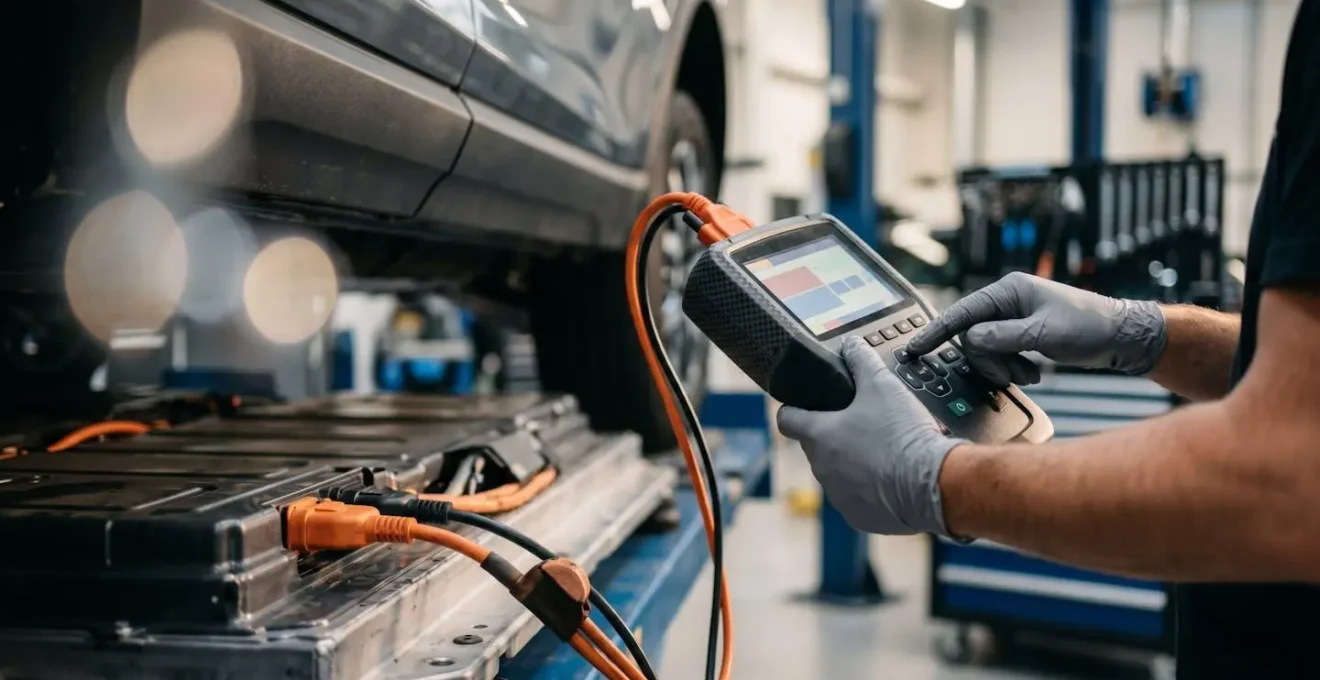
The battery health figure on a used EV’s dashboard is often a sales tactic, not a reliable diagnostic.
- Real-world battery capacity can be significantly lower than the displayed “State of Health” (SoH) suggests.
- Manufacturer warranties are designed to cover catastrophic failure, not the gradual, performance-sapping degradation that costs you range.
Recommendation: Learn to perform a simple, real-world capacity test during your test drive to uncover the truth the seller might not even know.
The biggest fear holding back UK buyers from the used electric car market isn’t the price—it’s the battery. You’ve found what looks like a great deal on a three-year-old EV, but a nagging voice whispers, “What if the battery is shot?” You picture yourself stranded on the M25 with a dead car and facing a five-figure repair bill. It’s a terrifying and perfectly valid concern.
Most advice you’ll find tells you to check the “State of Health” (SoH) on the dashboard or trust the remaining 8-year warranty. As a used car inspector, I can tell you that’s exactly what a seller hoping for a quick sale wants you to do. This “dashboard deception” can hide a multitude of sins, from a history of charging abuse to the early onset of irreversible degradation. The warranty? It’s a “warranty mirage,” a safety net with holes so big a bus could drive through them.
But what if the key to knowing a battery’s true condition wasn’t in the car’s software, but in understanding its physical tells and the real-world limits of its warranty? This guide isn’t about trusting the numbers on a screen. It’s about teaching you how to think and act like an inspector. We’ll bypass the dealership spin and uncover the hard truths about battery health.
Together, we will deconstruct what those health percentages really mean for your daily commute, expose the loopholes in manufacturer warranties, and give you a practical, actionable method to test a battery’s true capacity before you even think about signing any paperwork. This is your defence against buying a tired EV.
This comprehensive guide is structured to walk you through an inspector’s mindset, from understanding the numbers to the physical realities of battery repair and longevity. The following sections will equip you with the knowledge to make an informed, confident decision.
Summary: An Inspector’s Guide to Used EV Battery Health
- What Does 90% SoH Really Mean for Your Real-World Range?
- Why Your 8-Year Battery Warranty Might Not Cover Gradual Capacity Loss?
- What Happens to Your Battery When the Car is Scrapped in the UK?
- Repair or Replace: Can You Fix a Single Dead Cell for Under £1,000?
- The Charging Habit That Ages Your Battery Twice as Fast as Normal
- Why Do Traditional Lithium Batteries Catch Fire in Rare but Severe Cases?
- Does an Electric Car Really Save Money on Servicing or is it a Myth?
- Solid-State Batteries: Will They Really Solve Range Anxiety for UK Drivers?
What Does 90% SoH Really Mean for Your Real-World Range?
When you sit in a used EV, the first thing you’ll probably look for is the battery’s State of Health (SoH), usually shown as a percentage. A dealer might proudly point to “90% SoH” and tell you it’s “like new.” This is the first and most common piece of dashboard deception. That 90% figure doesn’t guarantee you 90% of the original range. It’s an estimate, often a very optimistic one, calculated by the car’s management system, which can be influenced by recent driving styles and charging patterns.
The only number that matters is the battery’s usable capacity in kilowatt-hours (kWh). A 90% SoH on a 60kWh battery should mean you have 54kWh of usable energy. But due to cell imbalance and degradation not captured by the simple SoH metric, you might only have 50kWh. That’s a real-world loss of over 15 miles of range that the dashboard is hiding from you. You can’t trust the car’s own report card; you have to conduct your own exam.
The only way to cut through this is with a real-world capacity test during your test drive. It requires some prep work with the seller, but it’s the most powerful tool you have to reveal the battery’s true condition. The process below turns you from a passive buyer into an active inspector, gathering your own evidence.
Your Action Plan: The Real-World Battery Capacity Test
- Request a Full Charge: Ask the seller to have the vehicle charged to 100% before you arrive. This is non-negotiable.
- Note the Starting Point: When you get in, photograph the dashboard showing the 100% State of Charge (SoC) and the displayed estimated range.
- Compare to Original Figures: Compare the displayed range to the car’s original, brand-new WLTP/EPA range. A huge discrepancy is your first red flag.
- The Test Drive: Drive the car until you’ve used a significant chunk of battery, ideally 30% to 50%. Use the car’s trip computer to note exactly how many kWh were consumed during that percentage drop.
- Calculate True Capacity: Now for the maths. If you used 20 kWh to go from 90% to 40% (a 50% drop), you can extrapolate. 20 kWh is 50% of the total capacity, so the true total capacity is approximately 40 kWh. Compare this to the car’s original factory specification to find the real SoH.
Why Your 8-Year Battery Warranty Might Not Cover Gradual Capacity Loss?
The second pillar of false security, after the dashboard’s SoH figure, is the manufacturer’s battery warranty. Typically advertised as lasting 8 years and 100,000 miles, it sounds like the ultimate peace of mind. This is the “warranty mirage.” What sellers conveniently forget to mention is that this warranty is primarily for catastrophic failure, not the gradual, creeping degradation that slowly strangles your car’s range and usefulness.
Almost every manufacturer sets a degradation threshold for a warranty claim, and it’s shockingly low. As an inspector, I’ve seen the disappointment on owners’ faces when they learn their car with only 60% of its original range doesn’t qualify for a replacement because the warranty only kicks in below a 70% capacity threshold. You could lose almost a third of your range, and the manufacturer would still consider the battery to be performing within specification. The warranty isn’t there to guarantee your car feels new; it’s there to protect the manufacturer from replacing expensive batteries unless they have absolutely failed.
Furthermore, these warranties are loaded with exclusions. As Recharged Auto points out in their analysis, “Improper modifications, aftermarket battery heaters, hacked charging hardware, or DIY repairs, can give the manufacturer ammunition to deny coverage.” Did the previous owner use a non-approved charger or have a third-party repair done? You might inherit that voided warranty without even knowing it.
The following table, based on a recent comparative analysis of EV warranties, clearly shows that the industry standard is to let a battery degrade significantly before they will step in. Notice the uniformity around the 70% mark.
| Manufacturer | Warranty Duration | Mileage Limit | Capacity Threshold |
|---|---|---|---|
| Tesla | 8 years | 100,000-150,000 miles | 70% |
| Nissan | 8 years | 100,000 miles | 70% (9/12 bars) |
| Hyundai/Kia | 10 years | 100,000 miles | 70% |
| Ford | 8 years | 100,000 miles | 70% |
| Rivian | 8 years | 175,000 miles | 70% |
| GM (Chevrolet/Cadillac) | 8 years | 100,000 miles | 70% |
What Happens to Your Battery When the Car is Scrapped in the UK?
A common question is what happens to the massive battery pack at the end of an EV’s life. Does it just end up in a landfill, a toxic time bomb? For a prospective used buyer in the UK, understanding the end-of-life process is reassuring, as it points to a mature and growing industry that sees value in these old packs. This value, in turn, supports the ecosystem of repair and refurbishment that can make owning an older EV more viable.
In the UK, a sophisticated circular economy is rapidly being built around EV batteries. Rather than being scrapped, batteries are increasingly being recovered, tested, and given a second life. This isn’t just an environmental aspiration; it’s a commercial reality. For example, as of 2019, it was estimated that the UK car-and-van fleet held 1,400 metric tonnes of lithium and 800 metric tonnes of cobalt, valuable materials that are now being systematically recovered.
This process gives rise to second-life applications. Modules that are no longer fit for the rigours of automotive use can be perfect for stationary energy storage, helping to power homes or balance the national grid. This creates a residual value for old batteries, which helps to lower the long-term cost of ownership for everyone.
Case Study: The Nissan & Ecobat UK Partnership
A prime example of this circular economy in action is the partnership between Nissan and Ecobat in the UK. Since 2021, Ecobat’s UK facility has become a hub for processing end-of-life batteries from salvaged Nissan LEAFs. They have performance-graded over 14,000 individual battery modules. These modules are then triaged: some are repaired for reuse in other vehicles, many are repurposed for second-life applications like home energy storage, and only those that are truly spent are sent for material recycling. This commercially viable model proves that a battery’s journey doesn’t end when the car is scrapped.
Repair or Replace: Can You Fix a Single Dead Cell for Under £1,000?
The spectre of a full battery replacement, often costing more than the car is worth, is what creates so much anxiety. But what if you don’t have to replace the entire pack? The idea of a modular repair—swapping out just the faulty part—is the holy grail for out-of-warranty EV owners. The question is, how realistic and affordable is it? The short answer to the title is: probably not for under £1,000, but it’s far cheaper than a full replacement.
A high-voltage battery isn’t a single unit. It’s a collection of modules, and each module contains numerous individual cells. A fault is often confined to one or two cells within a single module. Independent specialists are emerging who can diagnose the pack down to this level. As expert Carl Medlock of Medlock & Sons EV Repair explains, the process is methodical: “EV batteries are made of three components: cells, modules and packs. Once a customer comes in with an issue, we diagnose the problem with our equipment and try to isolate the modules that have the problematic cells inside of them.”
This targeted surgery is the key. Instead of a £10,000 bill for a new pack from the main dealer, you’re looking at replacing a single module. While the cost is still significant, it’s more manageable. According to recent industry data, these module-level repairs typically cost between $2,000 and $5,000 (approximately £1,600-£4,000). It’s not cheap, but it transforms a car-killing fault into a viable repair. This is the “cell-level economics” that a savvy buyer needs to understand. A car with a known-repairable battery design (where modules are accessible and available) is a much safer used bet.
The Charging Habit That Ages Your Battery Twice as Fast as Normal
Not all battery degradation is equal. Some of it is simply down to time and chemistry (calendar ageing), but a huge portion is caused by how the car is treated. As an inspector, if I could know only one thing about a used EV’s history, it would be its charging profile. This reveals the car’s “degradation signature.” And there is one specific habit that is a giant, flashing red flag: an over-reliance on high-power DC rapid charging.
Rapid chargers are a convenience for long journeys, but using them as a daily habit is like forcing your battery to sprint a marathon every day. The enemy here is heat. Pushing massive amounts of energy into the battery very quickly generates significant heat, which accelerates the chemical decay inside the battery cells. A car that has lived its life being gently topped up overnight on a 7kW home charger will have a much healthier battery than one that’s been constantly hammered at a 150kW motorway service station.
The data on this is stark and undeniable. A comprehensive study revealed the dramatic difference in ageing rates. It found that vehicles relying on DC fast charging above 100 kW for more than 12% of sessions degrade at up to 3.0% per year. This is double the rate of cars that are primarily charged on slower AC power, which degrade at a much healthier 1.5% per year. Over five years, that’s the difference between a battery with 92.5% of its health and one with only 85%—a significant gap in real-world range and value.
When viewing a used EV, always ask the seller about their charging habits. If possible, some cars have an onboard log that shows the ratio of AC to DC charging. A high proportion of DC charging is a major warning sign that the battery may be more “tired” than its age or mileage suggests.
Why Do Traditional Lithium Batteries Catch Fire in Rare but Severe Cases?
The media loves a dramatic EV fire story. The images are spectacular and feed into a primal fear of new technology. While it’s true that lithium-ion battery fires can be intense and difficult to extinguish, the reality is that they are exceptionally rare—far rarer than fires in conventional petrol and diesel cars. As a buyer, it’s important to replace fear with facts and understand the “why” behind these isolated incidents.
The root cause in almost all cases is a phenomenon called “thermal runaway.” This occurs when a single cell in the battery pack overheats due to a manufacturing defect, internal short circuit, or physical damage from a crash. This overheating cell releases its energy, which then heats up the adjacent cells, causing them to fail in a cascading chain reaction. The critical factor, therefore, is thermal management. An effective battery management system (BMS) is designed to monitor the temperature of every cell, cool them when necessary, and isolate any faulty cell before it can trigger a runaway event.
The industry has learned a great deal about this, and modern EVs are incredibly safe. Early models had teething problems, but these were quickly engineered out.
Case Study: How Tesla Mastered Thermal Management
In the early days of the Model S (2013-2014), battery pack failure rates were relatively high, reaching 8.5% for 2013 models. The cause was traced back to insufficient thermal management in the battery pack design. In response, Tesla implemented significant upgrades to its battery chemistry and, crucially, its thermal management systems from 2015 onwards. The results were dramatic: the high failure rates were eradicated, bringing them down to the industry average of 0.5% or less for warranty replacements and virtually eliminating thermal runaway incidents in normal operation.
Does an Electric Car Really Save Money on Servicing or is it a Myth?
One of the biggest selling points for EVs is the promise of lower running costs, particularly on servicing. With no oil changes, spark plugs, or exhaust systems to worry about, the theory is that maintenance is simpler and cheaper. While this is true for routine, scheduled servicing, it’s a dangerously incomplete picture that ignores the potential for much larger, non-routine costs. It’s a myth of omission.
The savings you make on a £200 annual service are completely wiped out if you’re hit with a major component failure. And in an EV, the big-ticket items are very big indeed. While the drivetrain itself is reliable, the associated high-voltage electronics—on-board chargers, inverters, and the battery pack itself—are complex and expensive. When they go wrong out of warranty, the costs can be eye-watering. For instance, battery replacement costs on standard cars typically range between £8,000 to £12,000 in the UK.
This isn’t just theoretical. Warranty data provides a clear picture. You would expect fewer claims on EVs due to their simpler mechanical nature, but the opposite is true. An analysis of warranty claims found that the frequency of claims is lower for EVs, but the cost of those claims is so much higher that, overall, the total value of warranty claims for electric vehicles are 30-50% higher on average than for their internal combustion engine (ICE) counterparts. This tells an important story: while EVs may break down less often, when they do, the repairs are significantly more expensive. The myth of “cheap servicing” is true, but it’s a small part of a much larger and more costly financial equation.
Key Takeaways
- Distrust the Dashboard: A used EV’s displayed State of Health (SoH) is an unreliable estimate. A real-world capacity test is the only way to know the truth.
- The Warranty Isn’t a Safety Net: Manufacturer warranties only cover catastrophic failure (typically below 70% capacity), not the gradual degradation that costs you range and value.
- Heat is the Enemy: A history of frequent DC rapid charging ages a battery up to twice as fast as slow AC home charging. Always ask about the car’s charging history.
Solid-State Batteries: Will They Really Solve Range Anxiety for UK Drivers?
The future of EV technology is often discussed in the context of solid-state batteries. They are painted as the ultimate solution—dramatically increasing range, cutting charging times to minutes, and eliminating fire risk. While the technology is promising, waiting for it to become mainstream means ignoring the incredible capability and longevity of the lithium-ion batteries available today. For the average UK driver, the solution to range anxiety is already here.
The fear of rapid battery degradation in current EVs is largely a holdover from first-generation models. The reality is that modern battery packs are proving to be remarkably robust and long-lasting, comfortably exceeding the typical ownership period of a car. As David Savage, a Vice President at Geotab, states after a major 2024 analysis of battery degradation, the data is clear. He concludes, “With these higher levels of sustained health, batteries in the latest EV models will comfortably outlast the usable life of the vehicle and will likely not need to be replaced.” This is a powerful statement from a company with a vast dataset on real-world vehicle performance.
This isn’t just an opinion; it’s backed by data showing that batteries maintain their health far better than early critics predicted. The obsession with a future “perfect” battery distracts from the fact that today’s “good enough” batteries are, in fact, excellent. They are safe, reliable, and retain a very high percentage of their capacity for hundreds of thousands of miles. Range anxiety for most UK drivers, whose daily mileage is well within the capabilities of even an older used EV, is more of a psychological barrier than a technological one. Solid-state will be an evolution, not a revolution that makes current EVs obsolete overnight.
By arming yourself with an inspector’s scepticism and the practical knowledge in this guide, you transform from a potential victim of dashboard deception into a confident, informed buyer. The right used EV is out there, and now you have the tools to find it. Evaluate the vehicle based on the real-world evidence you can gather, not the promises on a screen or in a brochure.