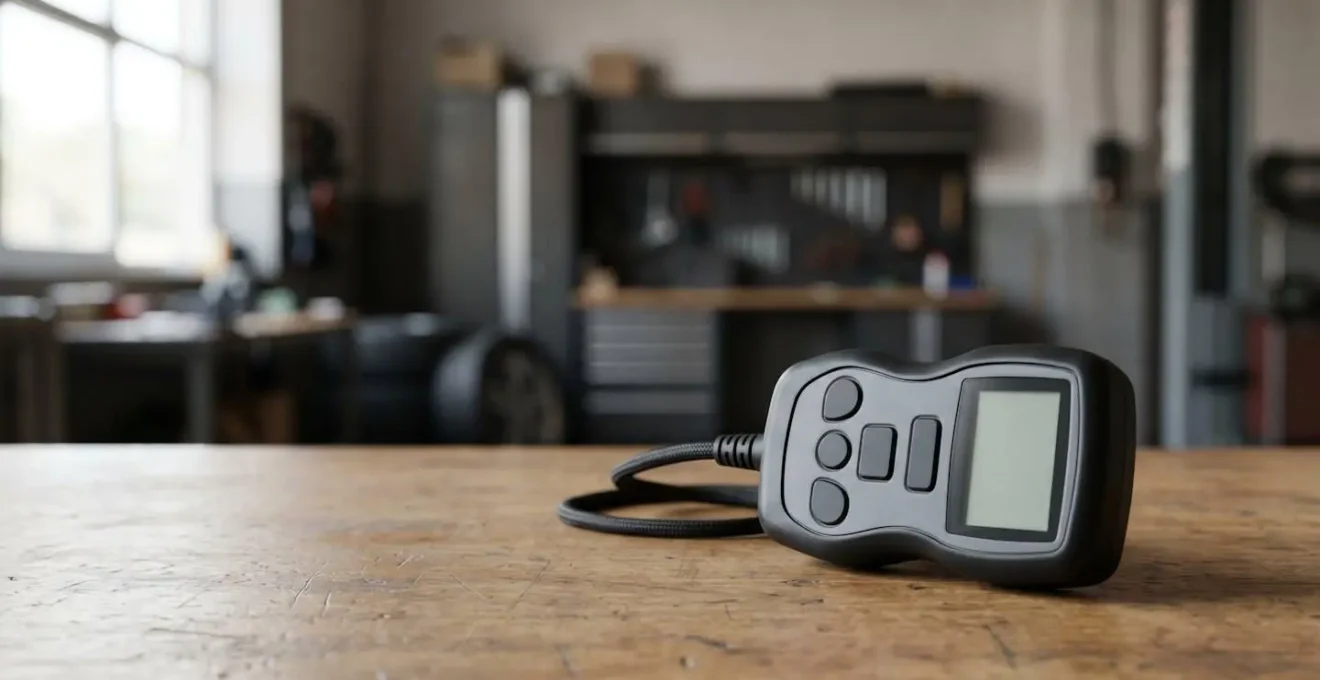
The key to saving thousands on car repairs isn’t just reading fault codes; it’s using a £20 scanner to have a data-driven dialogue with your garage and knowing your legal rights.
- A simple OBD-II tool can reveal if a £2,000 gearbox “failure” is actually a software bug, or if a catalyst fault is caused by something other than the expensive catalyst itself.
- UK ‘Right to Repair’ laws give you the power to use independent garages without voiding your warranty, provided you keep meticulous records.
Recommendation: Invest in a basic scanner, learn to interpret its data, and approach your next repair not as a customer, but as an informed project manager for your own vehicle.
The dreaded check engine light. It glows on your dashboard, a tiny amber symbol of impending financial doom. The immediate reaction for most is a sigh, a call to the garage, and the acceptance of a bill that often starts with £90-£120 just to “plug it in”. You’re told it’s a complex system, that only their specialist equipment can decipher the car’s secrets. You pay the fee, often followed by a quote for hundreds, or even thousands, in repairs, leaving you feeling powerless and a little bit poorer.
But what if that narrative is wrong? What if the key to unlocking those secrets costs less than a tank of petrol? An On-Board Diagnostics II (OBD-II) scanner, a simple tool available for under £20, is more than just a gadget. It is a lever. It’s your first step towards what we call repair sovereignty—taking back control over your own vehicle. This isn’t just about reading a code and Googling it. It’s about developing diagnostic intelligence: understanding the *logic* of your car’s systems, spotting patterns, and knowing when a simple sensor issue is being dressed up as a catastrophic failure.
Forget the idea that you need a master’s degree in engineering. This guide is built for the DIY enthusiast who’s tired of being kept in the dark. We’ll move beyond the basics and show you how to use this powerful little tool to understand specific, costly faults, from catalyst codes to transmission glitches. You will learn not just how to diagnose your car, but how to speak the same language as the garage, question their recommendations with data in hand, and leverage your rights under UK law to keep your warranty intact while saving a fortune.
This article provides a comprehensive roadmap, guiding you from understanding common fault codes to asserting your consumer rights. The following summary outlines the key areas we will explore to empower you in your journey to diagnostic independence.
Summary: A DIY Champion’s Guide to Car Diagnostics
- P0420 Code: Why Replacing the Sensor Might Not Fix Your Catalyst Fault?
- Why Main Dealers Charge £120/Hour for Diagnostics That Locals Do for £50?
- Why Your Car Needs a Software Update Instead of a New Gearbox?
- Yellow vs Red Lights: When Is It Safe to Drive to the Garage?
- How UK Right to Repair Laws Help You Fix Your Car Without Voiding Warranty?
- What Does 90% SoH Really Mean for Your Real-World Range?
- How to Trust Your Electronic Oil Sensor When There’s No Dipstick?
- The £3,000 Snap: How to Know When Your Timing Belt is About to Fail?
P0420 Code: Why Replacing the Sensor Might Not Fix Your Catalyst Fault?
The P0420 code, “Catalyst System Efficiency Below Threshold,” is the bane of many car owners. The immediate, and often incorrect, assumption from both DIYers and some garages is that the catalytic converter has failed, a repair costing over £1,000. More often than not, the garage might suggest replacing the downstream oxygen (O2) sensor as a “cheaper first step.” This is a classic diagnostic mistake. The P0420 code is a symptom, not a diagnosis. The downstream O2 sensor is the messenger telling you the catalyst isn’t doing its job; shooting the messenger rarely solves the problem.
True diagnostic intelligence means using your OBD-II scanner to investigate *why* the catalyst is underperforming. The cause could be an exhaust leak upstream, a misfiring spark plug dumping unburnt fuel into the exhaust, or even incorrect fuel trim. A cheap scanner paired with a good smartphone app allows you to view live data. You can graph the voltage from the upstream and downstream O2 sensors. A healthy catalyst will show a steady, flat line from the downstream sensor, while the upstream sensor fluctuates. If your downstream sensor is mirroring the upstream one, the catalyst isn’t working. But the real question is, why?
This is where you move from being a code reader to a diagnostician. Before you let anyone sell you a catalytic converter, you must use your tool to rule out the simpler, cheaper causes. It is this methodical process that separates a £20 fix from a £1,500 mistake.
Your action plan: P0420 Diagnostic Intelligence
- Use your OBD-II scanner to retrieve the P0420 code and establish baseline freeze frame data showing exact engine conditions (RPM, temperature, speed) when the code triggered.
- Perform live data monitoring to graph upstream (B1S1) and downstream (B1S2) oxygen sensor voltage. A healthy catalyst shows stable downstream readings; a failed catalyst shows downstream mimicking upstream fluctuations.
- Check for alternative causes: Inspect for exhaust leaks near sensors, scan for misfire codes (P0300 series), and verify fuel trim values are within a -10% to +10% range.
- Check Mode $06 catalyst monitor test results to identify degrading catalyst efficiency before the warning light appears.
- Test-drive the vehicle while monitoring freeze frame data to confirm whether the rear oxygen sensor responds correctly under the same conditions that triggered the code.
Why Main Dealers Charge £120/Hour for Diagnostics That Locals Do for £50?
The vast difference in diagnostic pricing between a main franchise dealer and a trusted independent garage is a source of constant debate. Why pay £120 when a local mechanic charges £50? The dealer’s justification rests on three pillars: proprietary manufacturer-specific equipment, brand-specific training, and exclusive access to Technical Service Bulletins (TSBs). TSBs are internal documents from the manufacturer detailing known faults and fixes for specific models, often involving software updates. This means a dealer can potentially solve a bizarre electrical gremlin in 30 minutes that an independent might spend hours chasing.
However, this is where your power as an informed owner comes in. The independent garage sector is highly competitive, and many successful “indies” are run by ex-dealer technicians who bring that brand-specific knowledge with them. Furthermore, they invest heavily in professional-grade multi-brand diagnostic tools that often rival dealer capabilities. Their lower overheads—less glamorous showrooms, no franchise fees—are passed directly to you. A mobile mechanic offers even greater convenience and lower costs for initial code reading, though they may lack the equipment for deep-level diagnostics.
This image showcases the kind of professional equipment that both dealers and top-tier independents use. Your £20 scanner is the first rung on this ladder, giving you the initial data to decide who to approach. The real value is in understanding what you’re paying for at each level. Don’t be dazzled by a shiny showroom; a great independent with the right tools and knowledge is often the smartest financial choice.
The following table, based on industry analysis, breaks down what you get for your money. This allows you to have a data-driven dialogue, questioning a high quote by knowing what the market rates are.
| Service Provider | Diagnostic Scan Cost | Labour Rate | What You Get |
|---|---|---|---|
| Main Franchise Dealer | £90-£150 | £100-£180/hour | Manufacturer-specific tools, TSB access, brand training, proprietary diagnostics |
| Independent Garage | £40-£80 | £50-£90/hour | Professional OBD-II equipment, multi-brand capability, often waived if repair done |
| Mobile Mechanic | £30-£60 | £40-£70/hour | Convenience, basic code reading, limited complex diagnostics |
Why Your Car Needs a Software Update Instead of a New Gearbox?
“You need a new gearbox.” These are some of the most feared words in car ownership, often accompanied by a quote running into thousands of pounds. But in the age of the software-defined vehicle, mechanical components are increasingly controlled by complex code, and sometimes the fault lies in the programming, not the physical parts. Modern automatic and dual-clutch transmissions use a Transmission Control Module (TCM) to manage shifts, clutch pressures, and torque. A bug or outdated calibration in this software can cause very real, very physical-seeming problems: jerky shifts, hesitation, false neutrals, and harsh engagement.
A garage that only thinks in terms of hardware will quote you for a new mechatronic unit or a full gearbox replacement. A garage with true diagnostic intelligence will first ask, “Is there a software update for the TCM?” Your £20 scanner can’t perform the update, but it can arm you with the knowledge to ask the right question. By searching owner forums for your specific car model and transmission type (e.g., “VW Golf DQ250 harsh shifting”), you can often find widespread reports of these issues being solved with a simple software flash from the dealer or a specialist.
Case Study: The VW/Audi DSG “Mechatronic Failure”
The renowned VW/Audi DSG gearbox became infamous for issues that dealers would quote £2,000-£4,000 to fix by replacing the mechatronic unit. However, independent specialists discovered that many of these “mechanical failures” were due to flawed software in the Transmission Control Module (TCM). A specialist can reprogram the TCM, a process often called a ‘TCU flash’, to recalculate clutch pressures and torque limiters in real-time. This software-only fix, costing a fraction of the hardware replacement, completely resolves the jerky shifts and harsh engagement, proving that a software update can be more powerful than a wrench.
Before you approve any major transmission work, you must do your research. Identify your exact transmission type, search for known software fixes or Technical Service Bulletins (TSBs), and then specifically ask your garage: “Have you checked for a TCM software update that addresses this shifting behaviour?” This single question, backed by a few hours of online research, can be the difference between a £200 software update and a £3,000 unnecessary repair.
Yellow vs Red Lights: When Is It Safe to Drive to the Garage?
Not all dashboard warning lights are created equal. A common mistake is to either panic at any light or, conversely, ignore them all. Your OBD-II scanner is a crucial triage tool in this situation, helping you distinguish between a “head’s up” and a “pull over now” emergency. The colour of the light is your first, most important clue.
Red lights demand an immediate and safe stop. These typically indicate a critical failure in a primary system. Think oil pressure, engine temperature, or brakes. These are non-negotiable. Pull over as soon as it is safe to do so and turn off the engine. Driving with low oil pressure can destroy an engine in minutes. Note that a basic OBD-II scanner often can’t read codes from brake or airbag systems, so a red light from these systems means you trust the light, not your scanner.
Yellow or amber lights are informational. They are telling you that a non-critical system has registered a fault. This is where your scanner shines. A solid check engine light, for example, could be anything from a loose fuel cap (a simple fix) to the P0420 catalyst code we discussed earlier. In most cases, it is safe to drive carefully to your destination or a garage. However, there is one critical exception: a flashing yellow check engine light. This indicates a severe engine misfire, a condition that is actively dumping unburnt fuel into your hot catalytic converter. This can cause catastrophic, irreversible damage to the catalyst within minutes, turning a potential £100 spark plug job into a £1,500+ repair. If you see a flashing check engine light, it’s the same as a red light: pull over immediately.
How UK Right to Repair Laws Help You Fix Your Car Without Voiding Warranty?
One of the biggest fears holding owners back from using independent garages or even their own diagnostic tools is the threat of “voiding the warranty.” This is often a scare tactic used by main dealers to retain their service monopoly. In reality, you have powerful legal protections. The UK retained the EU’s Block Exemption Regulations (BER) post-Brexit, which are the cornerstone of your repair sovereignty.
The BER explicitly gives you the legal right to have your car serviced or repaired at any VAT-registered independent garage, even during its warranty period, without it being voided. There are, however, critical conditions you must meet:
- The garage must follow the manufacturer’s official service schedule to the letter.
- They must use either genuine parts from the manufacturer or parts of “Original Equipment (OE) or matching quality.”
- You must keep meticulous, itemised records of all work done, including part numbers and fluid specifications.
This is where your role as an empowered owner is crucial. Simply reading fault codes with your £20 scanner does *not* void your warranty. It is a non-intrusive act. What can cause issues is clearing codes to hide a fault from a dealer, or fitting non-approved performance parts that then cause another component to fail. In that case, the manufacturer has the right to deny a claim, as they can prove the failure was caused by your modification, not a manufacturing defect.
Ultimately, the burden of proof lies with the manufacturer. If they deny a warranty claim after you’ve used an independent garage, they must legally prove that the work done by that garage directly caused the failure in question. With a full, detailed service history from a reputable independent, as confirmed by an analysis of UK garage practices, their case becomes very weak. Keep every receipt. Document everything. It’s your ultimate shield.
What Does 90% SoH Really Mean for Your Real-World Range?
For electric vehicle (EV) owners, the concept of Battery State of Health (SoH) is paramount. A used EV advertised with “90% SoH” sounds great, but what does it actually mean for the distance you can travel? The common assumption is that you’ve lost 10% of your range. The reality is far more complex, and your OBD-II scanner, paired with an EV-specific app like LeafSpy or Dr. Prius, is the only way to get the true picture.
The SoH percentage is just a single, often misleading, metric calculated by the Battery Management System (BMS). As EV battery experts point out:
A 10% drop in SoH does not necessarily mean a 10% drop in range. The relationship is not linear and is affected by the Battery Management System calibration, temperature, and driving style.
– EV Battery Diagnostic Research, Electric Vehicle Battery State of Health Assessment
A far more important metric, which your scanner can reveal, is the voltage variance between individual battery cells. A healthy battery pack has cells with very similar voltages. A variance greater than 0.05V between the highest and lowest cell is a major red flag, indicating one or more cells are degrading much faster than the rest. This weak link will dictate the performance of the entire pack and can lead to premature failure, regardless of what the overall SoH% says. Furthermore, real-world range is a function of usable capacity and efficiency. In winter, a battery’s capacity can drop by 20-40%. That 90% SoH battery might perform like a 70% SoH battery on a cold January morning. Your OBD-II tool helps you see beyond the dashboard “Guess-O-Meter” and understand the true health of your most expensive component.
How to Trust Your Electronic Oil Sensor When There’s No Dipstick?
The slow disappearance of the humble engine oil dipstick has caused considerable anxiety for DIY enthusiasts. For decades, it was the ultimate, foolproof way to check the lifeblood of your engine. Now, we are asked to place our trust in an electronic sensor and a menu on the dashboard. But can you trust it? The answer is yes, but only if you understand how it works and follow the correct procedure.
An electronic oil level sensor is not like a fuel gauge; it requires specific conditions for an accurate reading. Simply checking it cold on your driveway will likely give you a false, often low, reading. You must follow the manufacturer’s precise protocol.
- Get the engine to operating temperature. This means driving for at least 10-15 minutes. Cold, thick oil doesn’t settle correctly.
- Park on perfectly level ground. Even a slight incline can throw the sensor’s reading off significantly.
- Turn the engine off and wait. This is the most commonly missed step. You must wait at least 5-10 minutes for the oil circulating in the engine to drain back into the sump. Checking too soon will always show a low level.
- Follow the car’s specific menu. Many German cars, for instance, require you to access the oil level menu with the ignition on but the engine off after this waiting period.
If the sensor shows an error or a reading you suspect is wrong, your OBD-II scanner can provide a second opinion. Advanced apps can often read the raw data from the oil level sensor (sometimes in millimeters of height) or check for specific fault codes (P0520-P0524 series) that indicate a sensor failure. This allows you to distinguish between a genuinely low oil level and a faulty sensor, restoring the peace of mind the dipstick once provided.
Key Takeaways
- An OBD-II scanner is a tool for diagnostic intelligence, not just reading codes. It’s about understanding the ‘why’ behind a fault.
- Software can be the root of many physical-seeming mechanical problems. Always investigate potential software updates before agreeing to expensive hardware replacement.
- UK’s ‘Right to Repair’ laws empower you to use independent garages without voiding your warranty, but meticulous record-keeping is your responsibility and your best protection.
The £3,000 Snap: How to Know When Your Timing Belt is About to Fail?
Of all the potential failures in an internal combustion engine, a snapped timing belt is one of the most catastrophic. This reinforced rubber belt synchronises the rotation of the crankshaft and the camshaft, ensuring the engine’s pistons and valves move in perfect harmony. If it fails on an “interference” engine (which most modern engines are), the pistons will crash into the open valves, causing catastrophic damage. The result is a repair bill that frequently exceeds £3,000, often writing off an older vehicle. The good news is that a timing belt rarely fails without warning signs that you can detect—sometimes even with your OBD-II scanner.
The primary warning signs are auditory. Listen for a high-pitched squeal on a cold start, which could indicate a failing tensioner bearing, or a deep ticking/rattling noise from the engine cover area, suggesting a worn or stretched belt is slapping against its casing. Any oil leaking onto the belt will also drastically shorten its life. Your scanner can provide an early warning. A stretched belt can cause the cam and crank synchronization to drift slightly, which can trigger a P0016 (Crank/Cam Position Correlation) fault code long before you hear any noise. This is your engine’s way of telling you its timing is off, and it’s a critical warning to heed.
The most important factor, however, is service history. Timing belts are replaced based on intervals of both mileage (e.g., 80,000 miles) and age (e.g., 7 years), whichever comes first. Rubber degrades over time, even with low mileage. A preventive replacement costs a fraction of the engine rebuild, as the average repair cost can easily top £3,000. If you are buying a used car or are unsure of your service history, treat any unusual engine noise as a potential timing belt issue and get it professionally inspected immediately. It’s the ultimate example of a stitch in time saving nine—or in this case, a £600 job saving £3,000.
By investing a small amount in a diagnostic tool and a larger amount in your own knowledge, you shift the power dynamic. You are no longer just a driver; you are the manager of your vehicle’s health, armed with data and ready to make informed, cost-effective decisions.