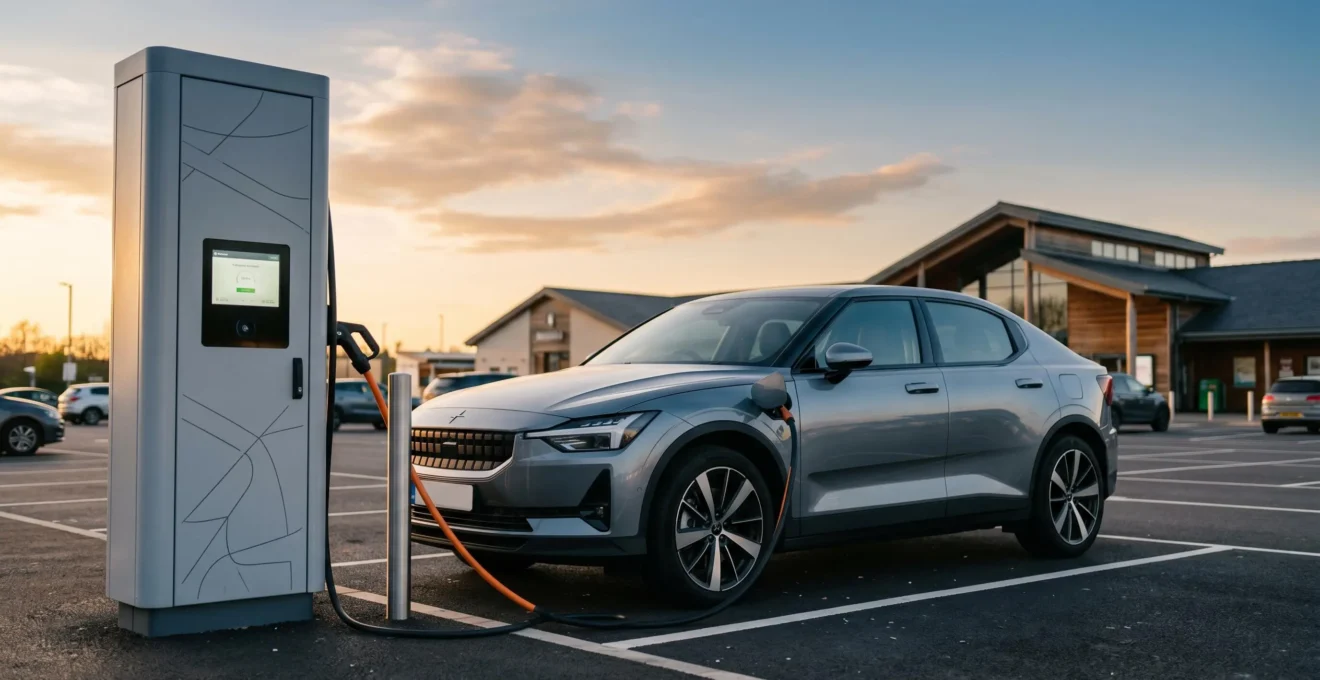
Paying nearly 80p/kWh for motorway charging isn’t just expensive; it’s a “stupidity tax” for not understanding the system’s flaws.
- Using slow 50kW chargers or inefficient older luxury EVs dramatically inflates your cost-per-mile due to poor charging curves and lower efficiency.
- Charging etiquette, like avoiding the 80-100% crawl, isn’t just polite—it’s a direct cost-saving strategy that frees up the network for everyone.
Recommendation: Stop focusing on the nearest charger. Start planning stops strategically based on charger speed, your specific vehicle’s efficiency, and the true value of your time to beat the high prices.
That heart-stopping moment when the charging screen displays a price of 79p per kilowatt-hour is a rite of passage for many UK electric vehicle drivers. It feels like a shakedown, a blatant exploitation of a captive audience on a long journey. You bought an EV to save on running costs, yet here you are, paying the equivalent of hyper-expensive petrol. The common advice is to “use an app” or “charge at home,” but this is useless when you’re 150 miles from your front door with a low battery.
This frustration is valid. The public charging network, especially at motorway services, often feels like a system designed against the user. It’s a messy landscape of variable speeds, inconsistent pricing, poor reliability, and unspoken rules of etiquette that can leave you paying far more than you need to. But what if the high price isn’t just a price? What if it’s a symptom of widespread inefficiency that you can learn to navigate and overcome?
This is not another guide telling you to download an app. This is a consumer advocate’s guide to beating the system. The key isn’t just finding a cheaper charger; it’s about understanding the hidden mechanics of charging—the efficiency gap of your car, the “charging taper penalty,” and the economics of the networks. By shifting your mindset from a passive driver to an active logistics manager for your own journey, you can consistently cut your motorway charging costs by 30% or more. We’ll expose the common mistakes, decode the subscription models, and give you the strategic framework to turn that feeling of being ripped off into the satisfaction of a journey well-planned and money well-saved.
This article provides a comprehensive roadmap to mastering the art of cost-effective public charging. We will dissect the most common pitfalls and provide actionable strategies to turn you into a savvy EV driver who never overpays at the motorway services again.
Summary: A Guide to Reducing Your EV Charging Costs at UK Motorways
- Why Plugging into a 50kW Unit is Wasting Your Time with a Modern EV?
- What to Do When the Only Working Charger is Blocked by a Petrol Car?
- Ionity Passport vs Tesla Membership: Which Subscription Saves Money for High Milers?
- The Charging Mistake That Enrages Other Drivers at Busy Service Stations
- How to Plan a Scotch Corner to London Trip Without Range Anxiety?
- When to Activate Battery Heating Before Arriving at a Supercharger?
- How the 2025 VED Changes Will Impact Your EV’s Running Costs?
- Depreciation Reality: Why That Cheap Luxury Saloon Will Cost You a Fortune?
Why Plugging into a 50kW Unit is Wasting Your Time with a Modern EV?
The sight of an empty 50kW rapid charger at a busy service station can feel like a gift. In reality, for any modern EV, it’s a trap. Plugging into one is often the single most expensive mistake you can make in terms of both time and money. The charging landscape has moved on, but these legacy units remain, luring unsuspecting drivers into a painfully slow and overpriced charging session. The core of the problem is the vast difference in what you pay versus the speed you get. The UK has seen a major push to install faster 150kW+ chargers, making older 50kW units increasingly obsolete on motorways precisely because they represent poor value.
The numbers are stark. For many modern EVs capable of accepting 100kW, 150kW, or even more, a 50kW charger is a bottleneck. It’s like trying to fill a swimming pool with a garden hose. Your car is begging for more power, but the charger simply can’t deliver it. You’ll be stuck there for an hour or more to add a meaningful amount of range, all while paying a premium price. Many networks have a flat rate for “rapid” charging, meaning you could be paying the same high price-per-kWh on a slow 50kW unit as you would on a blisteringly fast 350kW charger next to it.
This is where you must start thinking like a logistics manager. Your goal is to buy kWhs as quickly and cheaply as possible. A modern EV might add 100 miles of range in just 15-20 minutes on a 150kW+ ultra-rapid charger. On a 50kW unit, that same 100 miles could take 45 minutes or longer. You’re spending more than double the time for the same result, effectively doubling the “cost” of your time. Unless every single faster charger is occupied or broken, you should always avoid the 50kW option on a UK motorway. It’s a false economy that preys on a lack of knowledge.
What to Do When the Only Working Charger is Blocked by a Petrol Car?
Pulling into a service station with 5% battery, only to find the last available charger blocked by a petrol or diesel car—an act known as “ICE-ing”—is one of the most infuriating experiences for an EV driver. It’s not just an inconvenience; it’s a complete disregard for the needs of others and the functionality of the infrastructure. While your first instinct might be frustration, having a calm and methodical protocol is the most effective way to resolve the situation.
Before you do anything else, it’s crucial to document the situation. This isn’t about shaming, but about providing evidence if you need to escalate. Then, follow a clear chain of reporting. The charging networks and service station operators are increasingly aware of this problem and have systems in place, but they can only act if they are informed. The key is to be systematic, not emotional. Below is a step-by-step guide for what to do in the UK.
- Document the Incident: Note the exact location, charging bay number, and time. Take clear photos showing the non-EV in the EV-only bay, making sure the vehicle’s registration plate is visible.
- Report via the Charging App: Most major UK network apps like Gridserve, BP Pulse, or Ionity have a support or “report an issue” function. Use it to report the blocked charger in real-time. This creates an official log.
- Notify the Service Station Operator: Go to the main building and speak to the customer service desk (e.g., Moto, Welcome Break, Roadchef). Show them your photos and politely request they make a tannoy announcement for the vehicle’s owner.
- Use Community Warning Tools: Report the blocked charger on community apps like Zap-Map and PlugShare. This acts as a crucial real-time warning to other EV drivers heading to that location, saving them from the same fate.
- Consider Your Alternatives: While waiting, check your route planner. Major UK motorway corridors often have alternative charging hubs within a 5-10 mile radius that might be quicker to get to than waiting for the blocking vehicle to be moved.
Ionity Passport vs Tesla Membership: Which Subscription Saves Money for High Milers?
For any EV driver who regularly travels long distances in the UK, paying the ad-hoc, non-subscription price for charging is financial madness. It’s the equivalent of paying the full “rack rate” at a hotel when a discounted booking is just a click away. The two most compelling subscription offerings for non-Tesla drivers doing high motorway mileage are the Ionity Passport and the Tesla Membership, which opens up parts of the Supercharger network. But which one actually saves you more money? The answer depends entirely on your usage, but a simple calculation can reveal the clear winner for your driving habits.
Let’s break down the maths. The Ionity Passport typically involves a monthly fee that in return gives you a significant discount per kWh. Similarly, the Tesla Membership for non-Tesla owners reduces the per-kWh cost at their superchargers. Tesla recently made its offering more attractive, with a membership cost of £8.99 per month for a saving of around 10p per kWh, as confirmed by Tesla UK. Ionity’s Passport is slightly more expensive monthly but can offer a larger discount, often 30-40p per kWh, depending on the fluctuating base price.
So, how do you choose? You must calculate your break-even point.
- For Tesla: At £8.99/month and a 10p/kWh saving, you need to buy at least 90 kWh from their network each month to break even (£8.99 / £0.10 = 89.9). That’s roughly two full charges of a typical family EV. Anything more than that is pure profit.
- For Ionity: If the monthly fee is £11.99 and the discount is 35p/kWh, your break-even point is around 34 kWh (£11.99 / £0.35 = 34.2). This means the Ionity subscription starts paying for itself much faster, after just one moderate charging session.
The decision, therefore, comes down to network coverage on your typical routes. If your journeys are well-served by Ionity’s high-power chargers, its lower break-even point makes it extremely attractive. If, however, your routes are better covered by the expanding network of Tesla sites open to all EVs, and you know you’ll use more than 90kWh per month, the Tesla Membership is a solid choice. For a true high-miler, having both subscriptions during heavy-travel months can be the ultimate cost-saving strategy, providing maximum flexibility and ensuring you always get a discounted rate.
The Charging Mistake That Enrages Other Drivers at Busy Service Stations
There is one behaviour at a busy motorway charger that is guaranteed to provoke the silent, seething rage of every other EV driver waiting in the queue: sitting there, tethered to the charger, while your car trickles charge from 95% to 100%. This is not just poor etiquette; it’s a profound misunderstanding of how EV batteries and rapid chargers work. It’s a move that costs you and everyone else time and money. As one industry analysis bluntly puts it:
Charging to 100% on a UK public rapid charger is the most expensive electricity you can buy.
– UK EV charging etiquette guidance, Industry best practice analysis
This is due to the “charging curve.” A rapid charger will deliver its peak power to your battery when it’s relatively empty. As it fills up, typically past 80%, the car’s battery management system (BMS) dramatically slows down the charging speed to protect the battery cells. This is the Charging Taper Penalty. The time it takes to go from 80% to 95% can be as long as the time it took to go from 10% to 80%. You are occupying a high-demand piece of infrastructure for a tiny trickle of energy, holding up a queue of people who could be using that charger at its maximum speed.
This is a systemic problem. If one person hogs a charger for an extra 20 minutes to gain 10 miles of range, the entire flow of the service station is disrupted. The person waiting behind you now has a longer wait, and the person behind them might give up and try another location, increasing congestion elsewhere. Adhering to good etiquette is the only way the system works efficiently for everyone. It’s about treating the charger as a shared, finite resource.
Your Essential UK Charging Etiquette Checklist
- Charge to 80% Maximum: The final 20% can take as long as the first 60%. Unplugging at 80% saves you time and money and frees the charger for the next person who needs a fast top-up.
- Park Within the Lines: At tight UK service station layouts, poor parking can make neighbouring chargers unusable by blocking access or cable reach. Centre your vehicle properly.
- Confirm Charge Has Started: After you tap your card or use the app, always check your car’s display or the charger screen to confirm that power is actually flowing. A failed handshake can lock the charger for hours.
- Return Promptly When Charged: Most UK networks now impose hefty idle fees (£0.50-£1.00 per minute) after your car stops charging. Set an alarm on your phone for 5 minutes before it’s due to hit 80%.
- Don’t Use Chargers as Parking Bays: If your car is charged but you’re in the middle of a meal, be a good citizen. Move your car to a regular parking space to let someone else charge.
How to Plan a Scotch Corner to London Trip Without Range Anxiety?
The 250-mile-or-so drive from Scotch Corner down the A1(M) to London is a classic UK road trip and a perfect real-world test for an EV. For the unprepared driver, it’s a recipe for range anxiety. For the strategic driver, it’s an easy run with one well-planned, cost-effective stop. The key isn’t to just drive until the battery warning light comes on; it’s to use modern tools to create a robust plan before you even leave.
The A1(M) corridor is now well-served with high-speed charging. The old fear of being stranded is outdated. The new challenge is choosing the *best* stop, not just *any* stop. This involves a concept we’ll call the “Strategic Detour.” While motorway services offer ultimate convenience, they are almost always more expensive. A charging hub at a retail park just 2-3 miles off the motorway can be 15-20% cheaper per kWh. Your planning tool should allow you to weigh the 10-minute detour against a potential saving of £5-£10 on a single charge.
This is where apps like A Better Route Planner (ABRP) become indispensable. But simply putting in your start and end points isn’t enough. To get a reliable and cost-effective plan, you need to configure it correctly for UK conditions. A properly set up plan will tell you not just where to stop, but for how long, and what your battery percentage will be at every stage of the journey, effectively eliminating range anxiety.
- Input Your Exact Vehicle Model: ABRP’s strength is its detailed data on specific cars like the MG4 or Kia EV6, including their unique charging curves. This is critical for accurate time estimates.
- Set Realistic Consumption: Adjust the reference consumption to reflect UK motorway speeds. Driving at a constant 70mph uses significantly more energy (15-25% more) than the car’s official WLTP rating.
- Prioritise Reliable Networks: In the settings, tell the app to prioritise networks known for reliability in the UK, such as Gridserve, InstaVolt, and the Tesla Supercharger network.
- Set a Minimum Charger Threshold: Configure ABRP to only suggest stops at locations with at least 4-6 chargers. This is your insurance against arriving to find all chargers broken or in use.
- Factor in Amenity Quality: Compare the suggested stops. A 40-minute charge at a location like the Gridserve Electric Forecourt at Ferrybridge, with its comfortable lounge and quality coffee, is a far better experience than a 30-minute stop in a windswept, unlit corner of a retail park.
- Plan to Arrive with a Buffer: Always plan your trip to arrive at your destination with at least 10-15% battery remaining. This is your contingency for unexpected traffic, detours, or cold weather affecting your range.
When to Activate Battery Heating Before Arriving at a Supercharger?
One of the most overlooked but critical factors in achieving the advertised rapid charging speeds is your battery’s temperature. A cold battery is a slow battery. Plugging into an ultra-rapid charger with a cold battery pack is like asking a sprinter to run a 100m race without warming up—the performance will be sluggish and disappointing. This is the “Efficiency Gap” in action. Most modern EVs have a battery pre-conditioning function to solve this, but in the UK, you can’t always rely on it to work automatically.
The benefit of a warm battery is enormous. For a typical EV, a properly pre-conditioned battery can achieve its maximum charging speed almost instantly upon plugging in. A cold battery might start charging at a fraction of that speed, slowly ramping up as the process of charging itself warms it. This can add 10, 15, or even 20 minutes to a charging session. According to one UK analysis, effective pre-conditioning can reduce a 10-80% charge time by over 10 minutes, which could save you a significant amount of money in time and potential idle fees.
The problem is that automatic systems aren’t foolproof. Many EVs will only pre-condition the battery if you use the car’s built-in navigation to a known DC charger. However, the UK’s charging infrastructure is a patchwork. Many chargers are located in generic retail park or hotel car parks with a single postcode for the entire site. Your car’s navigation may not recognise that a specific charger exists at that postcode, and therefore, the automatic pre-conditioning will never activate. This is where manual intervention becomes a cost-saving skill.
- Understand Automatic Pre-conditioning: If your car supports it, always use the built-in navigation to a specific rapid charger (e.g., “Ionity, Wetherby Services”). The car should then automatically start warming the battery about 15-20 minutes before you arrive.
- Beware the UK Postcode Problem: If you’re navigating to a general postcode for a retail park, assume automatic pre-conditioning will fail. Your car simply doesn’t know you’re going there to charge.
- Activate Manually When Needed: If your vehicle has a manual battery pre-conditioning button (often found in the EV settings menu), use it. When you are 15-20 minutes away from your planned charging stop, activate it yourself.
- Accept the Small Energy Cost: Pre-conditioning will use a small amount of energy, perhaps 1-2% of your battery. This is a tiny price to pay for ensuring you get the fastest possible charging speed, saving you significant time.
- Prioritise in Cold Weather: This is absolutely critical in the UK winter (October to March). A cold-soaked battery can charge up to 50% slower. In winter, pre-conditioning isn’t a luxury; it’s essential for efficient travel.
How the 2025 VED Changes Will Impact Your EV’s Running Costs?
For years, one of the key selling points of an electric vehicle in the UK has been the zero-cost Vehicle Excise Duty (VED), or “road tax.” This significant saving is coming to an end. From April 2025, the rules are changing, and EV owners will need to factor a new annual cost into their budgets. While this news has been met with dismay by some, it’s crucial to understand the details and put them in perspective against the continued, massive savings on fuel.
The new rules remove the VED exemption for EVs first registered on or after 1 April 2017. As confirmed by the UK government, this means they will be liable for the standard annual VED rate, which is currently £195. Furthermore, the “expensive car supplement” will also apply to EVs. This is an additional charge for cars with a list price of over £40,000 when new. This supplement, currently £440 per year, is payable for five years from the second year the vehicle is registered. This means a premium EV will have a total VED bill of £635 per year during those years.
While nobody enjoys a new tax, it’s vital to see the bigger picture. A fixed annual cost of £195, while new, is minor compared to the savings you’ll continue to make by not buying petrol or diesel. The table below puts this into context for an average driver. Even with the new VED, the total annual running cost of an EV remains significantly lower than a comparable petrol car.
| Cost Category | Standard EV (under £40k) | Premium EV (over £40k) | Petrol Equivalent |
|---|---|---|---|
| Annual VED | £195 | £195 + £440 supplement (years 2-6) | £195 |
| Annual fuel/charging (10,000 miles) | ~£450 (home charging at 9p/kWh) | ~£450 (home charging) | ~£1,400 (petrol at £1.40/L) |
| Annual maintenance | ~£150 | ~£200 | ~£400 |
| Total annual running cost | ~£795 | ~£1,285 (years 2-6) | ~£1,995 |
| Net EV saving vs petrol | ~£1,200/year | ~£710/year (years 2-6) | Baseline |
The key takeaway is that while the VED-free party is over, the fundamental economic advantage of driving an EV remains firmly in place. Your running cost savings are simply reduced slightly, not eliminated.
Key Takeaways
- The true cost of motorway charging is a function of price, speed, and time; optimising for only one will cost you money.
- Systemic issues like legacy 50kW chargers and poor driver etiquette are major sources of inefficiency and cost that a savvy driver can avoid.
- Understanding the technical aspects of your own car—its efficiency, charging curve, and pre-conditioning—is the most powerful tool for reducing charging costs.
Depreciation Reality: Why That Cheap Luxury Saloon Will Cost You a Fortune?
The used EV market is flooded with tempting bargains. Three-year-old premium luxury saloons from legacy brands, which cost £80,000 new, can now be had for less than the price of a new family hatchback. It seems like an incredible deal, but for a high-mileage driver who relies on the public charging network, this “bargain” can quickly become a money pit. The hidden cost lies in the car’s inherent inefficiency—a factor that the first owner, who likely charged at home, never had to worry about.
Many of these first-generation luxury EVs were built on modified petrol car platforms and have poor energy efficiency. A case study comparing real-world motorway efficiency shows that while a modern, purpose-built EV like a Hyundai Ioniq 6 can achieve around 3.5 miles per kWh at 70mph, many older luxury EVs struggle to manage 2.5 miles/kWh. On a 200-mile motorway journey, this “Efficiency Gap” means the luxury car needs 23kWh more energy to cover the same distance. At the typical motorway rapid charging rate of 79p/kWh, that’s an extra £18 for a single trip. For a driver making 20 such trips a year, that’s an additional £360 in charging fees alone, vaporising any initial saving.
From April 2025, your EV will have a fixed running cost of £195 per year in VED, regardless of how much you drive.
– UK Government VED Policy, Vehicle Excise Duty regulations 2025
But the pain doesn’t stop there. These older models also often have disappointing charging curves. They might advertise a high peak charging speed, but they can only maintain it for a few minutes before the speed plummets. In contrast, many cheaper, more modern EVs can sustain a high charging speed for much longer, getting you back on the road faster. The result? You’re paying more per mile, and you’re spending more time waiting at the charger. That cheap luxury saloon suddenly feels very expensive when you’re standing in the rain at a service station, watching a newer, cheaper car charge twice as fast.
By abandoning the mindset of a passive consumer and embracing the role of a strategic operator, you can transform your relationship with public charging. You are now equipped with the knowledge to identify inefficiencies, exploit pricing structures, and plan your journeys with precision. Start applying these principles today to take control of your running costs and make every long-distance EV journey smoother, faster, and, most importantly, cheaper.