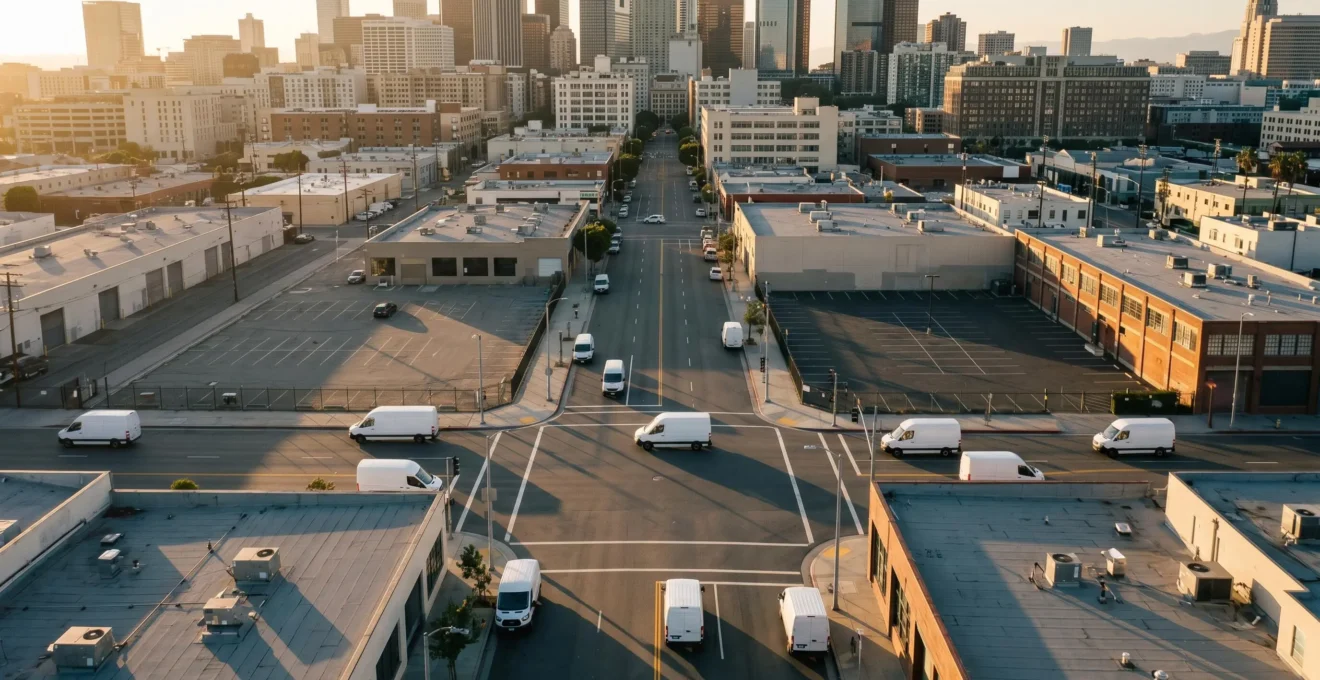
That ‘Sorry We Missed You’ notice isn’t a random failure; it’s a calculated outcome of a system optimising for cost and speed, not your personal convenience.
- Route algorithms must balance over 100 stops, traffic, and regulations, making ‘perfect’ impossible.
- Seemingly illogical costs like parking tickets and clean air zone fees are often budgeted as cheaper than avoiding them.
Recommendation: Understand that the system is designed for overall efficiency, not individual perfection. Your missed delivery is a data point in a vast logistical equation.
The sight of it is universally frustrating: the ‘Sorry We Missed You’ card tucked in your letterbox. It feels like a simple failure—a driver who didn’t try hard enough, a system that doesn’t work. The common assumption is that technology should have solved this by now. Surely a better app, a smarter GPS, or even a delivery drone could prevent this common annoyance. We imagine a world of perfect, on-time deliveries, orchestrated by flawless digital brains.
This vision, however, ignores the brutal reality of last-mile logistics. As a logistics operations manager, I can tell you that efficiency is our religion, but our scripture is written in the language of trade-offs, not perfection. That missed delivery isn’t an anomaly; it’s often the predictable, logical result of a hyper-optimised system pushed to its absolute physical and financial limits. The real question isn’t why the system fails, but what it’s truly being optimised for.
What if the core problem isn’t the technology, but the conflicting demands we place upon it? What if paying thousands in parking fines is more efficient than finding a legal spot, and what if pushing drivers to their human limits is the only way to make the numbers work? This isn’t about a single driver’s mistake. It’s about a complex web of systemic friction, calculated inefficiency, and the often-overlooked human variable at the heart of it all. This article will dissect the machine, revealing the hidden logic behind the frustrations of the final mile.
To understand the complex interplay of factors that determine whether your package arrives on time, we will explore the core operational challenges and technological solutions that define modern logistics. This table of contents outlines the key areas we will dissect to reveal the full picture.
Summary: Deconstructing the Last-Mile Delivery Machine
- How Algorithms Plan 120 Stops for a Driver in an 8-Hour Shift?
- How to Operate a Delivery Fleet in Birmingham’s CAZ Without Paying Fees?
- Cost of Doing Business: How Fleets Manage Thousands of Parking Tickets?
- Will a Robot Really Deliver Your Pizza in the Next 5 Years?
- The Human Cost of Algorithmic Management: Are Drivers Pushed Too Hard?
- The Planning Mistake That Leaves 40% of Commuters Stranded at Park & Rides
- How Geofencing Can Recover Your Stolen Plant Machinery in Under an Hour?
- Black Box Insurance: Is the Privacy Intrusion Worth the £400 Saving?
How Algorithms Plan 120 Stops for a Driver in an 8-Hour Shift?
The task of planning a delivery route is a modern version of the classic ‘Travelling Salesman Problem’—finding the shortest possible route to visit a set of locations. When you scale this to 120 stops, with the added constraints of delivery windows, traffic predictions, vehicle capacity, and driver break times, the complexity becomes astronomical. This is where route optimisation algorithms come in. They don’t just find the shortest path; they find the most cost-effective path. For logistics giants, this AI-driven approach is non-negotiable, with early adopters reporting a 20% reduction in delivery costs.
These algorithms process millions of data points to create a sequence that dictates not just the driver’s route, but the very order in which packages are loaded into the vehicle. The package for stop #78 must be loaded before the one for stop #23 if it’s deeper inside the van. This pre-sequencing is a physical manifestation of the digital plan.
However, the pursuit of the ‘optimal’ solution has its limits. As experts from the MIT Center for Transportation and Logistics note, finding the absolute perfect solution for 120 stops can be computationally prohibitive. According to a discussion on their “Vehicle Routing in the Age of AI” podcast, traditional methods take a very long time to find that optimal solution. Therefore, the system often settles for a ‘good enough’ solution that is 99% efficient, delivered in seconds. That 1% gap is where real-world friction—like an unexpected road closure—can cause the whole plan to unravel.
The result is a highly efficient but rigid plan, where any deviation creates a cascade of delays. The system is built for speed and cost, and flexibility is often the first casualty.
How to Operate a Delivery Fleet in Birmingham’s CAZ Without Paying Fees?
The short answer is: you often don’t. Clean Air Zones (CAZs) like Birmingham’s represent a major source of ‘systemic friction’ for logistics operations. These zones impose daily charges on non-compliant vehicles, creating a significant operational and financial headache. The goal is to force fleets to upgrade to cleaner vehicles, but the reality on the ground is far more complex. The challenge is so significant that even the authority that created the zone struggles with compliance; Birmingham City Council’s own fleet incurred £472,253 in charges from thousands of violations.
For a delivery company, this friction creates a stark choice. Do you invest millions in upgrading a fleet of hundreds of vehicles? Or do you treat the CAZ fee as a cost of doing business? Many companies attempt a third way: using algorithms to route vehicles around the zone. However, this is fraught with peril.
Case Study: The Birmingham CAZ Route Redesign Error
When the Birmingham CAZ was introduced, one logistics team made a critical error by using an algorithm optimised purely for the shortest distance. Drivers were routed on long, convoluted paths around the zone to avoid the charge. This backfired spectacularly: the increased fuel consumption and driver time were more expensive than simply paying the CAZ fee. The key lesson was that effective CAZ compliance requires algorithms to weigh multiple factors, including entry patterns and time spent within the zone, not just avoidance at all costs. This demonstrates a classic case of first-order optimisation leading to second-order failure.
Operating in a CAZ-restricted environment isn’t about simple avoidance. It’s about sophisticated, multi-variable analysis where sometimes, the most efficient solution is to deliberately enter the zone with a compliant vehicle, or even to pay the fee with a non-compliant one if the alternative is costlier.
Ultimately, the CAZ is just another variable in the complex equation of last-mile delivery, often leading to decisions that seem counter-intuitive from the outside.
Cost of Doing Business: How Fleets Manage Thousands of Parking Tickets?
To a consumer, a parking ticket is a costly mistake. To a large-scale delivery fleet, it’s a line item in the budget. This is the concept of ‘calculated inefficiency’ in its purest form. In dense urban environments, the time it would take for a driver to find a legal parking spot for every one of their 100+ stops would make same-day delivery impossible. The cost of that lost time far outweighs the cost of a parking fine. As a result, illegal parking is not just tolerated; it’s an implicit part of the business model.
The scale of this is staggering. In San Francisco, for example, UPS alone averaged more than 15 parking tickets per day throughout 2023. These aren’t seen as failures but as operational expenses. The company pays the fine, and the delivery schedule continues with minimal disruption.
This strategy is enabled by a disconnect between the action and its consequence. A spokesperson for the San Francisco Municipal Transportation Agency highlighted this very issue in an investigation, stating that “stopping fleet violations is challenging when the company pays the citations without any impact on the drivers”. The driver is algorithmically routed and pressured for time, the company absorbs the predictable fine, and the cycle continues. The system is designed to prioritise the flow of goods above adherence to parking regulations.
So, the next time you see a delivery van double-parked, understand that it’s likely not a rogue driver, but a driver executing a company strategy where the fine is simply the price of admission to the urban curb.
Will a Robot Really Deliver Your Pizza in the Next 5 Years?
The idea of a robot or drone delivering a package is a popular vision of the future, often touted as the ultimate solution to last-mile inefficiencies. While the image is compelling, the reality is more nuanced. Autonomous delivery is not a distant sci-fi dream; it’s a rapidly growing industry. However, its application will be far more specific than many imagine. The economics are undeniable, as market analysis projects the global autonomous last-mile delivery market to grow from $21.5 billion in 2024 to over $228 billion by 2035.
This investment isn’t going into pizza-delivering quadcopters that navigate apartment buildings. It’s being funnelled into highly specialised, ground-based robots designed for specific environments. They are the logical next step in optimising the ‘last 50 feet’ of a delivery, not the entire journey from the depot.
Case Study: Starship Technologies’ Sidewalk Robots
Starship Technologies provides a clear blueprint for the future of autonomous delivery. They operate a massive fleet of over 1,700 autonomous robots that complete around 10,000 deliveries every day, primarily on university campuses and in contained suburban areas. These six-wheeled robots don’t use roads; they navigate sidewalks, using a suite of sensors to make micro-decisions and avoid pedestrians. They are not replacing the delivery van but are instead creating a new category of delivery for small, on-demand orders like a single lunch or a few grocery items. They demonstrate that the path to scalability is through controlled environments and specialised tasks, not a one-size-fits-all robotic solution.
So, will a robot deliver your pizza in five years? If you live on a closed campus or in a specific partnered community, absolutely. It’s already happening. But for the vast majority of complex urban and rural deliveries, the human driver will remain the most adaptable and cost-effective ‘delivery vehicle’ for the foreseeable future. Robots will augment, not replace.
The role of robotics will be to handle the high-frequency, low-complexity deliveries, freeing up human drivers to tackle the more challenging and valuable routes.
The Human Cost of Algorithmic Management: Are Drivers Pushed Too Hard?
In the perfectly optimised world of logistics algorithms, the driver is often treated as just another variable—the ‘human variable’. They are the component that executes the plan, and their performance is monitored and measured with relentless precision. Metrics for time-per-stop, engine-off time, route compliance, and speed are constantly tracked. This algorithmic management can drive incredible efficiency, but it also creates immense pressure. This pressure is a key factor in why over 37% of last-mile delivery businesses cite finding suitable drivers as their top challenge. The job is demanding, and the churn rate is high.
The system pushes for maximum productivity, often at the expense of driver autonomy and well-being. A driver who takes a slightly longer route to avoid a known traffic bottleneck might be penalised for non-compliance with the ‘optimal’ route. The algorithm may not account for the local knowledge that a human possesses. This creates a fundamental tension: the system demands adherence, but reality often requires improvisation.
This is the paradox of last-mile logistics. The human driver is simultaneously the system’s greatest asset—able to problem-solve, navigate unpredictable situations, and provide a human touch—and its most unpredictable variable. Pushing them too hard with rigid, unforgiving metrics can lead to burnout, lower service quality, and ultimately, higher costs through recruitment and retention issues. As logistics analytics firm Locus points out, there must be a balance.
Focusing solely on speed metrics often backfires—balance productivity with safety, customer satisfaction, and equipment care.
– Locus logistics analytics research, Last Mile Delivery Analytics: Key Metrics & Benefits in 2026
Action Plan: Auditing the Human-Algorithm Interface
- Route Review: Analyse routes flagged for frequent deviation. Is the algorithm’s plan realistic for the given traffic and parking conditions?
- Metric Evaluation: Are you tracking only speed and stops? Add metrics for driver safety (e.g., hard braking events) and customer satisfaction feedback.
- Feedback Loop: Create a simple, structured channel for drivers to report inaccuracies in routing data (e.g., incorrect turn restrictions, new construction).
- Flexibility Scoring: Can you build in an ‘autonomy score’? Reward drivers who make efficient decisions that deviate from the plan but improve outcomes.
- Incentive Alignment: Ensure bonus structures don’t solely reward speed. Include incentives for vehicle care, safety records, and positive customer feedback.
The most truly efficient systems of the future will be those that learn to value the driver’s adaptability, not just measure their compliance.
The Planning Mistake That Leaves 40% of Commuters Stranded at Park & Rides
The “Park & Ride” concept is a classic top-down logistics solution: build a large car park on the edge of a city and run frequent public transport to the centre. On paper, it’s a perfect plan to reduce congestion. In reality, many of these schemes suffer from a fundamental planning mistake, with some facilities seeing up to 40% of potential users turn away because the car park is full or the connecting bus is inconvenient. This failure is a microcosm of the ‘Sorry We Missed You’ problem: it’s a system designed for a theoretical ‘optimal’ user that fails to account for real-world human behaviour and demand fluctuations.
Just as a delivery algorithm can create a route that is technically shortest but practically impossible, urban planners can create a transport solution that is logical in a spreadsheet but fails the test of daily use. They underestimate peak demand, misjudge the ‘last-mile’ connection from the bus stop to the final destination, or fail to provide the flexibility that a personal vehicle offers. It’s a failure to properly model the ‘customer’.
This type of planning error is becoming increasingly critical. The pressures on urban infrastructure are immense and growing. For instance, global research from the World Economic Forum forecasts a 78% increase in urban last-mile delivery demand by 2030. This explosion in traffic, from both commuters and delivery vans, means that flawed logistical plans—whether for people or parcels—will have ever-more-costly consequences. The 40% of stranded commuters at a Park & Ride are the canary in the coal mine for the wider systemic congestion to come.
It proves that successful logistics, whether for people or packages, requires a deep, data-driven understanding of real-world behaviour, not just an elegant plan on a map.
How Geofencing Can Recover Your Stolen Plant Machinery in Under an Hour?
High-value assets like construction diggers, generators, and other plant machinery are prime targets for theft. They are often left on unsecured sites and can be quickly loaded onto a truck and spirited away. For a logistics or construction company, the loss of a single £50,000 excavator is a major blow. This is where geofencing, a simple yet powerful application of GPS technology, becomes an essential security tool.
A geofence is a virtual perimeter for a real-world geographical area. Using a telematics device installed on the machinery, a logistics manager can draw a digital ‘fence’ around a construction site on a map. The system is then programmed with simple rules: if this asset moves outside the geofence between the hours of 6 PM and 6 AM, send an immediate alert to the manager’s phone. This transforms the security model from reactive to proactive.
Instead of discovering a theft the next morning, the owner is alerted the moment the asset begins to move. They can track its location in real-time on a map and coordinate directly with law enforcement. This ability to provide live, precise location data is what enables recoveries in under an hour. The thieves may have the machine, but the owner has its exact location, turning a potential total loss into a rapid, successful recovery operation. It’s a perfect example of using simple, robust location data to mitigate a high-cost risk.
Geofencing provides peace of mind by turning every high-value asset into a trackable entity with its own digital tripwire.
Key Takeaways
- The ‘missed delivery’ is often not a driver error but a systemic outcome of optimising for cost over convenience.
- Operational costs like parking fines and CAZ fees are frequently treated as calculated expenses, cheaper to pay than to avoid.
- Algorithmic route planning is about finding the ‘good enough’ solution quickly, not the perfect one, leaving a gap where real-world friction causes failure.
Black Box Insurance: Is the Privacy Intrusion Worth the £400 Saving?
The concept of ‘black box’ or telematics insurance is the consumer-facing version of the same logic that governs a delivery fleet. An insurance company installs a device in your car to monitor your driving habits—speed, braking, time of day—and in exchange for this data, offers a potentially significant discount, often cited as up to £400 for young drivers. You are trading your privacy and autonomy for a direct financial benefit. This is the exact same trade-off a delivery company makes when it implements algorithmic management.
The telematics box in your car is fundamentally the same technology as the one in a delivery van. Both are part of a broader trend of data-driven optimisation that is sweeping through all industries that involve moving things. While adoption is still in its early stages, recent industry data shows a 12% current adoption rate of AI across logistics companies, with those early adopters seeing tangible benefits. The logic is irresistible: more data leads to better risk assessment, which leads to lower costs.
This presents the ultimate question for both individuals and corporations. Is the intrusion worth the saving? For a young driver facing crippling insurance costs, giving up some privacy for a £400 saving is often a rational choice. For a logistics company facing razor-thin margins, monitoring drivers to achieve a 15% cost reduction is a competitive necessity. The ‘Sorry We Missed You’ problem is born from this same cold, hard calculation. The entire system is built on the premise that marginal gains in efficiency, aggregated over millions of deliveries, are worth the small, individual moments of friction and frustration.
The next time you get that missed delivery slip, you’re not just looking at a logistical failure; you’re seeing the tangible result of a system-wide decision to trade a little bit of your convenience for a whole lot of its own efficiency.