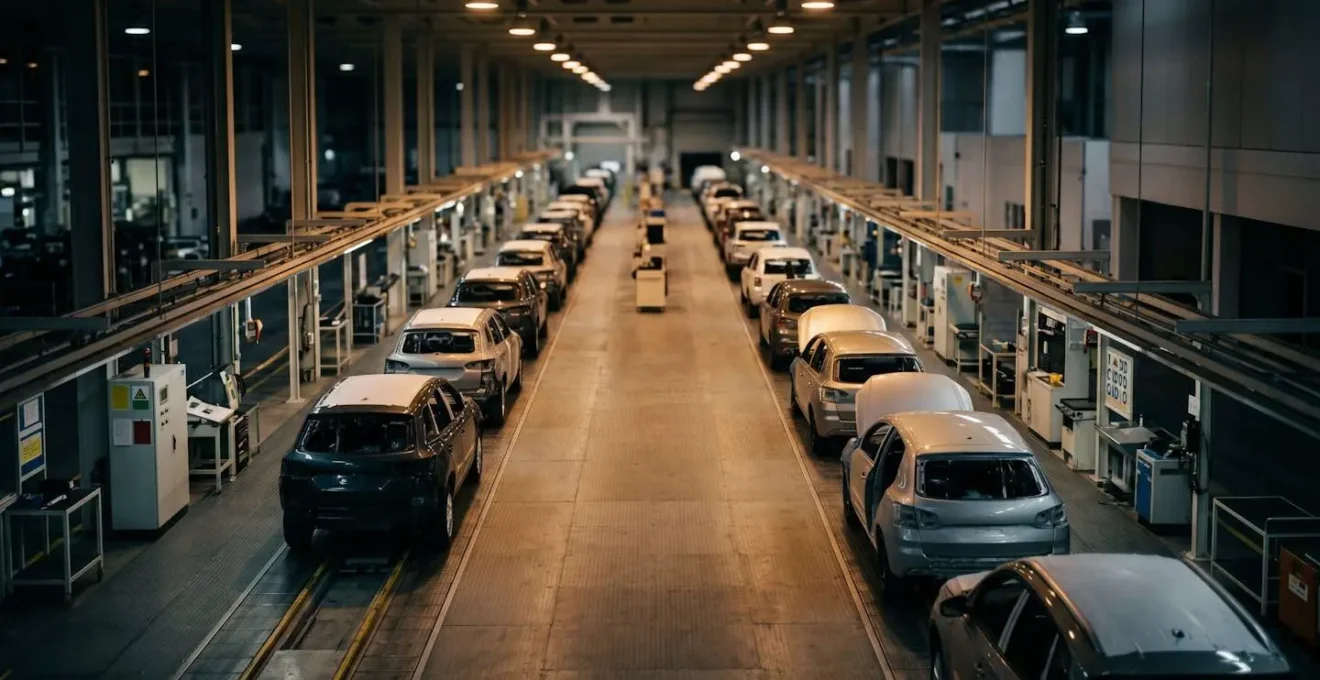
Your new car’s delay isn’t due to a single issue; it’s a symptom of a fragile global supply chain experiencing a systemic collapse.
- The ‘just-in-time’ manufacturing model, once a pillar of efficiency, has shattered, creating massive production backlogs.
- Critical choke points, from lithium mines and graphite refineries to post-Brexit ports, are adding months to component delivery times.
Recommendation: To navigate this market, you must shift your perspective from a consumer to a risk manager, understanding the hidden costs and vulnerabilities that now define the automotive industry.
Another email lands in your inbox. The subject line is all too familiar: “An Update on Your Vehicle Order.” Your delivery date has been pushed back again. The initial excitement of ordering your perfect new car has curdled into a lingering frustration. You’ve been told it’s because of the ‘chip shortage’ or ‘pandemic-related issues’, but these feel like vague excuses that don’t explain a delay stretching towards a year.
As a logistics crisis manager, I can tell you that these explanations aren’t wrong, but they are dangerously incomplete. They are single data points in a much larger, more chaotic picture. The global automotive supply chain, once a marvel of ‘just-in-time’ efficiency, has proven to be a house of cards in a hurricane. Its hyper-optimised, low-redundancy structure was its greatest strength and has now become its fatal flaw.
The truth is, your delay isn’t a simple production problem; it’s the result of a series of cascading failures. A fire in a Japanese semiconductor plant, a new trade tariff in Europe, a lockdown at a Chinese port, a shortage of truck drivers in the UK—each event sends a bullwhip crack of disruption down a line that has no slack left. To truly understand why you’re still waiting, you can’t just look at the assembly line. You have to deconstruct the entire value chain, from the raw materials in the ground to the complex financing agreement you signed.
This guide is your briefing. We will move beyond the headlines and diagnose the specific bottlenecks that are holding your car hostage. We’ll examine the broken manufacturing models, the geopolitical wars over raw materials, the hidden costs of shipping and trade policy, and the financial risks that are building as a direct result. This is the insider’s view of the crisis.
Summary: A Logistics Manager’s Guide to Why You’re Still Waiting
- Why the ‘Just-in-Time’ Model is Broken for the Auto Industry?
- Lithium Wars: Why Battery Shortages Will Keep EV Prices High?
- Why Replacing a Bumper Costs 20% More and Takes Longer Since Brexit?
- How Shipping Container Prices Impact the MSRP of Your New Car?
- Why UK-Made Batteries Are Critical for the British Auto Industry’s Survival?
- The Supply Chain Crisis That Could Stall Your EV Delivery by 6 Months
- PCP Bubble: What Happens if Your Car is Worth Less Than the Balloon Payment?
- How to Future-Proof Your Fleet Against the 2035 UK Petrol Ban?
Why the ‘Just-in-Time’ Model is Broken for the Auto Industry?
For decades, the automotive industry was the poster child for ‘Just-in-Time’ (JIT) manufacturing. The core principle was radical efficiency: parts would arrive at the factory from a global network of suppliers just as they were needed for assembly. This eliminated the immense cost of holding and managing vast warehouses full of inventory. The model was designed for “supply-chain efficiencies and economies of scale,” as Nissan’s COO Ashwani Gupta noted. However, its success was predicated on a stable, predictable world. That world no longer exists.
The pandemic was the initial shock, but the subsequent geopolitical instability and logistical snarl-ups revealed JIT’s critical vulnerability: it has zero tolerance for disruption. When a single supplier of a minor component shuts down, the entire assembly line can grind to a halt. The cost of this systemic fragility is staggering; analysis shows that for some manufacturers, automotive manufacturing faces unprecedented downtime costs, potentially reaching millions per hour. There is no buffer.
In response, the industry is undergoing a painful and expensive pivot from ‘Just-in-Time’ to ‘Just-in-Case’. This means building strategic inventory buffers, which involves finding or building massive warehouse space and tying up capital in parts that may sit for weeks or months. This is the antithesis of the lean manufacturing philosophy that defined the last 30 years, and its cost is being passed directly down the chain to your final invoice.
This shift to holding physical inventory is a direct admission that the old model is broken. It prioritises resilience over pure efficiency, a necessary correction but one that adds cost and complexity at every step. The price of avoiding a line-stoppage is now baked into the price of every vehicle, contributing to the “price adjustments” you may have seen on your order.
Lithium Wars: Why Battery Shortages Will Keep EV Prices High?
If you’ve ordered an electric vehicle, the ‘Just-in-Time’ problem is amplified by a second, more volatile crisis: the battle for raw materials. The heart of your EV, the battery, is at the centre of a geopolitical struggle for control over a handful of critical minerals. Lithium is the most famous, but the real choke points are often less obvious and highlight the supply chain’s fragility. For instance, the fact that a crisis at just one location could impact 6% of global lithium supply demonstrates supply concentration and its risks.
The problem isn’t just mining the raw materials; it’s the highly concentrated and specialised processing required to make them battery-grade. A perfect example of this hidden bottleneck is graphite, a critical material for battery anodes. Without it, the battery simply doesn’t work.
Case Study: The Graphite Processing Choke Point
Battery-grade graphite requires extreme purity levels of 99.95% or higher for lithium-ion battery anodes. China currently dominates over 90% of the world’s refined battery-grade graphite supply, creating a critical processing bottleneck. This has resulted in a projected 30% supply deficit by 2030, significantly impacting EV and battery production capabilities globally. As detailed in industry analysis, this single point of failure gives the controlling nation immense leverage, allowing it to restrict exports and cause immediate, worldwide production halts for nearly every EV manufacturer. This isn’t a hypothetical risk; it’s an active vulnerability.
This concentration of processing power for materials like graphite, cobalt, and lithium means that the supply can be throttled by a single government’s policy decision. This creates immense price volatility and supply uncertainty. Automakers are now scrambling to sign direct, long-term deals with mining and refining companies, effectively going to war with each other to secure the resources needed to meet their EV production targets. For you, the buyer, this means the price of your EV’s battery—which can be up to 40% of the vehicle’s total cost—is subject to global market forces far beyond the car dealership’s control.
Why Replacing a Bumper Costs 20% More and Takes Longer Since Brexit?
The disruption isn’t just affecting the production of new cars; it’s hitting the entire parts ecosystem. The process of getting a simple replacement part, like a bumper or a wing mirror, has become a case study in logistical friction, particularly in the UK. While the H2 title’s “20%” is a headline figure, the underlying data shows the trend is real and multifaceted. Since the UK’s departure from the EU, official data has documented at least an 8.7% increase in the price of spare parts, but this is just the tip of the iceberg.
The full cost increase is a combination of direct and indirect factors. The direct costs are new customs declarations, paperwork, and, in some cases, tariffs on parts imported from the European Union. These are fixed administrative costs that are now applied to millions of individual components that used to move frictionlessly across the channel. The once-seamless flow of parts from European mega-warehouses to UK distributors is now clogged with red tape.
The indirect costs are often even greater. An industry analyst investigating the issue for Car Dealer Magazine provided a clear diagnosis. As they stated in their report:
Brexit is a key factor, not just because of the additional duties levied on parts imported from mainland Europe but also because of increased labour costs caused by driver shortages in the supply chain
– Industry analyst quoted in Car Dealer Magazine, Car Dealer Magazine Brexit Parts Investigation
This combination of increased paperwork, new duties, and a shortage of labour (especially HGV drivers) creates a perfect storm of delays and cost inflation. A part that once took 48 hours to arrive from Germany might now take two weeks, held up at customs or waiting for a truck. Garages can’t complete repairs, courtesy cars are tied up, and the final bill for the consumer inevitably rises to cover all this new friction. Your car isn’t just waiting for parts from Asia; it’s waiting for parts from across the English Channel.
How Shipping Container Prices Impact the MSRP of Your New Car?
A modern car is a global product. Its components can cross the ocean multiple times before final assembly: raw materials to a processor, processed parts to a sub-assembly plant, and sub-assemblies to the final factory. Every one of these journeys typically happens inside a standard 40ft shipping container. For years, the cost of this shipping was a rounding error, a cheap and reliable utility. That changed dramatically.
The pandemic triggered a massive disruption in global shipping. Port closures, labour shortages, and a surge in demand for consumer goods created a worldwide shortage of available containers and port capacity. This sent shipping costs into the stratosphere. At the peak of the crisis, analysis of market data showed that shipping container prices reached unprecedented levels, with costs for a single 40ft container increasing by a factor of five or more on key routes. While prices have since moderated, they remain significantly higher and more volatile than pre-pandemic levels.
This price shock acts as a hidden tax on every single component of your vehicle. The plastic for the dashboard, the aluminium for the engine block, the copper for the wiring loom—if it crossed an ocean, its cost increased. An automaker might have contracts for hundreds of thousands of components, each now carrying an extra shipping surcharge. These small charges accumulate into a significant, non-negotiable cost increase that is inevitably factored into the Manufacturer’s Suggested Retail Price (MSRP).
Furthermore, the issue isn’t just cost, but also reliability. Port congestion means ships can wait weeks offshore to unload. A container with a critical batch of engine control units (ECUs) might be stuck at the bottom of a stack in a chaotic port for a month. This injects yet another layer of unpredictability into the already-broken ‘Just-in-Time’ model, directly contributing to the production delays that have pushed back your delivery date.
Why UK-Made Batteries Are Critical for the British Auto Industry’s Survival?
The push for UK-based battery manufacturing, or ‘gigafactories’, is often framed as a matter of national pride or job creation. From a logistics and trade perspective, it’s far more brutal and fundamental: it is a matter of survival. The reason lies in a complex but crucial area of international trade law known as ‘Rules of Origin’.
Post-Brexit trade agreements, particularly the one with the EU, contain strict Rules of Origin requirements. To qualify for tariff-free trade, a significant percentage of a car’s value must originate from the UK or the EU. This prevents the UK from simply becoming a final assembly point for components made cheaply elsewhere and then exporting them to the EU as ‘British’. This is where the battery becomes the single most important component.
Case Study: The Rules of Origin Imperative
As detailed in PA Consulting’s analysis of the automotive supply chain, trade agreements mandate high percentages of local value content for tariff-free trade. With batteries representing the single largest cost component of an electric vehicle (often 30-40% of its value), importing a battery from Asia and putting it in a UK-built car makes it nearly impossible to meet these local content thresholds. This makes domestic battery production not merely advantageous but essential. Without local battery manufacturing capacity, UK-based automakers face substantial tariffs on every vehicle they export to their largest market, rendering them instantly uncompetitive.
This isn’t a future problem; it’s a clear and present danger. If the UK auto industry cannot establish a robust, at-scale domestic battery supply chain, it will face a stark choice: absorb the crippling 10% tariff on EU-bound exports, or watch as car manufacturers relocate their EV production to mainland Europe to remain inside the tariff-free zone. The investment in UK gigafactories is therefore not an offensive strategy for growth, but a desperate defensive manoeuvre to prevent the collapse of the UK’s car manufacturing base.
The Supply Chain Crisis That Could Stall Your EV Delivery by 6 Months
All the systemic issues we’ve discussed—broken JIT models, material shortages, shipping chaos, and trade friction—converge to create the reality you are experiencing: unprecedented delivery delays. For certain vehicle types, particularly complex electric vehicles, fleet industry data confirms that current delivery timelines have reached unprecedented lengths of four to six months, and in many consumer cases, far longer. Your frustration is not unique; it is the new industry standard.
The most infamous bottleneck has been semiconductors, the tiny microchips that control everything from your infotainment screen to your engine management. A modern car can contain over 1,000 individual chips. The supply of these components is a perfect example of a high-tech, low-resilience supply chain. When the pandemic hit, automakers cancelled their chip orders, assuming a prolonged slump. When demand snapped back, they found the chip manufacturers had reallocated their production lines to consumer electronics, a more profitable sector. Automakers were sent to the back of the queue.
This has created a lag that the industry is still struggling to overcome. As a detailed analysis from Deecon Consulting on manufacturing impact highlights, the problem is deep-seated:
Lead times for many semiconductors are currently one year, and these devices are in just about everything we use
– Industry analysis, Deecon Consulting COVID-19 Manufacturing Impact Report
This means a car that is 99% complete can be left sitting in a factory car park for months, waiting for a single, inexpensive component. It’s the ultimate ‘Just-in-Time’ failure. While the situation for some types of chips is improving, the supply of more advanced, specialised processors remains tight. This single component failure demonstrates how the entire, multi-billion-pound automotive industry can be held hostage by the supply of an item that costs just a few pounds.
Key Takeaways
- The ‘Just-in-Time’ model has failed, forcing a costly industry-wide shift to holding expensive ‘Just-in-Case’ inventory.
- Critical choke points in raw material processing, like battery-grade graphite, create systemic vulnerabilities far beyond the mine itself.
- Hidden costs from shipping volatility and post-Brexit trade friction are now permanently factored into the price of every car and part.
PCP Bubble: What Happens if Your Car is Worth Less Than the Balloon Payment?
The supply chain crisis has had a paradoxical effect on car finance, particularly Personal Contract Purchase (PCP) deals. For the last few years, the shortage of new cars has caused a massive spike in used car values. Data from leading providers showed that between 2020 and 2022, automotive data providers documented dramatic valuation shifts, with some models appreciating significantly. This created a safety net for PCP customers: at the end of their term, their car was almost always worth more than the final ‘balloon’ payment, giving them equity to roll into their next deal.
This period of inflated values is ending. As new car supply slowly stabilises and economic pressures reduce demand, used car values are beginning to correct. This creates a significant risk of ‘negative equity’ for anyone who signed a PCP deal at the peak of the market. Negative equity occurs when your car’s actual market value at the end of the term is less than the Guaranteed Future Value (GFV) or balloon payment you are contracted to pay. Instead of having equity, you owe the finance company money just to hand the car back.
This financial risk is a direct consequence of the supply chain disruption and is now a critical factor for any new car buyer to consider. Managing this risk requires a more disciplined approach to car finance, moving away from focusing on the low monthly payment and instead understanding the total cost and the underlying value proposition.
Action Plan: Mitigating Negative Equity Risk
- Calculate Total Cost of Ownership (TCO): Before committing, analyse the total cost, including the balloon payment, not just the monthly figure.
- Maintain an Equity Buffer: Aim for a down payment that creates at least a 20% equity buffer to absorb potential market value drops.
- Separate Your Negotiations: Negotiate the price of your new car completely separately from your trade-in value to maintain transparency and avoid having negative equity hidden in the new deal.
- Stress-Test the GFV: Compare the dealer’s Guaranteed Future Value projection against historical depreciation curves for that specific model to see if it looks overly optimistic.
- Consider Price Certainty: Evaluate reservation-based sales models or locked-in pricing which can provide more certainty in a volatile market.
The PCP ‘bubble’ was a temporary distortion created by the supply crisis. As the market normalises, the fundamental risk of depreciation returns, and buyers must be prepared.
How to Future-Proof Your Fleet Against the 2035 UK Petrol Ban?
The 2035 ban on the sale of new petrol and diesel cars in the UK is not a distant deadline; it is the single most powerful forcing function shaping the automotive market today. It’s the reason manufacturers are investing billions in EVs, and it’s the catalyst for the ‘lithium wars’ and battery supply chain reconfiguration we’ve discussed. For a buyer, ‘future-proofing’ is no longer just about choosing the right model; it’s about understanding and navigating this seismic, multi-decade transition.
The scale of the required change is immense. Global projections show the electric vehicle fleet will expand nearly four-fold in just a few years. This rapid electrification puts immense strain on every part of the supply chain, from raw material extraction and electricity grids to charging infrastructure and technician training. The disruptions you are experiencing now are, in part, the growing pains of this forced, accelerated industrial revolution.
So, how do you ‘future-proof’ your personal transport strategy in this chaotic environment? It requires a shift in mindset. Instead of thinking about your ‘next car’, think about your ‘mobility needs’ for the next 3, 5, and 10 years. This involves several key considerations:
- Total Cost of Ownership (TCO): An EV may have a higher purchase price, but lower running costs. Conversely, a petrol car purchased now will face a rapidly depreciating resale value and potentially higher taxes as 2035 approaches. You must calculate the entire cost over your intended ownership period.
- Infrastructure Reality vs. Hype: Assess your personal access to charging. Do you have off-street parking for a home charger? Is your typical long-distance route well-served by reliable rapid chargers? Be realistic about the current state of public infrastructure, not its promised future.
- Embracing Agility: In a volatile market, long-term commitments carry more risk. Shorter-term finance deals, leasing, or even subscription services might offer more flexibility than a 5-year PCP on a technology that could be outdated in 3 years.
Future-proofing in this new era means prioritising flexibility, doing your own TCO calculations, and making decisions based on your real-world needs, not marketing promises. It means becoming a risk manager for your own driveway.
The next time you receive a delay notification, you will now understand the complex, interconnected web of failures behind it. The crucial next step is to use this knowledge to approach your next vehicle purchase not as a passive consumer, but as an informed strategist, evaluating not just the car, but the stability of the entire system that underpins it.