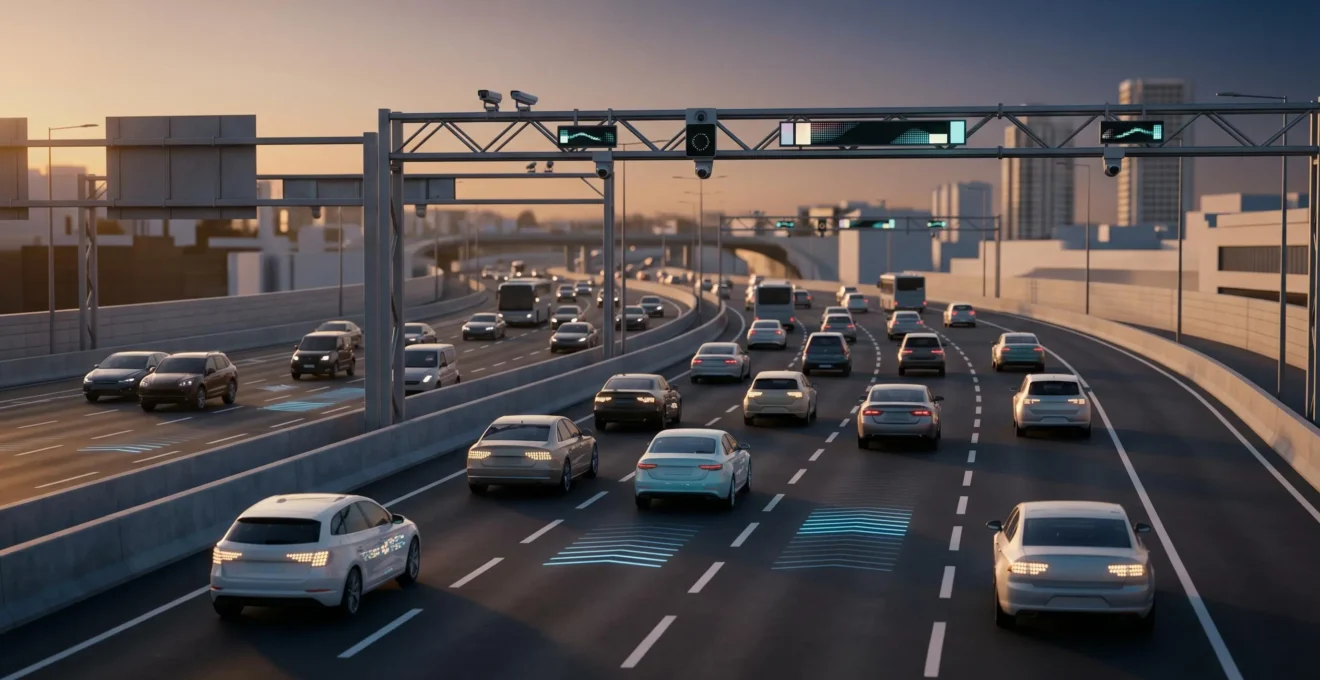
The fear of breaking down in a live lane on a Smart Motorway is a valid and terrifying concern for many UK drivers. While existing safety measures feel inadequate, a new layer of proactive protection is emerging. Vehicle-to-Everything (V2X) communication is not just another feature; it’s an invisible safety net that gives your car situational awareness. By allowing vehicles to talk to each other and to the road infrastructure itself, V2X aims to prevent incidents before they happen, turning a reactive, stressful environment into a proactive, connected, and ultimately safer one.
The flashing red ‘X’ on an overhead gantry. The unnerving feeling of lorries thundering past with no hard shoulder to offer sanctuary. For any UK driver, the term ‘Smart Motorway’ often evokes a knot of anxiety, centred on one terrifying thought: what if I break down right here, in a live lane?
This fear isn’t irrational. It’s born from a perceived shift of responsibility, where a physical safety barrier has been replaced by a digital one that can feel remote and fallible. The standard advice—stay in your vehicle, put on your hazards, call for help—feels terrifyingly insufficient when you are a sitting duck in a river of fast-moving traffic. We’ve been told that technology is the answer, but vague promises of “future systems” do little to reassure a driver in the here and now.
But what if the technology wasn’t some far-off dream, but a series of tangible, specific systems already being deployed? The key isn’t just about more cameras or faster response times. The true revolution is in communication. We need to move beyond thinking of a car as an isolated box and see it as a connected node in a network. This is the promise of Vehicle-to-Everything (V2X) technology. It’s not about making motorways ‘smarter’ in the abstract; it’s about giving your car, your digital co-pilot, the ability to see around corners, anticipate hazards, and build an invisible safety net around you.
This article, written from the perspective of a traffic infrastructure engineer, will demystify V2X. We won’t just talk about theory; we will explore the specific ways this technology is designed to address the very fears that keep you awake at night. We will look at how your car will know an ambulance is coming, how it can detect a pedestrian’s phone, and how your privacy is protected in this new, connected world. The goal is to replace fear with understanding, showing how a connected system can finally deliver on the promise of a truly safe Smart Motorway.
In this comprehensive overview, we will break down the complex world of V2X into understandable components. The following sections will guide you through the technology, its real-world applications, the challenges it faces, and what it means for you as a driver.
Summary: Smart Motorways and the V2X Safety Revolution
- How to Hit Every Green Light Using Traffic Signal Information?
- How Your Car Knows an Ambulance is Coming Before You Hear the Siren?
- Can Your Car Detect a Pedestrian’s Smartphone to Prevent a Collision?
- Who Can See Your Speed and Location When V2X is Active?
- Why Your VW Can’t Talk to a Toyota: The V2X Format War Explained?
- Who Tracks Your Location When You Connect Your Car to Smart City Grids?
- Why Your Car Brakes for Shadows: Understanding Phantom Activations?
- GSR2 Regulations: What the New Mandatory Safety Tech Means for UK Drivers?
How to Hit Every Green Light Using Traffic Signal Information?
Before we dive into the critical safety-of-life applications, it’s useful to understand V2X through a more common driving frustration: traffic lights. The concept of Green Light Optimal Speed Advisory (GLOSA) is a foundational element of the V2X ecosystem. It’s a simple but powerful idea: the traffic light infrastructure broadcasts its current status and upcoming signal timing to approaching vehicles.
Your car, acting as a digital co-pilot, receives this information. It then calculates and displays the optimal speed you need to maintain to arrive at the intersection just as the light turns green. This isn’t about encouraging you to speed up to “make the light.” On the contrary, it often advises you to slow down slightly, avoiding the need for a complete stop. The result is a smoother, more efficient, and less stressful journey. You save fuel, reduce brake wear, and contribute to a more harmonious traffic flow.
While this seems like a convenience feature, it demonstrates the core principle of V2X: giving the vehicle information beyond the line of sight of its own sensors. This technology is already being proven in the UK. For example, a recent trial showed that implementing GLOSA leads to tangible benefits for traffic flow. Indeed, a Birmingham trial demonstrated a 7% average journey time reduction. This efficiency is the first layer of the invisible safety net; smoother, more predictable traffic is inherently safer traffic.
How Your Car Knows an Ambulance is Coming Before You Hear the Siren?
Now, let’s apply that same principle of “seeing beyond the senses” to a high-stakes scenario. You’re on the motorway, music playing, focused on the traffic ahead. Suddenly, an ambulance needs to get past. The first you know of it is the faint, directionless sound of a siren, or worse, the sight of its flashing lights rapidly approaching in your rearview mirror. Panic sets in as you and other drivers try to safely make way.
V2X completely changes this dynamic. Emergency vehicles equipped with V2X transmitters broadcast a “digital siren.” This is a secure, high-priority message that travels far faster and further than sound or light. Your car receives this signal long before you could possibly hear a physical siren. An alert appears on your dashboard: “Emergency Vehicle Approaching. Move to Lane 1.” It’s calm, clear, and gives you seconds—or even minutes—of advance warning.
This isn’t just about convenience; it’s a monumental leap in safety for both road users and first responders. The potential impact is enormous. The U.S. National Highway Traffic Safety Administration (NHTSA) predicts that V2X technologies could prevent or mitigate the severity of up to 615,000 crashes annually in the US once fully deployed. As the go-e technical team concisely puts it:
with C-V2X, you can see an emergency vehicle long before you hear the siren
– go-e Technical Team, C-V2X Explained: All You Need To Know!
This single feature transforms a chaotic and dangerous situation into an orderly, pre-planned manoeuvre. It’s a perfect example of how the invisible safety net works proactively to eliminate a known risk on our roads.
Can Your Car Detect a Pedestrian’s Smartphone to Prevent a Collision?
The ultimate Smart Motorway nightmare is being outside your vehicle. Whether due to a breakdown, an accident, or being a first responder, a person on foot is terrifyingly vulnerable. Traditional vehicle sensors like cameras and radar can struggle to detect a pedestrian, especially in poor weather, at night, or if they are obscured by another vehicle. This is where Vehicle-to-Pedestrian (V2P) technology, a subset of V2X, provides a critical new layer of protection.
The principle is the same: communication. A pedestrian’s smartphone, running a compatible app, can broadcast its location. A stranded driver can activate a distress signal on their phone that is instantly communicated to the V2X network. Your oncoming vehicle receives this “pedestrian ahead” warning, even if the person is completely hidden from your view or your car’s sensors. Your car’s system can then issue an alert or even prime the brakes if a collision is imminent.
This is not science fiction. The technology is being actively tested and refined, with promising results. While not perfect, it dramatically increases the chance of detection. For instance, field experiments showed a 77% correct detection rate with a 50-meter maximum range for smartphone-based V2P systems. This range gives a driver travelling at 70mph crucial extra seconds to react. The effectiveness of these warnings in preventing unsafe behaviour has also been demonstrated. A field test showed that when distracted pedestrians received smartphone alerts about an approaching car, their risky crossing behaviour dropped from 18% to just 2%, highlighting the system’s power to change human actions and prevent tragedy.
Who Can See Your Speed and Location When V2X is Active?
As an engineer designing these systems, this is the question I hear most often. If my car is constantly broadcasting its position, speed, and direction, who is listening? Is my every move being tracked by the government or corporations? These are valid concerns, and the answer is fundamental to the entire system’s design: privacy is a core architectural principle, not an afterthought.
V2X communication is not like your phone’s GPS, which links your identity to your location. Instead, V2X operates on a system of anonymous, short-term digital certificates. Think of it like your car wearing a digital “mask.” It doesn’t broadcast “This is John Smith’s Ford Focus, license plate UK12 XYZ.” Instead, it broadcasts a message from an anonymous temporary ID, saying, “A vehicle is at this location, travelling at this speed.” Crucially, this temporary ID is changed frequently—sometimes multiple times per minute—making it computationally impossible to link these fleeting identities together to track a specific vehicle over time.
This system is managed by a framework called the Security Credential Management System (SCMS). Its entire purpose is to issue these anonymous certificates and ensure the integrity of the network without having the ability to track vehicles itself. As the system’s own technical documentation states, it’s a carefully balanced act:
SCMS deals with revocable privacy while preventing any given certificate management entity from tracking devices by the entity itself
– SCMS Technical Documentation, Cryptographic methods and systems for managing digital certificates
The only time a vehicle’s real identity can be revealed is under strict, legally-defined conditions, such as a court order, or if the vehicle is sending dangerously false information. The system is designed to provide safety through communication while fiercely protecting the privacy of law-abiding road users.
Why Your VW Can’t Talk to a Toyota: The V2X Format War Explained?
For the “invisible safety net” to work, every vehicle needs to speak the same language. If a BMW sends a “braking hard” warning, an approaching Mercedes needs to be able to understand it instantly. For years, the automotive industry was divided on what this language should be, leading to a “format war” between two competing technologies: DSRC and C-V2X.
DSRC (Dedicated Short-Range Communications) is an older standard based on a technology similar to Wi-Fi. It was adopted by early pioneers, including Volkswagen. C-V2X (Cellular-V2X), on the other hand, is a newer standard that leverages the massive global investment in cellular technology (4G and 5G). It uses modern cellular principles to communicate directly between vehicles (a function called “sidelink”) without needing to go through a cell tower.
This created a significant problem: the two systems were not compatible. A DSRC-equipped car was invisible to a C-V2X car, and vice versa. This fragmentation threatened to undermine the entire safety premise of V2X. However, over the past few years, the industry and regulators have largely consolidated around C-V2X. Its superior performance, longer range, and better scalability in dense traffic, combined with its clear evolutionary path to 5G, have made it the preferred choice for most major automakers and regions, including Europe and China.
The following table, based on an in-depth analysis by go-e, breaks down the key differences that led to C-V2X becoming the dominant standard.
| Feature | DSRC (Wi-Fi based) | C-V2X (Cellular based) |
|---|---|---|
| Technology Foundation | IEEE 802.11p / WAVE | 3GPP Release 14+ / 5G |
| Communication Range | Standard range | Extended range, better performance |
| Dense Traffic Performance | Limited scalability | Higher reliability in congestion |
| Industry Support | Early adopters, established auto/telecom | Cellular/tech giants, global telecoms |
| Standards Bodies | IEEE, SAE (US focus) | ETSI (EU), 3GPP (global) |
| Direct Communication | DSRC-based V2V | PC5 Sidelink (no network needed) |
| Network Integration | Limited cellular integration | Native 4G/5G network connectivity |
While some early models may still use DSRC, the path forward is now much clearer. This convergence on a single standard is a critical step in ensuring that the digital safety net is universal and seamless for all drivers.
Who Tracks Your Location When You Connect Your Car to Smart City Grids?
The privacy question extends beyond just your car’s own broadcasts. As vehicles become connected to the wider “smart city” infrastructure—traffic lights, road sensors, parking systems—a new concern arises: who operates this grid, and what can they see? Are we creating a centralised system that can track the movements of every citizen?
The engineering philosophy here mirrors the one used for vehicle-to-vehicle communication. The goal is to collect aggregate, anonymous data for system management, not to track individuals. The smart city grid needs to know that “500 vehicles passed this intersection in the last hour” to optimise traffic flow; it does not need to know that *your* specific vehicle was one of them. The entire security framework is built on this principle of data minimisation and anonymisation.
The system is designed with strict separations of power. The entity managing the traffic light network is different from the one issuing security credentials, which is different from the cellular network operator. This decentralisation is a key safeguard against mass surveillance. No single entity has the full picture. The official V2X Security Framework patent filings are explicit about this design intention, stating a core requirement that “road users should be unable to track one another and operators of a Security Credential Management System or wireless network operators should also be unable to track road users.” This principle of “privacy by design” is fundamental.
In essence, you should think of your interaction with the smart city grid like using a public transport system. The system operators know how many people are on the train to manage capacity, but they don’t know the name of every passenger. The focus is on the health and efficiency of the overall network, not the surveillance of its individual parts.
Key takeaways
- V2X is a proactive safety system, designed to provide warnings of hazards beyond the driver’s line of sight.
- It complements existing sensors (cameras, radar) by adding a layer of data and context, reducing errors like phantom braking.
- Privacy is a core design principle, using anonymous, rotating digital certificates to prevent tracking.
Why Your Car Brakes for Shadows: Understanding Phantom Activations?
One of the most unsettling experiences in a modern car is a “phantom braking” event. You’re driving along on cruise control, and the car’s automatic emergency braking (AEB) system slams on the brakes for no apparent reason—mistaking a shadow, a metal drain cover, or an overhead bridge for an imminent threat. This erodes trust in the very systems designed to protect you.
These events happen because the car’s sensors (camera, radar, lidar) are trying to interpret the world with limited information. A radar sees an object, and a camera sees a dark shape, but they lack the *context* to know if it’s a harmless shadow or a genuine hazard. This is precisely the problem V2X is designed to solve. It adds a crucial layer of contextual data that helps the car’s “brain” make a much more intelligent decision.
For example, if a car ahead brakes sharply, your car’s radar will detect the closing distance. But V2X adds another layer: your car receives a direct digital message from the car ahead saying, “I am performing an emergency stop.” This confirms the radar data and justifies an immediate braking response. Conversely, if your car’s camera sees a stationary object in the lane ahead, but the V2X data from roadside infrastructure confirms the lane is clear (perhaps the object is a “ghost” from a dirty lens or a complex shadow), the system can choose to ignore the faulty sensor reading, preventing a dangerous phantom braking event.
Case Study: The AutopleX Project
The AutopleX consortium, supported by UK government funding via Innovate UK, directly addressed this issue. Their research focused on helping autonomous vehicles safely merge onto motorways—a complex task where sensor uncertainty is high. Research from WMG at the University of Warwick found that when the vehicle received additional data from smart roadside V2X infrastructure, it could build a much more complete picture of traffic conditions. This extra data layer helped the car’s systems better compute the environment, significantly reducing sensor uncertainty and allowing for smoother, safer decision-making. This shows V2X doesn’t replace sensors; it makes them smarter.
GSR2 Regulations: What the New Mandatory Safety Tech Means for UK Drivers?
The conversation around V2X doesn’t happen in a vacuum. It builds upon a new, much higher baseline of vehicle safety mandated by law. As of July 2024, the General Safety Regulation 2 (GSR2) requires all new cars sold in the UK and EU to be fitted with a host of advanced safety technologies. This isn’t optional; it’s the new standard.
These technologies include systems like Intelligent Speed Assistance (ISA), which warns you if you’re exceeding the speed limit, Driver Drowsiness and Attention Warning, and an Event Data Recorder (EDR), which works like an aeroplane’s “black box” to record data in the seconds before a crash. The goal of GSR2 is to make the individual vehicle as safe as possible using onboard, self-contained systems.
Think of it this way: GSR2 fortifies the castle, while V2X builds the communication network between all the castles. The mandatory systems like AEB and Lane Keep Assist are your car’s personal armour. V2X is the intelligence network that tells your car where the threats are coming from before they even get to your gate. The two work together. A V2X warning of a stationary vehicle ahead is only useful if the car’s GSR2-mandated AEB system is ready and able to act on that information.
Action plan: Understanding your car’s new safety systems
- Identify Features: In your car’s manual or infotainment system, identify which GSR2 and V2X-related features are present (e.g., ISA, AEB, Traffic Jam Assist). List them out.
- Understand Alerts: For each feature, find out how it communicates with you. What does the icon look like? Is it a sound, a vibration, or a message on the screen?
- Customise Settings: Investigate the settings for each system. Can you adjust the sensitivity of the forward collision warning? Can you temporarily disable lane assist? Understand what you can control.
- Learn Overrides: Know how to manually override an automated action. For example, a firm press of the accelerator usually overrides ISA, and a firm turn of the wheel overrides lane-keeping. Practice this in a safe environment.
- Ask for a Demo: When you next buy a car or have it serviced, ask the dealership technician to walk you through the specific safety features and their real-world operation.
GSR2 is the foundation of modern road safety, ensuring every new driver has a vehicle equipped with a robust set of life-saving tools. V2X is the next logical step, connecting these safe vehicles into a cooperative network that makes the entire road system safer for everyone.
The journey towards truly safe Smart Motorways is not about a single magic bullet, but the careful integration of multiple layers of technology. From the foundational safety net of GSR2 to the advanced situational awareness of V2X, the goal is the same: to create a system that proactively protects, rather than reactively responds. The next time you drive on a motorway, the most important safety features may be the ones you can’t see, working silently to create an invisible shield around you.