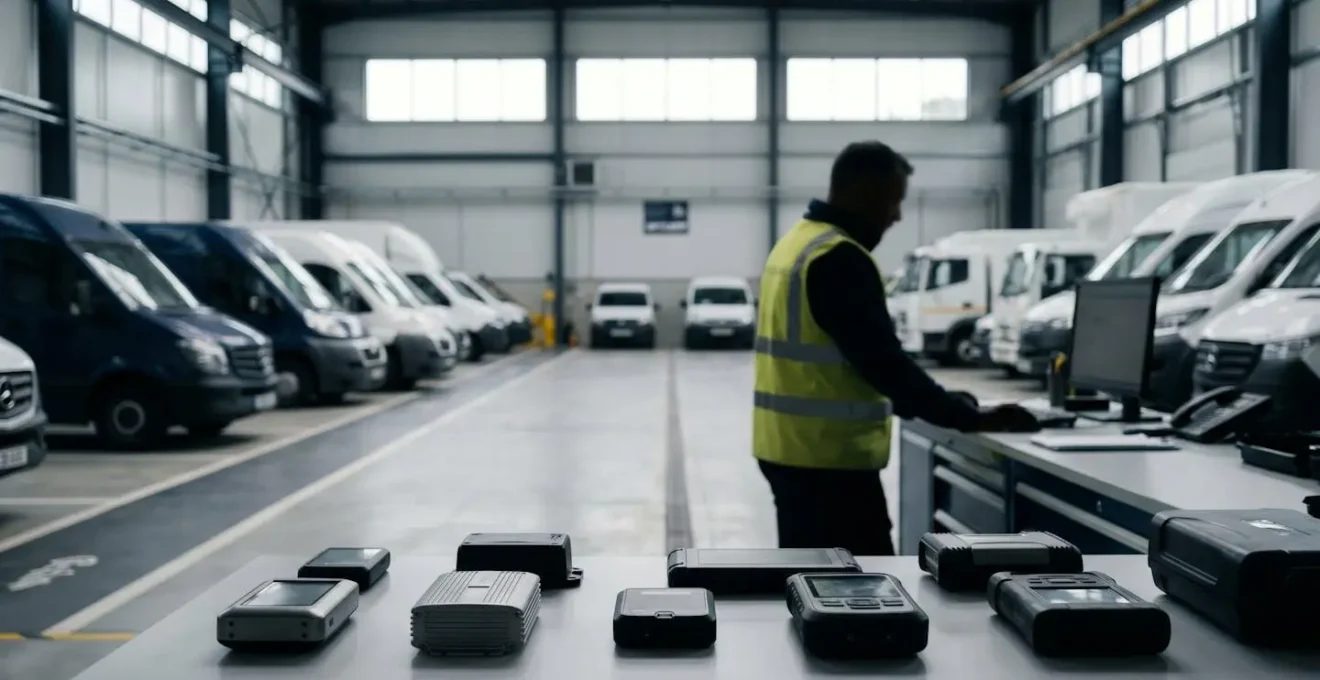
The key to cutting fleet breakdown costs isn’t just collecting telematics data; it’s using AI to translate subtle data patterns into high-value, preemptive mechanical interventions.
- Predictive models can forecast specific failures, like a battery dying, weeks before they happen, turning reactive repairs into scheduled maintenance.
- Shifting from fixed-mileage to real-wear servicing, guided by telematics, can reduce maintenance expenses by over 30% by servicing vehicles based on their actual operational stress.
Recommendation: Focus your strategy on telematics platforms that offer multi-factor insight and pattern recognition, not just raw data or simple threshold alerts.
As a logistics director, you are under constant pressure. Every delayed delivery, every vehicle unexpectedly stranded on the hard shoulder, translates directly into escalating costs, frustrated customers, and damage to your company’s reputation. The conventional wisdom has been to install telematics “black boxes” to monitor driver behaviour and track locations. Many fleets stop there, using a powerful tool for basic, reactive tasks. They see alerts for harsh braking or get a notification when a check engine light is already on—by which point, the damage is often done.
This approach is fundamentally flawed. It treats telematics as a rear-view mirror, a system for logging events that have already occurred. But what if the true power of this technology lies in its ability to function as a crystal ball? The conversation needs to shift from *preventive* maintenance, which still relies on fixed schedules and guesswork, to *predictive* maintenance. This is a strategy built not on generic mileage intervals, but on the unique, real-time data signature of each vehicle in your fleet.
The path to a 20% reduction in breakdown costs isn’t paved with more data; it’s paved with better insights. It requires a move away from reacting to isolated alerts and toward understanding the complex interplay of data patterns that signal an impending failure. This article will deconstruct the specific, data-driven mechanisms that enable this shift. We will explore how AI can forecast failures, why real-wear servicing is more cost-effective, and how to identify the critical alerts that demand immediate action, transforming your maintenance budget from a reactive expense into a strategic investment in reliability.
This guide provides a strategic blueprint, breaking down the essential components of a truly predictive maintenance program. The following sections detail the specific technologies, financial models, and operational shifts required to achieve significant cost savings and improve fleet reliability.
Summary: a data-driven strategy to eliminate fleet breakdowns
- How AI Can Predict a Battery Failure 2 Weeks Before the Van Won’t Start?
- Is Predictive Maintenance Software Worth the Monthly Fee for a Small Fleet?
- Why Servicing by Real Wear Is Cheaper Than Servicing by Fixed Mileage?
- The Telematics Alert That Saves You £1,500 on DPF Replacements?
- Telematics Providers: Which One Actually Offers Good Maintenance Insights?
- When to Intervene: 3 Telematics Alerts You Must Never Ignore from Your Drivers
- Detecting Fuel Siphoning: How Software Spots the Drop in the Tank?
- Black Box Insurance: Is the Privacy Intrusion Worth the £400 Saving?
How AI Can Predict a Battery Failure 2 Weeks Before the Van Won’t Start?
The most frustrating failures are often the most mundane. A driver turns the key on a cold morning, and nothing happens. The battery is dead. While seemingly simple, this event triggers a cascade of costly consequences: towing, driver downtime, and emergency labour. The traditional approach of periodic battery testing is ineffective because it only captures a single moment in time. A battery can test “fine” on Tuesday and fail on Thursday. This is where Artificial Intelligence transforms fleet management from a reactive practice to a predictive science, with some systems delivering 93% accuracy for 30-day battery failure predictions.
AI doesn’t just look at the current voltage. It analyzes a continuous stream of data, creating a unique health profile for each battery. This multi-factor analysis includes:
- Cranking Voltage Profile: How much does the voltage dip when the engine starts? How quickly does it recover? The pattern is more revealing than a single reading.
- Charging Behaviour: Is the alternator charging the battery correctly? Are there patterns of undercharging or overcharging that indicate a failing component?
- Temperature Cycles: The system correlates battery performance with ambient temperatures, learning how cold snaps affect each specific vehicle’s starting power.
Consider a regional distribution hub that saw three vans fail to start on a single February morning. This resulted in an average of 11 hours of downtime each, costing over $19,000. Manual checks two days prior showed no issues. The culprit was cold-cranking amp degradation, a gradual decline invisible to spot checks but glaringly obvious to an AI algorithm analyzing voltage trends over weeks. By detecting these subtle patterns, the system can flag a battery for replacement during its next scheduled service, effectively eliminating the possibility of a no-start failure and its associated costs.
Is Predictive Maintenance Software Worth the Monthly Fee for a Small Fleet?
For a logistics director managing a small to medium-sized fleet, every line item on the budget is scrutinised. A monthly subscription for predictive maintenance software can seem like a luxury, not a necessity. However, this perspective overlooks the powerful financial leverage the software provides. The question isn’t “Can I afford this software?” but rather “Can I afford the cost of another unplanned breakdown?”. The data is clear: the cost of inaction far outweighs the investment in prediction. In fact, industry data consistently demonstrates a 200-400% typical first-year ROI, with a positive return often seen in fleets with as few as 10 vehicles.
The key to understanding its value is to move beyond the monthly fee and calculate the total, often hidden, cost of a single breakdown. It’s not just the tow truck and the repair bill. It’s the driver’s wages during hours of inactivity, the lost revenue from a cancelled delivery, and the premium paid for emergency parts and labour. When a single unplanned breakdown can cost upwards of £1,900, preventing just two such events per year can pay for the entire annual software subscription for a 10-vehicle fleet.
Furthermore, the ROI isn’t limited to breakdown prevention. Predictive platforms often identify other inefficiencies. An alert for a slow tyre leak, for instance, not only prevents a blowout but also improves fuel efficiency by 2-3% once corrected. A well-documented maintenance history, automatically generated by the software, increases a vehicle’s resale value. This comprehensive view of value demonstrates that predictive software isn’t an expense; it’s a high-yield investment in operational efficiency and resilience.
Action plan: calculate your predictive maintenance ROI
- Calculate Total Cost of a Breakdown: Include towing (£150-£400), driver downtime (hourly rate × hours idle), lost revenue (daily revenue ÷ fleet size), emergency repair premium (3-5× planned repair cost), and reputational damage.
- Determine Monthly Software Cost: For a 10-vehicle fleet, mid-tier platforms cost approximately £250/month (£25/vehicle/month), totalling £3,000 annually.
- Calculate Break-Even Point: At an average cost of £1,900 per unplanned breakdown, preventing just 2 breakdowns per year covers the annual software investment.
- Account for Hidden ROI Streams: Factor in fuel efficiency gains from tyre pressure alerts (2-3% savings), higher vehicle resale values, and potential insurance premium reductions (5-15%).
- Apply Phased Implementation: Start by monitoring the single most costly failure point (e.g., batteries or DPFs) for 3-6 months to prove tangible ROI before a full fleet-wide rollout.
Why Servicing by Real Wear Is Cheaper Than Servicing by Fixed Mileage?
The traditional “service every 10,000 miles” model is a relic of an era with no data. It treats every mile as equal, ignoring the fundamental truth that how a vehicle is driven is more important than how far it is driven. A van used for short-run, stop-start urban deliveries experiences vastly different mechanical stress than an identical van covering long distances on the motorway. Servicing both on the same fixed schedule is inherently inefficient. You either service the motorway van too early, wasting money on parts with plenty of life left, or you service the city van too late, risking a breakdown. A recent fleet maintenance cost analysis reveals a potential 34% cost reduction by switching to this model.
Predictive telematics enables a strategy of Condition-Based Maintenance (CBM), or servicing by real wear. It uses data to measure the actual stress placed on components. By monitoring factors like engine hours, braking frequency, average speed, and engine load, the system builds a “stress score” for each vehicle. A service is triggered not by the odometer, but when a component’s cumulative stress reaches a critical threshold.
This data-driven approach has profound financial implications. Brake pads on the city van might need replacing at 8,000 miles, while the motorway van’s pads could last for 20,000. CBM ensures each vehicle gets exactly the maintenance it needs, precisely when it needs it. This eliminates the waste of premature servicing and the risk of late servicing, optimising both part longevity and vehicle uptime. It is the single most effective way to align your maintenance budget with the physical reality of your fleet’s operation, ensuring every pound spent on maintenance delivers maximum value.
The Telematics Alert That Saves You £1,500 on DPF Replacements?
For any modern diesel fleet, the Diesel Particulate Filter (DPF) is a critical, and critically expensive, component. A clogged DPF can cripple a vehicle, forcing it into “limp mode” and requiring immediate, costly attention. The financial stakes are high; a full DPF replacement can cost upwards of £1,500, whereas a forced workshop regeneration is a fraction of that. In fact, fleet managers face a clear cost hierarchy, with full replacements costing anywhere from $3,000 to $10,000.
The most valuable telematics alert is therefore not the one that tells you the DPF is already clogged. It’s the one that tells you the DPF is *struggling to clean itself*. This is the “Consecutive Failed Active Regeneration Cycles” alert. Active regeneration is the process where the vehicle’s engine management system injects extra fuel to burn off soot in the DPF. This typically happens automatically during motorway driving. However, for vehicles doing short, low-speed trips, the process is frequently interrupted and fails.
A basic telematics system might not even report this. An advanced, insight-driven platform identifies this pattern of failure. Receiving this alert is a critical decision point. Heeding it represents the lowest cost intervention: instructing the driver to perform a 30-minute highway run to allow a full regeneration cycle to complete. The cost is minimal—a small amount of fuel and driver time. Ignoring this early warning leads to the next tier of cost: a forced regeneration at a workshop, which can run into hundreds of pounds. Continued neglect results in irreversible clogging and the ultimate cost: a full DPF replacement. The telematics alert, therefore, isn’t just a piece of data; it’s a financial early warning system that can save you £1,500 with a simple, timely instruction.
Telematics Providers: Which One Actually Offers Good Maintenance Insights?
The telematics market is saturated with providers all promising to cut costs and improve efficiency. However, a fundamental distinction exists between two types of platforms: Data Aggregators and Insight Platforms. As a logistics director, choosing the right type of partner is the most critical decision you will make in your predictive maintenance strategy. A Data Aggregator is essentially a digital logbook. It collects data and presents it in a raw or lightly processed format. It will show you a Diagnostic Trouble Code (DTC) like ‘P0420’, leaving your team to google what it means and guess at its severity.
An Insight Platform, by contrast, acts as a data strategist. It doesn’t just display the code; it contextualises it. It uses multi-signal correlation to analyse the ‘P0420’ code alongside other parameters like fuel trim, oxygen sensor readings, and engine load history. Instead of a cryptic code, it provides a high-probability diagnosis: “EGR valve failure likely within 15 days. Part #XYZ. Estimated 2.5 hours labour.” This is the difference between being given a puzzle and being given the solution.
The core difference lies in the alerting approach. Data Aggregators use simple thresholds—alerting you when oil pressure drops below a set PSI. Insight Platforms use AI-driven pattern recognition, learning the unique normal operating baseline for each vehicle and alerting you to subtle deviations that signal a developing problem, often 20-45 days before a traditional system would flag an issue. This proactive window is where the true value lies, allowing you to schedule repairs during planned downtime instead of reacting to emergencies. The table below highlights the crucial differentiators.
| Capability | Data Aggregator | Insight Platform |
|---|---|---|
| Diagnostic Code Handling | Displays raw DTC codes (e.g., P0420) without context | Contextualizes codes with multi-factor analysis and failure probability |
| Alerting Approach | Threshold-based (alerts when parameter exceeds preset limit) | Pattern-based (AI detects deviations from vehicle-specific baseline) |
| Prediction Window | Reactive (alerts when problem already manifesting) | Proactive (20-45 day lead time before traditional diagnostics flag issue) |
| False Positive Management | 15-30% false positive rate typical | Below 5% through multi-signal correlation |
| Workflow Integration | Manual export of alerts to separate maintenance system | Automated work order generation, parts ordering, technician assignment |
| Maintenance Guidance | ‘Check engine’ – generic recommendation | ‘Replace EGR valve, Part #XYZ, estimated 2.5 hours labor, schedule during next planned downtime’ |
When to Intervene: 3 Telematics Alerts You Must Never Ignore from Your Drivers
While sophisticated AI and sensor data form the backbone of predictive maintenance, there is one sensor that is often overlooked: the experienced driver. A driver who spends eight hours a day in the same vehicle develops an intuitive feel for its performance. Dismissing their subjective feedback as “unverifiable” is a costly mistake. A truly strategic telematics program integrates this human intelligence, using data to validate and contextualise what drivers are reporting. This human-sensor correlation creates a powerful diagnostic tool. There are three combined alerts—a driver report plus a specific data point—that must trigger immediate action.
1. Alert: Driver Reports ‘Weird Noise’ + Telematics Shows No DTC Code. This is the classic “trust the human” scenario. Many purely mechanical issues, such as a worn suspension bushing or a loose exhaust hanger, produce audible symptoms long before any electronic sensor is triggered. When a driver’s report is logged with a timestamp, it becomes a documented event. This justifies a manual inspection, catching problems that even the most advanced AI cannot yet detect.
2. Alert: Driver Reports ‘Sluggish Performance’ + Telematics Confirms Spike in Failed DPF Regeneration Cycles. This is synergy in action. The driver’s subjective feeling of “sluggishness” is now objectively confirmed by the telematics data showing the DPF is struggling. This combined signal elevates the issue from a vague complaint to a high-priority work order. Intervening now prevents the vehicle from entering limp mode and requiring a costly roadside recovery.
3. Alert: Driver Reports ‘Check Engine Light Flickered Then Disappeared’ + Telematics Log Shows Intermittent Fault Code. This is the “ghost fault” that frustrates technicians and drivers alike. Without telematics, this report is often dismissed as “could not replicate.” With telematics, the intermittent fault is captured with timestamped evidence. This proves the driver’s report is valid and allows technicians to investigate a known, documented issue, preventing it from progressing into a permanent and more damaging failure.
Detecting Fuel Siphoning: How Software Spots the Drop in the Tank?
Fuel theft is a silent drain on a fleet’s profitability. Detecting it is more complex than simply monitoring the fuel gauge. A vehicle parked on a steep hill or a driver taking a sharp corner can cause “fuel slosh,” creating false alarms that waste a manager’s time and erode trust in the system. Modern telematics software combats this by employing a sophisticated, contextual logic algorithm. A high-confidence theft alert is triggered only when multiple, specific conditions are met simultaneously, moving far beyond a simple drop in level.
The core of this intelligent detection is multi-factor analysis. The algorithm cross-references several data streams before issuing an alert. A genuine alert for fuel siphoning will only be generated if:
- There is a significant fuel level decrease (e.g., over 20 litres).
- This decrease occurs while the vehicle’s engine is off.
- The vehicle’s GPS location is not at a registered, geofenced fuel station.
- The event’s timestamp falls outside of normal operational hours (e.g., overnight or on a weekend).
To further refine accuracy and eliminate false positives, the most advanced systems also incorporate data from accelerometers and gyroscopes. This allows the software to filter out fuel level changes caused by the vehicle’s orientation, such as parking on an incline. By fusing data from multiple sensors, this approach increases the reliability of genuine theft alerts to over 90%, compared to the roughly 60% accuracy of a basic single-sensor system. This gives fleet managers the confidence to take decisive action on real incidents, rather than chasing ghosts in the data.
Key takeaways
- True cost savings come from predictive insights, not just reactive data collection.
- Condition-based maintenance based on real wear is over 30% more cost-effective than fixed mileage schedules.
- The best telematics platforms translate raw data into specific, actionable maintenance instructions with high-probability diagnoses.
Black Box Insurance: Is the Privacy Intrusion Worth the £400 Saving?
The offer is tempting: install a black box, share your driving data, and save up to £400 on your fleet’s insurance premium. For a cost-conscious logistics director, it seems like an easy win. However, it often comes with a significant challenge: driver pushback. Employees can view the technology as an intrusive “spy in the cab,” leading to concerns about privacy, micromanagement, and a punitive work environment. The question then becomes how to balance the financial incentive with the human reality. The key is to reframe the entire purpose of the technology, positioning it not as a tool for management oversight, but as a system for driver protection, recognition, and operational excellence.
The £400 saving is just the tip of the iceberg. The same data used for insurance can power your entire predictive maintenance strategy. While the insurer is looking at braking and speed, your system is analysing engine health, predicting breakdowns, and optimising fuel use. Fleets that fully implement this technology report as many as 62% fewer unplanned breakdowns. This operational saving often dwarfs the initial insurance discount. By communicating this broader strategy, you can show drivers that the data is primarily used to keep their vehicles reliable and safe, not just to watch them.
To overcome resistance, implementation must be built on a foundation of transparency and fairness. A formal, clear policy is non-negotiable. This isn’t about surveillance; it’s about creating a safer, more efficient, and more rewarding environment for your best drivers. A structured approach is essential:
- Develop a Formal Telematics Policy: Work with HR and legal to state clearly what is monitored, why, and how the data is used for safety, maintenance, and compliance.
- Position it as a Driver Protection Tool: Demonstrate how data can exonerate drivers in non-fault accidents and provide an objective basis for safety bonuses.
- Ensure Transparent Communication: Hold pre-implementation meetings, give drivers access to their own data via apps, and establish a clear process for data disputes.
- Design a Fair Recognition System: Create a bonus structure based on objective metrics (smooth driving, speed compliance) and publicly recognise top performers.
- Establish Clear Data Boundaries: Define what is not monitored (e.g., no in-cab audio) and limit tracking to work hours, with clear role-based access to the data.
Ultimately, a successful telematics strategy is not just a technological implementation but a cultural one. By focusing on transparent, data-driven improvements that benefit both the company and the driver, you can move beyond simple cost savings and build a more resilient, reliable, and efficient fleet. The first step is to evaluate your current system not by the data it collects, but by the predictive insights it delivers.