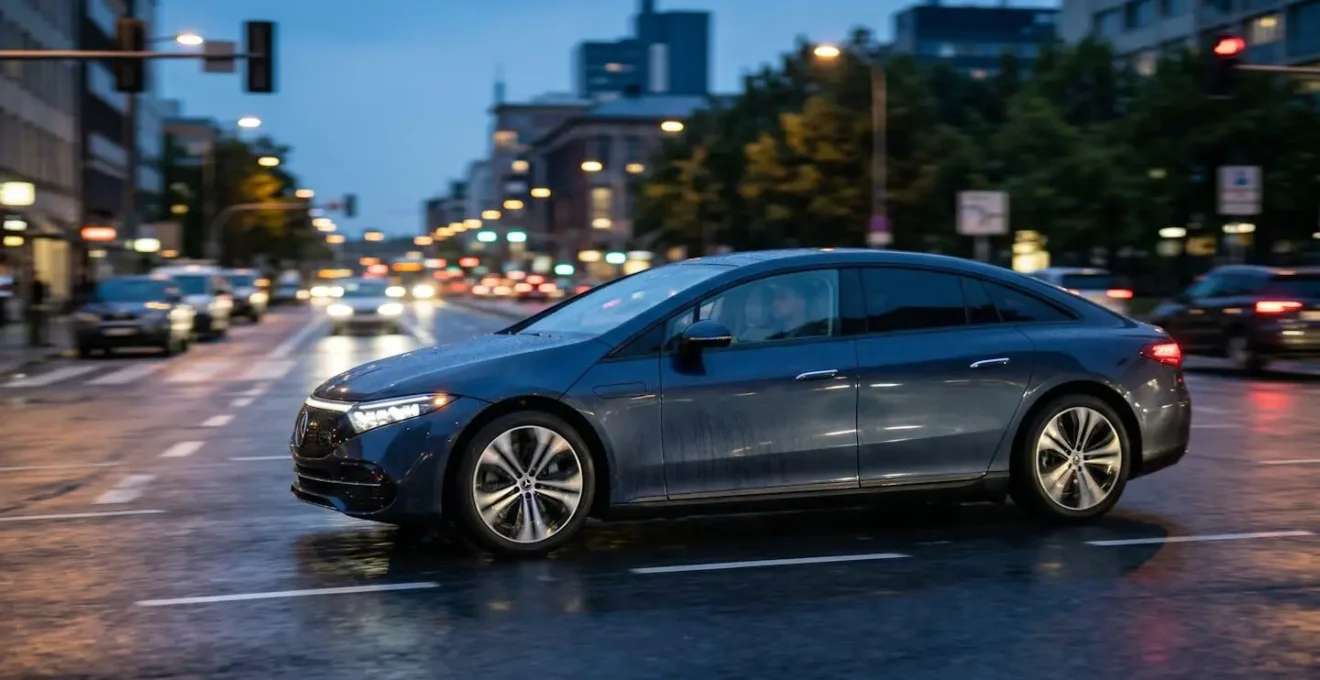
The secret to unlocking significant extra range isn’t setting regenerative braking to ‘High’ and forgetting it; it’s mastering it as a dynamic driving skill.
- Aggressive regen on icy UK roads is a major skid risk; safety requires turning it down.
- Coasting is often more efficient than light regeneration on motorways like the M1.
Recommendation: Treat your accelerator like a precision dimmer switch, not an on/off button, to achieve maximum efficiency and a smoother ride for your passengers.
If you’re an electric vehicle driver in London, you know the feeling. You watch your estimated range plummet in the relentless stop-start crawl of city traffic, and the promise of “free” miles from regenerative braking feels like a distant dream. Many drivers believe the answer is simple: crank up the regen setting to maximum and let the car do the work. It’s a common piece of advice, but it only scratches the surface and can even be counterproductive.
Regenerative braking, the process where your EV’s electric motor acts as a generator to slow the car down and feed energy back into the battery, is a powerful tool. Under optimal conditions, premium electric vehicles can recover over 70% of the kinetic energy that would otherwise be lost as heat through traditional brakes. However, treating it as a simple on/off feature is the biggest mistake you can make. True mastery—the kind that adds tangible miles to your range and makes you a safer, smoother driver—comes from understanding it as a dynamic system.
The real key isn’t the setting itself, but your ability to adapt it to every situation. It’s about knowing when to use strong regen to capture every watt in a traffic jam, when to dial it back for safety on a frosty morning, and even when to switch it off entirely and coast. This guide is designed to transform you from a passive EV owner into a skilled energy manager. We’ll move beyond the basics and explore the nuanced techniques for every scenario you’ll face on UK roads.
This article will walk you through the precise techniques to manage your vehicle’s energy. We’ll cover everything from critical safety settings for winter driving to advanced strategies for motorway efficiency and mastering the art of one-pedal driving without making your passengers feel unwell. Follow along to learn how to drive smarter, not just harder.
Summary: Mastering Regenerative Braking for Urban Efficiency
- Why You Should Reduce Regen Settings on Icy UK Roads to Avoid Skids?
- How to Make Your Brake Pads Last 80,000 Miles by Driving Smart?
- Paddles or Pedals: Which Regen Mode Gives You Better Control Downhill?
- The Regen Setting Mistake That Makes Your Passengers Sick in the Back Seat
- When to Coast and When to Regen: The Strategy for M1 Motorway Efficiency
- Heated Seats vs Cabin Heater: Which Saves More Energy on a Cold Morning?
- Why One-Pedal Mode Reduces Driver Fatigue by 50% on the M25?
- One-Pedal Driving: How to Master It in 3 Days Without Jerky Stops?
Why You Should Reduce Regen Settings on Icy UK Roads to Avoid Skids?
The first and most important lesson in mastering regenerative braking has nothing to do with efficiency—it’s about safety. On a dry road, high regen feels like a godsend, slowing the car decisively as soon as you lift off the accelerator. However, on a frosty B-road or a patch of black ice, that same strong deceleration can be your worst enemy. Because regenerative braking applies braking force only to the driven wheels (either front, rear, or all, depending on your EV’s motor setup), a high setting is like a sudden, sharp tug on those specific tyres. On a low-grip surface, this can be enough to break traction and initiate a skid, often before the car’s electronic stability control (ESC) has a chance to intervene.
Think of it as the electric equivalent of stamping on the brakes in a car without ABS. The sudden force overwhelms the available grip, leading to a loss of control. Reducing the regen setting to its lowest level, or even temporarily turning it off, allows you to manage deceleration with the traditional brake pedal. This distributes the braking force more evenly across all four wheels via the hydraulic system and allows the ABS and ESC systems to function as they were designed to in slippery conditions. Your priority in winter is predictable control, and that means sacrificing maximum energy recovery for maximum safety.
Your Action Plan: Winter Regen Safety Protocol
- On frosty mornings, set regen to its lowest level for the first 10-15 minutes of your drive. This gives your tyres time to warm up and improve their grip on the cold tarmac.
- When driving on known icy or untreated B-roads, proactively reduce your regen strength by at least 50% or switch to a ‘Low’ or ‘Coast’ mode to prevent sudden traction loss on the driven axle.
- Before setting off on a particularly cold day, find a safe, empty area to test your brake response. Perform a firm stop from a low speed (e.g., 20 mph) to feel how the ESC and regen systems are interacting.
- Actively monitor road conditions and your car’s tyre temperature data if available. Only begin to gradually increase the regen level once you are on well-gritted main roads and conditions have clearly improved.
- Remember to perform 3-4 firm stops from around 40 mph on a dry road once a month to clean rust from the brake discs and keep all components lubricated and ready for when you need them most.
This disciplined approach ensures you remain in complete control when grip is compromised, a non-negotiable foundation for any advanced driving technique.
How to Make Your Brake Pads Last 80,000 Miles by Driving Smart?
One of the most celebrated benefits of EV ownership is the dramatic reduction in brake wear. With regenerative braking handling up to 90% of your daily deceleration, the physical brake pads and discs are used far less frequently than in a conventional car. It’s not uncommon for EV owners who have mastered one-pedal driving to see their original brake pads last for 80,000, 100,000, or even more miles—a significant saving on maintenance costs. But here lies a paradox: not using your brakes enough can actually cause them to fail prematurely.
The problem is neglect. When brake discs and calipers are not used, they don’t get the necessary heat and friction to clean themselves. On UK roads, especially during damp or gritted winter months, a thin layer of rust and road grime can build up on the disc surface. More seriously, the caliper pins and pistons, which are designed to move freely, can begin to seize from lack of use. This can lead to sticking brakes, uneven wear, and a costly repair bill that completely negates the savings you were hoping for. The solution, counter-intuitively, is to intentionally use your friction brakes on a regular basis.
This doesn’t mean you should abandon your efficient driving style. It simply requires a small, scheduled maintenance routine to ensure the mechanical components remain healthy and ready for an emergency stop. This concept is often referred to as mechanical sympathy—driving in a way that preserves the health of the entire vehicle, not just optimizing one system at the expense of another.
Case Study: The Paradox of EV Brake Longevity
An analysis of EV braking systems highlights a common issue: while pads can last over 100,000 miles, infrequent use often leads to rust buildup on rotors and seized calipers. The study found that a crucial maintenance routine involves performing 3-4 firm stops from around 40 mph in a safe location on a monthly basis. As detailed in a technical brief on EV braking systems, this action cleans the disc surfaces and lubricates the moving caliper components, ironically extending their operational life through deliberate, occasional use.
By giving your friction brakes a brief “workout” each month, you ensure they’re ready when you need them most, turning a potential liability into a long-term financial benefit.
Paddles or Pedals: Which Regen Mode Gives You Better Control Downhill?
As you become more attuned to your EV, you’ll want to refine how you control its regenerative braking. Most modern EVs offer several methods, and choosing the right one for the situation, particularly on long descents, is key to both efficiency and control. The primary choices are typically using paddle shifters to select a regen level, engaging a “one-pedal driving” mode, or modulating a blended brake pedal. Each has distinct advantages depending on the terrain.
Paddle shifters, often found behind the steering wheel, allow for manual, on-the-fly adjustments to the regen strength. This is incredibly useful on long, winding A-roads or descents in national parks. You can increase the regen level for a tight corner and then decrease it to carry more momentum on a straight section, much like downshifting in a manual car. One-pedal driving, conversely, excels in steep urban environments. It allows for complete stops and holding the car on a hill without touching the brake pedal, perfect for traffic lights on a sharp incline. Finally, the blended brake pedal offers the most traditional feel, progressively adding regen as you first apply the pedal before engaging the friction brakes. This is often the smoothest and most intuitive for drivers new to EVs.
The following table breaks down the best use case and characteristics of each control method to help you choose the right tool for the job.
| Feature | Paddle Shifters | One-Pedal Driving | Blended Brake Pedal |
|---|---|---|---|
| Best Use Case | Long winding descents, National Parks | Steep city hills with traffic lights | Fine-grained control on varied terrain |
| Control Method | Manual regen level selection | Accelerator lift-off intensity | Progressive brake pedal pressure |
| Complete Stop | No (requires brake pedal) | Yes (holds at 0 mph) | Yes (traditional feel) |
| Learning Curve | Moderate (like manual gearbox) | Steep (3-day calibration period) | Low (familiar pedal muscle memory) |
Experimenting with each of these in different environments is the best way to discover which works best for your driving style and the roads you frequent most.
The Regen Setting Mistake That Makes Your Passengers Sick in the Back Seat
You’ve just picked up friends or family. You’re proud of your smooth, silent EV and your efficient driving. Yet, within ten minutes of navigating city traffic, you notice your rear-seat passengers looking a bit green. This is an all-too-common scenario caused by the number one regen setting mistake: treating the accelerator like an on/off switch in a high-regen mode. While you, the driver, can anticipate the deceleration, your passengers experience it as a series of sudden, unpleasant lurches and “head bob” moments. It’s the EV equivalent of a learner driver being jerky with the clutch.
The cause is the abrupt G-force spike when you lift your foot completely off the accelerator. The car’s maximum regenerative braking kicks in instantly, throwing passengers forward against their seatbelts. This is physically and mentally jarring. The key to passenger comfort is smoothness, and that requires you to re-learn how you come off the power. The goal is to create a gentle, progressive deceleration curve. You need to think of the top inch of your accelerator pedal’s travel not as a switch, but as a precision dimmer for deceleration. By easing off the pedal over a second or two, you can blend from acceleration to coasting to gentle regeneration seamlessly.
Mastering this “feathering” technique is a mark of a truly skilled EV driver. It demonstrates not just an understanding of the car’s mechanics, but also empathy for the people inside it. Here are some techniques to practice:
- The Dimmer Switch Mindset: Consciously treat the accelerator as a progressive controller. Instead of lifting off, think of it as “dialing down” the power smoothly over 2-3 seconds.
- Anticipate Earlier: Begin lifting your foot off the pedal at least 50 metres earlier than you normally would for a junction or red light. This gives you a longer period to create a gentle deceleration curve.
- Create a ‘Passenger Comfort’ Profile: If your car allows for custom driving profiles, create one with a standard or medium regen setting (instead of High). This can reduce the maximum jerk forces by a significant margin.
- The Water Cup Test: A classic advanced driving test. Place a full cup of water in a cup holder and aim to complete a journey through town without spilling a drop. This forces you to be exceptionally smooth with all your inputs.
This level of refinement not only makes journeys more pleasant but also contributes to efficiency by avoiding unnecessary, sharp decelerations.
When to Coast and When to Regen: The Strategy for M1 Motorway Efficiency
In city driving, the mantra is “regen, regen, regen.” Every slowdown is an opportunity to recapture energy. But once you’re on the motorway, like the M1, the rules of the game change entirely. At sustained high speeds, the primary force your car is fighting is not its own momentum, but aerodynamic drag. In this environment, preserving momentum is often more energy-efficient than the cycle of regenerating and then re-accelerating. This is where the art of coasting comes in.
Think of your car’s momentum at 70 mph as a “kinetic investment.” Cashing it in for a small amount of energy through light regen, only to spend more energy to build it back up, is a poor trade. A real-world test on a VW ID.Buzz showed that in many situations, using a coasting mode (or the lowest possible regen setting) was more efficient on flat or slightly downhill motorway sections. The strategy is to anticipate the road far ahead. If you see traffic slowing a half-mile away, it’s better to lift off early and coast, losing speed very gradually, than to keep your foot on and then use regen to brake closer to the traffic. While strong regen is highly efficient at capturing energy— when descending on a travel segment, KER can have an efficiency of over 85%—it’s not always the smartest choice when momentum is your most valuable asset.
Your motorway strategy should be:
- On flat ground: Use the lowest regen or a dedicated ‘coast’ mode. Use your accelerator to maintain speed and lift off far in advance of any slowdowns to preserve momentum.
- On long, gentle descents: This is a perfect scenario for light to medium regen. Select a level that is just enough to hold your speed steady against gravity without needing the accelerator or brakes. This is “free” energy capture.
- Approaching service stations or slip roads: Instead of braking late, lift off early and engage a higher regen level to smoothly and efficiently scrub off speed while recapturing a significant amount of energy.
By understanding when to preserve your kinetic investment and when to cash it in, you can add significant miles to your motorway range.
Heated Seats vs Cabin Heater: Which Saves More Energy on a Cold Morning?
Maximising your EV’s range isn’t just about how you accelerate and decelerate; it’s also about how you manage your energy consumption for comfort. On a cold British morning, the single biggest auxiliary drain on your battery is the cabin heater. Traditional resistance heaters in many EVs are incredibly power-hungry. In contrast, heated seats and a heated steering wheel are astonishingly efficient. Understanding the massive difference is crucial for preserving range in winter.
The science is simple: it takes a huge amount of energy to heat the entire volume of air inside a car cabin. A cabin heater can draw between 1,000 and 5,000 watts of power. In contrast, heating a small surface that is in direct contact with your body is far more effective and efficient. A study shows that most EV seat heaters use on the order of 50-100 watts per seat. That’s a staggering difference—using the cabin heater can be like turning on 50 heated seats at once. By using “contact heating” (seats and wheel) to keep yourself warm, you can turn the main cabin heater down or off entirely, saving a huge amount of energy.
The most effective method is a “Hybrid Heating” strategy that gives you the best of both worlds: initial comfort and sustained efficiency.
- Pre-condition While Plugged In: If your EV supports it, always pre-heat the cabin to a comfortable temperature using grid power before you unplug. You start your journey with a warm car and a full battery.
- The Initial Blast: Once you set off, use the main cabin heater on a high setting with air recirculation for just 3-5 minutes. This quickly takes the initial sharp chill out of the air.
- Switch to Contact Heat: Turn the main cabin heater off completely and rely solely on your heated seats and steering wheel to maintain personal warmth for the rest of the trip.
- Lower the Target Temperature: If you must use the cabin heater, set the thermostat to a more modest 17-18°C instead of 22°C, and use the heated seats to make up the difference in perceived warmth.
This method alone can reduce your heating energy consumption by 60-80% on a typical commute, directly translating to more miles in the bank.
Why One-Pedal Mode Reduces Driver Fatigue by 50% on the M25?
Driving on the M25 during rush hour is a test of patience. The constant switching between accelerator and brake pedal in slow-moving, phantom traffic jams is mentally and physically draining. This is where one-pedal driving shines, not just for efficiency, but for a dramatic reduction in driver fatigue. By modulating a single pedal for both acceleration and deceleration, you simplify the act of driving in dense traffic, freeing up significant cognitive resources.
Every time you move your foot from the accelerator to the brake and back again, it’s a small but distinct physical action that requires a decision. Multiplied over hundreds of repetitions during a single commute, this adds up to significant workload. One-pedal driving consolidates these actions. Your right foot stays in one place, making micro-adjustments to pressure to control your speed and distance to the car in front. Data shows that in urban conditions, drivers using one-pedal driving reduced their reliance on friction brakes by up to 60%, which directly correlates to fewer foot movements and less decision fatigue.
This simplification has a profound effect on your mental state. As an expert from Recharged Automotive Research noted when discussing the technology:
Human-factors research has found that this can reduce cognitive workload and increase perceived enjoyment for many drivers in everyday use.
– Recharged Automotive Research, One-Pedal Driving Explained: Pros, Cons & Safety
Reducing cognitive load means you have more mental capacity available to focus on more important tasks, like hazard perception and strategic positioning. You’re less stressed, more relaxed, and arrive at your destination feeling fresher. For anyone who regularly endures a congested commute, this benefit alone can be a more compelling reason to master the technique than the energy savings.
It transforms a chore into a smoother, more fluid process, making your daily drive significantly more pleasant.
Key Takeaways
- True EV efficiency comes from actively adapting your regen settings to the driving conditions—lower for icy roads, higher for dense city traffic.
- On motorways, preserving momentum by coasting is often more energy-efficient than the cycle of light regeneration and re-acceleration.
- Mastering smooth pedal modulation by treating the accelerator like a dimmer switch is the ultimate skill for maximising range and ensuring passenger comfort.
One-Pedal Driving: How to Master It in 3 Days Without Jerky Stops?
For many new EV drivers, the first experience with one-pedal driving can be off-putting. The strong deceleration feels aggressive, stops are jerky, and it’s easy to revert to the familiar two-pedal method. However, committing to a short, structured practice program can help you master the technique in just a few days, unlocking a smoother and more efficient driving style. The key is to intentionally calibrate your brain and your right foot to the car’s response curve in a safe, controlled environment. A study showed that, when mastered, one-pedal driving could potentially add 5% to your vehicle’s range, but the real benefit is the effortless control it provides in traffic.
This 3-day program is designed to build muscle memory and confidence progressively, moving from an empty car park to the real world.
Your 3-Day One-Pedal Mastery Program
- Day 1 – Empty Car Park Calibration: Find a large, empty space. First, practice accelerating to about 10 mph and then lifting your foot off completely to feel the maximum deceleration. Do this several times. Next, practice modulating the lift-off: try to achieve a 50% lift, then a 25% lift, then just a 10% lift. This drill calibrates your ankle to the pedal’s response curve.
- Day 2 – The Targeted Stopping Game: In the same car park, place an object like a reusable water bottle on the ground. From various speeds and distances, practice bringing the car to a complete stop with the nose of the car precisely at the bottle, using only the accelerator pedal. This game trains your brain to accurately judge distance and the required rate of deceleration.
- Day 3 – Real-World “Ghosting” Technique: In light, predictable traffic, engage one-pedal driving. Drive as you normally would, focusing on smooth lift-off for deceleration. However, keep your right foot hovering over the brake pedal. Do not use it, but know it’s there. This “ghosting” technique builds confidence, assuring your brain that you can revert to traditional braking in an instant if needed, which paradoxically helps you relax and commit to mastering the one-pedal stop.
The journey to becoming a truly masterful EV driver starts with this foundational skill. Begin applying these techniques on your next trip, and you will quickly notice a difference in your efficiency, your smoothness, and your overall enjoyment of the drive.