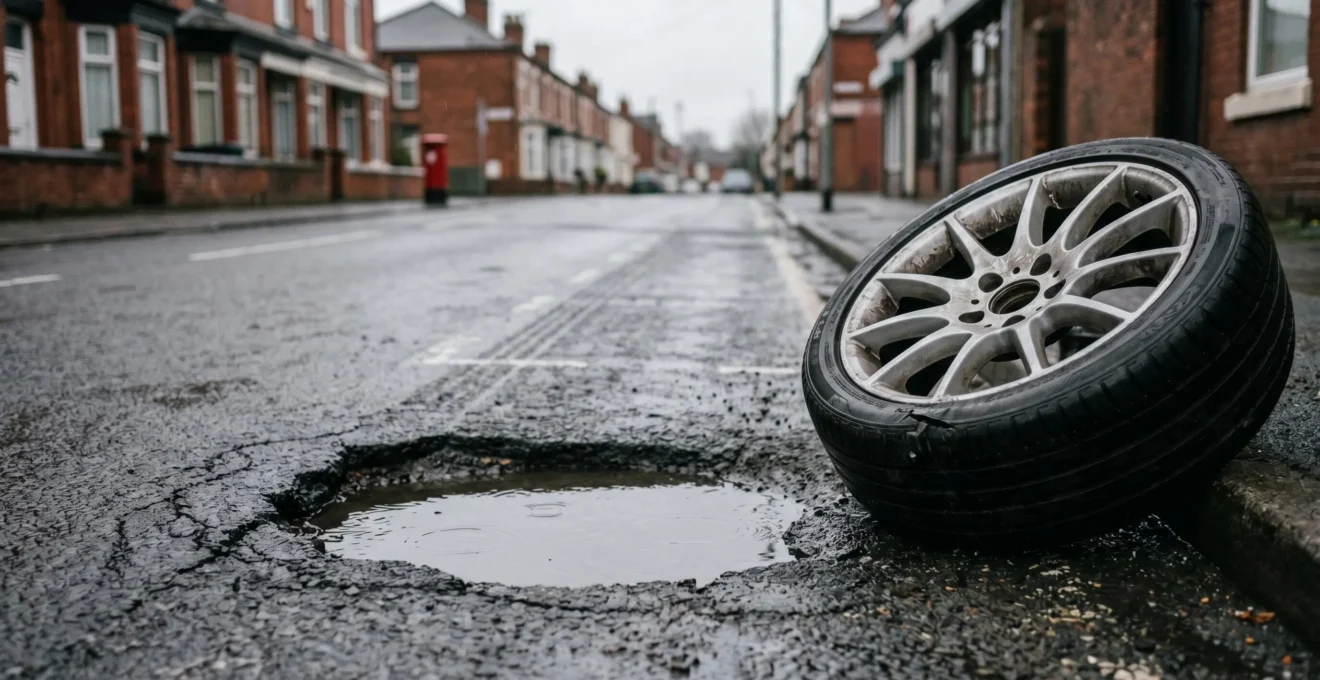
That jarring pothole impact isn’t a one-off cost; it’s the start of a silent financial cascade that continuously drains your bank account through accelerated wear and wasted fuel.
- Misaligned suspension geometry from a single hit invisibly shreds the inner edge of your tyres, drastically shortening their life.
- Increased rolling resistance from fighting against misaligned wheels can reduce your fuel efficiency by up to 10%, adding a stealth tax to every mile you drive.
- For heavier SUVs and complex luxury saloons, the forces are amplified, turning a simple pothole encounter into a potential write-off scenario costing thousands.
Recommendation: Treat a proactive wheel alignment check after a significant impact not as an expense, but as a crucial investment to halt this financial drain and protect your vehicle.
As a suspension and tyre specialist, I see the real aftermath of Britain’s crumbling roads every single day. A customer comes in, frustrated, complaining that their steering pulls to one side or that they’ve just failed an MOT on tyres they thought were fine. The conversation always starts the same way: “I hit a nasty pothole a few months back…” What most drivers don’t realise is that the initial, gut-wrenching thud is just the overture. The real damage is a silent financial cascade, an invisible process that begins the moment your car’s geometry is knocked out of alignment.
Many people think the solution is just to drive more carefully or to keep an eye on tyre pressures. While that’s sound advice, it completely misses the bigger picture. The problem isn’t just the risk of a sudden puncture or a cracked alloy wheel. The true, insidious cost comes from the continuous, accelerated ‘grind-down’ rate of your components. A misaligned car is a car fighting itself with every rotation of its wheels, and that fight is paid for directly out of your pocket in the form of prematurely worn tyres and wasted fuel.
But what if we could reframe the problem? What if, instead of seeing wheel alignment as a reactive repair, we treated it as preventative financial management for your car? This article will break down the hidden costs locked within your car’s suspension after a pothole impact. We will move beyond the obvious damage and quantify the invisible drain on your finances, showing you how to spot the signs, understand the risks, and make the smart investment that stops you from throwing money away with every mile you drive.
This guide provides a detailed breakdown of the real costs associated with pothole damage and vehicle misalignment. Explore each section to understand how to diagnose issues, calculate the financial impact, and make informed maintenance decisions.
Summary: Why British Potholes Are Costing You £200 a Year in Tyres and Fuel?
- Why 1.6mm is Legal but 3mm is Safe: The Wet Braking Difference?
- What Inner Edge Wear Tells You About Your Camber Settings?
- How Much Fuel Does a Misaligned Car Waste Over 10,000 Miles?
- Is a £80 Hunter Alignment Worth It for a Standard Family Hatchback?
- The Hidden Sidewall Bulge: How to Spot Tyre Damage Before a Blowout?
- How to Make Your Brake Pads Last 80,000 Miles by Driving Smart?
- Why Your Heavy SUV Will Eat Through £800 of Tyres Every 15,000 Miles?
- Depreciation Reality: Why That Cheap Luxury Saloon Will Cost You a Fortune?
Why 1.6mm is legal but 3mm is safe: The wet braking difference?
The first thing most drivers associate with tyre wear is the legal tread depth limit: 1.6mm. It’s a pass-or-fail number drilled into us for the annual MOT. However, treating 1.6mm as a target is one of the most dangerous and misguided economies a driver can make. The relationship between tread depth and safety, particularly in the wet, is not a straight line; it’s a cliff edge. As your tyres wear down, their ability to channel water away from the contact patch diminishes, but this effect accelerates dramatically once you go below 3mm.
Think of the grooves in your tyre as drainage channels for the road surface. At 8mm, you have a deep, efficient system. At 3mm, the system is compromised but still functional. Below this, the channels are too shallow to cope with the volume of water encountered at normal road speeds. The tyre can no longer push the water away, and it begins to ride on top of it—aquaplaning. The critical point is that the performance drop-off is exponential, not linear.
Landmark UK research proves this point unequivocally. A detailed study conducted by MIRA at their Nuneaton test track on typical British road surfaces revealed the shocking reality. When testing cars braking from just 50mph in wet conditions, the results were stark. Compared to a new tyre, a tyre at the legal limit of 1.6mm saw its stopping distance increase by a staggering 36.8% on standard asphalt. On the smoother concrete often found on older motorways and A-roads, that figure jumped to a terrifying 44.6% longer stopping distance. That’s not a few feet; it’s several car lengths, the difference between a near-miss and a serious collision.
What inner edge wear tells you about your camber settings?
After a pothole strike, your steering might feel slightly off, or it might feel perfectly fine. This is what makes misalignment so deceptive. The most telling early evidence of a problem isn’t felt through the steering wheel; it’s written on your tyres. Specifically, on the inner edge that you rarely see. When a car’s suspension is knocked out of alignment, one of the most common issues is incorrect ‘camber’. Camber is the vertical tilt of the wheel. If you look at the car from the front, ‘negative camber’ means the top of the wheels tilt inward. A small amount is often designed in for better cornering, but a pothole can force this angle far beyond its design tolerance.
When this happens, the car’s weight is no longer distributed evenly across the full width of the tyre tread. Instead, it becomes concentrated on the inside shoulder. This part of the tyre, which should only be taking a fraction of the load, is now supporting a significant portion of the vehicle’s weight. The result is a rapid, localised ‘grind-down’ of the inner tread blocks. This is your first and most important clue that you have an accumulating Geometry Debt. It’s the physical evidence that your car’s suspension is actively working to destroy your tyres.
The pattern is often described as ‘feathering’—if you run your hand across the tread from the outside in, it will feel smooth, but running it from the inside out will reveal sharp, raised edges on the tread blocks. As the image above clearly illustrates, the difference is stark: the outer tread remains deep and functional, while the inner edge is smoothed, worn, and often stripped of its sipes (the small slits that help in wet weather). You could have 5mm of tread across 80% of the tyre, but if the inner 20% is worn to the cords, the tyre is not only illegal but dangerously compromised. This is the calling card of negative camber caused by a pothole.
How much fuel does a misaligned car waste over 10,000 miles?
The financial damage from misalignment extends far beyond the cost of new tyres. It silently siphons money from your wallet every time you visit the petrol station. This is the ‘Fuel Efficiency Penalty’—a hidden tax on driving a car that is constantly fighting itself. When your wheels are correctly aligned, they run parallel to each other and perpendicular to the ground, creating the lowest possible rolling resistance. The engine’s power is used efficiently to move the car forward.
After a pothole knocks the geometry out, this harmony is lost. Wheels may be ‘toed-in’ or ‘toed-out’, meaning they are no longer parallel. One wheel might be trying to steer left while the other is trying to steer right. The effect is akin to dragging the tyre sideways down the road, even when you’re driving in a straight line. This ‘scrubbing’ action creates a massive increase in rolling resistance. The engine now has to work significantly harder to overcome this internal friction and maintain the same speed. More work for the engine means more fuel burned for every single mile travelled.
It is widely accepted in the automotive industry that severe misalignment can reduce fuel efficiency by up to 10%. Let’s translate that into real money for a typical UK driver. A standard family hatchback averages around 45 MPG. Over 10,000 miles, you would use approximately 222 gallons of fuel. With fuel prices hovering around £1.50 per litre (or £6.82 per gallon), your annual fuel bill for that mileage is roughly £1,514. A 10% reduction in efficiency means you’re now burning an extra 10% of fuel to cover the same distance. That’s an extra £151 wasted per year, simply because the wheels aren’t pointing in the right direction. This isn’t a one-off cost; it’s a continuous drain that persists until the alignment is corrected.
Is a £80 hunter alignment worth it for a standard family hatchback?
Faced with the evidence, the question is no longer “is my car damaged?” but “is the fix worth the cost?”. A basic ‘laser tracking’ check at a fast-fit centre might cost £40, but it often only measures the ‘toe’ angle on the front wheels. This is a blunt instrument that misses the crucial camber and caster angles, and ignores the rear wheels entirely, which is where many modern cars carry their adjustment points. A comprehensive four-wheel alignment using a modern system like a Hunter machine typically costs between £80 and £120. For a standard family hatchback, this can seem like a significant outlay for a problem you can’t necessarily see or feel.
However, we must frame this not as an expense, but as an investment with a clear return. Let’s do the maths. As we established, the Fuel Efficiency Penalty alone could be costing you over £150 per year. A single premium tyre for a modern hatchback can easily cost £120. If misalignment causes a pair of front tyres to wear out in 15,000 miles instead of their potential 25,000 miles, you’ve lost 10,000 miles of life. That’s a tangible loss of nearly £100. Add the fuel penalty and the tyre loss together, and you’re looking at a conservative annual cost of £250, all stemming from that one pothole.
Suddenly, the £80 for a proper, detailed alignment check and adjustment doesn’t look like a cost. It looks like a high-yield investment. You are spending £80 to prevent a guaranteed loss of £250 or more over the next year. It’s the single most effective piece of preventative geometry you can perform. It stops the silent financial cascade in its tracks, restores fuel efficiency, maximises tyre life, and improves the car’s overall safety and handling. For any driver covering average UK mileage, the payback period for a Hunter alignment is often less than six months.
Your Pre-Alignment Checklist: 5 Steps to an Honest Job
- Check for uneven tyre wear patterns by running your hand across the tread surface — feathering or sharp edges indicate existing alignment issues.
- Inspect all suspension components for play or wear — ask the garage specifically about ball joints and suspension arms before proceeding with alignment.
- Verify that tyres are properly inflated to manufacturer specifications — incorrect pressure can mask or mimic alignment problems.
- Request a ‘before and after’ printout showing the actual alignment measurements — this is your proof that work was necessary and has been completed to specification.
- Ask whether the alignment is two-wheel (front only) or four-wheel — most modern cars require a full four-wheel alignment for optimal results and to prevent tyre wear.
The hidden sidewall bulge: How to spot tyre damage before a blowout?
While uneven tread wear and poor fuel economy are slow, insidious consequences of pothole encounters, there is a far more immediate and dangerous threat: structural tyre damage. The force of a heavy vehicle hitting the sharp edge of a pothole at speed is immense. This impact can crush the tyre’s sidewall against the wheel rim, severing the internal fabric cords that give the tyre its strength and structure. This creates a weak spot in the tyre’s architecture.
Initially, this damage may be completely invisible. However, as air pressure from inside the tyre pushes against this weakened area, it begins to stretch and deform, forming a characteristic bulge or ‘aneurysm’ on the sidewall. This is not a cosmetic issue; it is a catastrophic failure waiting to happen. A tyre with a sidewall bulge has lost its structural integrity and could experience a complete blowout at any moment, especially under the stress of high speed or heavy cornering. This is why a bulge is an instant MOT failure and carries a severe penalty; UK regulations permit a fine of up to £2,500 and 3 penalty points for each illegal tyre on your vehicle.
Spotting these bulges requires a more deliberate inspection than a casual glance. They can be subtle and are often missed in normal daylight. The most effective method is to use a torch, even during the day.
As the image demonstrates, the key is to use ‘raking light’. By holding a torch (your phone’s light is perfect) almost parallel to the tyre’s surface, you cast long shadows that exaggerate any imperfections in the sidewall. Turn the steering to full lock to inspect the front tyres, and then roll the car forward or backward a few feet to inspect the full circumference of the rear tyres. A smooth, uniform surface is what you want to see. Any lump, bulge, or visible deformation is a sign of critical damage. That tyre is no longer safe and must be replaced immediately, no matter how much tread is left on it.
How to make your brake pads last 80,000 miles by driving smart?
Becoming a more mechanically sympathetic driver, a necessity spurred by our pothole-ridden roads, has benefits that ripple through the entire vehicle. The same mindset that helps preserve your suspension and tyres can also dramatically extend the life of your braking system. Brake pads and discs are consumable items, but their lifespan is not fixed; it’s almost entirely dependent on driving style. An aggressive driver who relies on late, heavy braking might get 20,000 miles from a set of pads. A smarter, more defensive driver can easily achieve 60,000, 70,000, or even 80,000 miles from the exact same components.
The secret is to use the brake pedal as a last resort, not a primary tool for speed control. This involves shifting your focus from the bumper of the car in front to the furthest point you can see down the road. By anticipating the flow of traffic, traffic lights, and junctions well in advance, you can replace abrupt braking with gentle deceleration. This means lifting off the accelerator early and allowing the car’s natural engine braking and momentum to slow you down gradually. Every time you have to brake hard, you are converting kinetic energy into wasted heat through friction. Smart driving aims to preserve that kinetic energy for as long as possible.
This approach isn’t about driving slowly; it’s about driving smoothly. Mastering these techniques not only saves you hundreds of pounds in brake replacements over the life of your car but also leads to a more relaxed, efficient, and safer journey. Here are some advanced techniques used by professional drivers:
- Scan the road 12-15 seconds ahead (approximately 400 metres at motorway speeds) rather than focusing only on the car directly in front—this dramatically reduces emergency braking situations.
- On approach to red lights or stopped traffic, lift off the accelerator early and allow the car to coast, using engine braking naturally rather than heavy brake application.
- For manual transmission vehicles on steep descents, select a lower gear (typically one or two gears lower than you’d use for climbing) to control speed without brake pedal contact.
- In hybrid and EV vehicles, maximize regenerative braking by anticipating stops earlier—the battery captures energy that would otherwise be wasted as brake heat.
- Avoid ‘riding the brake’ in traffic queues—instead use intermittent gentle braking to maintain following distance, reducing heat buildup in brake components.
Why your heavy suv will eat through £800 of tyres every 15,000 miles?
The laws of physics are unforgiving, and they are particularly harsh on the owners of heavy SUVs navigating the UK’s pothole-scarred road network. While a pothole presents a risk to any vehicle, the destructive forces are significantly amplified for heavier cars. The core issue is inertia and unsprung mass. An SUV’s wheel, tyre, and suspension assembly is substantially heavier than that of a family hatchback. When this weighty assembly hits the immovable edge of a pothole, the impact force is dramatically higher.
As the RAC’s technical team often points out, this increased inertia means the suspension has to work much harder to control the wheel’s movement. It’s more likely to be overwhelmed, resulting in a more violent impact being transmitted to the chassis and, crucially, a greater chance of knocking the suspension geometry out of its precise settings. Furthermore, the sheer weight of an SUV (often over two tonnes) means that even with perfect alignment, the tyres are under immense strain. When you add the scrubbing effect of misalignment into the mix, the rate of tyre wear accelerates exponentially. This is why a set of expensive, 20-inch SUV tyres can be reduced to the legal limit in just 15,000 miles or less, a shocking reality for many new owners.
The repair costs are also magnified. While RAC garage data shows drivers can expect an average bill of £460 for pothole-related repairs on a standard car, this figure can easily double for a premium SUV. These vehicles often feature more complex multi-link suspension systems and larger, more expensive components. A bent control arm or a damaged ball joint that might cost £150 to replace on a Ford Focus could be a £400 part on a Land Rover Discovery Sport. For SUV owners, a proactive alignment check isn’t just a good idea; it’s essential financial damage control.
Key Takeaways
- A single pothole impact initiates a “silent financial cascade” of costs through accelerated tyre wear and increased fuel consumption.
- Wheel alignment is not a reactive repair but a proactive investment; an £80 alignment can save over £200 annually in hidden costs.
- Heavier vehicles like SUVs and cars with complex suspension (e.g., older luxury saloons) are exponentially more vulnerable to severe, costly pothole damage.
Depreciation reality: Why that cheap luxury saloon will cost you a fortune?
There is a tempting category of vehicle on the used car market: the ten-year-old luxury saloon. Cars like the Audi A8, BMW 7 Series, or Mercedes S-Class, which cost £80,000 new, can be picked up for less than the price of a new supermini. They offer incredible comfort, performance, and technology for the money, but they also hide a catastrophic vulnerability to UK road conditions. These vehicles were engineered in Germany for smooth autobahns, equipped with complex and fragile air suspension and multi-link aluminium components that do not tolerate sharp, high-energy impacts.
For these cars, a pothole isn’t just a risk; it’s a potential financial write-off. A single, severe impact can trigger a cascade of failures. It might start with a cracked alloy wheel (£800 to replace), but the shockwave travels into the sophisticated suspension system. A delicate air spring can rupture (£1,000), a multi-link control arm can bend (£600), or a ride-height sensor can be destroyed (£250). Suddenly, a single pothole has generated a repair bill that can exceed the value of the car itself.
This isn’t hyperbole; it’s a reality reflected in insurance data. While a simple pothole claim for a tyre used to be a few hundred pounds, the average cost is soaring as more complex cars are damaged. According to Admiral insurance, the average settled pothole claim in 2023 was £4,595. This reflects the high cost of repairing or even writing off these technologically advanced but fragile vehicles.
Case Study: The Write-Off Cascade
Analysis of insurance data by Aviva provides a stark warning for drivers of complex vehicles. Their findings show that one in four cars damaged by potholes are now so extensively harmed that they are written off by insurers. The damage often goes far beyond a simple tyre or wheel. A single impact can cause a chain reaction, damaging suspension systems, cracking radiators, and even affecting the sensitive electronics in modern battery and driver-assist systems. For an older luxury vehicle with sophisticated but aged air suspension, a single pothole impact can easily lead to multiple, interconnected component failures, pushing the repair estimate far beyond the car’s market value and making a write-off the only economically viable option for the insurer.
The evidence is clear: ignoring the subtle signs of a misaligned vehicle is a false economy. The true cost of a pothole is not the initial impact, but the continuous, silent drain on your finances through destroyed tyres and wasted fuel. Taking a proactive stance by investing in a proper four-wheel alignment is the single most effective step you can take to stop this cascade, saving you hundreds of pounds and ensuring your car is safer and more efficient. Evaluate your vehicle and driving habits today, and consider if it’s time to invest in preventative geometry.