Stop-and-go cruise control is not a magic cure for commuter stress, but a complex tool that trades physical fatigue for a new kind of mental workload.
- While it promises a relaxed drive, its real-world quirks—like hesitant restarts and conservative gaps—require constant driver supervision and understanding.
- The key to reducing stress is not to blindly trust the system, but to master the “digital dance” between driver input and automated control.
Recommendation: Treat your car’s Traffic Jam Assist as an imperfect co-pilot. Learn its specific behaviours and limitations to truly benefit, and consider alternatives like one-pedal driving for a different approach to reducing fatigue.
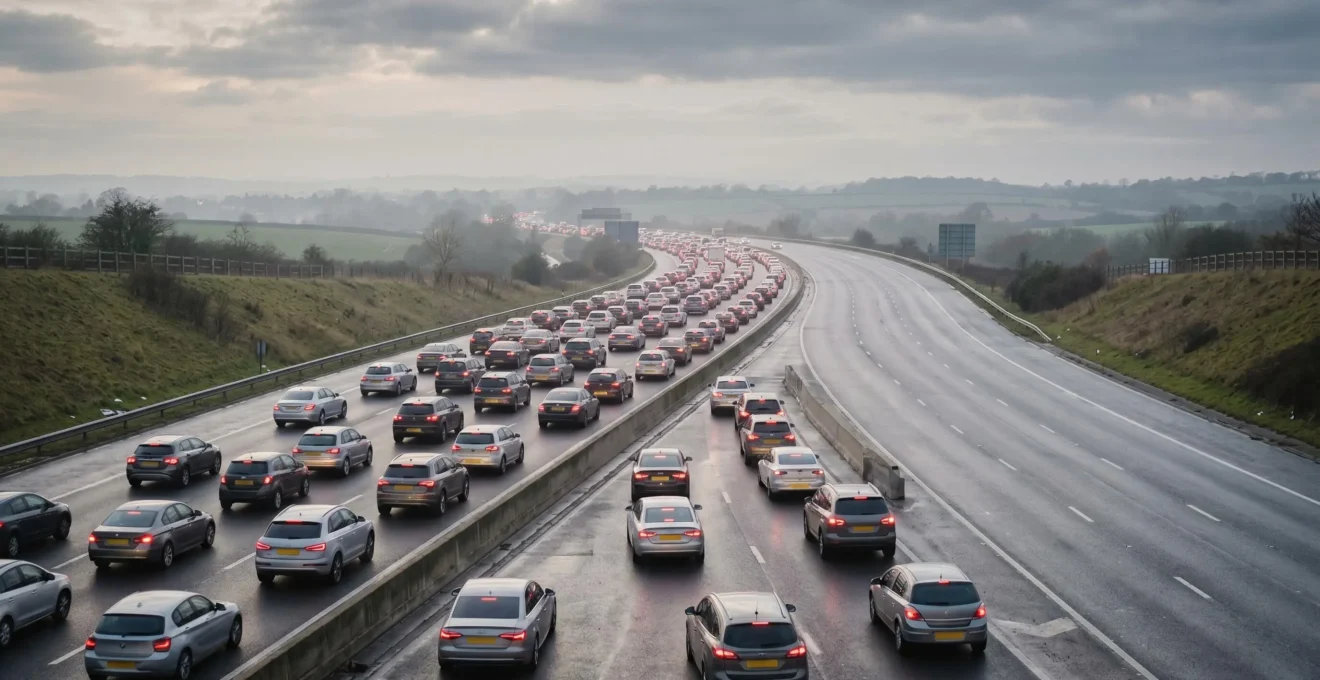
The daily crawl on the M25 is a ritual of patience and pain. For the millions who endure it, the dream of a car that drives itself through the relentless stop-and-go is more than a luxury—it’s a siren song of salvation. Automakers have answered this call with a suite of technologies, chief among them Adaptive Cruise Control (ACC) with Stop & Go, often bundled as ‘Traffic Jam Assist’. The promise is simple: set it, forget it, and let the car handle the monotonous braking and accelerating. This, we’re told, is the cure for commuter stress.
But as anyone who has lived with these systems knows, the reality is far more complicated. It’s less a handover of control and more a “digital dance” with a new, often frustrating, partner. The generic advice is to trust the technology but stay alert. However, this misses the point. The real challenge lies in understanding *why* the system behaves the way it does—why it leaves an infuriatingly large gap, why it hesitates after a stop, and when it might actually be making things worse. This isn’t just about handing over the pedals; it’s about managing a new kind of mental load.
This deep dive moves beyond the marketing brochures to explore the real-world experience of living with these semi-autonomous systems on Britain’s toughest roads. We’ll unpack the engineering compromises and psychological quirks that define this love-hate relationship. We’ll also explore a related but fundamentally different technology—one-pedal driving—that offers another path to a less stressful commute. The goal isn’t to find a perfect self-driving car, but to understand the tools we have today and master them for a genuinely better journey.
This article explores the nuances of modern driving aids to determine if they are truly the solution for the weary commuter. The following sections will guide you through the pros, cons, and hidden realities of these technologies.
Summary: The real cost and benefit of automated commuting
- Does adaptive cruise control save fuel in traffic jams vs human driving?
- Why ‘traffic jam assist’ is a medical necessity for high-mileage drivers?
- Why the ‘shortest’ gap setting is still too big for UK roundabouts?
- Why some cars won’t move after 3 seconds of stopping without a nudge?
- Why you should cancel cruise control when you hit standing water?
- Why owning a car in zone 1 London is costing you £3,000 more than it should?
- Why one-pedal mode reduces driver fatigue by 50% on the M25?
- One-pedal driving: how to master it in 3 days without jerky stops?
Does adaptive cruise control save fuel in traffic jams vs human driving?
The logical assumption is that a computer, with its ability to make minuscule, precise adjustments, would be more efficient than a human foot. The reality, however, is a mixed bag. In electric vehicles, for instance, the smooth, pre-programmed acceleration and deceleration profiles of ACC can be less effective at harvesting energy than an experienced EV driver. In fact, one study found that in some scenarios, ACC can lead to a 2.5% increase in energy consumption compared to human drivers who are actively trying to be efficient.
However, the story changes in low-speed, dense traffic. Here, the system’s ability to avoid sharp, unnecessary braking and acceleration can yield real benefits. An analysis by Argonne National Laboratory reveals that ACC consistently demonstrates improved fuel efficiency for trips averaging below 50 km/h (around 30 mph). The system’s placid nature smooths out the peaks and troughs of inefficient driving that humans are prone to when frustrated in a jam.
The problem is that current systems can sometimes be *too* reactive, creating their own inefficiencies. They can amplify traffic waves rather than dampen them, a phenomenon known as a “phantom traffic jam”. This highlights the complexity of the efficiency equation: it’s not just about the car, but how it interacts with the entire traffic ecosystem.
Case study: The Vanderbilt university ‘phantom jam’ experiment
Researchers at Vanderbilt University conducted a real-world test with seven identical vehicles all using the same ACC system. When the lead car gently reduced speed, each subsequent car braked progressively harder in a domino effect. The last car in the line slowed so much that its ACC system disengaged. This test proved that the logic in many current ACC systems, designed for safety above all, can inadvertently worsen traffic flow by over-reacting, rather than smoothing it out.
Why ‘traffic jam assist’ is a medical necessity for high-mileage drivers?
To call a car feature a “medical necessity” might sound like hyperbole, but for those spending hours a day in traffic, the argument is compelling. The benefit of Traffic Jam Assist isn’t just about convenience; it’s about mitigating the proven physiological and psychological toll of a stressful commute. Constant pedal work, the hyper-vigilance of maintaining a safe gap, and the mental arithmetic of judging speeds all contribute to a build-up of cortisol and driver fatigue.
A good Traffic Jam Assist system tackles this by reducing the physical workload to near zero. No more aching ankles or knees from hovering over the pedals. This physical relief is immediate and profound. More importantly, it tackles the mental load. By automating the two most taxing parts of jam driving—distance control and speed modulation—it frees up a significant amount of cognitive bandwidth. This is not about encouraging distraction; it’s about reducing the sources of stress that lead to fatigue and, ultimately, errors.
This concept can be described as avoiding fatigue transfer. A poorly implemented system doesn’t eliminate fatigue; it merely transfers it from a physical task (pedal work) to a mental one (anxiety about what the car will do next). A truly great system, however, reduces the total load, leaving the driver calmer, more refreshed, and safer at the end of their journey. For a high-mileage professional, whose livelihood depends on their ability to drive safely day in and day out, this is less a luxury and more a crucial tool for occupational health and long-term well-being.
Why the ‘shortest’ gap setting is still too big for UK roundabouts?
This is perhaps the single greatest source of frustration for UK drivers using ACC. You’re approaching a busy roundabout, you spot a gap, but the car, stubbornly maintaining its “shortest” pre-set distance to the vehicle in front, refuses to accelerate into it. The gap closes, and you’re left stationary, often to the symphony of horns from behind. The reason for this infuriating behaviour lies in a conflict between the system’s design philosophy and the unwritten rules of British driving.
ACC systems are designed with a global safety margin in mind. The “shortest” gap is typically calibrated to a minimum of 1 to 1.5 seconds of following distance. At 20 mph, that’s a gap of nearly 9 metres. In the cut-and-thrust world of a UK roundabout, a 9-metre gap is an open invitation for three other cars to push in. The system is not designed for the assertive, predictive style of driving that is required.
Furthermore, the sensors themselves have limitations. As a research paper on the subject notes, the sensors “usually have a limited angle of view and may lose the target detection on curvy roads.” As you approach a roundabout, the car in front is no longer directly ahead but curving away. The ACC system can momentarily lose sight of it, causing it to hesitate or even brake, precisely when you need it to be decisive. It’s a system designed for straight lines and predictable flow, thrown into the chaotic, circular ballet of a British junction.
Why some cars won’t move after 3 seconds of stopping without a nudge?
You’ve come to a complete halt in traffic. The car in front moves off, but yours just sits there. A frantic glance at the dashboard confirms the ACC is still active. This is the infamous “3-second rule,” a feature that feels like a software bug but is, in fact, a deliberate safety design. After a predetermined period of being stationary—typically around three seconds—most ACC systems will require driver confirmation to resume.
This confirmation is usually a light tap on the accelerator or a press of the ‘Resume’ button on the steering wheel. The engineering logic behind this is a “driver attentiveness check.” The designers reason that if the car has been stopped for more than a few seconds, the driver’s attention may have drifted. They might be looking at their phone, adjusting the radio, or simply daydreaming. Forcing a small, conscious action re-engages the driver, confirming they are aware of the situation and ready to move off.
It’s a legal and safety failsafe. In the event of an incident, the automaker can demonstrate that the system requires driver involvement to proceed from a standstill, reinforcing that the human is always in ultimate control. While it can be annoying in slow-creeping traffic where stops frequently last 4-5 seconds, it’s a fundamental part of the system confidence model. The car is essentially asking, “Are you still with me?” before it commits to moving. Understanding this transforms it from an annoyance into a predictable part of the “digital dance” with your co-pilot.
Why you should cancel cruise control when you hit standing water?
This is not a suggestion; it’s a critical safety instruction. Using any form of cruise control—adaptive or standard—through standing water is one of the most dangerous things a driver can do. The reason is rooted in the physics of aquaplaning and the inflexible logic of a computer.
Aquaplaning, or hydroplaning, occurs when a layer of water builds between the tyres and the road surface, leading to a complete loss of traction. Your tyres are no longer touching the road; they are skimming on water. As The AA advises, it can take just a couple of inches of water to cause aquaplaning at around 50mph. The correct human response is to ease off the accelerator, hold the steering wheel straight, and allow the car to decelerate naturally until the tyres regain contact with the tarmac.
A cruise control system will do the exact opposite. The system’s single-minded goal is to maintain a set speed. When the tyres hit the water, the resistance on the wheels suddenly drops. The cruise control interprets this as the car going “uphill” or needing more power. It will therefore command the engine to accelerate to maintain the target speed. Sending power to wheels that have no traction is a recipe for a catastrophic loss of control. The moment the tyres do regain some grip, the sudden application of power can cause the car to spin violently. It’s a situation where the system’s logic is fundamentally incompatible with safe physics.
Why owning a car in zone 1 London is costing you £3,000 more than it should?
The figure of £3,000 might seem precise, but it represents a very real, and often underestimated, financial burden for urban motorists. While every driver faces costs for insurance, fuel, and maintenance, owning a car in the heart of London adds several layers of unique and substantial expenses. It’s a financial gauntlet that makes the quality of your driving experience, especially during the inevitable traffic, all the more critical.
Let’s conduct a thought experiment on the potential “surcharges” of Zone 1 car ownership. First and foremost are the daily charges. The Congestion Charge is a fixed daily fee for driving within the central zone. Then there’s the Ultra Low Emission Zone (ULEZ) charge, which applies to any vehicle that doesn’t meet strict emissions standards. For a resident driving their car just five days a week, these two charges alone can easily spiral into thousands of pounds per year.
Beyond the official levies, there are the hidden costs. Parking is a major one; a resident’s parking permit can cost hundreds of pounds, and that’s if you can even find a space. Insurance premiums are also significantly higher in central London postcodes due to increased risks of theft, vandalism, and accidents. When you tally up these London-specific costs—ULEZ, Congestion Charge, inflated insurance, and permit parking—the £3,000 figure starts to look not just plausible, but potentially conservative. It highlights why any technology that can make the time spent in that expensive car even marginally less stressful is so highly sought after.
Why one-pedal mode reduces driver fatigue by 50% on the M25?
While the 50% figure is a bold claim, it captures the profound difference in driving experience that one-pedal mode offers, especially in the context of traffic. Unlike ACC, which is a layer of automation on top of traditional driving, one-pedal driving is a fundamental change in how you interact with the car. In an electric vehicle with this mode activated, lifting your foot off the accelerator initiates strong regenerative braking, slowing the car significantly without you ever touching the brake pedal. For M25 gridlock, this is a game-changer.
The reduction in fatigue comes from simplifying the driver’s primary task. Instead of constantly moving your right foot between two pedals—the accelerator and the brake—you now modulate your speed almost exclusively with one. This eliminates thousands of small physical actions over the course of a commute. It’s a simpler, more direct input method that dramatically reduces physical strain on the ankle and leg.
Interestingly, while this feels more efficient to the driver, it may not always be the most efficient for the battery. Nuanced research published in Nature demonstrates that, on average, attentive human drivers can achieve higher overall regenerative braking efficiency than even automated systems by anticipating conditions and coasting more effectively. However, the one-pedal system provides a consistent, high level of regeneration with every lift of the pedal. The trade-off is a slight dip in potential maximum efficiency for a massive gain in driver comfort and a reduction in mental load. In the context of a two-hour jam, most commuters would take that bargain every time.
Key takeaways
- ACC is not a simple fuel-saver; its efficiency depends heavily on speed, traffic conditions, and vehicle type.
- The biggest frustrations with ACC (gaps, hesitations) are often deliberate safety features, not bugs.
- For safety, you must always disengage cruise control in wet conditions where aquaplaning is a risk.
One-pedal driving: how to master it in 3 days without jerky stops?
Making the switch to one-pedal driving can feel unnatural at first. The strong deceleration when you lift off the accelerator can lead to jerky, head-nodding stops. However, with a little practice, it can become second nature, transforming your commute into a smoother, less stressful experience. The key is to recalibrate your muscle memory and treat the accelerator not as an on/off switch, but as a precise dimmer switch for speed.
Mastering this new driving style is a process of learning to anticipate and feather the accelerator. You’ll soon learn the exact lift-off point on the approach to a junction that will bring you to a smooth, perfect stop right at the line, without ever touching the brake. It becomes a satisfying challenge, a mini-game that keeps you engaged while reducing physical effort. The following plan can help you build confidence and master the technique in just a few days.
Your action plan: Three-day one-pedal driving mastery
- Day 1: Recalibrate in isolation. Practice in an empty car park. Treat the accelerator as a dimmer switch, not an on/off button. Focus on coming to complete stops on specific painted lines purely by feathering the accelerator’s release to retrain your muscle memory.
- Day 2: Build confidence in light traffic. Drive in light traffic while keeping your braking foot hovering over the brake pedal, but without touching it. This trains your brain to rely on the accelerator for 90% of speed modulation while keeping the safety reflex sharp.
- Day 3: Perfect the handoff. Master the blend from regenerative to friction braking. Focus on the exact moment the strong regenerative braking gives way to the physical brakes at very low speeds. Learn the precise lift-off point that allows for a seamless transition for chauffeur-smooth stops.
By following this progression, you replace the initial jerky experience with a sense of fluid control. It’s a skill that, once learned, makes returning to a traditional two-pedal car in traffic feel clumsy and archaic. It’s the final step in truly mastering the modern electric vehicle’s unique capabilities.
Start treating these driving aids not as a flawed attempt at self-driving, but as new tools that require skill and understanding to be used effectively. Your sanity on the daily commute depends on it.