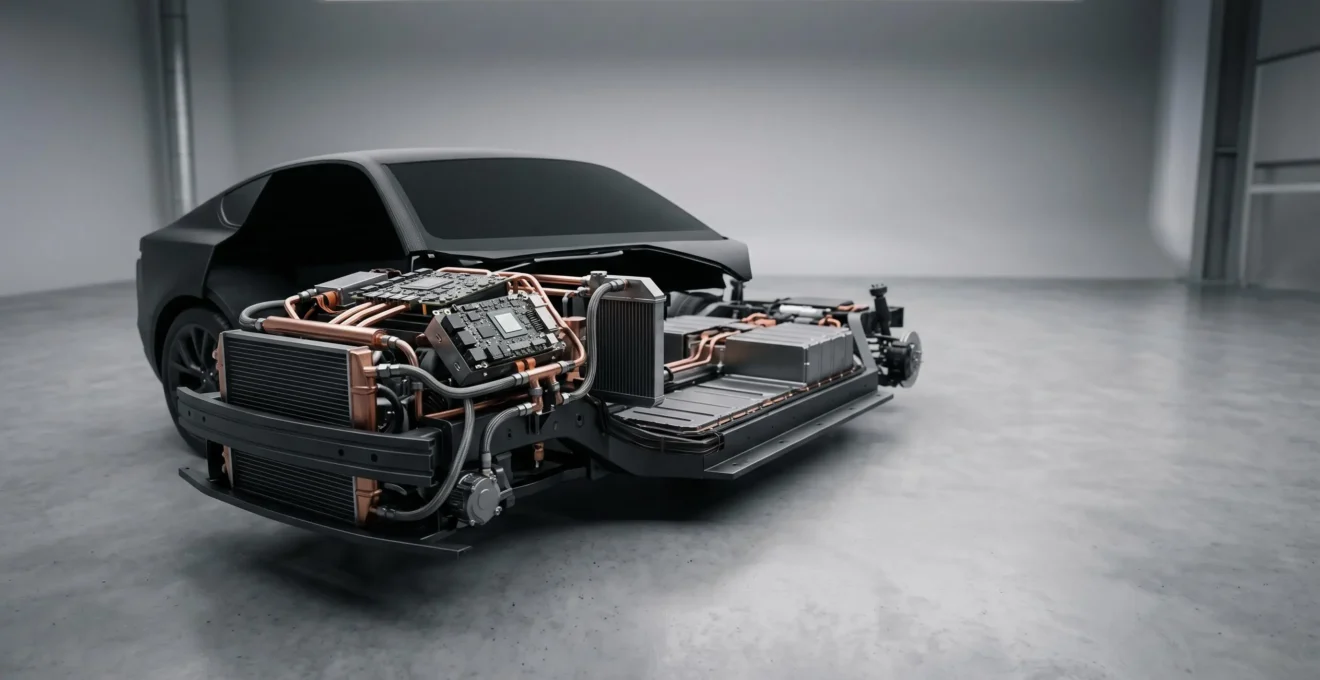
You hear the fans whirring in your parked car and assume it’s for the battery. The reality is far more complex. Your car is now a powerful, always-on server, and those fans are desperately trying to prevent its central brain from melting under a massive computational load. This article explains the profound architectural shift to centralized computing that’s changing everything from in-car features and data privacy to security and reliability.
If you’ve stood next to a new electric vehicle on a warm day, even when it’s turned off and not charging, you might have heard a surprising sound: the distinct hum of cooling fans. Your first thought is likely the battery. But what if that noise isn’t just for the battery pack? What if it’s for the car’s brain?
The automotive world is undergoing its most significant transformation since the invention of the internal combustion engine. We’re told cars are becoming “computers on wheels,” a phrase that has quickly become a cliché. It fails to capture the sheer scale and complexity of this change. It’s not about adding more screens or driver aids; it’s a fundamental re-architecting of the vehicle from a collection of simple, distributed calculators into a centralized, high-performance computing platform. This hidden supercomputer is the real reason for the fan noise, the seemingly random feature omissions, and a host of new challenges that mirror the world of enterprise data centers.
This shift from mechanical engineering to software and thermal engineering creates a new set of rules. The car’s value and functionality are no longer defined solely by its engine or chassis, but by its processing power, its software, and its ability to manage a massive thermal budget. In this article, we’ll dissect this hidden revolution, exploring why your next car is more like a server than you think and what that means for performance, security, data ownership, and long-term reliability.
To navigate this complex new reality, we will explore the core components of this transformation. This guide breaks down why your car’s computational power is exploding and the critical consequences for drivers and owners.
Summary: The Supercomputer in Your Driveway
- Why Your New Car Might Be Missing Wireless Charging Due to Chip Supply?
- PS5 Performance in a Car: Is It a Gimmick or the Future of Charging Breaks?
- Does Tesla Own Your Dashcam Footage or Do You?
- Why Your Car Must Process AI Decisions Locally Instead of the Cloud?
- The £2,000 Screen Failure: Why Cheap Memory Chips Kill Modern Infotainment?
- Level 3 Autonomy: When Can You Legally Take Your Eyes Off the Road?
- Can Hackers Steal Your Car by Cracking the Central OS?
- Software Defined Vehicles: Why Your Next Car Will Be More Like an iPhone?
Why Your New Car Might Be Missing Wireless Charging Due to Chip Supply?
The recent semiconductor shortage was widely reported as the reason for production delays and missing features. Many assumed this meant trivial components like chips for heated seats or wireless chargers were simply unavailable. While true, this explanation misses the deeper issue. The shortage didn’t just affect optional gadgets; it exposed the fragility of the new, chip-heavy vehicle architecture. In the old model, a car had up to 100 simple Electronic Control Units (ECUs), each performing a single function. A missing ECU for a non-critical function was an annoyance. In the new centralized architecture, a few powerful domain controllers manage entire vehicle functions.
The shortage forced manufacturers to make hard choices, often de-prioritizing lower-margin features to allocate precious, complex SoCs (Systems on a Chip) to core vehicle functions like the powertrain and infotainment. The problem wasn’t just a lack of simple chips, but a bottleneck in the supply of the powerful processors that form the new digital backbone of the car. The global automotive industry felt this acutely, with S&P Global Mobility estimating a production loss of 9.5 million units in 2021 alone due to this crunch.
This reveals a critical dependency: modern vehicle design is now entirely contingent on a stable supply of high-performance silicon. A missing wireless charging pad isn’t just an inconvenience; it’s a symptom of an industry grappling with its transformation into a branch of the consumer electronics sector, with all the supply chain vulnerabilities that entails.
PS5 Performance in a Car: Is It a Gimmick or the Future of Charging Breaks?
When automakers boast about having the processing power of a gaming console, it’s easy to dismiss it as a marketing gimmick. After all, do you really need to play AAA games on your dashboard? But from a hardware engineering perspective, this comparison is incredibly revealing. It’s not about the gaming itself; it’s about the class of processor the car now requires. A modern gaming console like the Xbox Series X is a thermal engineering marvel, built to manage the immense heat generated by a processor running at full tilt. For context, Microsoft rates its Xbox Series X custom processor at 12 teraflops of computational power.
Integrating this level of performance into a car, which lacks a console’s dedicated cooling solution and operates in a much harsher environment (from -20°C in a winter night to 60°C parked in the sun), is a monumental challenge. This is the origin of the “thermal budget.” Every watt of power the processor uses becomes a watt of heat that must be dissipated. This heat is the enemy of performance and longevity. If the central computer overheats, it will engage in thermal throttling—aggressively reducing its clock speed to cool down, resulting in a laggy screen, slow responses, and compromised functionality.
This is why you hear fans. The car is actively managing its thermal budget, using fans and sometimes even liquid cooling loops to keep its central brain operating within a safe temperature range. The “PS5 performance” isn’t for gaming; it’s the raw power needed for high-resolution displays, multiple camera streams for ADAS, and the complex software that runs it all. The gaming is just a happy, heat-generating by-product.
Does Tesla Own Your Dashcam Footage or Do You?
As cars become sophisticated sensor platforms, constantly recording video, audio, and telematics, the question of data ownership becomes paramount. The dashcam and Sentry Mode features are prime examples. Does the manufacturer have access to everything your car sees? This issue touches upon a core concept of modern computing: data sovereignty.
In the case of the most prominent example, Tesla has a clear public stance. The company’s privacy policy addresses this directly, aiming to reassure customers that their data remains their own. This commitment to on-device processing is a crucial pillar of user trust.
Sentry Mode and Dashcam camera recordings are processed and saved in the customer’s vehicle or an external device, never on the company’s servers.
– Tesla, Tesla Privacy Policy
This statement is more than just a policy; it’s a declaration of architectural philosophy. It mandates that the vehicle’s onboard computer must be powerful enough to handle all the video processing, analysis, and storage locally, without relying on the cloud. This reinforces the need for powerful, always-on hardware.
Case Study: Tesla’s Move to Local Encryption
In a 2026 software update, Tesla took this a step further by introducing end-to-end encryption for dashcam clips. Footage is encrypted on the car’s computer, and the decryption key is tied to the owner’s account, with the process happening entirely on the owner’s local device. The videos are never uploaded or decrypted on Tesla’s servers. This represents a significant technical implementation of data sovereignty, though it adds a layer of friction for users needing to quickly access footage for insurance purposes.
Why Your Car Must Process AI Decisions Locally Instead of the Cloud?
The single most important reason your car needs a supercomputer onboard is latency. For infotainment or navigation, a half-second delay in response from a cloud server is a minor annoyance. For a vehicle travelling at 70 mph, it’s the difference between a safe stop and a catastrophe. A car covers over 100 feet per second at that speed. Waiting for a remote server to analyze a sensor input and send back a command is a non-starter.
This is where edge computing becomes non-negotiable. All critical decisions, especially those related to Advanced Driver-Assistance Systems (ADAS) and autonomous driving, must be made “at the edge”—that is, on the vehicle’s local hardware. The car’s sensors (cameras, radar, lidar) generate a deluge of data that needs to be processed in real-time. This involves complex AI models for object detection, path prediction, and decision-making.
The time budget for such a decision is infinitesimally small. For autonomous systems, the benchmark for a complete sense-process-act cycle is incredibly demanding. Low-latency computing enabled by this edge architecture reduces response time to under 10 milliseconds. Achieving this requires immense, dedicated processing power located physically inside the vehicle. There is no cloud alternative for the laws of physics; the speed of light itself imposes a delay that is unacceptable for safety-critical functions.
The £2,000 Screen Failure: Why Cheap Memory Chips Kill Modern Infotainment?
As infotainment systems become more complex, stories of screen failures costing thousands to repair are becoming more common. The issue often isn’t the screen itself, but the memory chips embedded within the system. This highlights a fundamental tension in automotive design: the component lifecycle mismatch. A car is an asset designed to last for a decade or more. The consumer electronics components being integrated into it, particularly memory chips like eMMC flash, have a much shorter designed lifespan, often dictated by write cycles and consumer market trends.
These memory chips are not automotive-grade. They are often the same type of components found in smartphones or tablets, designed for a 3-5 year replacement cycle. In a car, they are subjected to constant data logging, extreme temperature swings, and vibration. Over time, the memory cells wear out. The result is a system that fails to boot, a permanently black screen, and a repair bill that involves replacing the entire computing module because the cheap memory chip is soldered to the main board.
This is a classic engineering trade-off. Using cheaper, consumer-grade components reduces the initial manufacturing cost but externalizes the long-term reliability risk onto the owner. The £2,000 repair bill is the price paid for a component lifecycle that is fundamentally misaligned with the expected lifespan of the vehicle it’s installed in. It’s a stark reminder that in a software-defined car, hardware quality and longevity are more important than ever.
Level 3 Autonomy: When Can You Legally Take Your Eyes Off the Road?
Level 3 autonomy, often called “eyes off,” represents a monumental legal and technical threshold. It’s the point where the driver can legally cede control and responsibility to the vehicle under specific conditions. This transition is not just about the car being a better driver; it’s about the car being able to prove it was in control and made the right decisions. This introduces a massive computational burden known as “defensive logging.”
For a manufacturer to accept liability, the vehicle’s central computer must record an immense amount of data. It needs to continuously log not just its own actions (steering input, brake application) but also the state of its sensors, the output of its perception algorithms, and the decision-making process of its AI. This creates a high-fidelity “black box” that can be used to reconstruct an accident scenario and legally vindicate the system. This data stream can run into terabytes per day.
This constant, high-stakes logging requires a powerful and robust computing platform that is always on and always recording, even when the “autonomy” feature isn’t actively steering. The hardware must be powerful enough to run the driving AI *and* manage this intensive logging process simultaneously without compromising on safety or performance. Therefore, the supercomputer in your car isn’t just for driving; it’s also for being its own lawyer.
Can Hackers Steal Your Car by Cracking the Central OS?
The short answer is: the risk is real and growing. The move towards a centralized architecture—the very thing that enables such powerful features—also creates a single, high-value target for cyberattacks. This is the downside of architectural consolidation. In the past, a car’s 100+ individual ECUs were isolated. Hacking the infotainment system would not give an attacker access to the brakes, as they were on separate, firewalled networks (like the CAN bus).
In a software-defined vehicle with a central OS, the lines are blurred. While extensive security measures like hypervisors and firewalls are in place to isolate critical functions (steering, braking) from non-critical ones (infotainment, Bluetooth), the shared hardware creates a potential attack surface. A vulnerability in a seemingly harmless application could, in theory, be exploited to gain deeper access to the system. This “privilege escalation” attack is a classic technique used by hackers in the IT world.
Automakers are now effectively software companies, and they face the same security challenges as Microsoft or Apple. They must constantly patch vulnerabilities, which is why Over-The-Air (OTA) updates are no longer a convenience but a critical security necessity. The central OS of your car is under constant threat, and its defense requires a level of processing power and architectural foresight that was unimaginable a decade ago.
Key Takeaways
- Modern cars are rapidly shifting from a distributed network of simple ECUs to a centralized, high-performance computing architecture, similar to a server.
- This consolidation creates immense thermal challenges, requiring active, “server-grade” cooling systems to prevent performance degradation (thermal throttling).
- For safety-critical functions like autonomous driving, local AI processing (“edge computing”) is non-negotiable due to latency, mandating powerful onboard hardware.
Software Defined Vehicles: Why Your Next Car Will Be More Like an iPhone?
All these threads—centralized computing, massive processing power, OTA updates, and cybersecurity challenges—converge on a single concept: the Software-Defined Vehicle (SDV). This is the end game. Your car is no longer a finished product when it leaves the factory. Like an iPhone, it is a hardware platform whose capabilities, features, and even performance can evolve over time through software updates.
This is a profound shift in what it means to own a car. Features can be added, bugs can be fixed, and performance can be enhanced remotely. It also opens the door to new business models, such as features-on-demand or subscriptions for things like enhanced performance or autonomous capabilities. The hardware—the central supercomputer—is intentionally over-provisioned at the factory to accommodate future software that hasn’t even been written yet. The fans you hear are cooling the potential for tomorrow.
Understanding this concept is crucial for any modern car buyer. You are no longer just buying horsepower and leather; you are buying into a software ecosystem. The quality of that software and the manufacturer’s commitment to updating it will define your ownership experience far more than the 0-60 time. The vehicle becomes a living device, not a static piece of metal.
Action Plan: How to Vet a Software-Defined Vehicle
- Check OTA Capability: Confirm if the car receives major feature updates Over-The-Air, not just map or infotainment updates. Ask if powertrain or ADAS software can be updated.
- Investigate the App Ecosystem: Does the car have a native app store or rely solely on phone projection (CarPlay/Android Auto)? A native ecosystem suggests a more robust underlying OS.
- Understand the Subscription Model: Identify which features are standard, which are one-time purchases, and which require an ongoing subscription. This reveals the manufacturer’s long-term strategy.
- Research the Update History: Look at forums and owner groups for the manufacturer’s track record. Do they release frequent, meaningful updates or are updates rare and minor?
- Assess the Hardware Headroom: Inquire about the onboard computer. While dealers may not know specifics, brands that actively market their “next-gen” platform are more likely to have invested in hardware for the future.
Embracing this new paradigm requires a shift in perspective. As you evaluate your next vehicle, look beyond the traditional metrics and start thinking like a tech analyst. Assess the software, the update strategy, and the digital architecture, for that is where the true value and future of the modern car now resides.