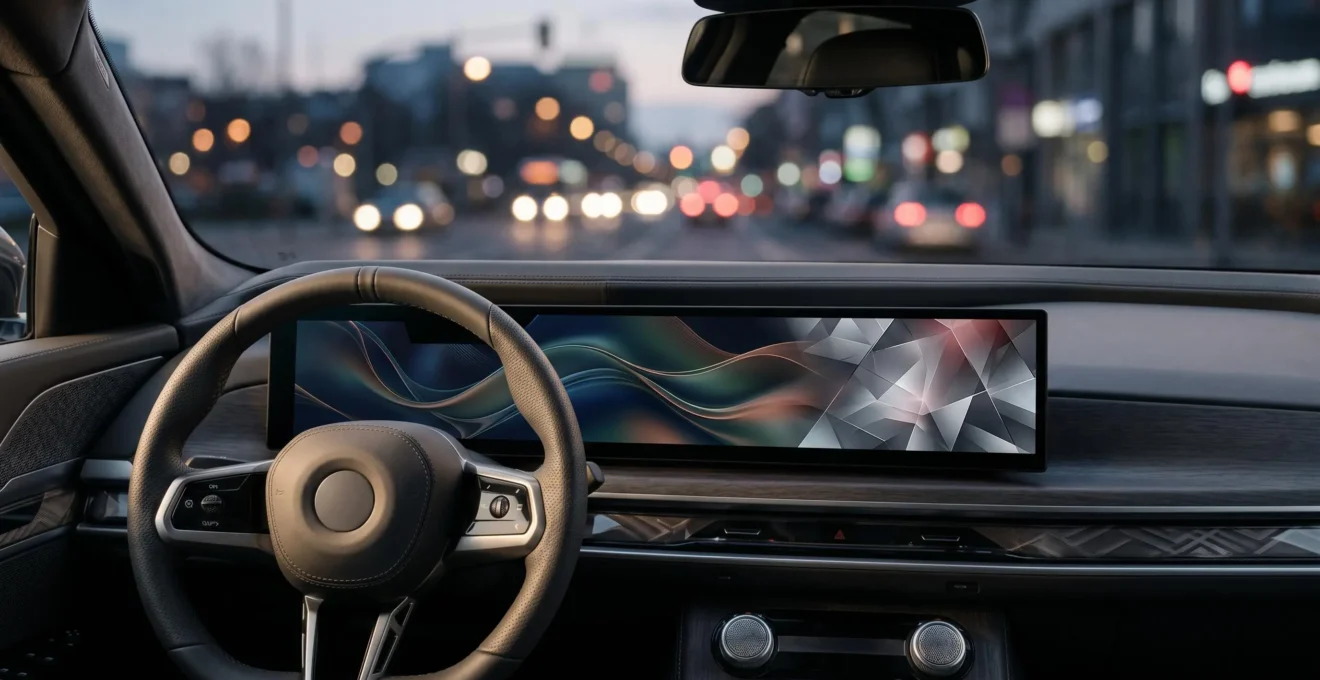
Choosing between Apple CarPlay and your car’s native system is not about which has better maps; it’s a critical decision about your privacy, security, and cognitive safety.
- Your car’s operating system may be sharing your driving habits with data brokers and insurers without your explicit consent.
- Relying on a phone for car functions introduces reliability failures and security risks that physical keys and buttons were designed to prevent.
- Touchscreen-heavy interfaces increase cognitive load, making simple tasks like adjusting the climate less safe than using physical buttons.
Recommendation: Evaluate your car’s interface based on its transparency and user control. Demand systems that prioritize your safety and privacy over the manufacturer’s ability to monetize your data.
The moment you get into a new car, the battle for the dashboard begins. Do you plug in your phone and let Apple CarPlay or Android Auto take over, offering a familiar, app-centric universe? Or do you stick with the manufacturer’s native operating system, the digital environment painstakingly designed by Ford, BMW, or Toyota? For most drivers, this is a simple question of convenience. They weigh Google Maps against the car’s built-in navigation or compare Spotify’s interface to the native media player. This is exactly where automakers and big tech want to keep the conversation: focused on surface-level features.
But this is a dangerously simplistic view. As a user experience (UX) designer, my focus is on usability, safety, and the often-invisible consequences of design choices. The decision you make every time you start your car is not just about preference. It’s a commitment that has profound implications for who pays for data, how secure your vehicle is, whether your insurance premiums go up, and even how safely you can perform basic tasks while driving. This isn’t a battle for the best user interface; it’s a battle for control over your data, your wallet, and your attention.
The slick, minimalist interfaces of modern cars hide a complex ecosystem of data collection, subscriptions, and potential vulnerabilities. The question isn’t “Which system is better?” The real question is, “What are the hidden costs of the system I choose?” This article will dissect that question from a UX perspective, moving beyond the app icons to reveal the critical trade-offs that manufacturers and tech giants would rather you didn’t consider. We will explore the tangible consequences of your choice on data consumption, vehicle security, system reliability, insurance privacy, and the fundamental safety of the human-machine interface.
To navigate this complex landscape, this guide is structured to address the most pressing concerns a driver faces when their car becomes a connected device. Each section tackles a critical question, providing the insights needed to make a truly informed decision.
Summary: Apple CarPlay vs Manufacturer OS: A UX Breakdown
- Who Pays for the 4G Data When You Stream Spotify in Your Car?
- Is Your Phone Safe Enough to Replace Your Car Key Fob Completely?
- Why Your Car App Fails to Connect Just When You Need to Defrost the Screen?
- Can Your Insurer Use Your Connected Car Data to Deny a Claim?
- Why Physical Buttons are Safer Than Touchscreens for Climate Control?
- Who Tracks Your Location When You Connect Your Car to Smart City Grids?
- Can Hackers Steal Your Car by Cracking the Central OS?
- Software Defined Vehicles: Why Your Next Car Will Be More Like an iPhone?
Who Pays for the 4G Data When You Stream Spotify in Your Car?
The first and most immediate cost of a connected car is data. When you stream music or use live traffic updates, that data has to travel over a cellular network, and someone has to pay the bill. The central conflict here is between two models: using your phone’s data plan (the CarPlay/Android Auto model) versus using the car’s built-in modem (the native OS model). On the surface, using your own phone seems straightforward. You already pay for a data plan; you’re just extending its use to your car. This gives you control and cost transparency.
However, automakers are aggressively pushing their own solution: an embedded SIM card (eSIM) and a dedicated data plan for the car itself. Often, this comes with a free trial period, after which it becomes a monthly subscription. Why the push? Because a connected car generates a staggering amount of data. According to industry forecasts, a single connected vehicle can generate up to 25 gigabytes of data per hour from its various sensors, cameras, and telematics systems. By controlling the data pipe, manufacturers can create new, recurring revenue streams, from premium connectivity packages to in-car marketplaces for services like parking or charging.
From a user experience perspective, this creates a confusing and often costly situation. You might be paying for a data plan on your phone *and* a separate subscription for your car, sometimes without a clear understanding of which connection is being used for which service. A driver might think their navigation is running off the car’s included plan, only to find it was tethered to their phone and consumed their personal hotspot data. This lack of transparency is a significant UX failure. It offloads the mental burden of cost management onto the user, who simply wants their music to play and their map to work. The choice is no longer just about the interface but about navigating a maze of hidden data costs and subscription models.
Is Your Phone Safe Enough to Replace Your Car Key Fob Completely?
The ultimate convenience offered by the connected car is the promise of replacing your bulky key fob with your smartphone. Using technologies like Bluetooth Low Energy (BLE), NFC, and Ultra-Wideband (UWB), you can unlock and start your car simply by approaching it with your phone in your pocket. This is a seamless user experience, a “just works” moment that feels like magic. The industry is betting heavily on this trend, with projections showing the adoption of UWB-enabled digital keys growing from 6% in 2024 to 40% by 2030.
However, this convenience introduces a significant new “attack surface.” A physical key is a single-purpose, highly secure device. A smartphone is a multi-purpose, network-connected computer that runs third-party apps and is a constant target for malware and phishing attacks. While UWB is more secure against the “relay attacks” that plagued older keyless entry systems, the phone itself remains a point of vulnerability. If your phone is compromised, could a hacker gain access to your digital car key? The answer is complex, but the risk is no longer theoretical.
This shift from a dedicated physical object to a software-based credential has very real security implications. The traditional fob had one job and did it securely. A phone juggles banking apps, social media, emails, and now, the keys to a multi-thousand-dollar asset. This convergence is convenient, but it also concentrates risk. The startling reality is that thieves have already adapted. Data on vehicle thefts reveals that 93% of recovered stolen vehicles in 2022 were taken without the thief ever having the physical keys. As digital keys become more common, the methods of attack will shift from radio signal interception to software-based exploits targeting the phone or the car’s OS directly. The UX promise of a keyless world must be weighed against the sobering reality of digital vulnerability.
Why Your Car App Fails to Connect Just When You Need to Defrost the Screen?
Every connected car owner has experienced this specific frustration: it’s a freezing morning, and you pull out your phone to remotely start the car and defrost the windshield. You tap the button in the app, and… “Connection Failed.” It’s infuriating because the feature fails at the precise moment it is most valuable. This isn’t just a random bug; it’s often a symptom of poor design in how the car handles network stress. A native OS that relies on a constant, stable connection for core features is brittle by design.
The car’s Telematics Control Unit (TCU) is constantly juggling signals, and the sheer volume can be overwhelming. As the Cloud4C Research Team notes in their Secure Industry Cloud for Automotive Industry Report:
When diagnostics, ADAS signals, battery metrics, and GPS streams are all running at the same time, a single connected fleet can provide millions of telemetry events every minute.
– Cloud4C Research Team, Secure Industry Cloud for Automotive Industry Report
This data flood puts immense pressure on the system’s connectivity. When the network is weak—for instance, in an underground parking garage or a rural area—the system’s recovery strategy becomes critical. A poorly designed system will simply keep trying the same failed procedure over and over. This exact behavior was observed in a technical analysis of a leading electric vehicle’s connectivity.
Case Study: Telematics Failure Under Network Stress
Research analyzing a Tesla’s Telematics Control Unit revealed that when faced with network failures, the TCU consistently entered repetitive reattachment loops. It would attempt the same connection procedure five or more times in a row without implementing any recovery strategies, like trying a different eSIM profile or using a randomized backoff delay to wait for better conditions. This deterministic loop is a classic connectivity anti-pattern, ensuring the car remains offline precisely when the connection is most challenging—and when the user most needs remote access.
This is a fundamental UX failure. A robust system should have a “graceful degradation” plan. If the high-bandwidth 4G connection fails, it should fall back to a lower-bandwidth method or at least provide clear feedback to the user explaining the problem. Instead, many systems enter a failure loop, leaving the user staring at a useless error message. In this context, the simplicity of CarPlay can be an advantage; if your phone has even a weak signal, its apps are designed with a mobile-first mindset, often better at handling intermittent connectivity than a car’s OS.
Can Your Insurer Use Your Connected Car Data to Deny a Claim?
This is the most alarming hidden cost of the connected car. Both native operating systems and phone-based systems collect vast amounts of telematics data: your speed, braking harshness, acceleration, time of day you drive, and precise location history. While manufacturers claim this data is used to “improve services,” it is also being packaged and sold to a shadowy ecosystem of data brokers, who in turn sell it to insurance companies. This is not a future possibility; it is happening now, often without the driver’s full, informed consent.
Insurers can use this data to build a detailed risk profile on you, which can lead to higher premiums or even denial of coverage, all based on data you may not have known was being collected. The legal analysis is clear, as stated by the law firm Morgan & Morgan:
Insurance companies can use driving data to decide how risky you are. That can mean higher premiums, fewer coverage options, or even denial of coverage.
– Morgan & Morgan Legal Analysis, Toyota Data Sharing Lawsuit Coverage
The process is often opaque. A driver might download a manufacturer’s app like MyCadillac or MyChevrolet to use remote features, unknowingly agreeing to data sharing in a lengthy terms of service document. This data then flows to brokers like LexisNexis or Verisk, who compile a “driver risk score” accessible to the insurance industry.
Case Study: GM OnStar Driver Denied Insurance
A Cadillac owner was shocked when he was denied car insurance coverage by multiple providers. Upon investigating, he obtained his LexisNexis report and discovered it contained 258 recorded driving events, including dates, times, and instances of hard braking or rapid acceleration. He learned that GM’s OnStar had been sharing this data after he downloaded the MyCadillac app. According to a report from the law firm AFS, he never explicitly enrolled in the “Smart Driver” program and was never able to get a clear explanation for how the data sharing was activated. This case highlights a massive disconnect between user expectations and manufacturer practices.
While Apple and Google also collect data, their privacy policies are generally more transparent and user-facing due to public scrutiny. The data collection by automakers is often buried deeper and is more directly tied to the vehicle’s core operation, making it harder to opt out of. This creates a severe trust issue and is perhaps the single most compelling reason to be wary of a manufacturer’s native OS.
Action plan: How to audit your car’s data sharing
- Review App Permissions: Go through your car manufacturer’s app (e.g., FordPass, MyBMW) and scrutinize the permissions. Look for any mention of “driving behavior,” “telematics,” or “insurance partners.”
- Check In-Car Settings: Navigate the infotainment system’s settings menu. Search for “Privacy,” “Data Sharing,” or “Connected Services.” Look for programs with names like “Smart Driver” or “Drive Score” and ensure they are disabled.
- Request Your Data: Contact the manufacturer’s customer service and formally request a copy of the telematics data they have collected on your vehicle. You have a right to this information.
- Check with Data Brokers: Request your free consumer disclosure report from data brokers like LexisNexis and Verisk to see if your driving data is being compiled.
- Read the Fine Print: Before renewing your insurance, specifically ask your agent if they use telematics data from third-party brokers to set premiums.
Why Physical Buttons are Safer Than Touchscreens for Climate Control?
From a UX perspective, one of the most troubling trends in modern car interiors is the replacement of physical buttons with large, monolithic touchscreens. Automakers favor this approach because it’s cheaper to manufacture and allows for flexible, software-updatable interfaces. It looks clean, minimalist, and futuristic. However, for core driving functions, it is an objective failure in usability and safety.
The reason is simple: cognitive load. Adjusting the fan speed with a physical knob is an act of muscle memory. Your hand knows where the knob is, and the tactile click of each new setting provides instant, non-visual feedback. You can do it without taking your eyes off the road. In contrast, performing the same action on a touchscreen requires:
- Visual Search: You must look at the screen to locate the climate control menu.
- Target Acquisition: You must accurately tap a small, flat icon, a task made difficult by a moving vehicle.
- Confirmation: You must look again to confirm the system registered your input correctly.
Each of these steps diverts your visual and cognitive attention away from the primary task of driving. These large glass panels are haptic dead zones; they offer no physical feedback to guide your fingers. A simple task that once took a fraction of a second of subconscious effort now becomes a multi-step, attention-draining process. This is not a matter of preference; it’s a measurable increase in driver distraction.
While both native OS and CarPlay/Android Auto exist on these screens, native systems are increasingly integrating core vehicle functions—like climate, defrosters, and even glove box latches—into their digital menus. CarPlay and Android Auto are generally confined to media, communication, and navigation, leaving vehicle functions to the automaker’s interface. Therefore, a car that retains physical buttons for frequent and critical tasks is inherently safer, regardless of whether you’re using the native OS or your phone for music. The move to all-touch interfaces is a classic case of prioritizing a brand’s aesthetic ego and manufacturing cost over the user’s fundamental safety and ease of use.
Who Tracks Your Location When You Connect Your Car to Smart City Grids?
The connected car doesn’t exist in a vacuum. It is becoming a key sensor in the emerging infrastructure of “smart cities.” When your vehicle communicates with this grid—for example, by receiving real-time traffic light timing (V2I, or Vehicle-to-Infrastructure) or finding an open parking spot—it is broadcasting data about its location, speed, and destination. This creates a new and far broader layer of tracking that goes beyond your personal relationship with the automaker.
The stakeholders in this ecosystem are numerous and their motives varied.
- Municipal Governments: They want to analyze traffic flow, reduce congestion, and manage infrastructure more efficiently. Their goal is primarily operational.
- Private Infrastructure Partners: Companies that build and manage the 5G networks, road sensors, and data platforms for smart cities. They have a commercial interest in monetizing the vast datasets they control.
- Third-Party Service Providers: App developers who might offer services like dynamic tolling, in-car payment for parking, or commercial delivery logistics. They need your location data to function.
- Data Aggregators: The same brokers who deal in insurance data are also keenly interested in population movement patterns for retail, advertising, and real estate analysis.
This creates a complex web of data sharing where your car’s location is no longer private information. While anonymization is often promised, re-identifying individuals from “anonymized” location data is notoriously easy, especially when cross-referenced with other datasets. Whether you use a native OS or a phone projection system, your car’s external communication with smart city infrastructure exposes your movements to a wider audience than ever before. The key difference is in the control layer. A native OS with V2X capabilities is directly integrated into this grid. A phone-based system may offer a degree of separation, with data being funneled through Apple’s or Google’s privacy frameworks, which, while not perfect, are often more user-centric than those of the automotive and infrastructure industries.
Can Hackers Steal Your Car by Cracking the Central OS?
The single biggest fear associated with connected cars is the possibility of a remote hack. While Hollywood depicts hackers taking control of a car’s steering at high speed, the more realistic and immediate threat is theft. As vehicles become more reliant on a centralized, software-driven operating system, that OS becomes a high-value target for criminals. A single vulnerability in the code could potentially provide a backdoor to unlock, start, and steal thousands of vehicles.
The threat is overwhelmingly remote. Cybersecurity research indicates that 95% of automotive cyberattacks in 2024 were conducted remotely, targeting the vehicle’s wireless communication channels and software, not its physical components. This represents a fundamental shift in the nature of car theft. The criminal is no longer a local actor with a slim jim but a sophisticated hacker potentially located anywhere in the world.
This is where the architecture of the in-car system matters immensely. A native OS that consolidates all vehicle functions—from infotainment to engine control to door locks—into one monolithic system creates a single point of failure. A breach in a seemingly innocuous part of the system, like the media player, could potentially be escalated to gain control over critical functions. This is a significant risk of highly integrated native systems.
In contrast, systems like Apple CarPlay and Android Auto operate in a “sandbox.” They are essentially self-contained applications running on the car’s hardware. They have limited and strictly defined access to the car’s core functions. A vulnerability in a CarPlay app is highly unlikely to grant a hacker control over the vehicle’s brakes or transmission. This sandboxed architecture provides a crucial layer of security through separation. While the native OS is still running in the background and remains a potential target, using a phone projection system prevents you from directly interacting with third-party applications that could be a vector for an attack on the car’s primary operating system.
Key Takeaways
- The choice between CarPlay and a native OS is a choice about data control, security, and hidden financial and cognitive costs.
- Automakers are actively monetizing your driving data, often without clear consent, by selling it to third parties like insurance companies.
- Physical buttons for core functions are objectively safer than touchscreen controls because they reduce cognitive load and driver distraction.
Software Defined Vehicles: Why Your Next Car Will Be More Like an iPhone?
All of these individual issues—data costs, security risks, privacy concerns, and interface design—are symptoms of a much larger industry trend: the transition to the Software-Defined Vehicle (SDV). In this model, the car’s value and functionality are determined less by its mechanical components and more by its software. Your next car is being designed to be more like a smartphone: a hardware platform whose capabilities are defined, updated, and monetized through software.
This explains why automakers are so desperate to control the dashboard. The native OS is the gateway to a future of recurring revenue. Think of a future where heated seats are a $5 monthly subscription, where extra horsepower can be “unlocked” for a weekend with an over-the-air (OTA) update, or where the car’s cameras can be activated as a subscription-based security system. This is the business model of the SDV, and it only works if the manufacturer controls the primary user interface and the financial transaction layer. CarPlay and Android Auto are a direct threat to this model because they shift control (and potential revenue) back to the phone’s ecosystem.
The economic forces driving this are immense. The market for a single component of this ecosystem, the UWB Digital Car Key, is projected to grow from USD 1.3 billion in 2024 to USD 5.2 billion by 2033. This is just one piece of the puzzle. From a UX perspective, the SDV is a double-edged sword. It offers incredible potential for personalization, updates, and new features throughout the life of the car. But it also opens the door to a confusing and potentially exploitative world of microtransactions, data monetization, and feature fragmentation. The “car as an iPhone” model means you may no longer fully own the features of the car you bought.
Ultimately, the choice is yours. You can embrace the familiar, sandboxed, and relatively transparent world of Apple CarPlay or Android Auto, tying your car’s digital life to your phone. Or you can engage with the native OS, gaining deeper integration with vehicle functions but at the cost of potential data exploitation, subscription fatigue, and questionable usability choices. The truly informed driver will make their choice not based on the icon design, but on a clear-eyed assessment of these hidden costs. Before you plug in your phone or accept a new set of terms and conditions, demand transparency and prioritize the system that puts you, the user, back in the driver’s seat.