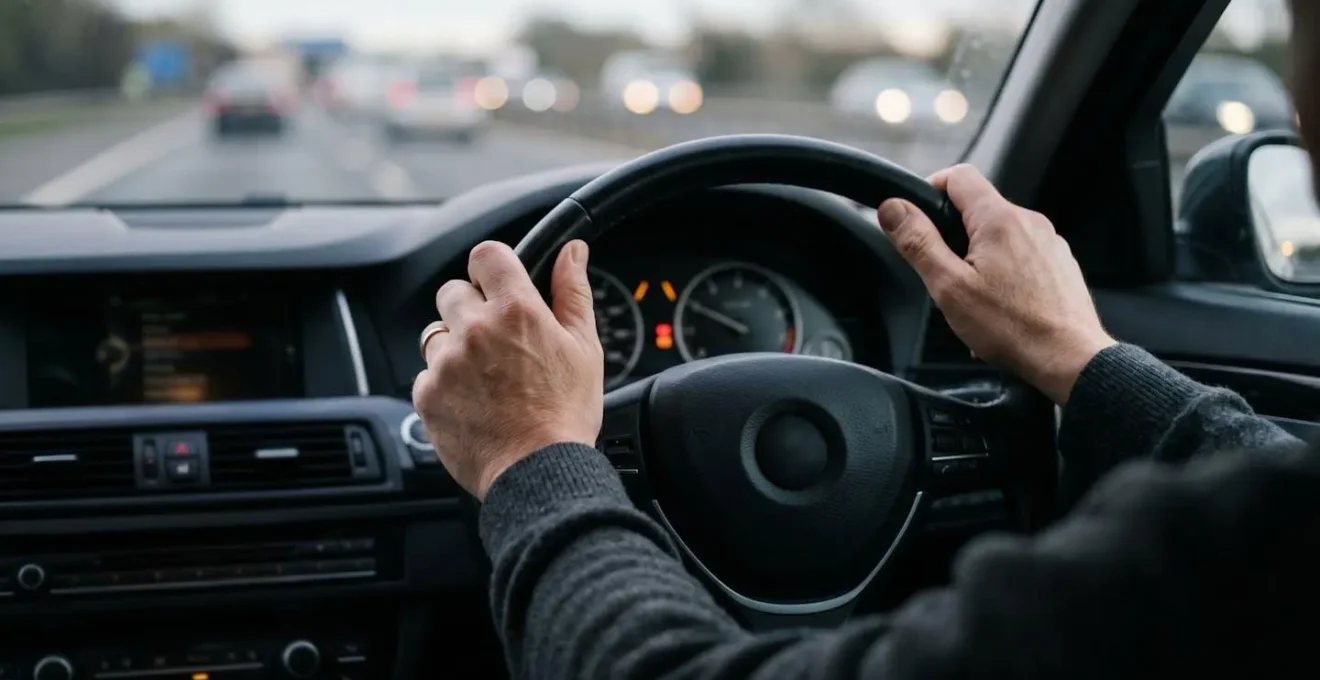
The key difference isn’t strength, it’s roles: Lane Departure Warning is a reactive co-pilot that corrects you, while Lane Centering makes you a proactive supervisor of the car itself.
- Reactive systems (warnings, nudges) only act when you make an error, often creating a ‘ping-pong’ effect inside the lane.
- Proactive systems (centering) steer continuously, fundamentally changing your job from simply driving to actively monitoring the system.
Recommendation: To fight fatigue, learn to trust the proactive system’s “eyes” and “hands,” but always be ready to override it in complex situations like roadworks or when near large vehicles.
You’re an hour into a monotonous motorway journey, the white lines blurring into a hypnotic rhythm. A light on your dashboard illuminates, showing a little car between two lines. But what does it actually do? For many drivers, the proliferation of Advanced Driver-Assistance Systems (ADAS) has created more confusion than comfort. The icons for Lane Departure Warning and Lane Centering look deceptively similar, leading many to believe they are variations of the same thing.
The common understanding is that one simply warns you while the other actively steers. While technically true, this view misses the profound operational difference. It’s like comparing a smoke alarm to a fire suppression sprinkler system; both relate to fire, but their function and level of intervention are worlds apart. The true distinction lies not in what the systems do, but in what they ask you, the driver, to do. The shift from a reactive warning to a proactive steering system isn’t a simple upgrade; it’s a fundamental change in your job description from active operator to system supervisor.
Understanding this transition is the real key to leveraging this technology to combat motorway fatigue effectively. This article will demystify the different stages of steering assist, explain the common “edge cases” where these systems can fail, and ultimately equip you to work in partnership with your car. By the end, you’ll see these features not as confusing gadgets, but as genuine tools for a safer, less stressful journey.
To navigate this complex topic, we will break down the key differences and related technologies. This guide will clarify how each system works, where it excels, and why it sometimes behaves in ways that can seem counter-intuitive to the driver.
Summary: Motorway Fatigue: How Lane Centering Differs From Lane Departure Warning
- The 3 Stages of Steering Assist: Which One Actually Steers for You?
- Why Lane Assist Tries to Steer You into Cones at Roadworks?
- Capacitive vs Torque: Why You Can’t Just Touch the Wheel with a Knee?
- Ford BlueCruise vs BMW Driving Assistant: Which Hands-Free Tech Works in UK?
- Why Does the Car Brake When a Lorry Drifts Slightly in the Next Lane?
- Why Blind Spot Warning is the Most Underrated Safety Feature on the M6?
- Why ‘Traffic Jam Assist’ is a Medical Necessity for High-Mileage Drivers?
- M25 Gridlock: Is Stop-and-Go Cruise Control the Cure for Commuter Stress?
The 3 Stages of Steering Assist: Which One Actually Steers for You?
To understand the difference, it’s best to think of steering assistance as an evolutionary ladder with three distinct rungs. Each rung represents a different philosophy of driver interaction and intervention. Confusing them is easy, as manufacturers often bundle them under vague marketing terms like “Driving Pack Plus.”
The first and most basic rung is Lane Departure Warning (LDW). This is a purely passive-aggressive system. It uses a forward-facing camera to watch the lane markings and will only intervene with a visual, audible, or haptic (vibrating wheel) warning when it detects you are unintentionally drifting out of your lane without signalling. It’s a digital rumble strip that yells at you for making a mistake.
The second rung is Lane Keep Assist (LKA). This is a reactive system. It does everything LDW does, but adds a brief, gentle steering or braking input to nudge you back into the centre of the lane. It’s an important step, but as many drivers experience, its reactive nature can be crude. As MotorBiscuit’s technical analysis points out:
Lane keep assist will often overcorrect, sending a car towards the opposite shoulder. Therefore, if you take your hands off and let lane keep assist drive, you’ll ‘ping pong’ back and fourth across your lane.
– MotorBiscuit Technical Analysis, MotorBiscuit automotive technology guide
The third and most advanced rung is Lane Centering Assist (LCA). This is the only system that truly steers for you. It’s a proactive system that continuously makes micro-adjustments to keep the car perfectly centered in the lane. It doesn’t wait for you to make a mistake. When combined with Adaptive Cruise Control (ACC), it forms the basis of what the industry defines as Level 2 automation. An official classification states that vehicles with both lane-keeping assistance and adaptive cruise control are fulfilling the requirements for this level of semi-autonomous driving. This proactive control is what genuinely reduces the driver’s cognitive load on long journeys.
Why Lane Assist Tries to Steer You into Cones at Roadworks?
One of the most unnerving experiences with lane assist technology is when it makes a decision that seems not just wrong, but dangerously illogical. A classic example is the system trying to follow the old, faded white lines into a coned-off area at roadworks, rather than obeying the new, bright yellow temporary lines. This is a perfect illustration of the system’s limitations and why the driver must always remain the ultimate supervisor.
The root of the problem lies in the system’s “eyes”—a camera, typically mounted at the top of the windscreen. This camera feeds a continuous stream of images to a computer running a complex algorithm designed to identify lane markings. In a perfect world of crisp, clear, and singular lines, this works beautifully. However, a typical British roadworks site is the opposite of a perfect world.
As the image above illustrates, the environment becomes a mess of conflicting data. The algorithm is suddenly faced with multiple sets of lines: worn white ones, bright yellow ones, maybe even the shadow of a crash barrier. It’s programmed with a hierarchy of rules, but under such visual chaos, it can make the wrong choice. It might prioritize the line that has the strongest contrast or the most familiar shape, which could be the old line leading directly towards the cones. This is a classic “edge case”—a real-world scenario that pushes the technology beyond the limits of its programming. It’s not that the system is stupid; it’s that it’s a literal-minded computer trying to interpret a messy, human-created environment.
Capacitive vs Torque: Why You Can’t Just Touch the Wheel with a Knee?
A common question from drivers new to Lane Centering is, “If the car is steering itself, why do I have to keep my hands on the wheel?” The follow-up is often a misguided attempt to “trick” the system by resting a knee or using a weight on the wheel. This approach fundamentally misunderstands the sophistication of modern driver monitoring systems, which are designed not just to check for presence, but for attentiveness.
Early systems used a simple torque sensor. They only required the driver to apply a slight turning force to the wheel every so often to prove they were still there. This was easily fooled. Today’s premium systems, however, have moved to a much smarter technology: capacitive sensing. The entire rim of the steering wheel is transformed into a sensitive touch detector, similar to a smartphone screen. It doesn’t just detect pressure; it detects the natural electrical properties of human skin. The system is constantly mapping where your hands are placed and can tell the difference between a firm grip and a light touch.
This technology is incredibly precise. Recent research has demonstrated capacitive sensor systems with an error rate of less than 0.2% for hand position estimation, proving it as a reliable method for monitoring driver engagement. But can it tell the difference between a hand and a knee? A revealing piece of information comes from official patent documentation for these systems. Describing the sensor’s capability, a patent from the USPTO states:
Capacitive sensors can measure the contact and position of other appendages (e.g., wrist, elbow, shoulder, and knee).
– USPTO Patent Documentation, System and method for responding to driver state – US Patent 10759436
The system isn’t just looking for a touch; it’s looking for a hand-like touch. It knows the difference in the electrical signal between a grasping hand and a propped knee or an inanimate object. This isn’t just a nag; it’s a crucial safety feature ensuring the “system supervisor” is ready to take back control at a moment’s notice.
Ford BlueCruise vs BMW Driving Assistant: Which Hands-Free Tech Works in UK?
The pinnacle of current steering assist technology is “hands-free” driving, a feature that moves beyond simple lane centering. These systems represent a significant step up, allowing the driver to take their hands off the wheel for extended periods under specific conditions. In the UK, this area is highly regulated, with Ford being the first to receive government approval for such a system.
Ford’s BlueCruise technology is a prime example of a geofenced, hands-free system. It relies on a combination of advanced sensors and highly detailed “HD maps” of the road network. According to official figures, BlueCruise can be activated on 2,300 miles of pre-mapped motorways in England, Scotland, and Wales, known as “Blue Zones.” Within these zones, and at speeds up to 80mph, the driver can go completely hands-free. However, their attentiveness is constantly monitored by an infrared camera that tracks their head position and eye gaze to ensure they are watching the road.
Comparing this to BMW’s offering reveals different philosophical and technical approaches to the same goal. The following table breaks down the key differences between Ford’s approved system and BMW’s capable, but differently implemented, technology in the context of UK driving.
| Feature | Ford BlueCruise | BMW Driving Assistant Plus |
|---|---|---|
| Hands-Free Operation | Yes, on Blue Zones | Yes, Highway Assistant mode |
| Geographic Restriction | Pre-mapped divided highways only | Most mapped divided highways |
| Maximum Speed | 80 mph (UK) / No stated limit (US) | 70 mph (updated 2023 from 40 mph) |
| UK Availability | 2,300 miles approved motorways | Available but geographically unrestricted |
| Driver Monitoring | Infrared eye-tracking camera | Capacitive steering wheel + camera |
| Auto Lane Change | Yes, with turn signal confirmation | Limited functionality |
| Cost Structure | £17.99/month after 90-day trial | Included in Driver Assistance Package |
While both offer a form of hands-free driving, Ford’s BlueCruise has specific DfT (Department for Transport) approval for its geofenced motorway sections in Great Britain, making it the first truly “legal” hands-off system. BMW’s system is equally capable but operates under a different framework, highlighting the rapidly evolving regulatory and technological landscape of semi-autonomous driving.
Why Does the Car Brake When a Lorry Drifts Slightly in the Next Lane?
One of the most common complaints about Adaptive Cruise Control (ACC), often paired with Lane Centering, is “phantom braking.” You’re cruising along on the motorway, and suddenly the car applies the brakes for no apparent reason, startling you and your passengers. Often, the culprit is a large vehicle, like a lorry, in the adjacent lane that drifts slightly towards your lane line.
This behaviour isn’t a “phantom” error; it’s a programmed safety precaution. The car’s forward-facing radar and camera systems are constantly calculating the trajectory and position of all objects ahead. A large lorry presents a significant radar signature. When it drifts even a few inches, the system’s predictive algorithm calculates a potential future risk of collision. Rather than wait to see if the lorry corrects itself, the system’s default programming is to err on the side of extreme caution and apply the brakes pre-emptively. It’s programmed for a worst-case scenario, even if a human driver would instantly recognise the situation as non-threatening.
As the “system supervisor,” you have the ability—and responsibility—to override these overly cautious interventions. A sudden jab of the brakes or a sharp turn of the wheel can disengage the system entirely, but a more finessed approach maintains the comfort and flow of the journey. Learning to smoothly override unnecessary braking is a key skill for working in harmony with ADAS.
Your Action Plan: Overriding Unnecessary ACC Braking
- Recognize the scenario: An adjacent vehicle begins a minor drift, but its driver shows signs of corrective action.
- Assess actual collision risk: Confirm that the vehicle remains within its lane boundaries and there is still sufficient clearance.
- Apply gentle accelerator pressure: A light, steady press on the throttle signals your awareness to the system and overrides the automatic braking without disengaging ACC entirely.
- Maintain smooth control: Avoid abrupt steering or braking inputs that could startle passengers or trigger further system warnings.
- Allow system re-engagement: Once the perceived threat has passed, simply release the accelerator. The ACC will resume its normal operation within a second or two.
This measured response keeps you in ultimate control, reduces passenger anxiety, and turns a potentially jarring event into a seamless non-issue, demonstrating a true partnership between driver and machine.
Why Blind Spot Warning is the Most Underrated Safety Feature on the M6?
While lane-centering technologies get most of the attention, there is another, more subtle ADAS feature that arguably does more to reduce the cognitive load and stress of motorway driving: Blind Spot Warning (BSW). On a perpetually busy and often rain-soaked stretch of road like the M6, with its constant merging and multi-lane manoeuvres, BSW transitions from a convenience to a near-essential safety tool.
Its brilliance lies in its simplicity and its superior sensing technology. Unlike a driver’s eyes or mirrors, which can be obscured by darkness, heavy rain, or fog, BSW relies on radar. The system uses sensors, typically hidden within the rear bumper, that are impervious to weather. This is their single greatest advantage. As one analysis by automotive experts at JD Power explains, the system uses “short-wave radar sensors in the rear bumper corners that can ‘see’ through rain and fog” where cameras and mirrors often fail.
This “superpower” has a direct impact on driver fatigue. Constantly performing head-checks and double-checking mirrors in heavy traffic is a mentally draining task. BSW automates this vigilance. The small, illuminated icon in your wing mirror—a simple, non-intrusive signal—replaces the need for a physical turn of the head. It doesn’t replace the need to be aware, but it provides a constant, reliable layer of confirmation. You are no longer solely responsible for peering into the gloom; you have a partner that never blinks and can see through the rain. This reduction in a repetitive, high-stakes monitoring task is a significant factor in arriving at your destination feeling less mentally exhausted.
Why ‘Traffic Jam Assist’ is a Medical Necessity for High-Mileage Drivers?
The term “medical necessity” might seem like an exaggeration for a car feature, but for high-mileage professional drivers, couriers, or sales reps, the cumulative physical and mental toll of daily traffic jams is a genuine occupational hazard. The constant cycle of braking, creeping forward, and braking again—for hours on end—leads to significant cognitive load, stress, and physical fatigue. This is where Traffic Jam Assist, a low-speed application of ACC and Lane Centering, becomes more than just a convenience.
Traffic Jam Assist automates the most mentally taxing part of driving in congestion. It takes over the throttle, the brake, and the minute steering adjustments required to keep your place in a slow-moving queue. This frees up an enormous amount of the driver’s mental bandwidth. Instead of making hundreds of tiny, repetitive decisions and movements, the driver’s role shifts back to one of high-level supervision—watching for motorcyclists filtering through traffic or anticipating sudden lane changes from other frustrated drivers.
The reduction in fatigue is not just anecdotal. Automotive testing has consistently shown the benefits of these systems in reducing the strain of long or congested drives. As confirmed by automotive testing analysis, hands-free driving technology combined with automated braking and acceleration can help make driving in congested traffic significantly easier and less fatiguing. By managing the monotonous and stressful elements of a traffic jam, the system allows the driver to conserve their mental energy for when it’s truly needed. For someone who spends hours a day in these conditions, this reduction in daily stress and fatigue can have a tangible, long-term impact on their overall well-being, making the feature feel less like a luxury and more like essential equipment.
Key Takeaways
- Proactive vs. Reactive: Lane Departure is a reactive ‘nudge’ when you err; Lane Centering is a proactive ‘steer’ that works continuously.
- You are the Supervisor: With Lane Centering, your job isn’t to steer, but to monitor the system and the environment, ready to take over.
- Technology has Limits: Systems rely on clear lane markings and can be confused by ‘edge cases’ like roadworks, requiring driver vigilance.
M25 Gridlock: Is Stop-and-Go Cruise Control the Cure for Commuter Stress?
There is perhaps no greater test of a driver’s patience in the UK than being caught in gridlock on the M25. The endless stop-and-go, the inches of movement, the constant vigilance—it’s the perfect recipe for commuter stress. It’s in this exact environment that the theoretical benefits of stop-and-go cruise control and traffic jam assist are put to their most severe, real-world test. Can this technology truly be the cure?
The answer is a qualified yes. Modern systems are now specifically engineered and validated for these gruelling conditions. They are no longer just for open-road cruising. The combination of radar, cameras, and sophisticated software allows the car to lock onto the vehicle ahead, maintaining a safe distance, bringing the car to a complete stop, and then automatically resuming movement when the traffic inches forward. This automates the entire frustrating dance of low-speed congestion.
Case Study: Ford BlueCruise UK Validation
To gain regulatory approval, Ford’s BlueCruise system underwent 100,000 miles of validation testing on UK and European roads specifically to prove its capability in handling real-world circumstances drivers encounter daily. A key part of this testing was its performance in congestion. The system demonstrated reliable performance controlling steering, acceleration, braking and lane positioning while maintaining safe distances to vehicles ahead—including bringing the vehicle to a complete halt in traffic jams and resuming movement automatically when traffic flows again.
This real-world validation is crucial. It proves the system is not a fragile prototype but a robust tool designed for the rigours of the daily commute. The “cure” for commuter stress isn’t about blindly handing over control. It’s about forming an educated partnership with the machine. By letting the system handle the monotonous, repetitive, and stressful tasks of stop-and-go traffic, the driver is freed to maintain a higher level of situational awareness, reducing their cognitive load and, ultimately, their stress level. You arrive at your destination not just physically, but mentally less drained.
Now that you understand the crucial differences in how these systems operate, the next step is to open your own car’s manual. Read the descriptions of its features with this new perspective, and then safely experiment with them on an open motorway to understand how your specific vehicle behaves.