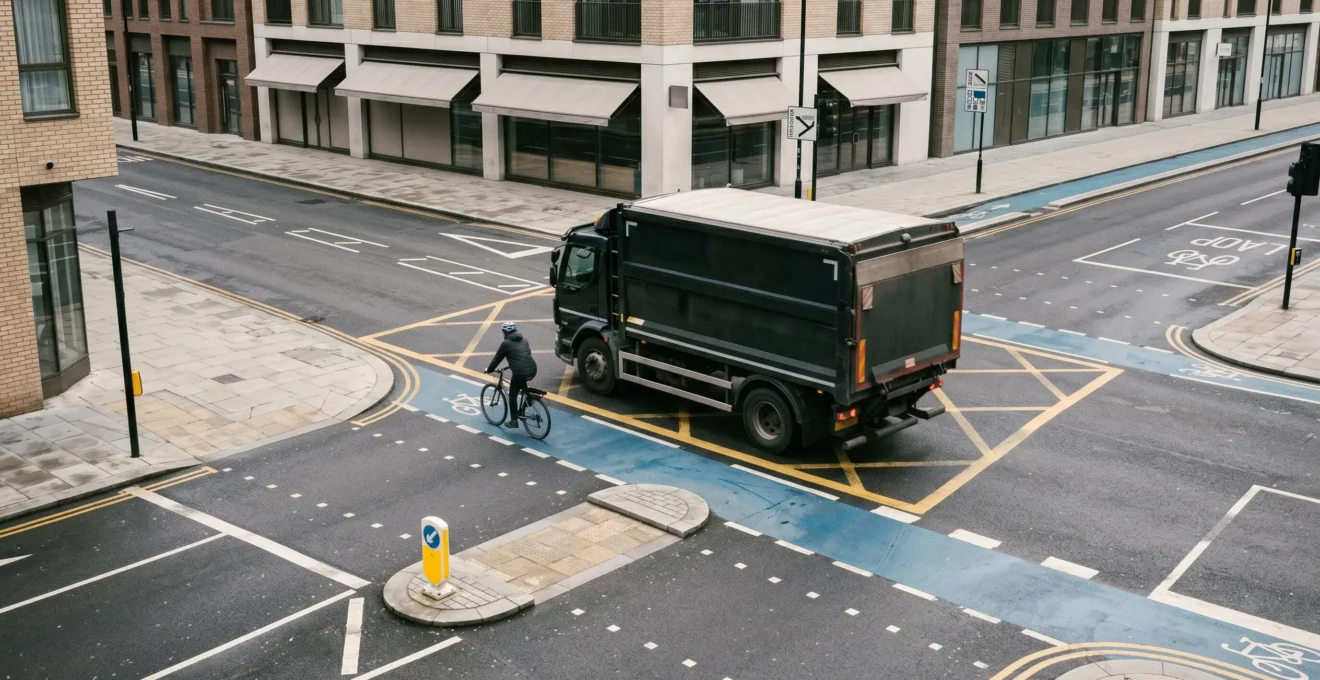
The constant fear of a cyclist in your blind spot isn’t just paranoia; it’s a critical perception gap that technology can now bridge, transforming driver anxiety into shared road safety.
- Advanced systems go beyond simple beeps, using sophisticated radar to track a cyclist’s speed and trajectory, offering a proactive safety net.
- Understanding why and how a sensor can fail (e.g., in heavy rain) is as crucial as knowing it’s there; modern systems build in redundancy to combat this.
Recommendation: For true peace of mind in London, look beyond the basic warning light and invest in a system with multi-sensor fusion and clear, decisive alerts.
There’s a specific kind of dread every city driver knows. It’s the slow-motion moment as you signal to turn left, check your mirrors for the tenth time, and begin to move, only to be paralysed by a single, terrifying thought: “Is there a cyclist there?” As a driver who is also a passionate advocate for cycling safety, I understand this tension intimately. It’s the conflict between the necessity of navigating our busy streets and the profound responsibility we feel for the vulnerable road users (VRUs) sharing the tarmac with us. The standard advice—”check your mirrors,” “be aware”—feels woefully inadequate against the fast, silent approach of a cyclist filtering through traffic.
For too long, the conversation has been stuck in a cycle of blame. But what if the solution isn’t about sharper eyes or slower speeds alone? What if the key lies in closing the fundamental perception gap between what a driver can physically see and the reality of the road around them? This is where active blind spot assistance transcends being a mere convenience. It becomes a tool of technological empathy, giving the driver a sixth sense that is constantly, tirelessly scanning those critical unseen areas. This isn’t just about adding another warning light to the dashboard; it’s about fundamentally changing the dynamic on our streets from one of conflict and fear to one of mutual, technology-enabled awareness.
This article will guide you through the reality of these systems. We will demystify the technology, explain the crucial differences between a cheap aftermarket add-on and a truly effective integrated system, and show you why understanding this technology is no longer optional for anyone driving in a city like London. It’s time to move beyond the anxiety and towards confident, safer driving for everyone.
Contents: A Driver’s Guide to Blind Spot Technology and Cyclist Safety
- Why Blind Spot Warning is the Most Underrated Safety Feature on the M6?
- Do You Need a Blind Spot Camera to Enter London in a Van?
- Can You Add Blind Spot Detection to an Older Car for Under £200?
- Beep, Light or Shake: Which Warning Type Gets Your Attention Fastest?
- Why Blind Spot Sensors Fail During Heavy Spray on the Motorway?
- Why Owning a Car in Zone 1 London Is Costing You £3,000 More Than It Should?
- Can Your Car Detect a Pedestrian’s Smartphone to Prevent a Collision?
- Smart Motorways: How V2X Could Finally Make Them Safe?
Why Blind Spot Warning is the Most Underrated Safety Feature on the M6?
On the vast, multi-lane expanse of a motorway like the M6, blind spot warning systems are often seen as a simple convenience, a helpful nudge for the lane-change manoeuvre. However, this perception drastically undersells the sophistication of the technology and its direct relevance to the chaotic ballet of urban traffic. The core value of a good system isn’t just detecting an object; it’s about the quality and precision of that detection. This is where the difference between sensor technologies becomes starkly apparent, a difference that has life-or-death implications in the city.
Many basic systems use 24GHz radar, which is effective for general vehicle detection on a clear day. However, advanced systems utilise 77GHz radar, a technology that offers a profound leap in capability. The primary advantage is resolution. According to data from industry leaders, the difference is staggering: a modern system can achieve a 4cm resolution for 77GHz compared to 75cm for 24GHz systems. This isn’t just a technical specification; it’s the difference between the system vaguely knowing ‘something’ is there and precisely identifying a slim bicycle frame distinct from a nearby guardrail or another car in the adjacent lane. This precision allows the system to not just detect presence but also accurately track the velocity and trajectory of a cyclist, anticipating a potential collision path long before a driver’s eyes could.
This high-fidelity data is the foundation of what we might call ‘technological empathy’. It provides the car’s safety brain with a clear, unambiguous picture of the vulnerable road user in the blind spot. This motorway-honed precision is precisely what’s needed to cut through the noise of a London street, offering a reliable digital co-pilot whose vigilance never wavers.
Do You Need a Blind Spot Camera to Enter London in a Van?
For anyone operating a commercial vehicle over 12 tonnes in Greater London, this question has a very clear and legally binding answer: yes, and the requirements are becoming stricter. Transport for London’s (TfL) Direct Vision Standard (DVS) is a landmark piece of legislation aimed directly at mitigating the risk posed by heavy goods vehicles (HGVs) to cyclists and pedestrians. The DVS rates vehicles from zero to five stars based on how much the driver can see directly from their cab. For vehicles that don’t meet a minimum star rating, a “Safe System” of devices must be fitted.
This is not a static requirement. The DVS is evolving. Initially, a one-star rating was the benchmark for many. However, the standards are tightening significantly. As part of the Progressive Safe System, a new mandate is coming into force which requires a 3-star minimum rating effective October 28, 2024. Vehicles falling short will need to install even more advanced blind spot detection systems that can actively detect, and not just passively observe, vulnerable road users. This moves beyond a simple camera and monitor setup to systems that must provide active warnings and demonstrate they can eliminate the blind spot.
The image below shows the typical placement for sensors required under these increasingly stringent regulations, covering not just the side blind spot but also the frontal area where moving-off incidents occur.
Choosing the right technology is critical for compliance and, more importantly, for actual safety. The options vary widely in performance, especially in the challenging British weather that every driver is familiar with. A simple ultrasonic sensor might be cheap, but its performance degrades in heavy rain. A camera is great for identification, but useless in fog or darkness. This is why the industry is moving towards more robust solutions.
This table gives a clear overview of how different DVS-compliant systems stack up against each other, highlighting the superior all-weather performance of radar-based technology.
| System Type | Detection Method | Weather Performance | Cyclist Detection Accuracy | Active Warning Capability |
|---|---|---|---|---|
| Ultrasonic Sensors | Sound wave proximity | Moderate (affected by heavy rain) | Basic presence detection only | Passive visual + audible alert |
| Camera-Based (DVS compliant) | Visual AI object recognition | Poor (degraded in fog/darkness) | High when visible, context-aware | Requires driver screen monitoring |
| 77GHz Radar | Millimeter-wave radio frequency | Excellent (unaffected by weather) | Precise distance and velocity tracking | Active haptic/audible intervention |
| Sensor Fusion (Camera + Radar) | Combined multi-input processing | Excellent with intelligent fallback | Highest accuracy and reliability | Context-adaptive multi-modal alerts |
Can You Add Blind Spot Detection to an Older Car for Under £200?
The promise of adding modern safety features to a beloved older car for a small sum is incredibly tempting. A quick search reveals a plethora of aftermarket blind spot detection kits, many priced well under £200. On the surface, they seem to offer a simple solution to the blind spot problem. However, the reality is far more complex. While it’s technically possible to bolt on sensors and a warning light, achieving the reliability and precision of a factory-fitted system is another matter entirely. The difference lies not in the components themselves, but in their integration and calibration—a process fraught with challenges.
An Original Equipment Manufacturer (OEM) system is deeply integrated into the car’s electronic nervous system. It knows your speed, your steering angle, and whether your turn signal is on. It uses this context to make intelligent decisions, preventing false alarms when you’re parking or when a car in the next lane is simply cruising alongside you. A budget aftermarket kit operates in isolation. It has one job: to detect an object in its field of view and issue a warning. This lack of context often leads to a system that cries wolf, triggering alerts for guardrails, parked cars, or heavy rain, quickly leading to ‘alarm fatigue’ where the driver begins to ignore the warnings altogether, rendering the system worse than useless.
Achieving a reliable installation is not a simple DIY task. It requires a deep understanding of vehicle electronics and a meticulous approach to sensor placement. Before attempting to fit a budget system, it’s vital to consider the potential pitfalls.
Action Plan: Auditing an Aftermarket System Installation
- Sensor Calibration: Unlike factory mounts, aftermarket sensors need precise angular alignment. How will you guarantee they aren’t aimed too low (missing cyclists) or too high (triggering on bridges)?
- Electrical Integration: Tapping into your car’s wiring (e.g., for power from the reverse lights) can trigger fault codes on modern vehicles. Do you have the correct wiring diagrams and tools to avoid this?
- Power & Cable Routing: How will you safely route cables from the exterior sensors to the cabin? Drilling new holes can risk water leaks and corrosion, while using existing passages requires avoiding hot engine parts and moving components.
- Alert Logic: A budget system warns you regardless of context. It can’t escalate a warning when you use your turn signal, which is the most critical moment. Is a constant, non-contextual alert truly helpful or just annoying?
- Maintenance & Cleaning: Bumper-mounted sensors get covered in road grime and spray, which can blind them. OEM systems often have self-cleaning or heated elements. How will you ensure your aftermarket sensors remain clean and functional?
Beep, Light or Shake: Which Warning Type Gets Your Attention Fastest?
Once a system detects a potential hazard, it faces a critical challenge: how to communicate that threat to the driver in a way that is immediate, unambiguous, and appropriate for the level of urgency? The choice of warning—a flashing light in the mirror, an audible beep, or a vibration in the steering wheel—is not arbitrary. It’s a deeply researched area of human factors engineering. As research into multimodal warning systems highlights, it’s vital to communicate the right level of urgency to command a driver’s attention effectively when it’s needed most.
The most common alert is a visual one: a small icon that illuminates in the wing mirror or A-pillar. This is a passive, ‘Level 1’ warning. It informs the driver of a vehicle’s presence, but doesn’t demand immediate action. It’s effective for general awareness on a motorway. However, in a complex urban environment where a driver’s visual attention is already saturated by traffic, pedestrians, and road signs, a small, silent light can be easily missed. This is where other modalities become crucial.
The next level is an active, ‘Level 2’ warning. This is typically triggered when the driver signals to turn while the system detects an object in the blind spot. The visual light will flash more urgently, and it’s often paired with an audible ‘beep’ or ‘chime’. This dual-modality approach is much more effective at cutting through the noise. According to guidance from safety bodies like the NHTSA, such signals are effective because they “can quickly re-orient the driver’s attention.” But the most advanced systems go one step further, incorporating a third sense: touch.
Haptic feedback, often a vibration in the steering wheel or the seat, is arguably the most compelling alert. It’s a non-directional, instinctive signal that bypasses conscious visual and auditory processing, tapping directly into our primal sense of touch to signal danger. The effectiveness of combining these alerts is not just theoretical; it’s backed by scientific data.
Case Study: The Power of Multisensory Warnings
A landmark driving simulator study by Ho, Reed, and Spence, published in the journal Human Factors, provides clear evidence. The researchers tested driver responses to different warning types for collision avoidance. The results were conclusive: multimodal alerts combining tactile feedback (vibration) with auditory cues (beeps) produced significantly faster driver response times. This combination was particularly effective in high-stress urban driving scenarios, precisely the environment where a London driver needs the most support.
Why Blind Spot Sensors Fail During Heavy Spray on the Motorway?
It’s a scenario that erodes confidence in technology. You’re driving on a wet motorway, surrounded by the heavy spray kicked up by trucks, and a warning message flashes on your dashboard: “Blind Spot Assist Unavailable”. At the very moment you feel most vulnerable and could use the extra help, the system gives up. This is a common experience, and it exposes the inherent physical limitations of certain sensor types. Understanding why this happens is key to appreciating the engineering that goes into more resilient, modern systems.
The most common culprits for weather-related failure are radar and ultrasonic sensors mounted in the rear bumper. While radar is generally excellent at penetrating rain, the sheer volume of water in heavy spray can create a dense curtain that absorbs or scatters the radar waves, effectively blinding the sensor. Similarly, ultrasonic sensors, which use sound waves, can be confused by the noise and physical interference of water droplets and road grime coating the sensor’s surface. A camera-based system, for obvious reasons, is rendered almost completely useless by the combination of low light, spray, and dirt obscuring the lens.
This “system fragility” is a significant problem. A safety system that is only reliable in perfect conditions is not a true safety system. This is why leading automotive engineers have moved away from relying on a single sensor type and embraced a strategy known as sensor fusion. This approach uses multiple, different types of sensors (e.g., radar, camera, and sometimes LiDAR) and a powerful central computer that “fuses” their data streams together. The system can cross-reference the inputs, using the strengths of one sensor to cover the weaknesses of another.
Case Study: Graceful Degradation through Sensor Fusion
The principle behind advanced sensor fusion is not just about adding more inputs; it’s about intelligent redundancy and “graceful degradation”. As described in the architectures of modern DVS-compliant systems, when one sensor is compromised, the system doesn’t just fail. For example, if heavy spray temporarily blinds a radar sensor, an AI-powered camera system, which excels at identifying the shape of a cyclist, can take precedence. The system might lose its ability to precisely measure distance but can still identify the presence and general location of a vulnerable road user. This strategy ensures the system maintains a level of functional safety, providing continuous protection even when conditions are far from ideal, a critical feature for the realities of UK motorway driving.
Why Owning a Car in Zone 1 London Is Costing You £3,000 More Than It Should?
The financial burdens of car ownership in central London are well-documented: congestion charges, ULEZ fees, exorbitant parking costs. But there’s a hidden cost that doesn’t appear on any bank statement, one that is measured in constant, low-level anxiety and the ever-present risk of a life-altering incident. The title’s figure of £3,000 pales in comparison to the psychological and human cost of a potential collision with a cyclist, a risk that is tragically concentrated at urban junctions.
The data is sobering. Written evidence submitted to the UK Parliament’s Transport Committee paints a stark picture of the dangers at intersections. It highlights that the “majority of KSI (Killed or Seriously Injured) collisions involving cyclists and HGVs appear to occur due to cyclists positioning themselves and then being caught in the blind spot of a left-turning vehicle.” While this specifically mentions HGVs, the dynamic is precisely the same for cars, vans, and buses. It is the classic, dreaded left-turn scenario.
The scale of the problem is significant. While cycling has become safer overall, collisions at junctions remain a persistent and deadly issue. Further evidence presented to Parliament confirms this, noting that while HGVs are involved in a minority of total cycling incidents, they are disproportionately represented in fatalities, with 18% of fatal cycle accidents involving an HGV, and almost half of those occurring at urban junctions. This is the specific risk that every driver making a left turn in London navigates daily. The true “cost” of driving in Zone 1 isn’t just financial; it’s the cognitive load of perpetually managing this risk. An effective blind spot assist system isn’t a luxury in this context; it’s an investment in mitigating this profound, unquantifiable cost.
Key takeaways
- True safety comes from technology that provides ‘technological empathy’—not just detecting an object, but understanding its context and trajectory.
- London’s Direct Vision Standard (DVS) is driving real change, mandating advanced, active sensor systems for commercial vehicles, setting a benchmark for all road users.
- Multimodal warnings (light, sound, and haptic vibration) are scientifically proven to be faster and more effective at capturing a driver’s attention in high-stress urban environments.
Can Your Car Detect a Pedestrian’s Smartphone to Prevent a Collision?
It sounds like a perfect futuristic solution: in an increasingly connected world, why can’t our cars simply talk to the smartphones of pedestrians and cyclists to avoid collisions? This concept, known as Vehicle-to-Everything (V2X) and specifically Vehicle-to-Pedestrian (V2P), holds immense promise for creating a truly integrated safety ecosystem. The idea is that a pedestrian’s phone could broadcast their location, and a vehicle’s system could receive this signal, making the person “visible” to the car long before sensors could see them.
However, the reality is that we are not there yet. While the technology is actively being developed and trialled, there are significant hurdles to overcome before this becomes a widespread, reliable feature. The primary challenge is standardisation. For V2P to work, every car manufacturer, every smartphone maker (like Apple and Google), and every network operator would need to agree on and implement a single, secure, and interoperable communication protocol. This is a monumental task that is still years away from completion.
Therefore, any claim that a current production vehicle can “detect a smartphone” to prevent a collision is misleading. Today’s advanced safety systems rely exclusively on active, line-of-sight sensors: radar, cameras, and LiDAR. They detect the physical presence of a cyclist or pedestrian, not a digital signal from their device. These systems are incredibly sophisticated, but they can only react to what they can “see”.
Case Study: The Current State of V2X Technology
Implementations by traffic technology leaders like Yunex Traffic demonstrate the current cutting edge. Their systems use AI-powered cameras and radar to detect and track vulnerable road users at intersections, providing warnings to drivers. While these systems are becoming “smarter” and can be connected to the cloud, they do not rely on V2P communication for primary detection. The U.S. Department of Transportation’s work on this topic confirms that while development of V2X is a priority, today’s effective systems are sensor-based. The potential for V2P is enormous, but for now, it remains a future goal rather than a present-day reality.
Smart Motorways: How V2X Could Finally Make Them Safe?
The debate around Smart Motorways often focuses on the dangers of stationary vehicles. However, the underlying technology being developed to solve these issues, particularly Vehicle-to-Everything (V2X) communication, has profound implications for the safety of all road users, including cyclists in urban environments. V2X is the umbrella term for technology that allows vehicles to communicate with each other (V2V), with infrastructure like traffic lights (V2I), and with pedestrians (V2P). It creates a digital net of shared awareness that can prevent accidents before they happen.
Imagine a scenario: a cyclist is approaching a blind junction. At the same time, a car is approaching the same junction from a different road. Today, safety relies on both parties seeing each other. In a V2X world, the cyclist’s connected bike or smartphone broadcasts their position and speed. The car receives this data and alerts the driver of the “unseen” cyclist, or could even apply the brakes preemptively. This is the ultimate expression of the proactive safety we’ve discussed. It moves beyond reacting to sensor data and into the realm of predicting and preventing conflict based on shared digital information.
This technology is the key to unlocking the next level of road safety. While the adoption of Advanced Driver-Assistance Systems (ADAS) has already had a positive impact, the problem is far from solved. Statistics show that the rate of UK cycling accidents per mile travelled fell by 30% between 2014 and 2023, partly due to the rise of features like blind spot cameras. Yet, as the UK Department for Transport reminds us, “Cars continue to be the cause of nearly half (46%) of pedal cycle fatalities.” This stark fact shows that sensor-based systems on individual cars are only part of the solution. The future lies in creating a connected ecosystem where every road user is a node in a collaborative safety network.
By moving from a mindset of individual responsibility to one of shared, technology-enabled awareness, we can transform our roads. Investing in and understanding the right blind spot technology is the first, most powerful step you can take as a driver to turn anxiety into confidence and contribute to a safer, more harmonious urban environment for all.