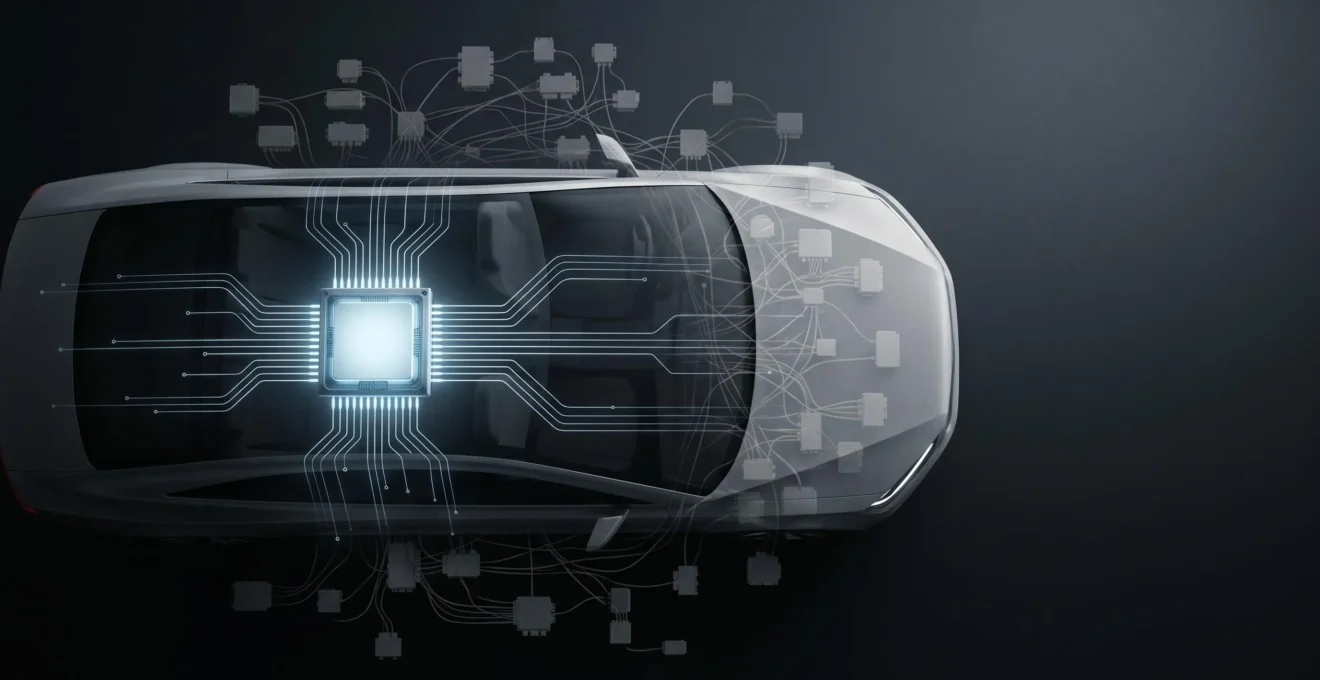
The shift to the Software-Defined Vehicle (SDV) is not a cosmetic change; it is a complete architectural overhaul that redefines the car as a centralized computing platform.
- Consolidating dozens of individual controllers into one powerful central computer (SoC) simplifies manufacturing and enables powerful, over-the-air software updates.
- This new architecture is what enables controversial business models like feature subscriptions and creates new challenges around cybersecurity and long-term hardware obsolescence.
Recommendation: When buying a new car, evaluate its software ecosystem, update policy, and data privacy controls as rigorously as you would its engine performance and fuel economy.
If you’ve stepped into a new car recently, you’ve likely noticed two things: the number of physical buttons is dwindling, and the screens are growing. It’s easy to dismiss this as a fleeting design trend, a mere imitation of the smartphone aesthetic pioneered by brands like Tesla. However, this surface-level change is the symptom of a much deeper, more fundamental transformation happening under the hood. The automotive industry is undergoing its most significant architectural revolution in decades, moving from a distributed, hardware-centric model to the era of the Software-Defined Vehicle (SDV).
From a systems architect’s perspective, a modern car is no longer just a mechanical object with some electronics bolted on. It’s a high-performance computing platform on wheels. The traditional approach involved using up to 100 individual Electronic Control Units (ECUs)—small, dedicated microprocessors—each responsible for a single function, like managing the engine, controlling the windows, or operating the anti-lock brakes. This decentralized model is being aggressively replaced by a centralized architecture, where a single, powerful computer coordinates nearly every function of the vehicle.
But this isn’t just an engineering exercise. The shift to a centralized software platform has profound implications for you, the owner. It changes not only how you interact with your car but also the very nature of ownership, the vehicle’s long-term value, and its security. This article will deconstruct the core principles of the SDV, moving beyond the simple “iPhone on wheels” analogy to explore the architectural choices and their real-world consequences—from monthly subscriptions for heated seats to the battle for control over your dashboard.
To navigate this new automotive landscape, it’s essential to understand the underlying logic that drives these changes. The following sections break down the key pillars of the software-defined vehicle, providing a clear view of the technology, the business models it enables, and the critical questions you should be asking before your next purchase.
Summary: Deconstructing the Software-Defined Vehicle
- Why One Central Computer is Better Than 100 Small Chips in Your Car?
- Heated Seats Subscription: Why BMW Wants You to Pay Monthly for Hardware You Own?
- Can Hackers Steal Your Car by Cracking the Central OS?
- Will Your Software-Defined Car Become Obsolete in 5 Years Like an Old iPad?
- How to Control Your House Heating from Your Dashboard Before You Arrive?
- Level 3 Autonomy: When Can You Legally Take Your Eyes Off the Road?
- Why Physical Buttons are Safer Than Touchscreens for Climate Control?
- Apple CarPlay vs Manufacturer OS: Who Really Owns the Dashboard?
Why One Central Computer is Better Than 100 Small Chips in Your Car?
For decades, automotive architecture resembled a sprawling, disorganized city. Every function—from engine timing to power windows—had its own dedicated ECU, a small computer running its own simple software. This resulted in a complex web of over 100 ECUs, all communicating through an aging, low-speed network called the CAN bus. This distributed model was reliable for simple tasks but created immense complexity in manufacturing, software updates, and adding new features. It was the equivalent of having a separate computer for every single application on your desktop.
The move to a centralized architecture replaces this complexity with a powerful, unified System-on-a-Chip (SoC), akin to the processors found in modern computers and smartphones. As General Motors is implementing for its 2028 Cadillac Escalade IQ, this central unit coordinates all vehicle subsystems in real time. This approach consolidates the functions of dozens of ECUs into a single, high-performance computing core. The benefits from a systems perspective are immense: it dramatically reduces the number of physical modules, simplifies the wiring harness, lowers manufacturing costs, and increases overall system reliability by reducing points of failure.
More importantly, this centralized model creates a clean separation between hardware and software through a Hardware Abstraction Layer (HAL). This allows automakers to develop a single, sophisticated operating system that can run across their entire vehicle portfolio, regardless of the specific hardware in each model. It enables rapid development and deployment of new features via Over-the-Air (OTA) updates, a task that was previously impossible or required a trip to the dealership. The market is responding to this efficiency; analysis projects the global Vehicle Central Computing Platform market to reach USD 36.4 billion by 2033, a testament to this architectural inevitability.
Heated Seats Subscription: Why BMW Wants You to Pay Monthly for Hardware You Own?
The controversial push by automakers like BMW to charge a monthly subscription for features like heated seats is not just a grab for more revenue; it is a direct business model consequence of the centralized SDV architecture. In the old model, if you wanted heated seats, the hardware and its dedicated ECU were installed at the factory. In the new model, the hardware is often installed as standard in all vehicles to simplify manufacturing, but its activation is controlled by the central operating system.
This is made possible through a software development technique called “feature flagging.” The code to operate the heated seats is present in the car’s OS, but it is disabled by a software switch, or “flag.” A subscription fee sends a signal to the car’s central computer to flip that switch and enable the function. This allows automakers to sell features on demand, create new revenue streams throughout the vehicle’s life, and offer more flexibility to second or third owners. However, the strategy can backfire spectacularly when applied to hardware that consumers perceive as a one-time purchase.
BMW’s experiment to charge $18 per month for heated seats was met with significant customer backlash and was ultimately abandoned in 2023. Customers rightly felt they were being asked to pay again for physical hardware already present in their car. Acknowledging the misstep, BMW’s Head of Product Communications, Alexandra Landers, admitted, “The criticism we got was from the seat heating, so this was probably not the best way to start with it.” While hardware-based subscriptions have been paused, the underlying model for software-based services (like advanced driver-assist features or cloud-connected navigation) remains a core part of the SDV strategy, as these require ongoing data processing and maintenance costs for the manufacturer.
Can Hackers Steal Your Car by Cracking the Central OS?
Consolidating dozens of isolated systems into a single, internet-connected central operating system fundamentally changes the security equation. While it simplifies the internal architecture, it also creates a massive, unified digital target. In cybersecurity terms, the vehicle’s “attack surface” has expanded dramatically. Instead of needing to physically access a specific ECU, a remote attacker can now theoretically target the central brain of the car through its various connectivity points, such as the infotainment system, Wi-Fi, or cellular connection.
The risks are no longer theoretical. The industry is seeing a sharp rise in malicious activity, with cybersecurity incidents surging by 39% in 2024 compared to the previous year. The threat is overwhelmingly remote; a 2024 Upstream Security report revealed that 95% of attacks are executed remotely, and 85% of those are long-range, meaning the attacker can be anywhere in the world. A successful breach of the central OS could potentially grant an attacker control over critical functions—from unlocking the doors and starting the engine to, in a worst-case scenario, interfering with steering or braking systems.
To counter this, manufacturers are adopting multi-layered security strategies borrowed from the IT industry. This includes network segmentation to isolate critical driving systems from less secure infotainment functions, robust encryption for all communications, and dedicated intrusion detection systems that monitor the vehicle’s internal network for anomalous activity. Furthermore, the ability to deploy OTA security patches is a crucial advantage of the SDV architecture, allowing automakers to respond to newly discovered vulnerabilities far more quickly than in the past. However, the responsibility also falls on the owner to be vigilant.
Your 5-Point SDV Security Audit
- Software Update Policy: Check the manufacturer’s policy on the duration of security update support. Does it cover the entire expected lifespan of the vehicle?
- Connected Services: Inventory all active connected services. Disable any you don’t use, such as remote diagnostics or third-party app integrations, to reduce potential entry points.
- Password Hygiene: Use strong, unique passwords for the vehicle’s companion app and any associated online accounts. Enable two-factor authentication wherever possible.
- Third-Party Apps: Be cautious when installing third-party applications on the infotainment system. Only use apps from trusted developers available through the official manufacturer app store.
- Physical Ports: Treat the vehicle’s USB and OBD-II ports with suspicion. Avoid plugging in untrusted devices that could introduce malware into the system.
Will Your Software-Defined Car Become Obsolete in 5 Years Like an Old iPad?
One of the most pressing questions for a tech-savvy buyer is longevity. We’ve all experienced it: a perfectly functional smartphone or tablet becomes frustratingly slow or loses access to new apps after just a few years because its hardware can no longer support the latest operating system. As cars become rolling computing platforms, the risk of this same software-driven obsolescence becomes very real. A vehicle’s mechanical components might be designed to last for 15 years, but will its central computer be able to keep up?
The core of the problem lies in the widening gap between the slow-moving automotive development cycle and the rapid pace of consumer electronics. The central SoC that is state-of-the-art today will be significantly outperformed by processors available in three to five years. While OTA updates can add features and fix bugs, they cannot magically upgrade the underlying hardware. Eventually, the processing power, memory, or storage will become a bottleneck, preventing the car from running new, more demanding applications or advanced autonomous features.
Consumer advocacy organizations like Euroconsumers are already documenting cases where manufacturers discontinue connectivity services or app support for older models, effectively reducing their functionality. For example, some Audi owners have lost connectivity features, while other brands limit smartphone app integration over time. This transforms the traditional one-time car sale into a continuous relationship where essential functions may depend on ongoing software support. As S&P Global Mobility analysts note, while OTA updates are beneficial, “some hardware still needs to be upgraded, especially in the infotainment and compute domains.” The industry is exploring modular hardware designs to address this, but for now, the risk of your five-year-old car feeling like a ten-year-old phone is a significant consideration.
How to Control Your House Heating from Your Dashboard Before You Arrive?
While the SDV architecture introduces new challenges, it also unlocks a new level of seamless integration between your car and your digital life. The centralized, internet-connected OS acts as a powerful hub, capable of communicating with other smart devices and cloud services. One of the most compelling use cases is the integration with the smart home ecosystem. This goes far beyond basic voice commands to make a phone call; it’s about the car becoming an active participant in your home’s automation.
The technical backbone for this is a series of Application Programming Interfaces (APIs). The vehicle’s OS can securely connect to the cloud platforms of smart home providers like Google Home, Amazon Alexa, or Apple HomeKit. When your car’s navigation system determines you are 15 minutes away from home, it can trigger a pre-defined “arrival” scene. This signal is sent from the car to the manufacturer’s cloud, which then communicates with your smart home’s cloud service.
This automated, location-based trigger can instruct your thermostat to switch from “away” mode to your preferred temperature, turn on the entryway and living room lights, open the garage door, and even start playing your favorite music playlist on your home speakers. The car is no longer an isolated bubble but a trusted device that orchestrates your environment in anticipation of your arrival. This level of deep integration, where the vehicle’s native systems (like GPS and connectivity) are leveraged, is something that simple phone-projection systems like Apple CarPlay or Android Auto cannot achieve on their own. It showcases the true potential of a car designed from the ground up as a connected software platform.
Level 3 Autonomy: When Can You Legally Take Your Eyes Off the Road?
Advanced Driver-Assistance Systems (ADAS) and autonomous driving are prime examples of features enabled by the immense processing power of a centralized SDV architecture. Level 3 autonomy, defined as a system where the car can manage most driving aspects and the driver can safely take their eyes off the road under specific conditions, is the next major frontier. While the technology is maturing rapidly, its widespread legal availability is held back by a factor that software updates alone cannot accelerate: validation.
The promise of simply “downloading” full self-driving capability is a misconception. Before any ADAS feature, especially one as critical as Level 3 autonomy, can be deployed to production vehicles, it must undergo an exhaustive validation and homologation cycle. This process involves millions of miles of real-world and simulated driving to test the system’s response to an almost infinite number of edge cases, from unpredictable pedestrians to unusual weather conditions. The system’s decisions must be proven to be safer than a human driver’s across a vast range of scenarios.
This rigorous testing is a major reason for the lag between technological demonstration and public availability. According to market research from IndexBox, these OEM validation and homologation cycles typically take 36 to 48 months for a new vehicle architecture. This means that many of the advanced autonomous systems announced by manufacturers in 2024-2025 will not reach volume production and legal approval until 2028-2030. The SDV’s ability to receive OTA updates is crucial for refining these systems post-launch and adding incremental improvements, but the initial green light depends on this long and arduous safety validation process, which varies by country and jurisdiction.
Why Physical Buttons are Safer Than Touchscreens for Climate Control?
The move toward massive touchscreens is one of the most visible and divisive aspects of the SDV. From a manufacturing and software design perspective, replacing a panel of physical buttons with a software interface is cheaper, more flexible, and allows for future updates. However, from a Human-Machine Interface (HMI) and safety perspective, it represents a significant step backward for core driving functions.
The key difference lies in cognitive load and muscle memory. A physical button, knob, or switch provides tactile feedback. After a short time, you can adjust the fan speed, change the temperature, or activate the defroster without taking your eyes off the road. Your brain builds a spatial and muscular memory of the control’s location and function. This is a low-cognitive-load operation that allows you to remain focused on the primary task of driving.
In contrast, a touchscreen interface demands your full visual and cognitive attention. To perform the same task, you must:
- Look away from the road to locate the correct menu on the screen.
- Visually identify the specific icon or slider for the desired function.
- Precisely touch a flat, non-tactile surface, often while the vehicle is in motion.
- Visually confirm that the input was registered correctly.
This multi-step process significantly increases the time your eyes are off the road and your mind is distracted from driving. While touchscreens are excellent for secondary, non-urgent tasks like navigation or media selection, relying on them for frequent and critical adjustments like climate control or volume introduces an unnecessary safety risk. Some automakers are recognizing this, reintroducing physical controls for core functions or implementing advanced haptic feedback that simulates the feel of a button on a flat screen, but the debate over the all-screen dashboard is far from over.
Key Takeaways
- The move to a centralized computer (SoC) is an architectural shift to simplify manufacturing and enable powerful OTA updates.
- Subscription models for hardware features are a direct business consequence of this new software-controlled architecture.
- Centralizing vehicle functions into one OS expands the cybersecurity “attack surface,” making robust, multi-layered security essential.
- The lifespan of your car’s digital features may be shorter than its mechanical ones, creating a new form of “digital depreciation.”
Apple CarPlay vs Manufacturer OS: Who Really Owns the Dashboard?
The final and perhaps most significant battleground in the software-defined vehicle is the dashboard itself. For the driver, systems like Apple CarPlay and Android Auto offer a familiar, user-friendly interface that seamlessly integrates with their digital life. However, for the automaker, ceding this prime digital real estate to a tech giant is an existential threat. The dashboard is the primary interface for the automaker’s services, data collection, and future revenue streams. This has created a fundamental tension between two opposing philosophies.
From a technical standpoint, CarPlay and Android Auto are “projection” systems. Your phone does all the processing and simply projects its display onto the car’s screen. As one industry analysis notes, this means it “can’t deeply interact with car hardware.” It can’t access vehicle data to optimize EV charging based on a route, it can’t sync the car’s ambient lighting with your music, and it can’t project navigation turns onto the heads-up display. It is a powerful but shallow layer of software.
A native, manufacturer-developed OS, on the other hand, is deeply integrated into the vehicle’s core. It has full access to every sensor and controller, allowing for a richer, more contextual experience. It is also the gateway for the automaker to offer high-margin connected services, from advanced driver-assist packages to in-car entertainment. This is a market with enormous potential; recent intelligence from Market.us predicts the global Automotive Operating System Market will reach USD 48.9 billion by 2034. Automakers like GM and Porsche are increasingly restricting or removing CarPlay to steer users toward their own native systems, betting that a superior, integrated experience will win over the convenience of phone projection. The winner of this battle will not only control the user experience but also a vast and lucrative stream of data and services.
Ultimately, the software-defined vehicle represents a paradigm shift that demands a new way of thinking from consumers. The questions are no longer just about horsepower and handling, but about processing power, update policies, and data privacy. To make an informed decision, your next step should be to evaluate a vehicle’s software strategy with the same diligence you apply to its mechanical specifications.