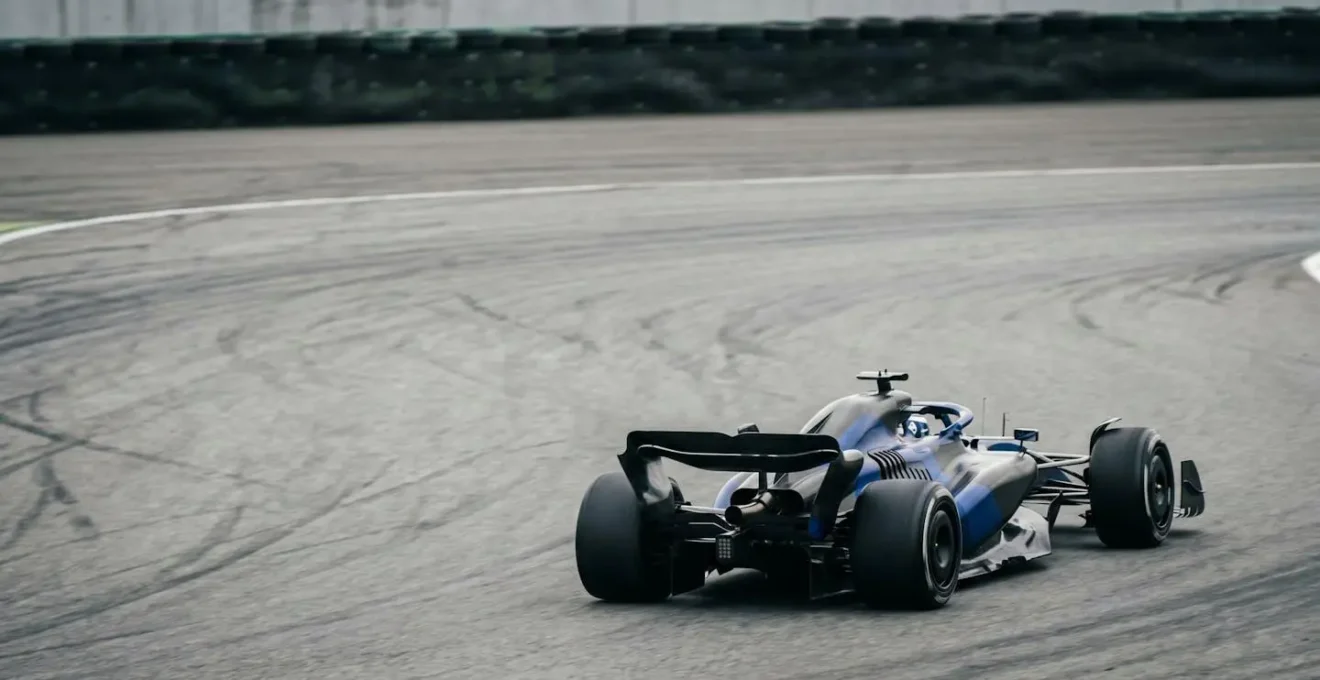
Contrary to thinking of Formula 1 cars as merely fast vehicles, it’s more accurate to see them as weapons of aerodynamic warfare. Every surface is designed to manipulate the air for grip, but in doing so, they expel a chaotic, turbulent wake—’dirty air’—that actively ‘poisons’ the environment for any rival following behind. This isn’t an unfortunate side effect; it’s a fundamental consequence of modern aerodynamics, turning the air itself into a defensive barrier that starves the trailing car of the downforce it needs to attack.
Watch any Formula 1 race, and you’ll hear the commentators, the drivers, and the engineers all lament the same invisible force: ‘dirty air’. A driver will close in rapidly on the car ahead down a straight, benefiting from the slipstream, only to suddenly lose performance and fall back as they enter a corner. It feels counter-intuitive. How can being right behind another car be both an advantage and a massive disadvantage at the same time? This paradox is the single biggest challenge to close racing and overtaking in modern motorsport.
The common understanding is that dirty air is just ‘turbulent air’. But this barely scratches the surface. To truly grasp it, you have to stop thinking about air as empty space and start visualizing it as a fluid, like water. Every F1 car is a masterfully sculpted object designed to navigate this invisible river, to harness its flow to generate immense grip, or downforce, pinning it to the track. But this process is inherently violent. The car consumes a clean, high-energy stream of air and expels a chaotic, low-energy wake—a set of churning rapids filled with vortices and eddies.
This isn’t just a messy byproduct; it’s the car’s aerodynamic signature. As an aerodynamicist, I don’t just see a car; I see a complex system for processing fluid. The front wing slices the flow, the floor sucks the car to the ground, and the rear wing manages the wake. The result is a ‘catastrophic downforce loss’ for the car behind, a phenomenon the FIA themselves have worked tirelessly to mitigate. This article will dissect this aerodynamic warfare, explaining how each part of the car contributes to the problem, why some ‘cures’ have had unintended side effects, and what the future holds in the quest for better racing.
This in-depth analysis will explore the core aerodynamic principles that govern modern Formula 1. We will break down why teams invest so heavily in controlled testing, how the car’s floor has become the new king of downforce, and why a car’s setup can look so drastically different from one track to another. Prepare to dive into the invisible world of airflow.
Summary: The Science of F1’s Aerodynamic Warfare
- Why Teams Spend Millions on Wind Tunnels Instead of Just Track Testing?
- How the Floor of the Car Generates 60% of the Grip?
- Monza vs Monaco: Why Wings Look Completely Different on These Tracks?
- Why Modern Aero Makes Racing in Heavy Rain Almost Impossible?
- Could Moving Wings Fix the Overtaking Problem Forever?
- Why 800V Systems Make Cars Lighter and More Agile on British B-Roads?
- Why is Porpoising Such a Hard Problem to Fix Mechanically?
- Reliability vs Performance: Why F1 Engines Have to Last 7 Races Now?
Why Teams Spend Millions on Wind Tunnels Instead of Just Track Testing?
Aerodynamic development is a war of millimeters fought in the dark. The forces at play are invisible, incredibly sensitive, and define a car’s performance. While track testing seems like the ultimate real-world validation, it is a surprisingly blunt and inefficient instrument for this purpose. The track environment is full of variables: wind gusts, temperature changes, and tyre degradation all contaminate the data. It’s impossible to isolate a single change to a front wing endplate when the wind speed has changed by five mph lap-to-lap.
This is why wind tunnels and Computational Fluid Dynamics (CFD) are the primary theaters of the aerodynamic war. A wind tunnel is a perfectly controlled environment. Here, we can mount a highly precise scale model of the car on a rolling road, blast it with a perfectly consistent stream of air, and measure the resulting forces with incredible accuracy. We can repeat a test a hundred times and get the same result, ensuring that any change in downforce or drag is a direct result of the design change we just made. It’s this pursuit of repeatable and reliable data that justifies the enormous expense.
CFD, a virtual wind tunnel running on supercomputers, allows for even faster iteration. Teams can simulate thousands of airflow variations before ever building a physical part. The regulations themselves acknowledge the power of these tools; according to F1’s aerodynamic testing regulations, teams are given a baseline allowance of wind tunnel runs and CFD tests, which is then adjusted based on their championship position. This handicap system is designed to prevent a single team from running away with development, proving just how crucial this off-track battle is to on-track success.
How the Floor of the Car Generates 60% of the Grip?
For decades, the most visible parts of an F1 car—the front and rear wings—were the primary architects of downforce. They worked by pushing down on the car from above. However, this method is a major culprit in creating ‘dirty air’, as it aggressively flings air outwards and upwards, creating a huge, turbulent wake. The 2022 regulations fundamentally shifted this philosophy by re-introducing a powerful, yet much older, concept: ground effect. Instead of pushing the car down, ground effect sucks the car to the track from underneath.
The floor of a modern F1 car is no longer a flat plank. It’s a pair of intricately shaped tunnels, known as Venturi tunnels. As air enters the wider opening at the front of these tunnels, it is forced to accelerate as the tunnel narrows towards the middle (the ‘throat’). According to Bernoulli’s principle, this increase in air speed creates a powerful area of low pressure. This low-pressure zone effectively acts like a giant suction cup, pulling the entire car downwards with immense force. It’s a much more efficient and ‘cleaner’ way of generating downforce, as it relies less on wake-generating wings.
The impact of this change is staggering. As F1’s own technical team explains, the underbody has become the dominant aerodynamic device. Indeed, technical analysis reveals that up to 60% of a car’s total downforce can come from its floor and diffuser. This shift is the single biggest reason why cars are now better able to follow each other. By managing the airflow underneath the car and directing it upwards in a more controlled plume, the chaotic ‘outwash’ that plagued previous generations has been significantly reduced, improving the ‘aerodynamic hygiene’ of the car’s wake.
As one analysis from F1Technical neatly summarizes the principle’s power:
The underbody and rear diffuser are the largest contributor to overall downforce, producing between 60-65% of the car’s downforce
– F1Technical engineering analysis, The Ground Effect technical feature
Monza vs Monaco: Why Wings Look Completely Different on These Tracks?
If the floor provides the bulk of a car’s downforce, the wings are the fine-tuning instruments. They are used to balance the car’s aerodynamic platform and are adapted specifically for the demands of each circuit. The starkest contrast can be seen by comparing the cars at Monza and Monaco. This comparison perfectly illustrates the eternal trade-off in motorsport: downforce versus drag. Downforce is the grip that allows high-speed cornering, while drag is the aerodynamic resistance that limits top speed on the straights.
Monaco is a tight, twisting street circuit with no long straights. Here, top speed is irrelevant; maximum cornering grip is everything. Teams will bolt on their biggest, most aggressive wings, creating a “high-downforce” package. These wings look like massive, multi-element barn doors. They generate enormous downforce, allowing the cars to navigate the slow, tight corners with incredible agility, but they also create a huge amount of drag, like an open parachute. In Monaco, this is a price worth paying.
Monza, the “Temple of Speed,” is the polar opposite. It is a circuit defined by its immensely long straights, connected by a few fast chicanes. Here, drag is the enemy. Teams will run a “low-downforce” package, with wings so thin and flat they are nicknamed ‘Monza specials’. These skinny wings produce just enough downforce to get through the corners while minimizing drag to maximize velocity on the straints. The Drag Reduction System (DRS), a flap on the rear wing that the driver can open on designated straights, is the ultimate expression of this philosophy—it ‘stalls’ the rear wing, temporarily dumping drag (and downforce) for a crucial top-speed advantage to aid overtaking, a necessary band-aid for the ‘dirty air’ problem.
Why Modern Aero Makes Racing in Heavy Rain Almost Impossible?
There’s a growing and worrying trend in Formula 1: red flags at the first sign of heavy rain. While safety is paramount, fans and even some drivers feel the sport has become overly cautious. The reason, however, is not a lack of bravery but a direct and dangerous consequence of modern aerodynamics. The very ground effect systems designed to improve racing in the dry have made it nearly impossible in the wet. The culprit is the sheer volume of water being displaced by the car’s underfloor.
Think back to our fluid analogy. The Venturi tunnels are designed to manage the flow of air—a low-density fluid. When it rains heavily, the track is covered in standing water, a fluid nearly 1,000 times denser than air. As the car’s floor passes over this water, it doesn’t just manage it; it inhales it and ejects it with phenomenal force. The result is not just ‘spray’; it’s a blinding, opaque wall of atomized water that hangs in the air for seconds, far longer than the spray from old-generation cars which was mostly kicked up by the tyres.
For a driver following behind, visibility drops to absolute zero. It’s like driving through a car wash at 180 mph. They cannot see the car in front, the braking markers, or the edges of the track. Furthermore, this immense volume of water can cause the car itself to ‘aquaplane’, where the tyres lose contact with the asphalt and the car effectively becomes an uncontrollable boat. The ground effect floor acts as a firehose, and this unintended consequence turns wet weather racing from a test of skill into a game of pure chance. Until a solution is found for managing this spray, lengthy delays and red flags will remain an unfortunate reality.
Could Moving Wings Fix the Overtaking Problem Forever?
The 2022 regulations, with their focus on ground effect, were a significant step towards better ‘aerodynamic hygiene’. Before these rules, research conducted ahead of the 2022 regulations showed that a car following at one car length lost a staggering 47% of its downforce. The new cars improved this, but the problem has crept back as teams find new ways to generate ‘outwash’. So, what is the next frontier? The answer lies in a concept F1 has long flirted with: active aerodynamics.
Currently, a car’s aerodynamic setup is fixed (apart from the DRS flap). It’s a compromise designed to work reasonably well across all parts of the lap. Active aerodynamics would change this completely. Imagine wings that can change their angle of attack from corner to corner, or bodywork that can morph to reduce drag on the straights and maximize downforce in braking zones. This would allow a car to be perfectly optimized for every single meter of the track.
For overtaking, the potential is revolutionary. A following car could retract its aerodynamic elements to slice through the dirty air with minimal drag, then instantly redeploy them for maximum grip when it pulls alongside to make a move. The leading car, in turn, could have its aero configuration limited when a rival is close, preventing it from ‘weaponizing’ its wake. The upcoming 2026 regulations are a major step in this direction, introducing moveable front and rear wings. According to FIA simulations for the 2026 active aerodynamics regulations, this could slash downforce loss to just 20% at 10 meters. This ‘smart’ approach could finally end the cat-and-mouse game of dirty air, creating a more dynamic and thrilling spectacle where drivers can truly battle on merit.
Why 800V Systems Make Cars Lighter and More Agile on British B-Roads?
At first glance, a title mentioning 800V systems and British B-roads seems out of place in a discussion about Formula 1. It speaks to the world of high-performance electric road cars. However, the core engineering principle it alludes to—using higher voltage to improve efficiency and reduce weight—is a battle that is fought just as fiercely in the heart of an F1 power unit as it is in a new Porsche Taycan. While aerodynamics get the headlines, the quest for lightness and efficiency is a constant, underlying theme in F1 performance.
An F1 power unit is a hybrid marvel, combining a traditional internal combustion engine with powerful electric motors (the MGU-K and MGU-H). A fundamental law of electricity states that Power = Voltage x Current. To deliver a certain amount of power, you can either use a low voltage and a high current, or a high voltage and a low current. High current is the enemy of lightness; it requires thick, heavy copper cables to handle the electrical load without overheating. By increasing the system’s voltage, you can deliver the same power with a much lower current. This allows engineers to use thinner, lighter wiring throughout the entire electrical system.
In a sport where teams will spend thousands of dollars to save a few grams, this principle is critical. Lighter wiring means a lighter car. A lighter car is more agile; it accelerates faster, brakes later, and changes direction more quickly. Every gram saved in the power unit or chassis is a gram that can be strategically redeployed as ballast to perfect the car’s balance. So, while F1 cars don’t use the exact same ‘800V’ architecture as a road car, they are governed by the same physical laws. The relentless pursuit of higher efficiency to reduce weight is a parallel war being fought away from the airflow, but it has just as profound an impact on the car’s ultimate agility and lap time.
Why is Porpoising Such a Hard Problem to Fix Mechanically?
The return of ground effect in 2022 brought back a violent and long-forgotten aerodynamic phenomenon: ‘porpoising’. The name, coined in the 1980s, perfectly describes the motion: cars would violently bounce up and down on the straights, like a porpoise leaping through water. As Top Gear’s technical team explains, “Porpoising is an aerodynamic phenomenon that F1 cars began to suffer from after the adoption of the so-called ‘ground effect’ philosophy, where air is sucked underneath a car to pull it down.”
The mechanism is a vicious cycle. As the car gains speed, the Venturi tunnels generate more downforce, sucking the car closer to the ground. This increases the suction effect further. However, if the floor gets too close to the track, the airflow ‘stalls’—the tunnel chokes, and the airflow breaks down suddenly. In that instant, the downforce vanishes. The car’s suspension, suddenly unloaded, springs the chassis back up. As the car rises, clean air rushes back into the tunnels, the downforce instantly returns, and the entire cycle repeats. This isn’t a gentle oscillation; a scientific analysis of the 2022 porpoising phenomenon found a brutal 4-6 Hz bouncing frequency at high speeds.
Fixing this is an engineering nightmare. The simplest solution is to raise the car’s ride height. This moves the floor further from the ground, making it less likely to stall. But this also reduces the overall downforce, making the car slower. The alternative is to stiffen the suspension to physically prevent the car from being sucked down. However, this creates a harsh, unforgiving ride that struggles to absorb bumps and kerbs, again compromising performance. Teams are therefore trapped in a delicate balancing act: they must run the car as low and soft as possible for maximum aerodynamic performance, but just high and stiff enough to prevent the violent onset of porpoising. Finding that perfect, knife-edge sweet spot is what separates a winning car from an undriveable one.
Engineer’s Checklist: Diagnosing Aero Instability
- Points of Contact: List all aero surfaces and floor contact points where the stall could originate.
- Collecte: Inventory existing data from CFD, wind tunnel, and track sensors (ride height, suspension travel, pressure taps).
- Cohérence: Compare on-track behavior with simulation data. Does CFD predict the stall point accurately?
- Mémorabilité/émotion: Identify the unique frequency and amplitude of the oscillation. Is it a sharp stall or a slow-building bounce?
- Plan d’intégration: Propose targeted fixes—stiffer plank, revised floor geometry, or suspension adjustments—and prioritize based on performance impact vs. stability gain.
Key Takeaways
- ‘Dirty Air’ is not just turbulence; it’s a low-energy, chaotic wake that starves a following car of the downforce needed for grip.
- Modern F1 cars use ‘ground effect’—sucking the car to the track via the underfloor—to generate up to 60% of their downforce, a more efficient method than traditional wings.
- The battle against dirty air is a constant technological war, with future regulations banking on ‘active aerodynamics’ (moving wings) as the next major solution.
Reliability vs Performance: Why F1 Engines Have to Last 7 Races Now?
In the high-stakes world of Formula 1, the pursuit of performance seems absolute. Yet, there is an equally important, often conflicting, goal: reliability. The days of teams bolting a fresh, screaming V10 engine into the car for every single session are long gone. Today, we are in an era of extreme efficiency and cost control, where the power unit is no longer a disposable asset but a long-term component that must endure a significant portion of the season.
Under current regulations, each driver is allocated a strictly limited number of key power unit components for the entire 24-race season. For example, they might only be allowed three Internal Combustion Engines (ICE), three MGU-Hs, and three MGU-Ks. Exceeding this allocation results in a grid penalty. A simple calculation shows that each set of components must therefore last for roughly 7 or 8 race weekends, which include practice sessions, qualifying, and the Grand Prix itself. This forces a monumental shift in engineering philosophy.
This creates a fundamental trade-off. An engine designer could easily extract more horsepower by running components at higher temperatures, pressures, and RPMs. However, running at this absolute ragged edge would dramatically shorten the life of those components, guaranteeing a failure long before the 7-race target. Therefore, engineers must dial back the ultimate performance to build in a margin of safety and endurance. Every decision is a compromise: is an extra 5 horsepower worth the risk of a 1% higher chance of failure in race six? This balancing act between outright speed and strategic endurance is a core part of modern F1, adding a layer of long-term strategy to the season-long battle.
The invisible war of aerodynamics, the mechanical compromises, and the strategic limitations on components all combine to create the complex and fascinating challenge that is modern Formula 1. Understanding these underlying principles is the first step to truly appreciating the skill of the drivers and the genius of the engineers. To put this knowledge into practice, the next logical step is to analyze how these factors play out on your favorite circuit.