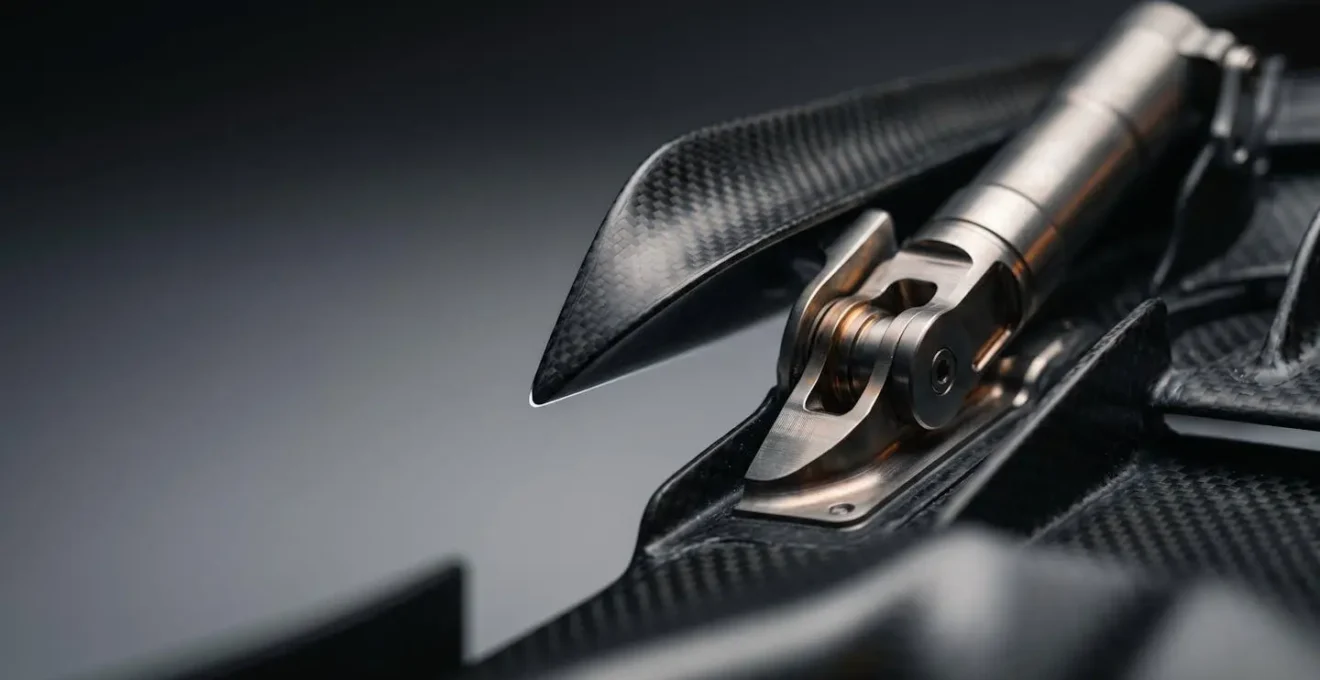
Contrary to the belief that DRS creates simple, boring overtakes, it has actually morphed Formula 1 into a complex strategic battleground where the “easy” pass is often a trap.
- The true art of modern racing lies not in the DRS activation itself, but in the high-stakes game theory of detection zones and the psychological warfare on the pit wall.
- Superior race strategy, like a perfectly executed overcut, has proven to be a more powerful weapon than a simple straight-line speed advantage, nullifying the perceived power of DRS.
Recommendation: Next time you watch a race, ignore the moment the wing opens and instead focus on the 2-3 laps prior. The real overtake happened there, through tire management and strategic positioning.
It’s the moment that splits the Formula 1 fanbase down the middle. A car closes to within a second of the one ahead, a flap flips open on the rear wing, and with a surge of speed, it glides past on the straight. For many purists, it’s the epitome of artificial racing, a “push-to-pass” button that sanitizes the raw, wheel-to-wheel combat that defines the sport. The common refrain is that DRS has replaced daring lunges and masterful racecraft with simple, predictable “highway passes,” turning a battle of gladiators into a foregone conclusion. The frustration is palpable: is this really overtaking, or just driving by?
This sentiment, while understandable, arguably misses the profound and often counter-intuitive strategic layer that DRS has inadvertently created. The system, designed as a simple band-aid to solve the problem of “dirty air,” has become a central piece in a high-speed chess match. It has warped the very physics and psychology of a Grand Prix, forcing drivers and, more importantly, the mathematicians on the pit wall, into a complex game of cat and mouse. The ‘easy’ pass is often a strategic illusion, a lure into a trap sprung laps later through tire degradation or compromised track position.
But what if the key to appreciating modern F1 isn’t to wish DRS away, but to understand the deeper game it commands? This article will deconstruct the DRS debate, not by arguing for or against it, but by revealing the hidden strategic battles it creates. From the bizarre sight of drivers braking *before* a corner to the race-ruining reality of an “aerodynamic checkmate,” we will explore how this controversial tool has shaped the sport. We will uncover how the most cunning teams have learned to look beyond the obvious advantage and have found ways to defeat DRS not with more speed, but with superior intellect.
This analysis unpacks the strategic nuances and unintended consequences of Formula 1’s most divisive technology. Follow along as we explore the intricate game theory that unfolds at over 200 mph.
Summary: Deconstructing the DRS Chess Match
- Why Drivers Brake Before the Line to Get DRS Behind?
- What Happens When the Flap Stays Open at the End of the Straight?
- Is Defending Against a DRS Overtake Hopeless?
- Why Being Stuck in a ‘DRS Train’ Ruins Your Race Strategy?
- Will Active Aero Replace DRS in 2026 Regulations?
- Could Moving Wings Fix the Overtaking Problem Forever?
- Do Teams Use Fake Radio Messages to Trick Rivals?
- Undercut vs Overcut: How Mathematicians Win Races from the Pit Wall?
Why Drivers Brake Before the Line to Get DRS Behind?
It is one of the most counter-intuitive sights in motorsport: two cars, approaching a corner, and the one behind deliberately slows down. This isn’t a mistake; it’s a calculated move in the high-stakes poker game of DRS. The detection point, typically placed just before the final corner of a straight, is the new battleground. The rule is simple: be within one second of the car ahead at this point, and you get DRS on the following straight. This has created a bizarre but fascinating game of “after you, please.”
In tight battles, particularly on circuits like Baku or Jeddah, a driver leading into the detection zone might be at a disadvantage. Giving the car behind a potent speed boost for the next straight can be a tactical suicide. Therefore, we see drivers “gifting” the position before the line, braking early to force their rival to pass them and thus cross the detection point first. The driver who is now second then gets the DRS advantage and can execute a much easier pass on the straight. It’s a strategic sacrifice, trading a small amount of time and temporary position for a near-guaranteed overtake. This chess match on asphalt turns the straight from a simple drag race into a complex puzzle of positioning and timing.
This image perfectly captures the essence of that strategic dilemma. It’s no longer about being the fastest in a straight line, but about being the smartest in the final 50 meters leading up to it. The driver who understands this game of chicken, who can manipulate the gap to their advantage, holds the true power. It is a clear demonstration that DRS is not just a button, but a tool that has fundamentally altered the psychological landscape of a wheel-to-wheel fight. The goal isn’t just to be in front; it’s to be in front at the right moment.
What Happens When the Flap Stays Open at the End of the Straight?
For all the talk of DRS being an “easy” button, it remains a piece of high-performance mechanical technology operating under extreme forces. And when it fails, the consequences are instantaneous and catastrophic. The rear wing of a Formula 1 car is responsible for generating the massive downforce that glues the car to the track through high-speed corners. DRS works by opening a slot in this wing, “stalling” it to drastically reduce drag and downforce. This is great for straight-line speed, but entering a 180-mph corner without that rear downforce is like an ice skater hitting a patch of oil. The result is a complete loss of rear grip, an immediate, violent spin, and a massive impact.
The system is designed with a primary deactivation button for the driver and a failsafe that closes it automatically upon brake application. However, driver error or a rare mechanical or hydraulic glitch can leave the flap stuck open. The car, suddenly stripped of its rear aerodynamic stability, becomes an unguided missile. The transition from controlled speed to utter chaos happens in a fraction of a second, serving as a brutal reminder of the physical forces at play and the razor’s edge these drivers operate on.
Case Study: Jack Doohan’s 185 MPH Suzuka Crash
A stark illustration of this danger was seen during a practice session for the 2025 Japanese Grand Prix. As detailed in an analysis of the 185 mph crash, Alpine driver Jack Doohan failed to manually close his DRS upon approach to the legendary Turn 1 at Suzuka. The open wing created a catastrophic aerodynamic imbalance, causing an instantaneous spin. The team confirmed it was a driver misjudgment, not a mechanical failure. This incident is a chilling testament to the fact that while DRS may feel like a video game feature, its failure transforms the car into an incredibly dangerous and unstable machine.
This very real danger is something drivers are acutely aware of, as Ferrari’s Carlos Sainz pointed out after the incident:
I’m surprised this hasn’t happened more often, because I’ve had moments where I’ve mispressed the DRS button and it has stayed open – it gives you a massive snap and a massive fright.
– Carlos Sainz, Newsweek – F1 Drivers Raise Serious Safety Concerns After Doohan’s 185 MPH Crash
Is Defending Against a DRS Overtake Hopeless?
From the grandstands, it often looks that way. A car with its rear wing agape cruises past a seemingly helpless competitor. This fuels the purist’s argument that DRS has removed the art of defending. But on the track, defending against a DRS-assisted attack has evolved into its own highly-specialized skill set. It’s no longer about just positioning the car in the middle of the track; it’s about a multi-faceted strategy involving battery deployment, tire management, and a deep understanding of aerodynamics.
A skilled defender knows the pass is likely inevitable on the straight. The real goal is to make the pass as costly as possible for the attacker. This can mean forcing the overtaking car to take a sub-optimal, wider line into the next corner, immediately compromising their exit and offering a chance to strike back. Another key tactic is “breaking the tow” just before the DRS zone, using a slight weave to disrupt the slipstream and make the attacker’s job marginally harder. The most sophisticated defense involves “weaponized turbulence,” placing the car to deliberately feed dirty, hot air to the attacking car’s tires and engine, forcing them to back off or suffer increased degradation. It’s a subtle, attritional war, not a single, dramatic block.
Your Checklist for Spotting a True Strategic Defense
- Early Energy Deployment: Does the defending driver use their ERS boost at the beginning of the straight to build an initial gap, forcing the attacker to use more energy to close in?
- Late Apex Positioning: Watch the defender’s line into the corner after the straight. Do they sacrifice their own entry to force the attacker onto the dirty, low-grip part of the track?
- “Lift and Coast” Baiting: Does the defender subtly lift off the throttle early to save energy, baiting the attacker into using up their own battery reserves for a pass that was going to happen anyway?
- The Snap-Back: How quickly does the defender get back on the attacker’s tail after being passed? A good defender is already planning their re-attack for the next DRS zone.
- Tire Phase Analysis: Is the defender on older, harder tires? Their entire defensive strategy is about surviving until their next pit stop, not winning a single corner’s battle.
While modern F1 races can see between 40-60 overtakes per race, the most masterful drive is often by the driver who finishes in their starting position after holding off a faster car for 20 laps. It’s a defense of a thousand cuts, not a single stonewall, and it’s a form of racecraft that is as impressive as any daring lunge.
Why Being Stuck in a ‘DRS Train’ Ruins Your Race Strategy?
The “DRS Train” is the system’s most infamous and frustrating byproduct. It’s the ultimate example of a good intention leading to a paradoxical outcome. The phenomenon occurs when a line of three or more cars are all following each other within one-second intervals. The car in second place gets DRS on the leader, the car in third gets DRS on the second, and so on. When everyone has the same advantage, it is effectively neutralized. The result is a high-speed procession, an aerodynamic checkmate where no one can generate enough of a speed differential to make a move. This strategic paralysis is infuriating for fans and drivers alike, as Max Verstappen once noted, “I was stuck in the DRS train and basically just stayed there. It was difficult to pass.”
But the damage goes far beyond the lack of on-track action. For a driver trapped in the middle of this train, it’s a strategic nightmare that actively ruins their race. Following another car closely, even with DRS, means running in “dirty air.” This turbulent air drastically reduces the efficiency of your own car’s aerodynamics, causing the car to slide and overheat its tires. The engine also struggles to cool effectively, forcing the team to dial down its performance. You are simultaneously burning through your tires and unable to use your car’s full potential, all while being unable to pass the car in front or pull away from the car behind.
This driver’s-eye view captures the claustrophobia and frustration perfectly. It’s a state of strategic entrapment. The pit wall is helpless; pitting means losing a handful of positions, but staying out means destroying the tires that are the foundation of any alternative strategy. This problem is becoming more acute, as evidenced by McLaren’s own analysis which revealed an 11% drop in overtakes from 2023 to 2024, despite the rules staying stable. It shows that as teams perfect their cars, the aerodynamic wake becomes more powerful, making these DRS trains even more common and more punishing.
Will Active Aero Replace DRS in 2026 Regulations?
Yes, but it’s not a simple replacement; it’s a fundamental philosophical shift. The 2026 regulations will do away with the proximity-based DRS system and introduce a universal active aerodynamics package. This is the FIA’s attempt to move away from a “band-aid” for overtaking and address the root of the problem: the aerodynamic wake that creates dirty air. Instead of an attacking-only tool, all cars will be equipped with movable front and rear wings that can switch between two modes: a high-downforce “Z-Mode” for cornering and a low-drag “X-Mode” for the straights.
The key difference is that this ability is available to every driver on every straight, regardless of the gap to the car in front. The goal is to reduce the overall “dirty air” effect, allowing cars to follow each other more closely through corners, which should theoretically create more natural overtaking opportunities. The system is designed to maintain aerodynamic balance, adjusting both front and rear wings simultaneously, avoiding the perilous instability of a DRS-only system. A recent breakdown of the 2026 F1 regulations confirms this shift from a tactical overtaking aid to a universal aerodynamic state management system.
However, the commentator’s cynical eyebrow should be raised. Engineers are already warning of unintended consequences. If all cars switch to the low-drag X-Mode at the same time on a straight, will it not just create a new, faster type of procession? The speed differential between cars could actually decrease, potentially creating “active aero trains” that are even harder to escape than the current DRS trains. The rule-makers are acutely aware of this risk. As FIA’s Nikolas Tombazis stated, the goal is not to make passing effortless.
We don’t want cars to just move on to each other. Advancements must also be a struggle.
– Nikolas Tombazis (FIA Single-Seater Technical Director), Sportskeeda – FIA looking for ways to make overtakes tricky in F1 races with DRS in 2026
This suggests the FIA might introduce a form of “manual override” or an extra boost of energy deployment for attacking cars to ensure a “struggle” remains. The 2026 rules aren’t the end of the debate; they are simply the beginning of a new, even more complex chapter.
Could Moving Wings Fix the Overtaking Problem Forever?
To ask if moving wings can “fix” overtaking is to misunderstand the very nature of Formula 1. The sport is a perpetual arms race between offense and defense, an oscillating battle between the engineers designing cars that can slice through the air and those designing cars that can punch a hole in it. There is no “forever” fix, only a temporary advantage for one side before the other adapts. Movable wings, in the form of DRS, were the FIA’s definitive offensive weapon, and its immediate impact was undeniable.
When DRS was introduced for the 2011 season, its effect was staggering. Analysis shows there was an 81% increase in overtakes from 2010 to 2011, the final year without it. This single statistic is the “original sin” for many purists. It represents the moment the FIA intervened so heavily that it changed the character of on-track battles. The problem the FIA was trying to solve was real: as aerodynamic understanding grew, the “dirty air” behind cars became so disruptive that passing had become nearly impossible. DRS was a sledgehammer solution to a delicate problem.
The “overtaking problem” is not static. It is a function of the regulations at any given time. The ground-effect cars of the early 1980s produced fantastic racing. The flat-bottomed, high-wake cars of the early 2000s were processional. The 2022 ground-effect revival aimed to reduce dirty air and allow closer racing, but teams have already found ways to generate “outwash” and re-create the problem in a new form. Movable wings are a tool to manage the symptoms of a car’s aerodynamic design. They don’t address the fundamental disease: the fact that a car’s optimal aerodynamic performance inherently creates a disadvantage for anyone following it. Therefore, any solution, including movable wings, will always be a compromise, a constant recalibration in the endless war between offensive and defensive aerodynamics.
Do Teams Use Fake Radio Messages to Trick Rivals?
Absolutely. Welcome to the invisible battlefield of Formula 1: psychological warfare. Every team knows that their radio communications are not private. The most critical messages are broadcast to the world, and more importantly, to the pit walls of their direct competitors. This has turned the team radio from a simple tool for instruction into a complex instrument of deception. The art of the “dummy” message is a core part of a modern race strategist’s playbook.
The most common tactic is the fake pit stop call. A team might broadcast a message like “Box, box, box!” knowing full well the driver is going to stay out. The goal is to spook the rival team into reacting. If the car ahead pits to cover off the non-existent threat, you’ve just gained a massive track position advantage. If the car behind pits, you’ve forced them onto a different, potentially less optimal strategy. It’s a low-risk, high-reward gamble that plays on the paranoia and split-second decision-making of the pit wall.
Beyond the obvious fakes, there are layers of coded language. When a driver is told “we need to increase the pace,” it might be a genuine instruction, or it could be a message for the rival team’s benefit, suggesting a strength that isn’t really there. Conversely, a message complaining about tire graining could be a genuine problem, or it could be a deliberate feint to lull the opposition into a false sense of security. Teams use pre-agreed phrases, seemingly innocuous words, or even specific sequences of radio checks to communicate their true intentions while broadcasting a smokescreen to the world. In this arena, what isn’t said is often more important than what is.
Key Takeaways
- DRS is less of an “overtaking button” and more of a strategic tool that has created a complex game of positioning and timing.
- The real dangers of DRS lie in mechanical or human error, which can lead to catastrophic high-speed accidents due to loss of downforce.
- The “DRS train” is the system’s biggest flaw, neutralizing its own advantage and causing severe tire and engine degradation for trapped cars.
Undercut vs Overcut: How Mathematicians Win Races from the Pit Wall?
Here lies the ultimate rebuttal to the DRS purist. If DRS is an all-powerful, race-deciding tool, how can a slower car on older tires beat a faster car with a fully-functional DRS? The answer is found in the quiet, calculated world of the pit wall, in the strategic duel between the “undercut” and the “overcut.” This is where races are truly won and lost, and it proves that intellect can triumph over brute force. As one analysis succinctly puts it, “DRS alone does not create overtaking—it amplifies opportunities that already exist due to tire and aerodynamic conditions.” The job of the strategist is to create those conditions.
The undercut is the classic F1 strategy: pit a lap or two before your rival. On fresh tires, you can put in a series of blisteringly fast laps. When your rival eventually pits, you emerge ahead. It’s an aggressive move that leverages the power of new rubber. The overcut is its more cerebral, riskier cousin. This involves staying out on older tires while your rival pits. The gamble is that your driver can be so much faster on a clear track, with better-managed tires, that they can build a big enough gap to pit and still emerge in front. It relies on supreme confidence in your driver’s ability to conserve tire life and the car’s gentle nature on its rubber.
In the DRS era, conventional wisdom favored the undercut. Why risk staying out when you could be a sitting duck for a DRS pass? However, this is a prime example of “Strategic Blindness.” The smartest teams realized that DRS trains were creating a new opportunity.
Case Study: McLaren’s 2024 Overcut Dominance
McLaren’s championship-winning 2024 season was a masterclass in overcut strategy. The team systematically chose to extend their drivers’ stints, allowing rivals to get stuck battling each other in DRS trains, burning up their tires in turbulent air. Meanwhile, the McLaren drivers circulated in clean air, preserving their rubber. As their end-of-season strategy analysis shows, Lando Norris’s victories often featured minimal on-track passing but were defined by extending tire life far beyond competitors. Oscar Piastri won in Baku despite being 18th fastest in the speed trap, proving that superior tire advantage and track position gained via the overcut could completely nullify a DRS speed deficit. They won not by being the fastest, but by being the smartest.
This demonstrates the ultimate truth of modern F1. DRS is a powerful piece on the chessboard, but it is not the king. A perfectly timed overcut, born from data analysis and driver skill, is the checkmate. It is the purest form of racing strategy, and its continued success is the best evidence that the art of the pass has not died; it has just moved from the straight to the pit wall.
To truly appreciate the multi-layered strategy of a Grand Prix, the next step is to watch a race not as a spectator, but as a strategist, looking for the subtle clues and hidden battles that decide the outcome long before the chequered flag.