The common belief is that F1 strategy is about fast reactions. The reality is that every race-winning move is pre-calculated from millions of data points.
- The “undercut” isn’t just about new tires; it’s a bet on the mathematical delta between a driver’s lightning-fast out-lap and a rival’s dying in-lap.
- A pit stop under a Safety Car can cut the time lost by over 50%, making it an irresistible but intensely calculated gamble on track position and probability.
Recommendation: To truly understand modern Formula 1, stop just watching the cars and start appreciating the data-driven wargame being played on the pit wall.
You’re on the edge of your seat. The driver you’re rooting for is leading, but then the radio crackles with a message you dread: “Box, box.” You scream at the television, “No! It’s too early! What are they thinking?!” You watch in despair as your driver peels into the pit lane, convinced the race strategist has just thrown away a victory with a foolish, inexplicable decision. This frustration is a rite of passage for every Formula 1 fan. We see the “what,” but the “why” remains shrouded in the secrecy of the pit wall.
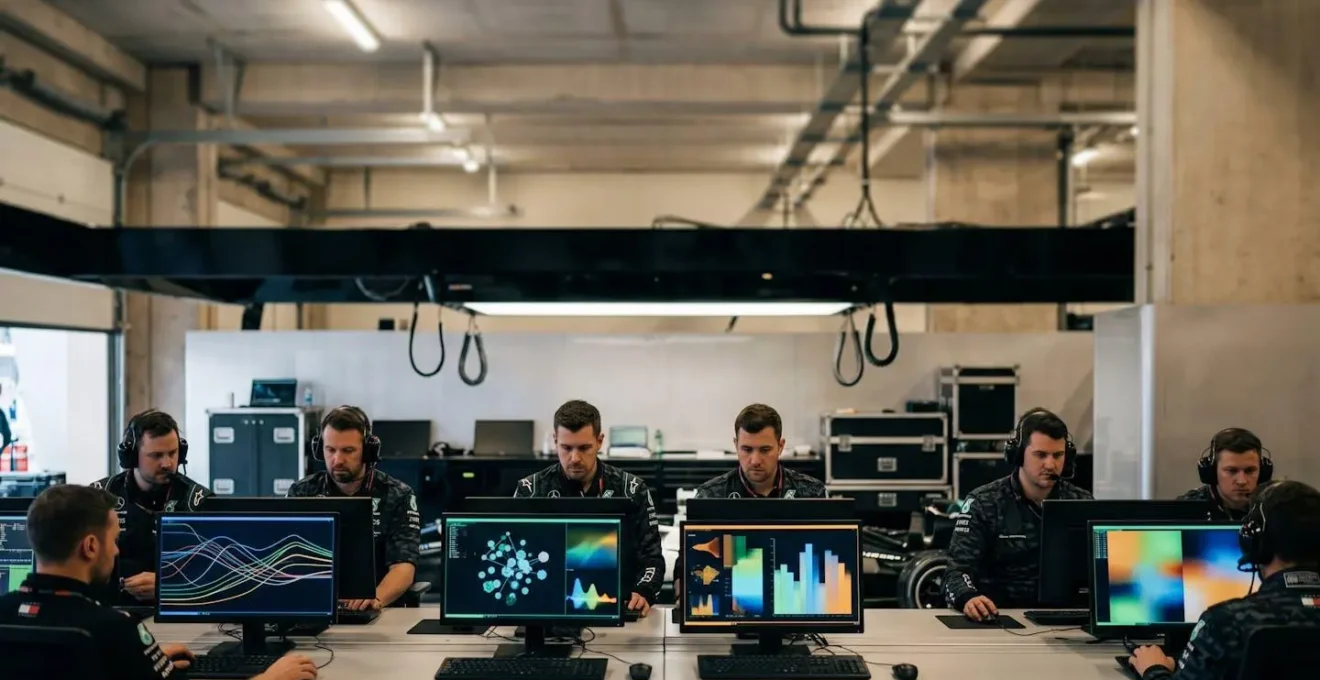
Most analysis scratches the surface, talking about “undercuts,” “overcuts,” and “free” pit stops under the Safety Car. These concepts are treated as simple tactical moves. But this view misses the revolution that has transformed F1 strategy. The modern pit wall is not a garage of mechanics with stopwatches; it is a high-frequency trading floor operating at 200 mph. Every decision, from a seemingly minor instruction to “lift and coast” to the race-defining call to pit, is the output of a complex mathematical model running millions of probabilistic simulations in real time.
But if the real key to winning isn’t reacting faster, but calculating better, how does it work? Forget gut feelings and hot takes. The truth lies in the data, the algorithms, and the cold, hard math that dictates the flow of the race. It’s a world where strategists play 4D chess, using telemetry as their pieces and probability as their guide.
This article will pull back the curtain. We will explore the critical questions you’ve always had, not with simplistic answers, but by revealing the data-driven thinking behind each one. By the end, you’ll understand the mathematical wargame that unfolds lap after lap, turning your viewing experience from one of frustration into one of deep strategic appreciation.
Summary: Undercut vs. Overcut: How Mathematicians Win Races from the Pit Wall
- Why Are Drivers Told to Lift Off the Throttle When Racing?
- How Do Teams Know It Will Rain in Exactly 3 Minutes?
- Why is a Pit Stop ‘Cheaper’ Under a Safety Car?
- How Much Should the Engineer Tell the Driver How to Drive?
- Do Teams Use Fake Radio Messages to Trick Rivals?
- How to Calculate the Exact Lap to Pit Based on Degradation Curves?
- Why an Undercut Fails if You Come Out Behind a Slower Car?
- The Math of the Undercut: How Stopping Early Gains You Track Position?
Why Are Drivers Told to Lift Off the Throttle When Racing?
The instruction “lift and coast” sounds counter-intuitive in a sport defined by flat-out speed. Fans often interpret it as a sign of a problem or a surrender. The reality is the exact opposite: it is an offensive weapon rooted in fundamental physics and race-long optimization. While modern F1 cars have not refueled during races since 2010, managing fuel is more critical than ever. Every liter of fuel has mass, and mass requires energy to accelerate. Less fuel means a lighter car, and a lighter car is a faster car.
This is where the mathematical modeling begins before the race even starts. Strategists calculate the absolute minimum fuel required to finish the race, but then they deliberately under-fuel the car. Why? Because the performance benefit of a lighter car in the opening phase of the race is immense. According to F1 fuel strategy analysis, starting just 8 kg lighter can be worth several tenths of a second per lap in the opening stint. This advantage allows a driver to build a gap or stay in contention when it matters most.
The “lift and coast” instruction is simply the team cashing in on that early-race bet. The driver lifts off the throttle before the braking zone, coasting for a moment without using fuel, then brakes as normal. This saves a tiny amount of fuel each time, but over dozens of laps, these fragments add up, ensuring the driver can finish the race they started with a significant performance advantage. It’s not about saving fuel to avoid running out; it’s about investing mass for lap time at the most optimal point in the race.
How Do Teams Know It Will Rain in Exactly 3 Minutes?
When a race engineer calmly informs their driver, “Rain expected in three minutes, Turn 4 first, light intensity for five laps,” it sounds like clairvoyance. This isn’t a lucky guess based on a local weather app; it’s the product of a sophisticated, multi-million dollar meteorological operation. Teams do not deal in vague possibilities; they deal in high-probability, actionable specifics. This precision is a cornerstone of modern F1 strategy, turning the chaotic variable of weather into a quantifiable risk.
As the official Formula 1 website notes in its analysis of team weather operations, this level of detail is standard practice:
Race engineers don’t supply their drivers with nebulous possibilities, instead they deal in specifics, relaying precise information: how many minutes until rain starts falling; which corner it hits first; how intense; for what duration.
– Formula 1 Official, Formula 1 – Watching the skies: how weather forecasting works in F1
This is achieved by combining multiple data streams. Teams employ their own meteorologists who use specialized, high-resolution Doppler radar systems positioned around the track. These systems track the density, speed, and direction of individual rain cells with far greater precision than public-facing forecasts. They can see not just that a cloud is approaching, but can model its moisture content and trajectory to predict exactly which part of the circuit it will hit and when. This hyper-local forecasting is the key.
This data is fed directly into the team’s strategy software. Rain is no longer a simple “yes/no” question. It becomes a set of variables: percentage chance of precipitation, predicted start time, duration, and intensity (mm/hr). The software can then simulate the impact on lap times, cross-referencing with tire performance data to calculate the optimal lap to switch from slicks to intermediates or full wets. The engineer’s calm message is the final output of this immense data-crunching exercise.
Why is a Pit Stop ‘Cheaper’ Under a Safety Car?
The term “cheap” or “free” pit stop under a Safety Car (SC) or Virtual Safety Car (VSC) is common, but it masks the simple yet powerful mathematics at play. A pit stop is never free; it always costs time. The strategic genius is in minimizing that cost. Under normal green-flag conditions, a driver pitting loses a significant amount of time to rivals who remain on track at full racing speed. The total time lost, known as the “pit stop delta,” includes driving down the pit lane (at a reduced speed limit), the physical stop itself, and accelerating back out.
At most circuits, this delta is substantial. Research suggests that a typical green flag pit stop costs around 22 seconds of track time. This means if you pit, a rival who stays out will be 22 seconds further up the road. However, when the Safety Car is deployed, the entire field is forced to slow down and follow it at a greatly reduced pace. Your rivals are no longer flying by at 200 mph; they are trundling along at 80 mph.
This is the crucial factor. While you are navigating the pit lane and your crew is changing your tires, your opponents are also lapping slowly on the main circuit. The time you lose *relative to them* is dramatically reduced. The same analysis shows that the pit stop delta under a Safety Car can drop to as low as 11 seconds—a 50% reduction in time loss. This is the “discount” the Safety Car provides. It’s a limited-time offer that can completely reshape a race, allowing drivers to make a necessary tire change for half the usual penalty. The decision then becomes a rapid calculation of track position, tire wear, and the probability of the race restarting soon.
How Much Should the Engineer Tell the Driver How to Drive?
The constant stream of radio communication between a race engineer and driver can seem like micromanagement. Instructions on brake bias, differential settings, and energy management might sound like the engineer is playing a video game. However, this communication is not about telling an elite athlete how to do their job; it’s about providing them with precisely filtered information that is impossible for them to perceive from the cockpit. The goal is to offload the driver’s mental capacity, allowing them to focus solely on driving at the absolute limit.
Case Study: The Data Deluge
The modern F1 car is a mobile data center. As detailed by sports technology firm Catapult, F1 teams utilize systems that capture more than 1,000 data points per second from hundreds of sensors on the car. This torrent of information—covering everything from tire temperatures and brake wear to engine parameters and aerodynamic pressure—is streamed back to the pit wall in real time. It is humanly impossible for a driver to process this. Instead, as former Aston Martin Head of Race Strategy Bernadette Collins explains, the role of the strategy team is to run this data through predictive models and distill it into simple, actionable instructions. A message like “Brake bias two clicks forward” isn’t a criticism of the driver’s technique; it’s the result of a simulation that calculated this change would optimize tire temperature and extend the life of the stint by two laps.
The engineer acts as a human-to-machine interface. They see the entire battlefield—their driver’s telemetry, the competitor’s pace, the GPS location of every car on track, and the output of the strategy software. A driver can only see the next corner. When an engineer tells the driver they are losing two-tenths in a specific corner compared to a rival, they are not saying “drive faster.” They are providing a piece of the puzzle, allowing the driver to adjust their line or technique on the next lap. It’s a collaborative process of data-driven performance optimization, not a driving lesson.
The balance is crucial. Too much information leads to cognitive overload and distraction. Too little leaves the driver “flying blind” against rivals who are being fed superior data. The art of race engineering is finding that perfect equilibrium, providing the right piece of information at the exact right moment to unlock the car’s ultimate potential.
Do Teams Use Fake Radio Messages to Trick Rivals?
In a world of such intense data analysis, the idea of using “fake” radio messages seems almost primitive. Yet, it is a fascinating and entirely plausible element of the psychological warfare and game theory that pervades Formula 1. The key lies in understanding one crucial fact: since 2014, Formula 1 has broadcast a selection of team radio messages to the public and, therefore, to other teams. This transformed what was a private communication channel into a public-facing strategic variable.
Once a message is broadcast, it can be used for deception. The most classic example is the “phantom pit stop.” A team might tell their driver to “Box, box” and even have the pit crew run into the pit lane, all in the full view of the television cameras. The rival team, fearing they will lose track position to an undercut, might react by pitting their own driver. The first team’s driver then simply stays out, having successfully baited their competitor into a sub-optimal pit stop. This is a high-risk, high-reward maneuver that relies on the other team’s paranoia.
This is pure game theory. Team A is not just making a decision based on their own optimal strategy; they are making a decision based on what they *predict* Team B will do in reaction to their move. By broadcasting a fake message, they are introducing false information into Team B’s decision-making model. While teams have become wise to the most obvious tricks, the potential for more subtle misinformation remains. A message feigning concern about tire wear could pressure a rival to manage their own pace. A message suggesting a switch to an alternative strategy (“Plan B”) could cause the competition to waste valuable time and resources modeling a threat that doesn’t actually exist.
While teams will rarely admit to it, the moment radio became public, every message became a potential tool. The question for the strategist on the pit wall is no longer just “What do I tell my driver?” but also “What do I want my rival to hear?”
How to Calculate the Exact Lap to Pit Based on Degradation Curves?
The decision of which lap to pit is the single most important strategic call in most races. Get it right, and you can win a race you shouldn’t have. Get it wrong by a single lap, and you can lose one you should have won. This decision is not a guess; it’s the result of relentless data modeling focused on one thing: tire degradation. Every tire compound has a performance cliff—a point where the rubber has worn or overheated to such an extent that its grip falls off dramatically, causing lap times to plummet.
A strategist’s primary job is to predict exactly when that cliff will arrive. They do this by creating a “degradation curve.” During practice sessions, teams run each tire compound for several laps, meticulously recording the lap time and the tire’s condition. This data is used to model how much time the tire loses, on average, per lap. For example, a soft tire might be 1.5 seconds faster than a hard tire on the first lap, but it might degrade at a rate of 0.15 seconds per lap, while the hard tire only degrades at 0.05 seconds per lap.
During the race, this pre-race model is updated in real time with the actual performance of the car. The strategists compare the live lap times to their predicted curve. If the driver is lapping faster than the model predicted, it might mean the tires are holding up better than expected, and the team can extend the stint. If the lap times start to drop off sooner than predicted, it’s a signal that the performance cliff is imminent, and an immediate pit stop is required. The team’s software constantly runs simulations to find the “crossover” point—the exact lap where the time lost from staying out on old, slow tires becomes greater than the time it would take to pit and re-join the race on fresh, fast ones.
Action Plan: Identifying the Pit Window
- Establish Baselines: Collect degradation data for all available tire compounds from practice sessions to build initial performance curves.
- Monitor Live Deltas: Track the real-time lap times of your car and key competitors, comparing them against the predicted degradation curves.
- Calculate the Crossover Point: Continuously simulate the time loss on old tires versus the time cost of a pit stop plus the pace on new tires to identify the optimal lap.
- Factor in Traffic: Overlay GPS data of all cars to find a “clear air” window to pit into, ensuring the out-lap is not compromised.
- Execute or Adapt: Make the call based on the optimal calculated lap, but be ready to adapt instantly to on-track events like a Safety Car.
Why an Undercut Fails if You Come Out Behind a Slower Car?
The undercut is a powerful weapon, but its success is critically dependent on one factor: clear air. The entire mathematical premise of the undercut relies on the pitting driver being able to use the full performance of their fresh tires on their “out-lap”—the first lap after leaving the pits. If they can put in a blistering lap while their rival is still circulating on old, worn rubber, they can make up the time deficit of the pit stop and emerge ahead.
However, this strategy collapses instantly if the driver exits the pit lane and finds themselves directly behind a slower car. This could be a backmarker being lapped or simply a car from the midfield running its own race. The effect is catastrophic for the undercut attempt. The driver is now stuck, unable to deploy the full pace of their new tires. They are forced to drive at the pace of the car in front, negating the very advantage they pitted for.
The out-lap, which needed to be seconds faster than the rival’s pace, is now compromised. Every moment spent behind the slower car is a moment where the rival, still on their old tires, is continuing to extend the gap. By the time the rival pits a lap or two later, they will emerge from their own stop comfortably ahead, the undercut having been completely neutralized. This is why strategists are obsessed with “traffic.” Their software isn’t just looking at the gap to the car they are racing; it’s modeling the entire field, using GPS data to predict where their car will re-join the track after a pit stop.
A “perfect” undercut window is not just about tire wear; it’s about finding a gap in the traffic big enough to guarantee the driver at least one, and preferably two, laps of unimpeded running. If that window doesn’t exist, attempting the undercut is often a bigger gamble than staying out.
Key Takeaways
- Fuel vs. Lap Time: Every kilogram of fuel saved translates directly into lap time, making “lift and coast” an offensive strategy, not a defensive one.
- The Safety Car Discount: The value of a pit stop is often halved under a safety car, turning it into a high-stakes game of probability and track position.
- The Undercut Equation: An undercut’s success hinges on a simple formula: (Your faster out-lap on new tires) > (Rival’s slower in-lap on old tires + their pit stop time).
The Math of the Undercut: How Stopping Early Gains You Track Position?
We’ve discussed the variables and the risks, but the beauty of the undercut lies in its pure, undeniable mathematics. It is a calculated assault on the clock, a bet that the performance gain from new tires will outweigh the time lost in the pit lane. At its heart is the battle between two laps: the “in-lap” of the car staying out and the “out-lap” of the car that has just pitted. The entire success of the strategy hinges on the time delta between these two specific laps.
Imagine Driver A is chasing Driver B. Driver A’s team decides to “pull the trigger” on the undercut. Driver A dives into the pits. Their in-lap might be slow as they manage worn tires. Meanwhile, Driver B stays on track, their tires also degrading. Now the race begins. Driver A emerges from the pits on brand new, soft tires with optimal grip and temperature. Their mission is to execute the fastest single lap of their race—the out-lap. With the tires at their peak, they can brake later, accelerate harder, and carry more speed through the corners. At the same time, Driver B must complete their own in-lap on old, worn rubber, losing time in every braking zone and corner. They then have to complete their pit stop.
The math is simple: If the total time Driver A gains from their blistering out-lap compared to Driver B’s sluggish in-lap is greater than the gap that existed between them before the stop, the undercut is successful. It’s a race against a ghost car, and it’s won or lost by tenths of a second, calculated by software that, according to sports technology experts, runs over 2 million predictive simulations for every strategic possibility.
Case Study: Vettel’s Textbook Undercut Victory
A classic demonstration of this principle was Sebastian Vettel’s win for Ferrari at the 2019 Singapore Grand Prix. Pitting from third place before his teammate Charles Leclerc and rival Lewis Hamilton, Vettel used his fresh tires to produce an exceptionally quick out-lap. Leclerc and Hamilton, staying out on older rubber, could not match his pace on their respective in-laps. As documented in a Motorsport.com analysis of F1 strategy, by the time Leclerc emerged from his own pit stop a lap later, Vettel had already flown past to take the effective race lead. He had converted a mathematical advantage into track position, a move that ultimately secured him his final F1 victory.
So the next time a car pits “too early” and you feel the urge to question the strategist’s sanity, resist it. Instead, start the stopwatch. Watch the sector times on the screen. Compare the out-lap to the in-lap. You are no longer just a spectator; you are an analyst, witnessing the beautiful, high-stakes mathematics of Formula 1 unfold in real time.