The common belief is that an F1 car’s survival cell saves a driver because it’s unbreakable; the engineering truth is that it saves the driver because we design it to break in a perfectly controlled way.
- Carbon fiber’s value isn’t just its strength, but its ability to be engineered for “controlled fragmentation,” turning catastrophic crash energy into thousands of tiny fractures.
- Unlike metal which bends and deforms, carbon composites delaminate and shatter, absorbing vastly more energy per kilogram and protecting the integrity of the monocoque.
Recommendation: Next time you see a driver walk away from a massive crash, don’t just see a strong chassis. See the result of a deliberate engineering philosophy where every shattered piece did exactly what it was designed to do.
When a Formula 1 car, a marvel of speed and fragility, smashes into a barrier at over 200mph and disintegrates into a cloud of black dust and twisted metal, a collective gasp is followed by a single, anxious search. We scan the wreckage for the one part that must remain intact: the ‘survival cell’. When the driver emerges, seemingly unscathed, the commentators praise the incredible strength of the carbon fiber monocoque. They are right, but they are also missing the fundamental point. As engineers, our goal isn’t to build an unbreakable car. That would be fatal.
The common understanding is that carbon fiber is simply “strong and light.” While true, this barely scratches the surface. The real magic, the reason that driver is walking away, lies in a philosophy of controlled failure. We don’t just trust the material; we command it. We spend months running simulations and performing physical tests not to prevent the material from breaking, but to dictate the precise manner in which it will shatter. The cloud of black fragments you see is not a sign of failure; it is the signature of a successful, pre-ordained energy dissipation strategy. It’s a symphony of destruction where every component plays its part to protect the conductor at the center.
This article will deconstruct that symphony. We will move beyond the platitudes of “strong and light” and explore the engineering principles that govern the life, death, and afterlife of these advanced composites. We will see why you can’t simply patch a cracked wing, why your road car isn’t made of the same stuff, and how the very soul of the material—the weave itself—is programmed to sacrifice itself for the driver.
This guide delves into the intricate world of composite engineering in motorsport. Follow along as we break down the science behind the survival cell, from its creation to its controlled destruction on the track.
Summary: The Engineering of an F1 Survival Cell
- Can You Fix a Cracked Carbon Front Wing or is it Scrap?
- Why Don’t Road Cars Use F1-Grade Carbon Fiber Chassis?
- How Does Carbon Fiber Shatter to Dissipate Crash Energy?
- What Happens to Broken F1 Wings After the Race?
- How Carbon Parts Offset the Heavy Batteries in Modern Hybrids?
- Why Your ‘Zero Emission’ EV Has a Carbon Debt to Pay Off in its First 20,000 Miles?
- Why Following Another Car Overheats Your Engine?
- Reliability vs Performance: Why F1 Engines Have to Last 7 Races Now?
Can You Fix a Cracked Carbon Front Wing or is it Scrap?
The short answer is: it’s almost always scrap. To an outsider, a small crack on a multi-million dollar front wing might seem repairable. To a composite engineer, that visible crack is merely the symptom of a much deeper, invisible problem: internal delamination. A carbon fiber component is a matrix of thousands of precisely oriented fibers suspended in a hardened resin. When it takes an impact, the energy doesn’t just crack the surface; it travels through the part, shearing the bonds between layers. These internal failures are impossible to see with the naked eye but catastrophically compromise the part’s structural integrity.
We can’t just “patch” the weave. Any repair would create a stiff, unpredictable point in a component designed for specific flex and load characteristics. To ensure safety, teams use advanced non-destructive testing (NDT) methods. As highlighted by non-destructive testing specialists, techniques like ultrasonic inspection are used to detect internal flaws that are completely invisible externally. An ultrasound probe is run over the surface, and a computer analyzes the returning signals to map out any voids, debonding, or delamination inside the composite laminate. More often than not, the part is quarantined and designated for disposal. We don’t take chances; we trust the data. If the internal structure is compromised, the part is a liability.
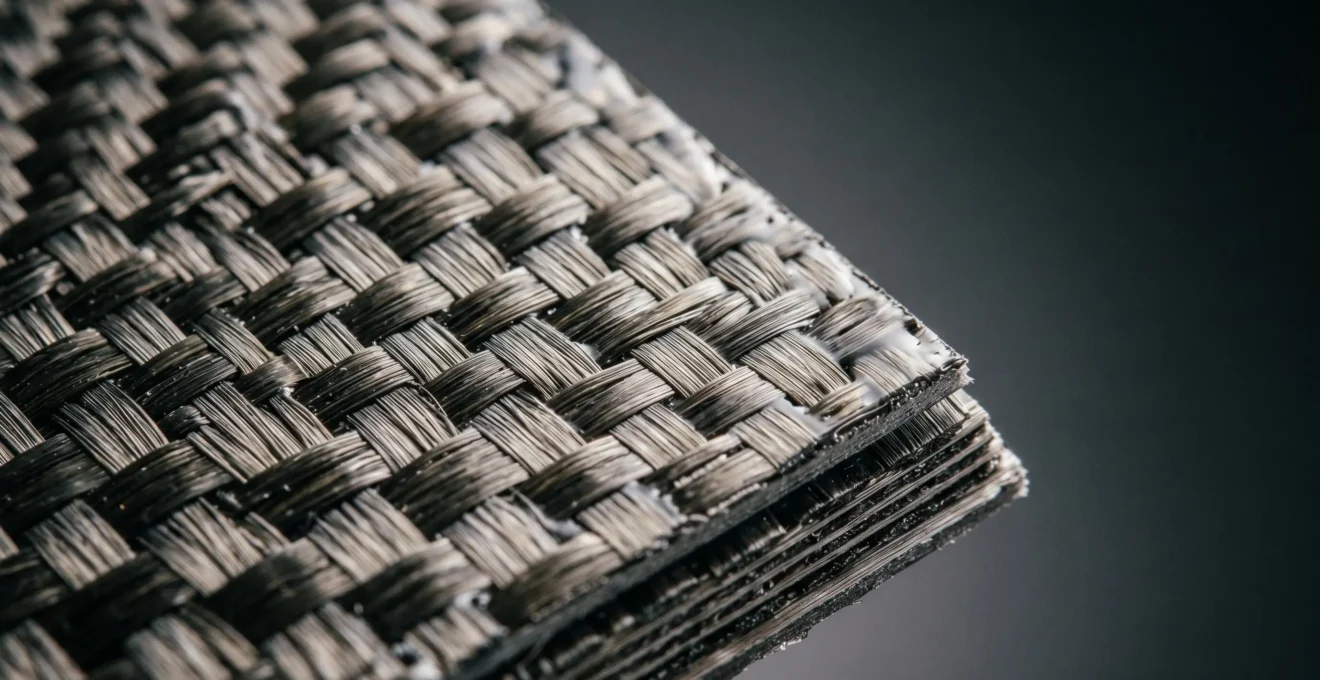
The image above gives a sense of the material’s complexity. Each woven fiber has a purpose. A repair would disrupt this engineered perfection. Therefore, unless the damage is purely superficial on a non-structural element, the part is retired. Its job is done, and its potential for unpredictable failure is too high a risk.
Your Action Plan: Assessing a Damaged Composite Component
- Visual Inspection: Document all visible surface damage. Look for cracks, chips, and areas where the surface weave pattern appears distorted or milky-white, which can indicate stress.
- Tap Testing (Coin Test): Gently tap the surface around the damaged area with a coin. A sharp, crisp sound indicates a solid laminate. A dull, flat thud suggests underlying delamination.
- Ultrasonic Scan: Use calibrated NDT equipment to perform a full scan of the component, focusing on the impacted area and its surroundings to map the full extent of internal damage.
- Compare to Baseline: Cross-reference the scan data with the component’s original design specifications and load tolerances. Determine if the damage exceeds the acceptable limits for repair.
- Decision & Quarantine: Based on the data, make a clear “repair or scrap” decision. If scrapped, ensure the part is physically quarantined and marked to prevent accidental reuse.
Why Don’t Road Cars Use F1-Grade Carbon Fiber Chassis?
The primary obstacles are not just cost, but manufacturing philosophy and scale. In Formula 1, we build a few dozen chassis per year. In the automotive world, manufacturers build thousands of cars per day. This fundamental difference dictates every choice. As automotive manufacturing research reveals, metal body parts can be stamped out by massive presses in a matter of seconds. By contrast, a single large carbon fiber part can take many minutes, or even hours, to be laid up, molded, and cured in an autoclave.
This time-intensive process involves laying individual sheets of “pre-preg” carbon fiber into a mold by hand, vacuum-bagging the assembly, and then “cooking” it under immense pressure and heat. It’s a process closer to artisanal baking than mass production. While a stamped steel chassis might cost a few hundred dollars, a full carbon monocoque is orders of magnitude more expensive. The materials are costly, the tooling is complex, and the labor is highly skilled.
Even as technology advances, the cost remains a formidable barrier for mass-market vehicles. The introduction of more “affordable” off-the-shelf solutions highlights this gap.
Case Study: The ‘Affordable’ Carbon Monocoque
F1 supplier Dash-CAE developed the TR01, a carbon monocoque chassis aimed at low-volume supercar manufacturers. Priced at under £30,000 ($38,000), it was marketed as a breakthrough, roughly 50% cheaper than comparable bespoke solutions. The chassis itself is a marvel of engineering, weighing a mere 50kg while offering immense torsional stiffness (35,000 Nm/Deg). However, this “low-cost” price point is still exponentially higher than a traditional steel or aluminum chassis, demonstrating precisely why F1-grade technology, even when scaled for affordability, remains prohibitive for any vehicle produced in significant numbers.
Beyond cost and time, there is the issue of repairability. A collision in a road car often results in a trip to the body shop, where bent metal can be pulled and repaired. As we’ve established, significant damage to a carbon monocoque is often a fatal flaw, requiring the entire chassis to be written off. For an F1 team, this is an accepted cost of racing; for a daily driver and an insurance company, it’s an economic non-starter.
How Does Carbon Fiber Shatter to Dissipate Crash Energy?
This is the heart of the engineering philosophy. We design carbon fiber to shatter. A metal chassis in a crash will bend, crumple, and deform, absorbing energy in the process. This is effective, but it has limits. A carbon fiber composite structure absorbs energy through a process of complete, controlled self-destruction. Instead of bending, it undergoes a series of rapid, violent failures: the resin matrix cracks, the individual carbon fibers snap, and the layers of the composite (the ‘laminate’) peel apart from each other in a process called delamination.
This cascade of failures requires an immense amount of energy. Every snapped fiber and every square millimeter of delamination is a tiny pocket of crash energy that has been converted into sound, heat, and material destruction. It’s the ultimate sacrificial act. As researchers at the Oak Ridge National Laboratory noted, “Composite structures fail through a combination of fracture mechanisms, which involve fiber fracture, matrix cracking, fiber-matrix debonding, and delamination.” Each of these mechanisms is a tool we use. By precisely controlling the orientation of the fibers, the thickness of the layers, and the shape of the component, we can dictate the failure path, directing the destructive energy away from the survival cell.
The result is an incredible capacity for energy absorption. While steel can absorb around 10-15 kilojoules per kilogram (kJ/kg) of its weight in a crash, Formula 1 materials engineering data shows that carbon fiber crash structures can absorb from 40 kJ/kg up to 70 kJ/kg in the most refined designs. The scattered debris you see in the image above isn’t just wreckage; it is a physical manifestation of that absorbed energy. Every fragment represents a piece of the impact that the driver did not have to endure.
What Happens to Broken F1 Wings After the Race?
Once a carbon fiber component is deemed scrap, its journey is far from over. It enters a triage system that balances economic, promotional, and, increasingly, environmental considerations. The first path is forensic analysis. The broken part is meticulously studied by engineers to understand the exact failure modes. Was the failure consistent with simulation data? Did it reveal a design flaw or a manufacturing defect? This data is invaluable for future iterations.
After analysis, the paths diverge. Some non-structural or less critical parts might be repaired and repurposed for use on show cars or in simulators. However, the vast majority of crash-damaged parts, especially wings and floor sections, are destined for one of two fates: the memorabilia market or recycling. Authentic, race-used components are highly sought after by collectors. Teams have dedicated programs to sell these authenticated pieces, turning a piece of wreckage into a significant revenue stream. A small endplate can be sold for hundreds of dollars, while a complete front wing can fetch tens of thousands.
The final path is material recovery, a process fraught with challenges. As FIA Single Seater Director Nikolas Tombazis explains, “A lot of the specialised materials used within our ecosystem are non-recyclable – and their sustainable counterparts simply cannot achieve the same safety weight and performance standards.” This is the hard truth of F1 composites. While metals like titanium and aluminum can be extracted and recycled relatively easily, the carbon fiber itself is difficult to reclaim. The process of separating the fibers from the hardened epoxy resin is energy-intensive. The resulting “chopped” fibers have lost their length and alignment, meaning they can only be repurposed into lower-performance applications, not back into an F1 car.
The F1 Component Triage System
After a race, damaged components are sorted into three main streams. First, they are meticulously analyzed for performance data and failure insights. Second, if the part is deemed safe and has provenance, it is authenticated and sold through official team memorabilia channels, a lucrative market for fans and collectors. Third, components that cannot be sold or reused are sent to specialized partners. These partners dismantle the parts to recover valuable and recyclable metals like titanium and magnesium. The remaining carbon composite material is then processed, often through pyrolysis (high-heat decomposition), to recover the fibers for secondary applications, adhering to environmental regulations but acknowledging the challenge of true “circularity.”
How Carbon Parts Offset the Heavy Batteries in Modern Hybrids?
The introduction of heavy hybrid power units and batteries in F1 presented a massive challenge: how to add hundreds of pounds of hardware without compromising performance. The answer was an even more aggressive and strategic use of carbon fiber composites. The goal of using carbon fiber is not just to meet the minimum weight limit, but to give engineers the freedom to place weight exactly where they want it for maximum performance.
The FIA sets a minimum weight for the car, which stands at nearly 800 kg including the driver for the 2025 season. Every gram saved on the chassis, bodywork, or suspension through the use of carbon fiber is a gram that can be strategically re-allocated in the form of ballast. This ballast, typically made of dense tungsten, is placed as low as possible in the chassis to lower the car’s center of gravity (CG). A lower CG reduces body roll, improves responsiveness, and ultimately leads to faster cornering speeds.
With the arrival of heavy batteries and MGU-K units, this strategy became more critical than ever. The batteries are inherently heavy and often have to be placed higher in the chassis than ideal. By making components like the halo, engine cover, and even gearbox casings out of ultra-lightweight composites, we can offset the high-placed weight of the hybrid system. This allows the team to still achieve a low and optimized CG. As Paul Ferraiolo, a product planning head at BMW, noted about the strategic use of carbon fiber in their road cars: “We’re saving weight, but we’re saving weight up high. It allows our engineers to design a car with a lower center of gravity.” This principle is magnified tenfold in the competitive world of F1.
Every single component is scrutinized. Is it possible to make it lighter? Can we use a different carbon weave or a more exotic resin system? This relentless pursuit of “light-weighting” isn’t just about hitting a target number on a scale; it’s about gaining the strategic freedom to build a faster, more balanced race car.
Why Your ‘Zero Emission’ EV Has a Carbon Debt to Pay Off in its First 20,000 Miles?
While a high-performance Electric Vehicle (EV) may have zero tailpipe emissions, it begins its life with a significant “carbon debt” from its manufacturing process. This debt is even larger when the vehicle relies on advanced materials like carbon fiber composites to offset the weight of its massive battery pack. The very process that makes carbon fiber so strong—curing it in a high-temperature, high-pressure autoclave—is incredibly energy-intensive.
This “embedded carbon” is the total greenhouse gas emission associated with producing a product, from mining the raw materials to final assembly. For an EV, the battery is the largest contributor, but for a performance EV using a carbon chassis, the body itself adds a substantial amount. The cost of manufacturing is a rough proxy for its energy cost. While a standard steel chassis is energy-intensive in its own right, the specialized, multi-stage process of creating a carbon monocoque puts it in another league.
According to composite manufacturing industry data, a full carbon fiber body or monocoque chassis can cost anywhere from $30,000 to over $150,000. This financial cost reflects the immense energy, skilled labor, and complex tooling required. This initial carbon debt must be “paid off” over the vehicle’s lifetime by the emissions it saves compared to a gasoline-powered equivalent. For many standard EVs, this break-even point is estimated to be around 15,000-20,000 miles, depending on the electricity grid’s carbon intensity. For a high-performance EV laden with energy-intensive carbon fiber, that break-even point is pushed even further down the road.
This doesn’t negate the long-term benefits of electrification, but it provides a more complete and honest picture. As engineers, we must consider the entire lifecycle of the material, from its energetic birth to its difficult-to-recycle end. The “zero-emission” label applies at the tailpipe, but the environmental cost begins long before the wheels ever turn.
Why Following Another Car Overheats Your Engine?
The ability of carbon fiber to be molded into incredibly complex aerodynamic shapes is both a blessing and a curse. While these intricate wings, floors, and diffusers generate the downforce that allows for incredible cornering speeds, they also create a wake of turbulent air, often called “dirty air.” For a following car, this dirty air is a double-edged sword. It drastically reduces the downforce available to the car behind, making it harder to follow closely, and it also cripples its ability to cool itself.
An F1 car is a finely tuned thermal system. Air is channeled through various ducts to cool the radiator, oil coolers, and electronics. This system is designed to work in clean, undisturbed airflow. When a car is stuck in the dirty air of a vehicle ahead, the turbulent, lower-energy air is not effective at entering the cooling ducts. The flow is disrupted, and the radiators receive a fraction of the cool, high-velocity air they need to function efficiently. As a result, engine and water temperatures can rise dramatically in just a few corners, forcing the driver to back off to prevent a catastrophic failure.
Recognizing this issue was a major impediment to close racing, recent F1 regulations have specifically targeted the nature of this wake. As F1 technical analysts have noted, the current generation of cars was designed to create an “‘upwash’ wake, throwing the dirty air up and over the following car.” This is achieved through complex floor tunnels and diffuser shapes—all made possible by carbon fiber—that aim to direct the turbulent air upwards, leaving a cleaner path for the car behind to follow and, crucially, to cool its power unit.
So, while the material itself doesn’t cause the overheating, its ability to create powerful aerodynamic structures is the root cause of the “dirty air” phenomenon that starves the following car’s engine of the clean, cool air it needs to survive.
Key Takeaways
- Carbon fiber’s primary safety function is not being unbreakable, but its engineered ability to shatter in a controlled way, absorbing far more energy than metal.
- The high cost and slow, labor-intensive manufacturing process (autoclave curing) make F1-grade monocoques economically unviable for mass-produced road cars.
- The material allows for strategic weight saving, enabling engineers to place ballast low in the car to optimize the center of gravity, which is critical for performance with heavy hybrid systems.
Reliability vs Performance: Why F1 Engines Have to Last 7 Races Now?
The same carbon fiber composites that form the safety-critical survival cell are also used in components that must withstand the brutal, unrelenting environment of the F1 power unit. This is where the ultimate engineering trade-off between performance and reliability is most stark. Regulations now mandate that major power unit components must last for a significant portion of the season—roughly seven races—a far cry from the days when engines were rebuilt after every session.
This rule forces a profound shift in design philosophy. It’s no longer enough to build the most powerful engine; we must build one that can sustain that power under extreme stress for thousands of miles. Components are subjected to incredible forces, with engines running at up to 15,000 RPM with intense heat and mechanical stress. Carbon composites are used for things like airboxes and intake plenums, where their stiffness-to-weight ratio is crucial, but they must be designed to resist the constant vibration and thermal cycling without failing.
The FIA enforces this reliability mandate through rigorous testing and a limited pool of components for the season. Exceeding the allocation results in grid penalties, directly impacting a team’s championship hopes. This creates a constant tension. As FIA’s Nikolas Tombazis noted regarding durability tests, “over the latter half of the season we came to the conclusion that we needed to toughen a bit more the tests.” This reflects the cat-and-mouse game where teams push the limits of the materials to find performance, and the governing body responds by increasing the durability requirements.
Ultimately, the challenge is to find the perfect balance. We use advanced simulations and materials science to predict the lifespan of a component, pushing it to the very edge of its operational window. A part that fails one lap before the end of its seventh Grand Prix is a failure. A part that has 50% of its life left after being retired is also a failure, as it means it was over-engineered and too heavy. The goal is to have the component expire harmlessly on the dyno, back at the factory, after successfully completing its mission on track. That is the pinnacle of the reliability-versus-performance challenge.
The next time you watch a race, look beyond the speed. Appreciate the material science that allows a driver to walk away from a wreck, the strategic genius of weight placement, and the engineering discipline required to make these incredible machines not just fast, but durable. You are watching a masterclass in applied physics, where every component has a purpose, and even destruction is part of the plan.