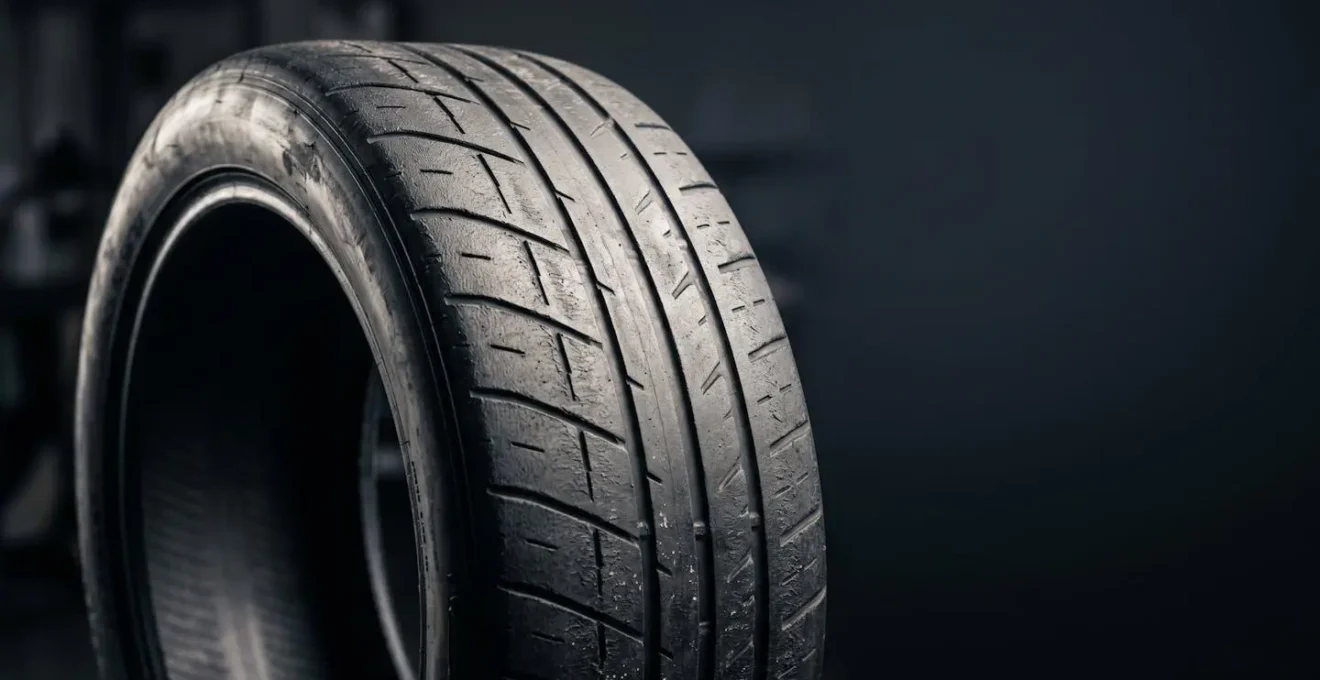
Contrary to what it looks like, the tyre “cliff” is not about running out of rubber; it’s the sudden, catastrophic collapse of the tyre’s internal structure.
- Grip comes from a fragile balance of thermal energy and the structural integrity of the tyre’s internal framework, known as the carcass.
- Each heat cycle (heating up and cooling down) makes the carcass more brittle, leading to a non-linear drop in performance that feels like a cliff.
Recommendation: Stop watching the surface tread and start thinking about the tyre’s hidden structural health and thermal history to truly understand race strategy.
You’ve seen it a hundred times. A driver is setting competitive lap times, holding their own in a tight battle. Then, seemingly out of nowhere, their pace evaporates. Two, sometimes three seconds a lap are gone. The engineer comes on the radio with a calm but urgent, “Box, box, we’re falling off the cliff.” Yet when the car pits, there appears to be plenty of rubber left on the tyre. The common wisdom says tyres just “wear out,” but that doesn’t explain the sudden, dramatic nature of the performance loss. It’s not a gentle slope; it’s a sheer drop.
As a tyre engineer, my world is that black round rubber. And I can tell you that the conventional view is fundamentally wrong. We are not just managing wear. We are managing energy, temperature, and most importantly, structural integrity. The secret to the cliff lies not on the surface of the tyre, but deep within its construction. The visible tread is a deceptive liar. The truth is in the carcass—the tyre’s skeleton—and its ability to withstand the immense forces and thermal cycles of a race stint. This isn’t a simple story of abrasion; it’s a complex narrative of material science, thermal dynamics, and eventual, inevitable structural collapse.
This guide will take you inside the tyre. We will deconstruct the mechanisms that lead to the cliff, explore the visual cues of a dying tyre, and unravel the strategic calculations that define modern motorsport. By the end, you won’t just see a car losing pace; you’ll understand the physics of why it happens.
Table of Contents: An Engineer’s Deep Dive into the Tyre Cliff
- Why Can You Have Plenty of Rubber Left But No Grip?
- What Does ‘Graining’ Look Like and Why Does it Slow the Car?
- How to Calculate the Exact Lap to Pit Based on Degradation Curves?
- Why is the Out-Lap Critical for Tyre Life in the First Stint?
- When is the Exact Moment to Switch from Wets to Inters?
- What Inner Edge Wear Tells You About Your Camber Settings?
- Why You Need a Fresh Tyre Advantage to Make the Undercut Work?
- The Math of the Undercut: How Stopping Early Gains You Track Position?
Why Can You Have Plenty of Rubber Left But No Grip?
The most common misconception in racing is that grip is proportional to the amount of tread rubber on the tyre. The reality is far more complex. The grip is a product of a tyre operating within its intended thermal and structural window. The ‘cliff’ occurs when one of these systems fails, even if the other appears intact. The most common culprit is the catastrophic failure of the tyre’s internal structure, the carcass. As experts from Hankook Tire explain, the carcass is the true foundation of performance.
The carcass is the framework of the tyre, the most important part. Referring to all layers made up of tyre cord where internal air pressure, weight and shock are absorbed.
– Hankook Tire, Tyre Structure – Tyre Guide
Think of the carcass as the skeleton and the tread as the muscle. You can have plenty of muscle, but if the skeleton breaks, the system collapses. Each time a tyre is heated to operating temperature and then cools down, it completes a ‘heat cycle’. This process makes the internal structure more brittle over time. Extensive analysis shows that after 15 or more heat cycles, motorsport tyres can lose their structural resilience. The tyre may look fine, but its internal framework is fatigued and can no longer support the tread correctly under load. This causes the contact patch to deform unpredictably, breaking the bond with the asphalt and sending grip plummeting. The cliff isn’t rubber disappearing; it’s the moment the foundation crumbles.
This image perfectly illustrates the concept: the foundation shows micro-fractures, indicating internal failure, while the main structure remains visually intact. This is precisely what happens inside a tyre. The tread you see is the intact pillar; the failing carcass is the cracked foundation you don’t. The sudden loss of grip is the moment these internal micro-fractures connect and lead to a systemic failure in managing cornering loads.
What Does ‘Graining’ Look Like and Why Does it Slow the Car?
Graining is one of the most misunderstood phenomena in tyre management. Visually, a grained tyre surface looks rough and textured, almost like it’s covered in small, balled-up pieces of rubber. This is not the smooth, uniform wear you might expect. This texture is the direct cause of grip loss. Instead of a clean, flat contact patch interlocking with the track surface, the car is essentially driving on thousands of tiny, unstable rubber marbles. This reduces the effective contact area and creates a slippery, unpredictable feeling for the driver.
The root cause is a thermal imbalance within the tyre. As former Mercedes Chief Technical Officer Mike Elliott explains, it’s often about temperature differential. “If a tyre’s really cold, we can get something called cold graining. It rubs away in little lumps and that graining loses you grip and wears the tyres away very quickly.” This happens when the surface of the tyre heats up rapidly from friction, but the internal carcass remains too cold. The cold, stiff carcass flexes less, causing the hot, malleable surface rubber to tear and shear away, forming the ‘grains’ that then stick back to the surface. This was a major issue during the inaugural Las Vegas Grand Prix, where the 4-5°C ambient temperature made it nearly impossible to get heat into the carcass, leading to severe graining for many teams.
Essentially, graining turns the tyre’s surface into an abrasive, self-destructing layer. It not only reduces grip but also dramatically accelerates wear, as the process of tearing and re-attaching rubber is highly destructive. Managing graining isn’t just about driving smoothly; it’s about managing the thermal energy across the entire tyre structure, from the surface to the core.
How to Calculate the Exact Lap to Pit Based on Degradation Curves?
The decision of when to pit is not a gut feeling; it’s one of the most data-intensive calculations in motorsport. Teams use degradation curves to model the loss of performance over a stint and predict the ‘cliff’. A degradation curve is a simple but powerful tool: a graph plotting lap time against lap number. By running practice stints, teams collect data to establish a baseline trend, such as a loss of 0.1 seconds per lap. This line is then projected forward to forecast when the lap times will become critically slow. The goal is to pit just before the curve steepens dramatically—the graphical representation of the cliff.
This process is so crucial that race strategists run thousands of simulations before a race, modeling different scenarios for tyre wear, traffic, and safety cars. They calculate the ‘crossover point’, which is the lap where the time lost on old tyres plus the time for a pit stop is greater than the time gained by switching to fresh tyres. This calculation determines the optimal pit window. However, this is not a static calculation. Factors like a driver pushing harder than expected, higher track temperatures, or battling another car can accelerate degradation, forcing the engineers to constantly update their models in real-time.
The degradation curve is the primary tool for turning tyre behaviour into a predictive strategy. It transforms the abstract feeling of ‘losing grip’ into a concrete dataset that dictates the most important strategic decision of the race. While you may not have a multi-million dollar strategy department, you can apply the same principles.
Your Action Plan: Charting a Tyre Degradation Curve
- Run a consistent stint of 10-15 laps maintaining identical driving inputs and racing line.
- Log lap times for each lap, excluding outliers caused by traffic or errors.
- Plot lap times against lap number in a spreadsheet to visualize the degradation trend.
- Calculate the average time loss per lap (e.g., +0.08s/lap) using linear regression or moving averages.
- Project the degradation curve forward to predict performance drop-off for future laps.
- Identify the ‘cliff point’ where degradation accelerates non-linearly, indicating critical tyre failure.
Why is the Out-Lap Critical for Tyre Life in the First Stint?
The out-lap—the first lap after leaving the pits—is arguably the most important lap for the entire life of a tyre. The way a driver brings a new set of tyres up to temperature sets the stage for the entire stint. A common mistake is to push too aggressively too soon, in an attempt to get the tyres “switched on.” This is a critical error that can permanently damage the tyre before it has even completed a single racing lap. The problem, once again, is thermal imbalance. The surface heats up quickly from scrubbing and sliding, but the deep internal carcass takes much longer to absorb the thermal energy.
Case Study: Permanent Damage from Aggressive Out-Laps
Analysis of graining and blistering patterns consistently reveals that pushing tyres too hard when they are cold inflicts permanent damage. An overly aggressive out-lap overheats the tyre surface long before the carcass reaches its optimal temperature. This thermal shock can cause the surface compound to shear away from the cooler layers underneath. This shearing creates microscopic origin points for blistering that will persist throughout the entire stint. No amount of careful tyre management afterwards can undo this initial damage; the tyre’s longevity is compromised from the very first kilometre.
Modern F1 teams use sophisticated methods to manage this process, including heating the wheel rims themselves. This helps to transfer heat into the carcass more gently and evenly before the car even hits the track. The relationship is surprisingly direct; according to Formula 1 thermal management data, a 10°C increase in wheel rim temperature leads to an approximate 1°C increase in the tyre carcass temperature. This demonstrates the obsessive level of detail required to prepare a tyre. The out-lap isn’t just a warm-up; it’s a delicate baking process. Rushing it is like putting a frozen dish into a blazing hot oven—the outside burns while the inside remains frozen, and the entire structure is ruined.
When is the Exact Moment to Switch from Wets to Inters?
The transition from a full wet tyre to an intermediate is one of the most high-stakes decisions in racing. Make the call a lap too early, and the driver will struggle for heat and grip, aquaplaning on the remaining standing water. A lap too late, and the intermediates will be destroyed by overheating on a drying track. The “crossover point” is the target, but it’s a moving one. The exact moment is not defined by a single piece of data, but by a confluence of sensory cues from the driver and data from the pit wall. A key indicator is when the full wet tyre itself starts to overheat and grain.
As the track dries, there is less water to cool the tyre. The tread blocks, designed to pump massive amounts of water, start to move around too much on the drier surface. This flexing generates immense heat. According to Formula 1’s official definition, graining occurs “when the tyre’s carcass is cold and surface is hot, with the resulting flex in the tyre causing the rubber to chunk off and stick to the surface of the tyre, reducing grip.” When this starts happening to a wet tyre, it’s a definitive sign that the tyre is out of its operating window and the track is ready for an intermediate.
Case Study: Reading the Signs in Las Vegas
During the cold Las Vegas Grand Prix, drivers faced extreme challenges getting slick tyres into their operating window. Alex Albon famously predicted that drivers would need three or even four preparation laps in qualifying just to build enough temperature for a single push lap. This scenario provides a perfect analogy for the wet-to-inter switch. When a driver reports that they are struggling to keep temperature in their wet tyres, or conversely, that the tyres feel like they are overheating and “moving around,” it’s a clear signal. The moment the current compound cannot effectively generate or maintain temperature for the conditions, it is the exact time to switch to a compound better suited for that energy level—in this case, the intermediate.
What Inner Edge Wear Tells You About Your Camber Settings?
Tyre wear is a story written on rubber, and an experienced engineer can read it like a book. One of the most common narratives is excessive wear on the inside edge of the tyre. This is a classic symptom of running too much negative camber. Camber is the angle of the wheel relative to the vertical axis when viewed from the front. Negative camber means the top of the wheel is tilted inwards, towards the car’s chassis. This is done intentionally to maximize the contact patch of the outside tyres during cornering, as the car’s body roll naturally tries to lift the inside edge of the tyre off the ground.
However, there’s a fine line. While optimal for cornering, excessive negative camber means that on the straights, the car is riding primarily on that small inside edge. This concentrates the entire load, temperature, and wear onto a narrow strip of rubber. The ideal setup is a compromise. Engineers use pyrometers to measure the temperature across the tyre’s surface immediately after a run. A perfect setup results in a specific temperature gradient. According to motorsport tyre temperature analysis, the ideal spread for many racing applications is to have the inner edge 7-10°C hotter than the outer edge. If the inner edge is significantly hotter than this, or if visual inspection shows it wearing down much faster, it’s a clear sign that the negative camber is too aggressive. This not only causes premature tyre failure but also reduces braking and traction performance on the straights.
It is also crucial to differentiate this wear from problems caused by incorrect toe settings. Toe refers to the angle of the wheels when viewed from above. Excessive toe-out (wheels pointing away from each other) can also scrub the inside edges, but it typically creates a feathered, diagonal wear pattern, whereas pure camber wear is more uniform around the circumference.
Diagnostic Checklist: Camber or Toe Problem?
- Measure hot tyre pressures immediately after coming off track to ensure they are within specification.
- Inspect the wear pattern location; inner edge wear points towards camber or toe issues.
- Check the temperature spread across the tyre width; the ideal is an inner edge 7-10°C hotter than the outer.
- If inner edge wear is consistent around the tyre’s circumference, suspect excessive negative camber as the primary cause.
- If the wear pattern shows diagonal scrubbing marks or a feathered texture, excessive toe-out is likely the culprit or is exacerbating the camber effect.
- Adjust camber first to correct the temperature spread, then re-test; if the problem persists, investigate the toe settings.
Key Takeaways
- The “cliff” is a structural failure of the tyre’s carcass, not just a loss of surface rubber.
- Thermal cycles (heating and cooling) make the tyre’s internal structure brittle, leading to sudden, non-linear performance drops.
- The undercut strategy relies on a significant performance delta between fresh and old tyres, which is only effective in clear air.
Why You Need a Fresh Tyre Advantage to Make the Undercut Work?
The undercut is one of motorsport’s most powerful strategic weapons, but its success hinges on one simple principle: the performance gap, or ‘delta’, between a fresh set of tyres and a worn set. As highlighted by strategy experts at Catapult Sports, “If degradation is high, the benefit of racing on fresh rubber makes the undercut a strong manoeuvre.” The entire strategy is a gamble that the time gained by the driver on fresh tyres over one or two laps will be greater than the time lost by the rival who stays out on their old tyres, plus the time they will lose in their own pit stop.
For the undercut to be effective, this tyre performance delta needs to be significant. If the tyres are durable and degradation is low, a driver on new tyres might only be a few tenths of a second faster per lap. This is often not enough to overcome the time lost in the pit lane (typically 20-25 seconds). However, if the tyres are at or near the ‘cliff’, the performance drop-off is dramatic. A driver on worn tyres might be 2-3 seconds slower than one on fresh tyres. In this scenario, the undercut becomes incredibly powerful, allowing a driver to make up huge chunks of time and leapfrog their opponent after the pit stop cycle is complete.
However, the strategy is not just about raw tyre pace. Its success is critically dependent on the strategic context of the race, particularly traffic.
Case Study: The Traffic Variable in Undercut Strategy
Analysis of modern Formula 1 strategy reveals a critical caveat to the undercut: its effectiveness is severely compromised if the pitting driver emerges into traffic. The time gained from the fresh tyre performance is immediately nullified by having to follow a slower car. This erases the “clear air” advantage that is fundamental to the strategy. The most sophisticated teams therefore calculate not just the tyre delta and pit loss time, but also the precise on-track position of every other car. They aim to release their driver into a window of clear track, allowing them at least two to three laps of unobstructed running to fully exploit the fresh rubber advantage before their rival can respond.
The Math of the Undercut: How Stopping Early Gains You Track Position?
At its core, the math of the undercut is a simple time-and-distance problem. The goal is to use the superior pace of fresh tyres to cover the same amount of track in less time than a rival on older, slower tyres. Let’s break down the equation. Imagine Car A is chasing Car B. Car A decides to ‘undercut’ Car B by pitting a lap earlier. The total time for Car A’s undercut lap is: (In-lap time) + (Pit Stop Time) + (Out-lap time on fresh tyres). For the undercut to succeed, this total time must be less than the time it takes Car B to complete their single lap on old tyres during that same period.
The critical variables are the performance delta of the tyres and the pit stop loss. If a fresh set of tyres is 2 seconds per lap faster than a worn set, and the pit stop costs 22 seconds, Car A needs to be within approximately 20 seconds of Car B before the stop to have a chance. But there are other factors. Track evolution, or the ‘rubbering in’ of the circuit, plays a huge role. A ‘green’ track at the start of a race can be much slower. Analysis shows a driver can face a penalty of up to 0.5s per lap on a green track compared to one with a layer of rubber laid down. A successful undercut leverages this, with the driver on fresh tyres helping to rubber-in the track, making it faster for themselves and potentially slightly slower for the rival still on old tyres.
This calculation is a constant battle. The leading car, seeing the undercut attempt, can respond by pushing harder on their in-lap to minimize the time loss. The chasing car, on their out-lap, will push to the absolute limit, knowing every tenth of a second is crucial. It’s a dynamic, lap-by-lap game of chess where the currency is time and the playing pieces are made of rubber.
So, the next time you watch a race and see a driver’s lap times suddenly plummet, don’t just think “worn out tyres.” Think of the fatigued carcass, the completed heat cycles, the collapsing structural integrity. You’ll be seeing the race not as a casual viewer, but as an engineer, understanding the invisible forces that dictate victory and defeat.