The constant beeps and unexpected interventions in your new car aren’t faults; they are the result of the mandatory GSR2 safety regulations designed to save lives.
- These systems are designed to reduce accidents by monitoring speed, lane position, and potential collisions, often acting faster than a human can.
- While most cannot be permanently disabled by law, understanding how they work is the key to a smoother and safer driving experience.
Recommendation: Learn to work with these new safety assistants by understanding the regulatory reason behind each alert, turning potential annoyance into informed cooperation.
You’ve just taken delivery of a brand-new 2024 car. The drive home is a symphony of unfamiliar chimes, beeps, and perhaps even a disconcerting tug on the steering wheel as you drift near a white line. Your first thought might be, “Is something wrong with it?” For a generation of drivers accustomed to focusing on horsepower or infotainment screens, this new, sometimes intrusive, layer of technology can be jarring and confusing.
This isn’t a glitch. Your car isn’t faulty. It’s meticulously following a strict new set of rules known as the General Safety Regulation 2 (GSR2). Even with the UK’s departure from the EU, the deeply integrated nature of the European automotive market means most cars sold here are built to this single, harmonised standard. The key to a peaceful drive isn’t trying to silence these systems, but understanding the ‘why’ behind each ‘what’. It’s about translating the car’s new digital language.
This guide will act as your regulatory translator. We will decode the purpose and function behind the most common and confusing scenarios created by this new wave of mandatory safety technology. By understanding the intent behind each beep and intervention, you can transform from a frustrated driver into an informed collaborator, working with your vehicle’s advanced systems to ensure a safer journey for everyone on the road.
This article provides a detailed breakdown of the most frequently asked questions and concerns. By exploring the regulatory and technical reasons for each new feature, you’ll gain a clear understanding of what your car is doing and, more importantly, why.
Summary: A UK Driver’s Guide to New Mandatory Vehicle Safety
- Why You Must Calibrate Cameras After Changing a Windscreen?
- Do Emergency Braking Systems Actually Lower Your Insurance Premium?
- Can You Legally Turn Off the Speed Limit Beep in New Cars?
- Why Your Car Brakes for Shadows: Understanding Phantom Activations?
- How to Temporarily Disable Traction Control for Mud or Snow?
- Who Tracks Your Location When You Connect Your Car to Smart City Grids?
- Can Your Car Detect a Pedestrian’s Smartphone to Prevent a Collision?
- Smart Motorways: How V2X Could Finally Make Them Safe?
Why You Must Calibrate Cameras After Changing a Windscreen?
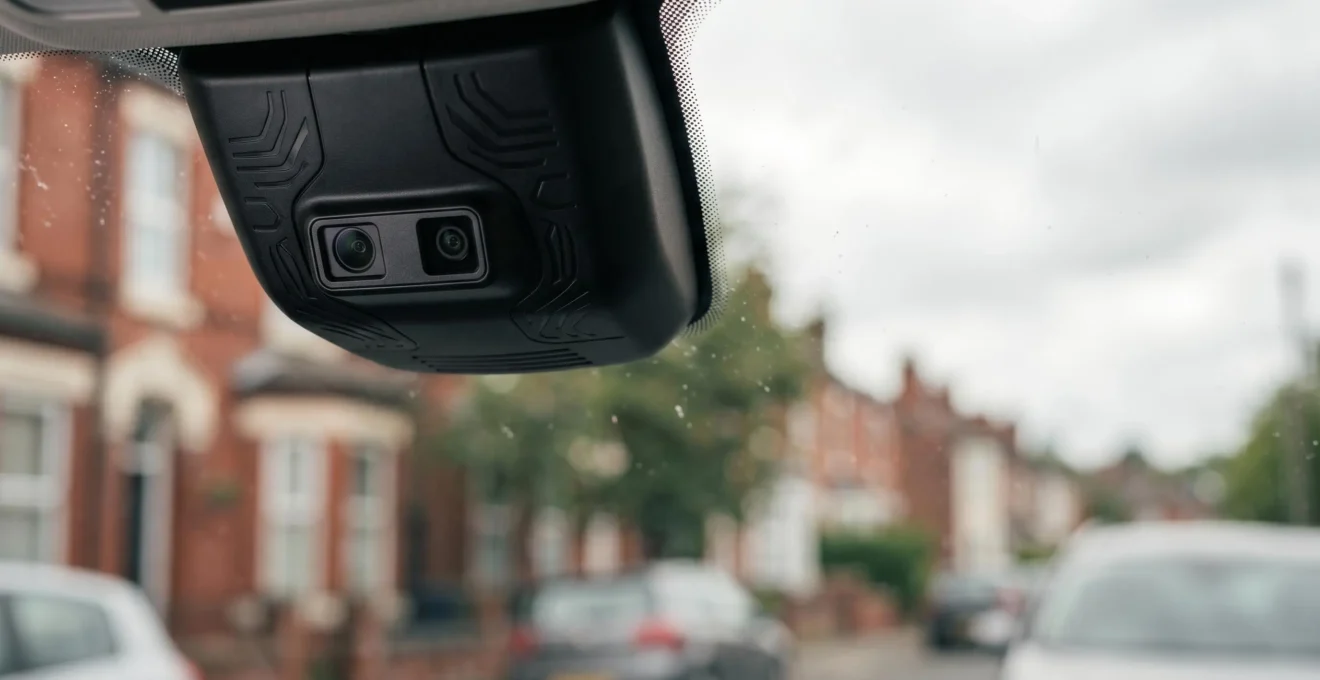
The modern car windscreen is no longer a simple piece of laminated glass; it’s a critical component of your car’s digital nervous system. Mounted behind it are the sophisticated cameras that serve as the primary ‘eyes’ for many of the Advanced Driver Assistance Systems (ADAS) mandated by GSR2, including Lane Keeping Assist and Autonomous Emergency Braking (AEB). These systems rely on millimetre-perfect alignment to accurately perceive the world, judge distances, and identify lane markings, other vehicles, and pedestrians.
When a windscreen is replaced, the camera is detached and then re-mounted. Even the slightest deviation from its original factory position—a difference of a single millimetre or a fraction of a degree in angle—can be magnified over distance, causing the system to ‘see’ the road incorrectly. This could lead to it failing to detect a hazard, or worse, reacting to a non-existent one. Calibration is the electronic process of re-aligning the camera’s viewpoint with the vehicle’s thrust line, ensuring what it sees is an accurate representation of reality.
Skipping this step might save a small amount in the short term, but it carries significant safety and financial risks. A misaligned system can lead to erratic behaviour and system failures. Furthermore, a minor collision can become extraordinarily expensive if it damages these integrated components. As Thatcham Research highlights in a detailed analysis of repair costs:
A 2023 study by Thatcham Research highlighted a low-speed frontal collision on a popular family SUV. The physical damage was minimal, but because it damaged a radar sensor, the total repair cost, including parts, paint, and calibration, exceeded £2,800.
– Thatcham Research, Wecovr ADAS Repair Costs UK Report 2026
Therefore, calibration isn’t an optional upsell; it’s a non-negotiable safety procedure essential for the correct functioning of your car’s most important safety features. Insisting on calibration after a windscreen replacement is crucial for your safety and financial well-being.
Do Emergency Braking Systems Actually Lower Your Insurance Premium?
The short answer is yes, but the mechanism is more indirect than a simple discount on your personal policy. Insurers don’t typically offer a line-item discount labelled “AEB Reduction.” Instead, the presence and effectiveness of a vehicle’s Autonomous Emergency Braking (AEB) system are now a fundamental factor in determining its overall insurance group rating, which in turn heavily influences the premium you pay.
The logic is simple: AEB systems are proven to reduce accidents. Research consistently shows that vehicles equipped with AEB are involved in significantly fewer rear-end collisions, one of the most common types of urban accidents. This reduction in claim frequency and severity makes the vehicle inherently less risky to insure. The key is standardisation and verified performance. Insurers needed a reliable way to know which systems actually worked as advertised.
This is where UK-based Thatcham Research plays a pivotal role. They are the authority responsible for testing and rating the effectiveness of these systems on behalf of the insurance industry. A car that performs well in Thatcham’s rigorous tests will be viewed more favourably. As confirmed by industry reports, this is now a formal part of the process, a development that benefits consumers through the group rating system.
According to an analysis by experts, the impact of this technology is undeniable. As noted in a key industry report, the Association of British Insurers has formalised this link: “The Association of British Insurers, which has authorised Thatcham Motor Insurance Research Centre to undertake all AEB testing to validate the effectiveness of individual systems, has now introduced AEB into its group rating calculations.” This means that choosing a car with a highly-rated AEB system directly contributes to a lower insurance group, and consequently, a lower premium over the long term.
Can You Legally Turn Off the Speed Limit Beep in New Cars?
This is one of the most talked-about and often misunderstood features of the GSR2 mandate. The system, known as Intelligent Speed Assistance (ISA), uses a forward-facing camera to read speed limit signs and cross-references this with GPS data. If you exceed the detected speed limit, the car will issue a warning—typically a visual alert on the dashboard followed by an audible chime or beep.
So, can you turn it off? Yes, you can. On most new vehicles, the ISA warning can be deactivated through the car’s infotainment menu or via a physical button. However, there is a crucial catch mandated by the regulation. As explained in a detailed breakdown by Fleet News, the system’s default state is ‘on’. This means that while you can turn it off for your current journey, it is legally required to automatically re-enable itself every time you restart the car.
The regulatory intent behind this is clear. Authorities want the system to be active as a default safety net, forcing a conscious decision from the driver to deactivate it on each trip. The goal is to nudge driver behaviour towards compliance with speed limits. The ‘why’ behind this push is sobering; EU road safety statistics have shown that speed is a factor in a vast number of road fatalities. The ISA system is a direct technological intervention aimed at tackling this persistent problem.
As highlighted in a Fleet News analysis, the core of the GSR2 requirement is this automatic reactivation: “It can be switched off but GSR2 requirements mandate that the feature is reenabled – automatically switched back on – every time the car is started. This is the key difference in GSR2 compliant vehicles versus existing vehicles which already possess a form of traffic sign recognition.” This “annoyance” is, from a regulatory perspective, a core feature designed to maximise the system’s safety impact by ensuring it is active for the majority of journeys.
Why Your Car Brakes for Shadows: Understanding Phantom Activations?
You’re driving on a clear road, there are no other cars around, and suddenly your car brakes sharply for no apparent reason. This unnerving experience is known as “phantom braking,” and it’s a known, albeit rare, side effect of Autonomous Emergency Braking (AEB) systems. It’s not that your car is haunted; it’s that its digital senses have misinterpreted the world. These systems work by combining data from radar and cameras—a process called sensor fusion—to build a picture of the road ahead.
The system’s software is programmed to analyse this data for patterns that indicate a potential collision. The challenge is that the real world is infinitely complex and messy. A phantom braking event occurs when the system’s algorithm incorrectly identifies a benign object as a threat. This is a classic engineering trade-off: if the system is too sensitive, it will have more false positives (phantom braking); if it’s not sensitive enough, it could miss a real hazard.
Common triggers for these false positives are often things that trick the car’s camera or radar. These can include:
- Sudden, dark shadows cast by bridges or overhanging trees, which the camera might see as a solid object.
- Low-hanging streetlights or large, reflective road signs that can confuse the radar.
- Metal manhole covers or expansion joints on bridges that can create a strong radar reflection.
- Adverse weather like heavy rain, dense fog, or direct, low-sun glare that can impair the camera’s vision.
This is a recognized issue across the industry, and safety investigations have documented hundreds of thousands of reported incidents. While automakers are constantly refining their software algorithms to better distinguish between real threats and false alarms, the phenomenon highlights the immense challenge of teaching a machine to perceive the world with the same nuance as a human driver.
How to Temporarily Disable Traction Control for Mud or Snow?
Traction Control Systems (TCS) and Electronic Stability Control (ESC) are life-saving technologies, designed to prevent wheelspin and skidding by reducing engine power or applying individual brakes. In 99% of driving situations, you should leave them on. However, there is one specific scenario where these systems can work against you: when you are stuck in deep snow, mud, or on ice.
In these low-grip situations, you sometimes need a controlled amount of wheelspin to dig through the loose surface and find purchase on the firmer ground beneath. A proactive TCS, however, will detect this wheelspin, interpret it as a loss of control, and cut the engine power precisely when you need it most. This can leave you completely immobile. For this reason, nearly all vehicles provide a way to temporarily disable the traction control system.
The process is straightforward, but it’s crucial to do it safely. You should only ever disable traction control when moving at a very low speed or when stationary, and only for the purpose of getting unstuck. Once you are back on a clear, gritted road, the system should be re-enabled for your safety. Many modern systems will even do this for you automatically once you exceed a certain speed (e.g., 30 mph). Finding the button and knowing the process before you get stuck is key.
Action Plan: Getting Unstuck with Controlled Wheelspin
- Ensure Safety: Only attempt this when your vehicle is stationary or moving below 5 mph. Never disable safety systems on a public road in normal conditions.
- Locate the Button: Find the traction control button on your dashboard or center console. It’s typically marked with a car icon and wavy “skid” lines beneath it.
- Press and Hold: A short press might only partially disable the system. For full deactivation, you often need to press and hold the button for 2-3 seconds until a warning light appears.
- Confirm Deactivation: Check for a corresponding warning light (usually the same icon as the button) to illuminate on your instrument cluster. This confirms the system is off.
- Proceed with Caution: Apply gentle and steady throttle to allow the wheels to spin slightly, clearing the snow or mud and helping the tires find grip. Avoid aggressive acceleration.
Who Tracks Your Location When You Connect Your Car to Smart City Grids?
The question of location tracking in modern vehicles is complex, touching on privacy, safety, and the evolving infrastructure of our cities. While the vision of cars constantly communicating with “smart city grids” is still largely in its infancy in the UK, the technological foundations for this are being laid by regulations like GSR2. The systems mandated—GPS for ISA, data recorders for accidents—create a vehicle that is more aware of its location and status than ever before.
Currently, the primary entities with potential access to your location data are the vehicle manufacturer (for telematics and connected services like remote start or stolen vehicle tracking), your smartphone (via Apple CarPlay or Android Auto), and your insurance company if you have a “black box” telematics policy. Direct, real-time connection to municipal “smart city grids” for traffic management is not a widespread reality for the average UK driver today.
However, the key consideration for UK drivers is the market’s structure. Even post-Brexit, many manufacturers opt not to create UK-specific software variants due to cost and complexity. This means UK cars often come with EU-specification software and hardware, which may include components designed for future Vehicle-to-Everything (V2X) communication. A legal analysis of GSR2’s impact on the UK noted that while the UK hasn’t formally adopted the regulation, market forces mean most vehicles sold here will be compliant anyway.
Therefore, while a city council isn’t actively tracking your commute via a smart grid today, you are driving a vehicle that is increasingly equipped with the hardware and software to make that possible in the future. The data is being generated; the question for society and regulators moving forward will be who gets to access it, for what purpose, and with what level of consent. For now, the “tracking” is primarily for the car’s own internal systems and the connected services you explicitly opt into.
Can Your Car Detect a Pedestrian’s Smartphone to Prevent a Collision?
This is an intriguing idea and a common misconception about how current pedestrian detection systems work. The simple answer is no: your car’s AEB system does not detect a pedestrian’s smartphone via Bluetooth or Wi-Fi to identify them as a person. The technology, while advanced, operates on more direct principles of sight and reflection.
Modern pedestrian AEB systems use the same sensor fusion of cameras and radar (or sometimes Lidar) as they do for detecting other vehicles. The camera identifies a shape that matches a pre-programmed library of human-like figures. The radar simultaneously measures the object’s distance, speed, and direction of travel. When both sensors agree that a pedestrian-shaped object is on a collision course, and the driver hasn’t reacted, the system intervenes.
The reason for this focus is stark. While modern cars are exceptionally good at protecting their occupants in a crash, these passive safety features do little for those outside the vehicle. Vulnerable Road Users (VRUs)—pedestrians, cyclists, and motorcyclists—remain disproportionately at risk on our roads.
KSI (killed or seriously injured) statistics amongst VRUs remain stubbornly high at more than 11,000 each year.
– Yousif Al Ani, Principal Engineer for ADAS, Thatcham Research
While future V2P (Vehicle-to-Pedestrian) technology might involve pedestrians’ phones broadcasting their location, today’s systems are entirely reliant on what the car can see and detect for itself. This is why system performance can be affected by factors like poor weather, low light, or if the pedestrian is partially obscured. It is not searching for a digital signal, but rather a visual and radar-based confirmation of a person in the path of the vehicle.
Key Takeaways
- GSR2 is a European regulation, but its mandatory safety technologies are standard in most new cars sold in the UK due to market integration.
- Features like Intelligent Speed Assistance (ISA) and Autonomous Emergency Braking (AEB) are designed to mitigate human error but can feel intrusive until you understand their purpose.
- Understanding the system’s logic (e.g., why windscreen camera calibration is vital or how traction control works) is key to avoiding frustration and potential high repair costs.
Smart Motorways: How V2X Could Finally Make Them Safe?
The debate around the safety of smart motorways in the UK is intense, largely focusing on the risks of breaking down in a live lane without a hard shoulder. While current solutions involve static cameras and human-operated signals, the future promised by GSR2’s technological trajectory points towards a more dynamic and automated solution: Vehicle-to-Everything (V2X) communication.
V2X is a technology that allows vehicles to communicate wirelessly with each other (V2V), with roadside infrastructure like traffic lights (V2I), and with other road users (V2P). In the context of a smart motorway, the benefit is immediate. A car that breaks down could instantly and automatically broadcast a digital “hazard” signal to all approaching vehicles, warning them of the stationary vehicle long before it becomes visible. It could also alert the motorway’s central control system, pinpointing the exact location for a faster response.
This creates a digital “hard shoulder” around the stranded vehicle, a layer of information that travels faster than the cars themselves. It moves the safety system from a reactive model (spotting a breakdown on a camera) to a proactive one (the breakdown announces itself). This is the kind of leap in safety that current infrastructure struggles to provide.
All the individual GSR2 systems—AEB, lane-keeping, data recorders—are stepping stones. They are building the foundation of sensors, processing power, and connectivity required for a fully cooperative V2X environment. This is all in service of a single, ambitious goal that underpins all modern road safety legislation: Vision Zero. This long-term objective aims for a transport system with zero fatalities and serious injuries by 2050. The beeps and interventions of today are the early dialect of a future language of total road awareness, where V2X could be the key to finally delivering on the safety promise of smart motorways.
Now that you understand the “why” behind your car’s new behaviours, the next logical step is to ensure your vehicle is always maintained to the highest safety standard. Whether it’s a windscreen replacement or a minor body repair, choose a service provider who understands the complexities of ADAS calibration and can guarantee your safety systems are functioning as the regulations intended.