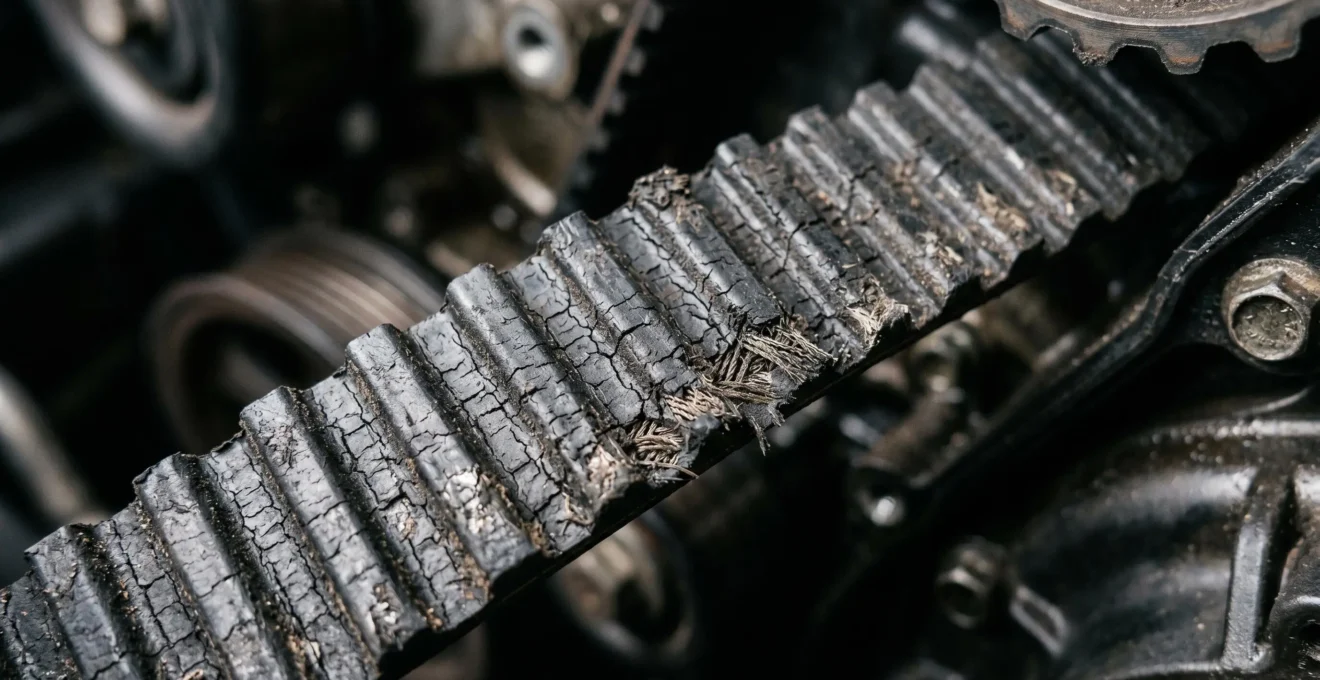
There’s a sound every seasoned mechanic dreads hearing from a customer’s car. It’s not a loud bang, but a quiet, high-pitched whine that seems to follow the engine’s RPM. For a car owner approaching that daunting 80,000-mile service, this sound is more than an annoyance; it’s the whisper of a potential £3,000 repair bill. Most drivers think about their timing belt only in terms of mileage, dutifully noting the manufacturer’s recommended service interval in their logbook. They believe hitting that 100,000-mile mark is the only trigger for this crucial maintenance.
I’ve been a mechanic for long enough to see the devastating results of this misunderstanding. I’ve seen immaculate, low-mileage cars towed in with destroyed engines, all because a part costing less than a new TV was neglected. The common advice is to “change it at the recommended interval,” but this barely scratches the surface. The real danger isn’t just the belt itself. It’s the cascade of failures that a weakening timing system can unleash, often with little to no warning.
The truth is that preventing catastrophic engine failure is about more than just watching the odometer. It’s about understanding the system as a whole—the belt, the tensioner, the water pump, and even the oil you use. This isn’t about scaring you into a service; it’s about shifting your perspective from simple mileage-based maintenance to a more holistic, risk-averse strategy. The real key isn’t just knowing *when* the belt might fail, but understanding the interconnected system that can cause it to snap prematurely.
This guide will walk you through the critical signs and hidden risks that most articles overlook. We will explore the mechanical realities of engine synchronization, the non-negotiable component replacements, the silent killer of rubber degradation, and the subtle sounds that signal imminent failure. By the end, you’ll understand your engine not as a collection of separate parts, but as an interconnected system where one small act of preventative maintenance can avert a financial disaster.
Summary: Decoding the Risks of Timing Belt Neglect
- Will a Snapped Belt Definitely Destroy Your Engine or Just Stop It?
- Why You Must Replace the Water Pump When Changing the Timing Belt?
- Why Low Mileage Cars Still Need a Belt Change Every 5 Years?
- That Whining Sound: Is Your Belt Tensioner Bearing Worn Out?
- Timing Chain vs Belt: Which One Really Lasts the Life of the Car?
- P0420 Code: Why Replacing the Sensor Might Not Fix Your Catalyst Fault?
- Why waiting 20,000 Miles for an Oil Change Is a Gamble with Your Turbo?
- 5W-30 vs 0W-20:The £3,000 Snap: How to Know When Your Timing Belt is About to Fail?
Will a Snapped Belt Definitely Destroy Your Engine or Just Stop It?
This is the most critical question, and the answer separates a major inconvenience from a financial catastrophe. The outcome depends entirely on your engine’s design: interference or non-interference. A non-interference engine is the lucky exception; if the timing belt snaps, the engine simply stops. The pistons and valves operate in separate spaces, so they never collide. The repair, while not cheap, involves re-timing the engine and installing a new belt kit.
However, most modern engines are interference engines, designed for higher compression and efficiency. Here, the pistons and valves share the same space in the cylinder, but at different times, perfectly synchronized by the timing belt. When that belt snaps, the synchronization is lost in milliseconds. The crankshaft keeps spinning for a few more rotations, pushing pistons upwards, while the camshafts stop, leaving some valves open in their path. The result is a brutal collision: pistons slam into the open valves, bending them, cracking pistons, and sometimes destroying the entire cylinder head. This is the “£3,000 snap,” and often, the cost to repair it exceeds the value of the car.
Case Study: The Borescope Confession
After a timing belt failure, the difference between a £800 bill and a £3,000+ bill is whether the pistons and valves have collided. Mechanics use a diagnostic technique involving a borescope camera, inserted through the spark plug holes, to visually inspect for damage. This allows a technician to see the tell-tale “witness marks” on piston tops where they’ve impacted the valves, or even see the bent valves themselves. This method provides definitive proof of an interference engine’s catastrophic failure, empowering you with a clear diagnosis before committing to a full engine teardown.
Even a belt failure at idle speed on an interference engine isn’t safe; it can cause hidden damage like slightly bent valves that lead to a gradual loss of compression and poor performance down the road. The risk is simply too high to ignore.
Why You Must Replace the Water Pump When Changing the Timing Belt?
“My mechanic wants to charge me extra to replace the water pump. Is he ripping me off?” I hear this question all the time. The answer is an emphatic no. Declining the water pump replacement during a timing belt service is one of the most common and costly mistakes a car owner can make. In many engines, the timing belt drives the water pump. This means that to access the pump, a technician must perform the exact same labour-intensive job as replacing the timing belt itself—removing covers, pulleys, and the belt.
The water pump and the timing belt tensioner bearing are wear-and-tear items with similar lifespans to the belt. The logic is simple: if you are already paying for 3-5 hours of labour to access a 7-year-old belt, you must replace the 7-year-old water pump and tensioner sitting right next to it. If you don’t, you are starting a new countdown. The old pump’s bearing could fail six months later, seizing up or leaking coolant directly onto your brand-new timing belt. Coolant contamination rapidly degrades the rubber, causing premature failure.
As the AutoZone Technical Staff wisely puts it in their “Timing Belt Replacement Costs and When to Replace Guide”:
There is nothing worse than paying for a timing belt service, declining the water pump replacement for an additional $100, only to find out 6 months later that the water pump is leaking.
– AutoZone Technical Staff, Timing Belt Replacement Costs and When to Replace Guide
The minor cost of the water pump part itself is an insurance policy against paying for the entire labour charge a second time. This is the definition of “false economy.” A complete timing belt kit, including the belt, tensioner, idler pulleys, and water pump, resets the clock on the entire system.
This “Cost of Deferral” is not theoretical. As this analysis shows, skipping the pump initially almost guarantees a higher total cost within a short period.
| Replacement Strategy | Initial Cost (2026) | Risk Factor | 18-Month Total Cost |
|---|---|---|---|
| Belt-only replacement | $600 – $900 | High (pump failure likely) | $1,400 – $2,100 (belt + later pump labor) |
| Full kit (belt, pump, tensioner) | $1,200 – $1,500 | Low (all components new) | $1,200 – $1,500 (one-time cost) |
| Deferred pump replacement scenario | $600 – $900 (initial) | Very High | $1,600 – $2,300 (duplicate labor costs) |
| Labor cost savings when replacing water pump with timing belt: approximately $400 versus separate replacement | |||
Why Low Mileage Cars Still Need a Belt Change Every 5 Years?
This is a concept many car owners struggle with. “My car only has 40,000 miles, but it’s eight years old. The manual says 100,000 miles. I’m safe, right?” Wrong. This is a dangerous assumption. Timing belts are made of reinforced rubber compounds, and like the tyres on your car, they are susceptible to degradation from age, regardless of use. The engine bay is a hostile environment, subjecting the belt to constant heat cycles, ozone, moisture, and potential chemical contamination from oil or coolant fumes.
Over time, the rubber becomes hard and brittle. Micro-cracks develop, and the internal fabric cords that provide strength can weaken. A belt that looks perfectly fine on the surface can be structurally compromised and ready to snap. This is why virtually every manufacturer provides both a mileage *and* a time interval for replacement. The rule is to replace it at whichever threshold comes first. While specific intervals vary, there’s a strong industry consensus that no rubber timing belt should be trusted beyond a certain age.
In fact, industry consensus sets a 7-year maximum, with many mechanics recommending an even more conservative 5-year interval for cars in harsh climates. As the technical experts at KML Belt explain:
A vehicle driven only 5,000 miles per year for 10 years has a belt that is a decade old — and despite its low mileage, that belt has been exposed to heat cycling, ozone, moisture, and chemical contamination for the full 10 years.
– KML Belt Technical Team, How Long Does a Rubber Timing Belt Last? Lifespan Guide
Think of it this way: a low-mileage, 10-year-old belt is far more dangerous than a high-mileage, 2-year-old belt. The risk is invisible and accumulates with each passing season. Ignoring the time-based interval is a gamble against chemistry and physics, and it’s a bet you will eventually lose.
That Whining Sound: Is Your Belt Tensioner Bearing Worn Out?
Of all the potential warning signs, a high-pitched whining or whirring sound that rises and falls with engine speed is the most classic symptom of a failing timing system component. While the belt itself is silent, the bearings within the tensioner and idler pulleys are not. These bearings are sealed units packed with grease, designed to last the life of the belt. However, over thousands of heat cycles, that grease can dry up or become contaminated.
When the grease fails, the metal ball bearings inside start to run dry. This creates friction, which generates heat and the characteristic high-pitched whine. This is not just a noise; it is the sound of a component in its death throes. If left unchecked, the bearing will eventually overheat and seize. A seized pulley can instantly shred the timing belt or cause it to jump time, leading to the same catastrophic engine damage as a snapped belt. Therefore, any new or unusual whining sound from the front of the engine demands immediate investigation.
The challenge is isolating the noise. The engine’s accessory belt (or serpentine belt) drives the alternator, power steering pump, and A/C compressor, all of which have bearings that can also fail and produce a similar whine. A good mechanic can distinguish between the two, but you can do some preliminary diagnosis yourself.
Action Plan: Diagnosing a Whining Noise in the Timing System
- Listen for RPM Correlation: Check if the whining sound’s pitch and volume increase proportionally as you rev the engine. This strongly suggests a failing bearing in a rotating component like a tensioner or idler.
- Test Cold vs. Hot: Note when the noise occurs. A bearing that whines only when the engine is cold may have thickened grease, while a whine that appears or worsens when hot indicates advanced wear and metal-on-metal contact.
- Check for Accessory Load Changes: If the noise changes or gets louder when you turn the steering wheel to full lock (loading the power steering pump) or switch the A/C on and off, the issue is more likely in the auxiliary belt system, not the timing belt system.
- Perform Stethoscope Isolation (with caution): A mechanic uses a stethoscope to pinpoint the exact source. You can simulate this by placing the tip of a long screwdriver against non-moving parts near the timing cover (like the engine block or bracket) and holding the handle to your ear. The noise will be loudest near the failing component. Never do this near moving parts.
- Understand the Failure Mechanism: Remember that sealed bearings fail because their internal grease breaks down from heat and time. This leads to dry metal-on-metal contact, creating the signature whine before the bearing seizes completely.
Timing Chain vs Belt: Which One Really Lasts the Life of the Car?
There’s a common belief that cars with timing chains are inherently superior because the chain “lasts the life of the car.” While a chain is certainly more durable than a rubber belt, this statement comes with a huge asterisk: its longevity is entirely dependent on meticulous oil maintenance. A timing chain is a metal, bicycle-style chain that runs inside the engine, lubricated by engine oil. A timing belt is a reinforced rubber belt that runs outside the engine and is a scheduled replacement item.
A well-maintained timing chain system can indeed last for a very long time, with some sources stating chains may not need attention until well over 200,000+ miles, unless symptoms like rattling appear. The system relies on hydraulic tensioners, which use oil pressure to keep the chain taut. Plastic or nylon guides are used to keep the chain tracking correctly. Herein lies the weakness: if oil changes are skipped or the wrong oil is used, sludge builds up. This sludge can clog the tiny passages in the hydraulic tensioner, causing it to lose pressure. A slack chain will rattle against the guides, eventually breaking them and leading to catastrophic failure.
So, which is better? It’s a trade-off between predictable costs and maintenance discipline. A timing belt has a finite life and represents a predictable, recurring expense. A timing chain has a theoretically infinite life but an unpredictable and very high failure cost if maintenance is neglected. The “life of the car” myth falls apart the moment an owner starts extending their oil change intervals.
This comparative table breaks down the true total cost of ownership for both systems, highlighting the critical role of maintenance.
| System Type | Scheduled Maintenance | Typical Cost Range | Failure Risk Profile | Total 200k Mile Cost |
|---|---|---|---|---|
| Timing Belt | Predictable: every 60-100k miles | $600 – $1,500 per service | Low if maintained; catastrophic if neglected | $1,200 – $3,000 (2-3 replacements) |
| Timing Chain (well-maintained) | None scheduled; oil changes critical | $0 (no routine replacement) | Very Low with proper oil maintenance | $0 – $500 (tensioner/guide maintenance) |
| Timing Chain (poorly maintained) | Irregular or skipped oil changes | $1,500 – $4,000 (failure repair) | High due to sludge, tensioner failure, guide breakage | $1,500 – $4,000+ (catastrophic failure) |
P0420 Code: Why Replacing the Sensor Might Not Fix Your Catalyst Fault?
A “P0420 – Catalyst System Efficiency Below Threshold” code is one of the most dreaded check engine lights, often signaling the need for an expensive catalytic converter replacement. The typical response is to blame the oxygen sensors or the converter itself. However, in a perfect example of a cascade failure, the root cause can sometimes be traced all the way back to a worn or stretched timing belt. This is a diagnostic fallacy many owners and even some technicians fall into: treating the symptom (the code) instead of the true underlying disease.
Here’s how the chain reaction happens: A timing belt doesn’t just snap; it can stretch over time. If it stretches enough to jump one tooth on the camshaft gear, the engine’s timing is now slightly retarded. This means the valves are not opening and closing at the optimal moment. The consequence is incomplete combustion. Not all the fuel injected into the cylinder burns properly. This unburnt fuel is then pushed out into the exhaust system.
Case Study: The Belt That Cooked a Converter
When unburnt fuel enters the exhaust, it doesn’t just disappear. It hits the catalytic converter, which operates at extremely high temperatures (400-800°C). The raw fuel ignites inside the converter, superheating its delicate internal honeycomb structure made of precious metals. This process, known as “after-ignition,” can cause the honeycomb to melt, clog, or crack. The downstream oxygen sensor detects that the converter is no longer cleaning the exhaust efficiently and triggers the P0420 code. A savvy mechanic, before recommending a £1,000+ converter replacement, will first verify the engine’s mechanical timing. Using a scanner to check the correlation between the crankshaft and camshaft position sensors can quickly reveal if the timing is off, pointing to a stretched belt as the real culprit.
Replacing the catalytic converter in this scenario without first fixing the timing belt is a complete waste of money. The new converter would simply be destroyed by the same unburnt fuel from the poorly timed engine. It’s a stark reminder that in a complex system like a car, one small issue in one area can manifest as a major, and misleading, problem somewhere else.
Why waiting 20,000 Miles for an Oil Change Is a Gamble with Your Turbo?
Modern car manufacturers often promote extended oil change intervals—sometimes up to 20,000 miles—as a selling point. For an engine with a timing chain or even a “wet belt” (a timing belt that runs in oil), this is one of the most dangerous gambles you can take. While this advice might apply to an engine with a traditional dry timing belt, it’s a recipe for disaster when oil is a key component of the timing system.
Engine oil doesn’t just lubricate; it also cools, cleans, and provides hydraulic pressure. Over time, it breaks down and becomes contaminated with combustion byproducts, forming a thick, gritty substance called sludge. This sludge is the mortal enemy of a timing chain system. As Rick’s Free Auto Repair Advice notes, “Sludge from missed oil changes can clog the tensioner, leaving the chain slack, which causes rattling and rapid wear.” That clogged tensioner means the chain isn’t held tight, allowing it to slap against its guides, causing wear and noise, particularly on cold starts.
The problem isn’t just with chains. Any oil leak, even a minor one from a valve cover gasket, can be fatal to a dry timing belt. The rubber used in timing belts is not designed to be oil-resistant. Oil contamination causes the rubber to swell, soften, and lose its structural integrity. An oil-soaked belt will quickly stretch, slip, or snap. In fact, reports show that oil or coolant contamination can cause timing belt failure in as little as 10,000 to 20,000 miles—a fraction of its normal lifespan. This is why addressing oil leaks around the front of the engine is not an aesthetic issue; it’s a critical preventative maintenance task.
For turbocharged engines, the stakes are even higher. The turbocharger’s bearings are lubricated by the same engine oil. Sludge can starve the turbo of oil, leading to catastrophic failure. A risk-averse approach dictates that for any engine, especially one with a turbo or a timing chain, oil changes should be performed much more frequently than the maximum manufacturer recommendation—typically every 5,000 to 7,500 miles, using the correct specification of synthetic oil.
Key Takeaways
- An interference engine will likely be destroyed if the timing belt snaps. There is no “limping home.”
- Replacing just the belt is false economy. The water pump and tensioner must be replaced at the same time to reset the clock on the entire system.
- Time is as destructive as mileage. A 5-year-old, low-mileage belt is a ticking time bomb and must be replaced.
5W-30 vs 0W-20:The £3,000 Snap: How to Know When Your Timing Belt is About to Fail?
If neglecting oil changes is a major risk, using the wrong *type* of oil can be just as destructive, especially in modern engines with timing chains. The numbers on a bottle of oil, like 5W-30 or 0W-20, represent its viscosity (resistance to flow) at cold and hot temperatures. Modern engines are designed with incredibly tight tolerances and rely on thinner oils (like 0W-20) that can flow quickly on a cold start to lubricate critical components immediately. The hydraulic timing chain tensioner is one of the most sensitive of these components.
Using a thicker oil than specified, such as putting 10W-40 in an engine designed for 0W-20, can have a direct and damaging effect. The thicker oil is too slow to build pressure when the engine is cold. This delay means the hydraulic tensioner doesn’t get pressurized instantly, leaving the timing chain slack for the first few critical seconds after a cold start. This is the source of the infamous “2-second rattle” that many owners of certain models report hearing. That rattle is the sound of the loose chain physically slapping against its plastic or nylon guides.
Case Study: Death by Wrong Viscosity
A customer’s car, designed for 0W-20 oil, was repeatedly serviced at a quick-lube shop that used a bulk 10W-30 oil. The owner noticed a brief rattle on cold mornings but dismissed it. Each cold start, however, was causing incremental damage. The slack chain was chipping away at the plastic guides. After 30,000 miles of this abuse, a piece of a guide rail broke off, fell into the timing case, and jammed the chain, causing it to jump several teeth. The result was bent valves and a multi-thousand-pound repair bill, all directly traceable to using oil that was too thick when cold. This directly links an incorrect oil choice to long-term, catastrophic engine failure.
This is not a theoretical problem. The choice of oil is not a matter of preference; it is a critical engineering specification. Using the exact viscosity and specification of oil recommended by your car’s manufacturer is one of the simplest and most effective ways to protect your timing chain system and ensure the longevity of your engine. The small amount of money saved by using a cheaper, incorrect oil is dwarfed by the potential cost of the damage it can cause.
Ultimately, safeguarding your engine from a catastrophic timing belt failure is not about finding a single secret or magic bullet. It’s about adopting a mechanic’s mindset: assume components will fail, understand their interconnectedness, and act proactively. By replacing the belt, water pump, and tensioner as a complete kit, respecting the time interval as much as the mileage, and using the exact right oil, you are not just performing maintenance; you are actively managing risk and making the single best investment in your vehicle’s long-term health.