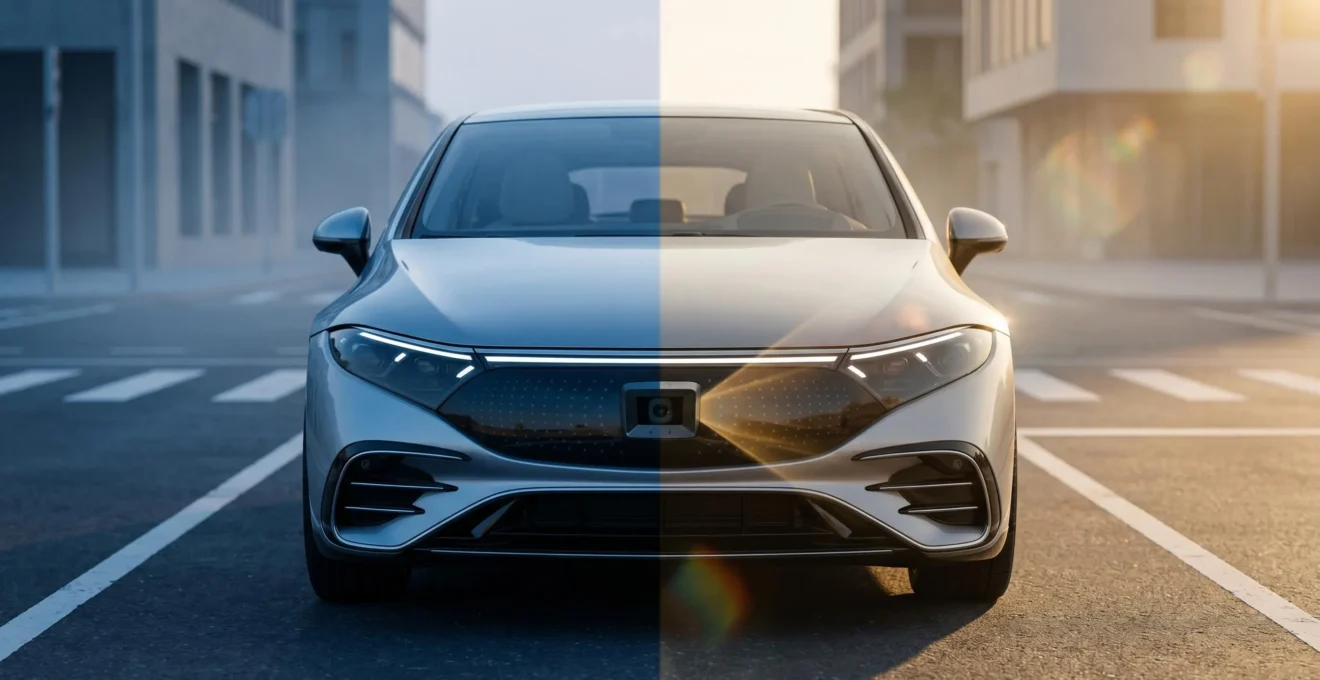
The debate isn’t about which sensor is ‘better’, but which system architecture best manages inevitable real-world failures.
- Camera-only systems struggle with direct depth perception and adverse conditions, creating reliability issues like phantom braking.
- LiDAR provides precise 3D mapping but has its own historical costs and performance limitations in severe weather that must be accounted for.
Recommendation: True safety relies on strategic redundancy—using multiple, different sensor types (Vision, LiDAR, Radar, V2X) so the predictable failure of one is covered by the strengths of another.
The debate over the best path to autonomous driving often boils down to a seemingly simple choice: cameras versus LiDAR. On one side, Tesla champions a “Vision-only” approach, arguing that cameras, paired with sophisticated AI, can replicate human sight and are all that’s needed. On the other, nearly every other automaker and tech company invests heavily in LiDAR (Light Detection and Ranging), insisting that its laser-based 3D mapping is non-negotiable for safety. This public discourse is filled with simplified arguments about cost and all-weather performance, often missing the core engineering principles at stake.
From an autonomous systems engineer’s perspective, the conversation isn’t about picking a single winning sensor. It’s about deeply understanding the fundamental limitations and failure modes of each technology. The real challenge is designing a system that is robust enough to handle the inevitable “edge cases”—the sudden glare, dense fog, or ambiguous shadows that can fool any single sensor. This article moves beyond the marketing hype to provide an engineering-focused analysis. We will dissect the critical trade-offs, explore why systems fail, and reveal how true safety is not a matter of a single sensor’s supremacy, but of intelligent, multi-layered redundancy.
This guide will explore the core technical and practical questions that define the current state of autonomous sensor technology. By examining cost, performance in adverse conditions, legal liabilities, and the evolution of the hardware itself, you will gain a clearer understanding of the engineering challenges and the path toward a genuinely safe autonomous future.
Summary: Tesla Vision vs. LiDAR: An Engineer’s Analysis of Autonomous Safety
- Why Does Adding LiDAR Tech Add £5,000 to the Car’s Price Tag?
- Can LiDAR See Through Fog Better Than Cameras or Radar?
- Level 3 Autonomy: When Can You Legally Take Your Eyes Off the Road?
- Why Do LiDAR Cars Have That Ugly Bump on the Roof?
- Luminar vs Valeo: Who Makes the Eyes for Your Next Car?
- Why Your Car Brakes for Shadows: Understanding Phantom Activations?
- Can Your Car Detect a Pedestrian’s Smartphone to Prevent a Collision?
- Smart Motorways: How V2X Could Finally Make Them Safe?
Why Does Adding LiDAR Tech Add £5,000 to the Car’s Price Tag?
The perception that LiDAR is prohibitively expensive is one of the most enduring arguments against its widespread adoption, but this view is rapidly becoming outdated. While early mechanical LiDAR units used in research vehicles did cost tens of thousands of pounds, the industry is undergoing a dramatic cost reduction driven by technological evolution and manufacturing scale. The £5,000 figure is a relic of the past; the reality is that prices are plummeting.
The primary driver of this change is the shift from bulky, mechanical rotating scanners to compact, solid-state systems. These new designs have fewer moving parts, making them more reliable and far easier to manufacture at scale. Industry announcements confirm this trend, with reports that single long-range LiDAR unit prices have dropped to only $150 to $200 in China. This is not a distant future projection; it’s a current market reality that dismantles the high-cost argument.
This cost-down engineering is a deliberate strategy to make LiDAR a standard safety feature, not a luxury add-on. As the Kyber Photonics Team noted in an IEEE Spectrum article, the industry’s goal is to produce LiDAR systems that are “around the size of a wallet” and “cost one hundred dollars.”
Case Study: Luminar’s Cost Reduction Roadmap
Luminar, a key supplier for automakers like Volvo, provides a clear example of this trajectory. Their current-generation Iris sensor is estimated to cost roughly $1,000. However, their next-generation “Halo” series, planned for 2026, aims to be just one inch tall, consume minimal power, and cost only $500. This 50% cost reduction in just a few years demonstrates how quickly solid-state technology is making high-performance LiDAR economically viable for mass-market vehicles.
Ultimately, the high price tag is a myth rooted in first-generation technology. The modern LiDAR industry is aggressively pursuing a low-cost, high-volume model that will make these sensors a ubiquitous part of the automotive safety landscape, much like airbags and ABS.
Can LiDAR See Through Fog Better Than Cameras or Radar?
This question gets to the heart of a critical engineering concept: every sensor has an Achilles’ heel. While LiDAR creates a beautifully detailed 3D map of the world in clear conditions, its performance significantly degrades in adverse weather like fog, heavy rain, or snow. The short answer is no; LiDAR does not “see through” fog better than radar. In fact, it is often the most affected sensor in the autonomous suite.
The reason lies in physics. LiDAR works by emitting pulses of light and measuring the time it takes for reflections to return. Fog consists of suspended water droplets that scatter and absorb this light, drastically reducing the sensor’s effective range and the density of its “point cloud.” An empirical analysis found that in thick fog, LiDAR’s ability to detect common materials like aluminum and steel could drop to zero at distances of just 20–30 meters, though retroreflective materials preserved at least 74% of LiDAR point cloud data. This makes relying solely on LiDAR in poor weather a significant safety risk.
This is where sensor redundancy becomes paramount. Unlike light-based systems, radar uses radio waves that are largely unaffected by fog, dust, or precipitation. As the technical team at ifm explains, “Radar detects objects through fog, clouds, precipitation, and dust. LiDAR struggles in adverse weather.” While radar lacks the high resolution of LiDAR and cannot classify objects as effectively as a camera, its ability to reliably detect the presence and velocity of a large metallic object (like a car) through a wall of fog is its unique, life-saving strength.
Therefore, a robust system doesn’t ask which sensor is “better” in fog. It uses all of them, understanding that the camera and LiDAR will be compromised, and elevates the radar’s simpler but more reliable signal to maintain situational awareness. This is the essence of a safe, all-weather autonomous system.
Level 3 Autonomy: When Can You Legally Take Your Eyes Off the Road?
Level 3 (L3) autonomy represents a pivotal—and legally complex—shift in the relationship between driver and vehicle. Defined as “Conditional Automation,” it is the first level where the driver is not expected to be in constant control. You can legally take your eyes off the road, but only when the system is active and within its strict operational limits. The most critical distinction of L3 is that “at L3, legal liability shifts to the manufacturer while the system is active.” This single fact dictates the cautious and limited deployment of L3 systems today.
Because the automaker assumes legal responsibility for the car’s actions, L3 systems are designed with an extremely narrow Operational Design Domain (ODD). This refers to the specific set of conditions—such as road type, speed, weather, and time of day—under which the system is certified to operate safely. If any of these conditions are not met, the system will not activate or will demand the driver take back control.
Case Study: The Narrow ODD of Mercedes-Benz DRIVE PILOT
The Mercedes-Benz Drive Pilot is one of the first certified L3 systems available. However, its ODD highlights the industry’s cautious approach. As seen in the cautious rollout of Mercedes-Benz Drive Pilot, the system is confined to specific, pre-mapped highways, operates only in traffic jam conditions at speeds up to 60 km/h (40 mph), and requires clear weather and daylight. These severe limitations are not due to a lack of technical capability but are a direct consequence of the manufacturer assuming liability. The automaker must be virtually certain the system will not fail within this domain.
So, when can you take your eyes off the road? Only in very specific, low-speed, clear-weather traffic jams on approved highways. While this may seem underwhelming, it’s a necessary first step. As technology improves and real-world data accumulates, these ODDs will gradually expand. However, the prospect of hands-off, eyes-off driving on any road in any condition remains a distant, post-L3 reality, with some estimates suggesting that by 2030, up to 10% of new global car sales could be L3 vehicles.
Why Do LiDAR Cars Have That Ugly Bump on the Roof?
The prominent “bump” or “hump” seen on the roof of many early autonomous development vehicles is a direct result of the first generation of LiDAR technology. These were mechanical LiDAR units, which, as Hesai Technology explains, “can conduct 360-degree scanning of the surroundings” by physically spinning an array of lasers and detectors at high speed. To get an unobstructed, 360-degree view of the environment, the highest point on the vehicle—the roof—was the only logical mounting location.
This design, while effective for data collection, came with significant drawbacks for production vehicles. The spinning mechanism was complex, expensive, and susceptible to mechanical wear and tear. Aesthetically, the roof-mounted “can” was a non-starter for consumer vehicles, and it also introduced significant aerodynamic drag, which is particularly undesirable for electric vehicles where efficiency is paramount.
The “ugly bump” is now rapidly disappearing thanks to the advent of solid-state LiDAR. Unlike their mechanical predecessors, solid-state lidars have no moving parts. They steer the laser beam electronically, which makes them far more compact, robust, and affordable. However, this comes with a trade-off: a single solid-state unit typically has a much smaller field of view (often 120 degrees or less) compared to the 360-degree coverage of a mechanical unit.
Case Study: The Shift to Integrated Solid-State LiDAR
The modern solution, as detailed in analyses of the technology, is to abandon the single, central sensor in favor of distributing multiple solid-state units around the vehicle. Automakers now seamlessly integrate three or four of these smaller, non-rotating sensors into the grille, front fenders, and rear bumper. This approach achieves the necessary 360-degree coverage without the aesthetic and aerodynamic penalties of a roof-mounted unit. The total cost of these multiple sensors is often still lower than a single, older mechanical unit, showcasing a clear win for both design and engineering.
The bump on the roof, therefore, is a visual artifact of a previous technological era. Its disappearance is a clear sign of LiDAR’s maturation into a technology that is ready for seamless integration into mass-produced consumer cars.
Luminar vs Valeo: Who Makes the Eyes for Your Next Car?
As LiDAR becomes a mainstream automotive component, the market is not a monolith. Instead, a few key players are emerging with distinct strategies and technologies, targeting different segments of the autonomous driving market. Two of the most significant are Luminar and Valeo, and understanding their differences reveals the engineering trade-offs at the heart of the industry. The market they compete in is substantial; industry analysts predict the automotive lidar sector will reach $3.6 billion by 2029, a massive increase from its 2023 valuation.
The choice between a supplier like Luminar and one like Valeo is not a simple question of which is “better.” It’s a strategic decision by an automaker based on their specific goals: are they aiming for high-end, long-range Level 3+ autonomy, or are they focused on deploying cost-effective, high-volume advanced driver-assistance systems (ADAS)? The following comparison highlights their divergent approaches.
| Specification | Luminar (High-End Autonomy) | Valeo SCALA 2 (Mass-Market ADAS) |
|---|---|---|
| Wavelength Technology | 1550nm (eye-safer, higher power) | 905nm (standard, cost-effective) |
| Detection Range | Long-range (250m+ for L3/L4) | Shorter-range (optimized for ADAS) |
| Target Market | Premium vehicles (Volvo, Mercedes) | Mass-market safety systems |
| Key Components | Proprietary 1550nm laser system | 905nm IR laser (Excelitas), APD array (Hamamatsu) |
| Strategic Focus | True autonomy capabilities | Widespread driver assistance |
Luminar has focused on the high-performance end of the spectrum with its 1550nm wavelength technology. This allows them to use a more powerful laser that is still safe for the human eye, resulting in superior range (over 250 meters) and performance, making it a preferred choice for automakers like Volvo and Mercedes pursuing true “hands-off” capabilities. Valeo, on the other hand, has mastered the 905nm wavelength, a more mature and cost-effective technology. Their SCALA series is a market leader, designed to enhance ADAS features like emergency braking and adaptive cruise control for the mass market. It’s about making millions of cars safer, rather than enabling full autonomy on a select few.
Ultimately, both companies are likely to succeed. Your next car’s “eyes” might be from Luminar if it’s a premium model with L3 ambitions, or from Valeo if its focus is on providing robust, accessible safety features. The market is large enough for both philosophies.
Why Your Car Brakes for Shadows: Understanding Phantom Activations?
Phantom braking—where an autonomous or semi-autonomous vehicle brakes suddenly and sharply for no apparent reason—is a jarring and potentially dangerous failure of a car’s perception system. This issue is most prominently associated with camera-only systems, and it exposes the fundamental weakness of relying on a single sensor type: a lack of robust, direct distance measurement.
A camera system does not “see” depth in the way a human does. It processes a 2D image and uses complex AI algorithms to infer depth and identify objects. This process is computationally intensive and can be easily confused by high-contrast lighting, ambiguous shadows, or unusual visual information. A dark shadow cast by an overpass on a bright day can be misinterpreted by the AI as a solid, stationary obstacle, triggering the automatic emergency braking system. This is a classic example of an edge case where the system’s interpretation of reality diverges dangerously from the truth.
The problem is serious enough that U.S. regulators have taken notice. As reported in 2026, the National Highway Traffic Safety Administration (NHTSA) escalated its investigation into Tesla Full Self-Driving, opening an “engineering analysis” to specifically evaluate how camera visibility is degraded by roadway conditions like glare. As one TechTimes analysis noted, “In contrast to LIDAR and radar systems… Tesla’s camera-only system falters in adverse conditions.”
This is where a multi-sensor suite including LiDAR and radar provides crucial redundancy. LiDAR does not interpret; it measures. It floods the scene with laser pulses and generates a geometrically precise 3D point cloud. To a LiDAR sensor, a shadow on the road is non-existent because the laser pulses simply travel through it and reflect off the road surface itself. The system receives unambiguous data: the road is flat and clear. By fusing the LiDAR data (confirming no physical obstacle) with the camera data (which sees a dark patch), the system can correctly identify the shadow and ignore it, preventing a phantom braking event.
Phantom braking is not just a software bug; it is a systemic vulnerability of a perception system that lacks a direct, reliable method of measuring distance to objects. It is a powerful argument for the necessity of sensor fusion and redundancy.
Can Your Car Detect a Pedestrian’s Smartphone to Prevent a Collision?
The debate between Vision and LiDAR often focuses on line-of-sight sensors, but a new layer of safety technology is emerging that operates beyond what the car can “see.” This is the realm of Vehicle-to-Everything (V2X) communication, and one of its most promising applications is the ability for a car to detect a pedestrian even when they are completely hidden from view.
This is made possible by Vehicle-to-Pedestrian (V2P) technology. The core idea is simple but powerful: modern smartphones are equipped with communication technologies like Wi-Fi, Bluetooth, and cellular radios (including 5G). V2P standards allow a pedestrian’s smartphone to broadcast a standardized, anonymous safety message. A nearby vehicle equipped with a compatible V2X receiver can pick up this signal, instantly becoming aware of the pedestrian’s presence, location, and trajectory.
As a technical analysis from the National Center for Biotechnology Information describes, “Vehicle-to-Pedestrian (V2P) communication… allows a car to receive a direct digital signal from a pedestrian’s smartphone, making the car ‘aware’ of them even if completely obscured from view.” This is a paradigm shift for safety. Imagine a scenario where a child is about to run into the street from between two parked cars. No camera, LiDAR, or radar could detect them until it’s too late. With V2P, the car would have already received a digital “ping” from the child’s parent’s smartphone, alerting the autonomous system to a potential hazard in a non-line-of-sight (NLOS) situation.
This technology is not a replacement for onboard sensors. A car cannot brake for a smartphone; it must still use its cameras and LiDAR to visually confirm and track the pedestrian once they become visible. However, V2P acts as an invaluable early-warning system. It provides a layer of digital redundancy that complements physical sensors, giving the vehicle critical extra moments to slow down and prepare for a potential collision. It transforms the safety equation from purely reactive (detecting what is visible) to proactive (anticipating what is not yet visible).
Key Takeaways
- LiDAR’s cost is no longer a barrier; solid-state technology is making it affordable for mass-market vehicles.
- No single sensor is perfect. A safe system requires redundancy: Radar for severe weather, LiDAR for 3D precision, and Cameras for object classification.
- True Level 3 autonomy is severely restricted by legal liability, leading to very narrow Operational Design Domains (ODDs) focused on low-risk scenarios.
Smart Motorways: How V2X Could Finally Make Them Safe?
The concept of the “smart motorway” has been controversial, primarily because removing the hard shoulder creates a high-risk scenario when a vehicle becomes stranded in a live lane. Onboard sensors can only react to a stopped vehicle once it comes into view, which is often too late. Vehicle-to-Everything (V2X) communication offers a systemic solution, transforming the motorway from a collection of isolated vehicles into a cooperative, intelligent network.
V2X is not a single technology but a suite of communication protocols that allow vehicles to talk to each other and to the infrastructure around them. It provides the “digital senses” that can see around corners, through traffic, and miles down the road. Instead of relying solely on what a single car’s sensors can perceive, it leverages the collective awareness of the entire system. This creates multiple layers of proactive safety that are impossible to achieve with onboard sensors alone.
The potential for V2X to mitigate the inherent dangers of smart motorways is immense. By providing advanced warning of hazards long before they are physically visible, it gives both human drivers and autonomous systems the one thing they need most in an emergency: time. It is the ultimate expression of system-level safety, where the solution lies not in a better sensor, but in a smarter, more connected environment.
Action plan: The Three Layers of V2X for Smart Motorway Safety
- V2I (Vehicle-to-Infrastructure): Traffic management centers and gantries broadcast real-time hazard warnings directly to connected vehicles, alerting them to stranded vehicles, lane closures, or accidents before on-board sensors can detect the danger.
- V2V (Vehicle-to-Vehicle): When a vehicle brakes suddenly, it instantly transmits a ‘hard braking’ alert to following vehicles, allowing them to begin emergency braking before drivers see brake lights or sensors detect deceleration. A stranded vehicle could broadcast a continuous “hazard” signal.
- Standardization Challenge: The primary obstacle remains the lack of a universally adopted communication protocol (e.g., DSRC vs. C-V2X) and regulatory framework, preventing vehicles from ‘speaking the same language’ and making cooperative safety systems ineffective until resolved.
To truly evaluate the safety of any autonomous system, the next step is to look beyond the marketing and ask the critical question: how does it handle failure? Scrutinize the sensor suite for genuine redundancy and demand transparency on its Operational Design Domain.