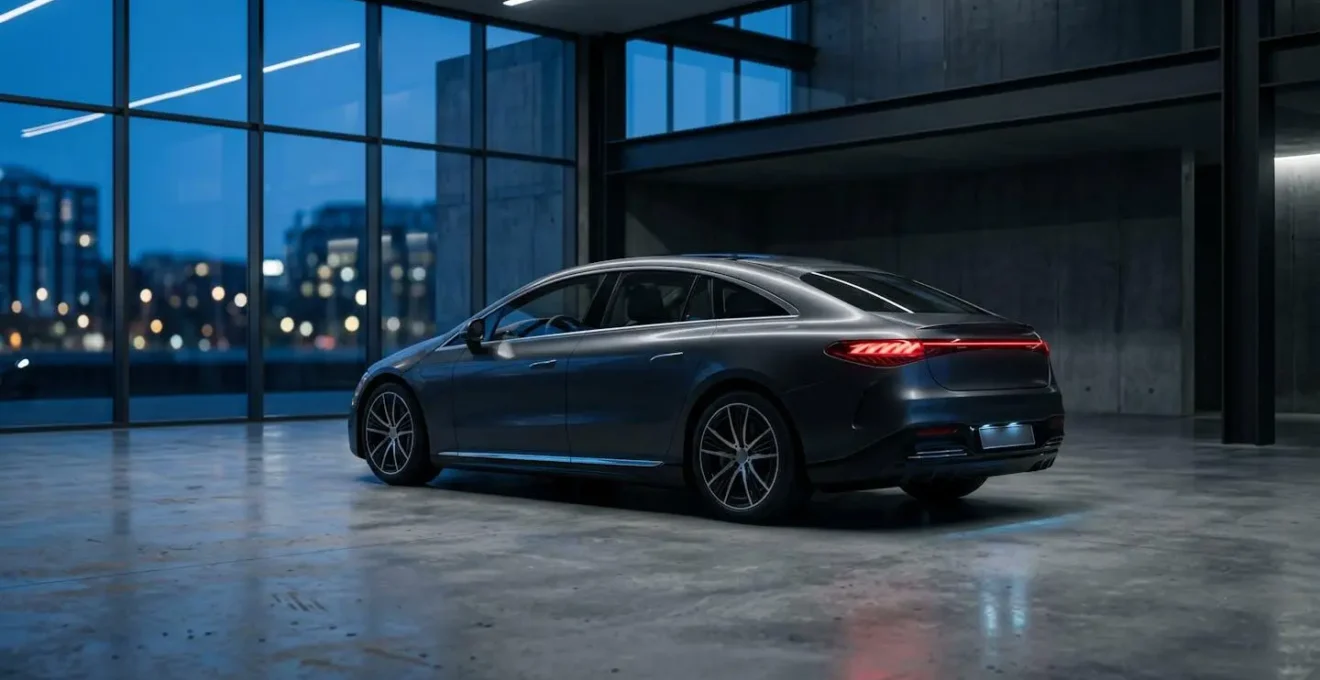
The shift you felt in your car’s handling wasn’t an anomaly; it was a scheduled software release that fundamentally re-engineered its performance characteristics.
- Modern vehicles are versioned products, where Over-the-Air (OTA) updates modify everything from infotainment (SOTA) to core firmware controlling the powertrain and suspension (FOTA).
- Each update is a deliberate change with a purpose, akin to software release notes, designed to improve efficiency, fix bugs, or patch critical security vulnerabilities.
Recommendation: Treat your car’s software updates with the same attention as its mechanical service. Understand that you are no longer driving a static machine, but a dynamic, evolving piece of software on wheels.
You park your performance car at night, and it drives perfectly. The next morning, you notice something is different. The suspension feels a touch firmer, the throttle response seems recalibrated, or the gear shifts are subtly smoother. You haven’t been to a mechanic, so what happened? The answer lies in a silent, overnight process: an Over-the-Air (OTA) software update. Many owners associate these updates with new streaming apps or user interface tweaks on the main screen. Brands like Tesla, Ford, and VW have normalized this process. However, this view only scratches the surface.
The core of the issue is a paradigm shift. We must stop thinking of a car as a finished mechanical object and start seeing it as a versioned product, much like a smartphone’s operating system. The feeling that your car “changed” is correct, because it did. A new version of its core software was deployed, containing adjustments that can be as profound as changing the damping rates of the adaptive suspension or altering the torque delivery map of the electric motors. This isn’t a bug; it’s a feature of the modern Software-Defined Vehicle (SDV).
But if this is the new reality, what does it mean for you, the owner? It means understanding the “release notes” for your vehicle is now as important as knowing its oil change interval. This article will deconstruct the reality of OTA updates from the perspective of a software release manager. We will explore how these updates work, the risks involved, their impact on modifications, and why the future of automotive performance is inextricably linked to code. We will go beyond the superficial features and dive into the firmware that defines your driving experience.
This guide breaks down the critical aspects of Over-the-Air updates, providing a clear roadmap to understanding how your vehicle evolves long after it leaves the factory. The following sections will equip you with the knowledge to navigate this new automotive landscape with confidence.
Summary: OTA Updates: How Your Car Can Change Handling Characteristics Overnight?
- What to Do If Your Car Won’t Start After a Failed Nightly Update?
- Do You Need Home Wi-Fi in the Garage to Update Your Car?
- Why You Should Never Skip a Security Patch Update on Your Car?
- Will an OTA Update Wipe Your £500 ECU Remap?
- How Long Will Manufacturers Release Updates for Your 2024 Car?
- Why Your Car Needs a Software Update Instead of a New Gearbox?
- Why One Central Computer is Better Than 100 Small Chips in Your Car?
- Software Defined Vehicles: Why Your Next Car Will Be More Like an iPhone?
What to Do If Your Car Won’t Start After a Failed Nightly Update?
The most unnerving experience for a modern car owner is a failed software deployment. You wake up to a vehicle that is unresponsive—a “bricked” multi-ton piece of technology. While alarming, it’s a known risk in software release management. Industry analysis suggests that 15-20% of OTA updates in the automotive sector encounter some form of deployment failure, ranging from minor glitches to a complete non-start condition. These failures can be caused by a momentary loss of connectivity, low battery voltage, or a bug in the update package itself.
This scenario highlights the importance of robust recovery systems. In November 2023, Rivian famously deployed an incorrect OTA update that temporarily disabled infotainment and driver displays across a portion of its fleet. However, the issue was resolved within 36 hours via a corrective OTA “hotfix.” This was possible because modern vehicles often use an A/B partition system. The update installs on a secondary, inactive partition of the car’s computer. If the update succeeds, the system reboots to the new version. If it fails, it can revert to the previous, stable version on the primary partition. When this automatic rollback fails, manual intervention is required. This is a crucial element of the diagnostic process after a failed update.
When faced with a car that won’t start after an update, resist the urge to perform a hard reset or disconnect the 12V battery unless instructed by the manufacturer. Your first steps should be methodical, treating it as a software issue, not a mechanical one. The data from your vehicle’s failed attempt is invaluable for engineers to diagnose the root cause and deploy a targeted fix. The following checklist outlines a safe and effective course of action.
Action Plan for a Failed Vehicle Update
- Check the Basics: Before assuming the worst, verify the vehicle’s 12V battery has adequate voltage. A weak battery is a common cause of update failure.
- Document Everything: Use your phone to take clear photos or videos of any error messages or symbols displayed on the instrument cluster or infotainment screen. This is crucial evidence for the support team.
- Consult the Manual: Check the digital or physical owner’s manual. Manufacturers often include a section on OTA updates with explanations for specific error codes.
- Contact Official Support: Use the manufacturer’s dedicated mobile app or roadside assistance helpline to report the failed update. Provide the error messages you documented.
- Await a Corrective Patch: Do not attempt to force a restart repeatedly. The engineering team is likely already aware of the issue and working on a remote fix, which will be pushed to your car automatically.
Do You Need Home Wi-Fi in the Garage to Update Your Car?
The simple answer is, for major updates, yes. While your car’s built-in cellular connection is sufficient for small data packets like traffic updates or remote lock/unlock commands, it is often inadequate for downloading large software packages. These files can be several gigabytes in size, and a stable, high-bandwidth connection is critical to ensure data integrity during the download process. As Tesla’s official documentation states, “In most cases, your vehicle must be connected to Wi-Fi to download the software update.” This isn’t just a suggestion; it’s a core requirement for a successful deployment.
From a release manager’s perspective, relying on a stable Wi-Fi network minimizes the risk of a corrupted download. A cellular signal can fluctuate in a garage, leading to dropped packets and an incomplete file. To combat this, automotive systems employ sophisticated techniques similar to those used in enterprise software delivery. These include:
- Update file segmentation: The large update is broken into smaller, manageable chunks. If the connection drops, the download can resume from the last successfully received chunk rather than starting over.
- Progressive downloading: The system dynamically adjusts the data transfer rate based on network strength to maintain a stable flow.
- Local caching: The entire update file is downloaded and stored locally on the vehicle’s computer first. An integrity check (checksum) is performed to ensure the file is 100% correct before the installation process is even allowed to begin.
Therefore, having a strong and reliable Wi-Fi signal reaching your garage is not just a matter of convenience; it’s a fundamental part of the update deployment infrastructure. If your home Wi-Fi doesn’t reach your parking spot, consider a Wi-Fi range extender or a mesh network system. This small investment in your home network is a direct investment in the long-term health and functionality of your vehicle.
Why You Should Never Skip a Security Patch Update on Your Car?
Skipping a security patch on your computer or phone is risky; skipping one on your car is reckless. A modern vehicle is a complex network of computers on wheels, with some high-end models containing more than 100 million lines of code according to Carnegie Mellon University’s Software Engineering Institute. Every line of code represents a potential attack surface, a possible vulnerability that could be exploited by malicious actors. Unlike a computer, a compromised vehicle has direct control over physical systems that affect your safety and the safety of others.
The most visceral demonstration of this threat remains the 2015 Jeep Cherokee hack. Security researchers Charlie Miller and Chris Valasek demonstrated that they could remotely gain control of a moving vehicle on a highway. From their laptop miles away, they were able to manipulate the steering, disable the brakes, and control the engine. This wasn’t science fiction; it was a real-world exploitation of a software vulnerability. The incident led Fiat Chrysler to issue a physical recall for 1.4 million vehicles to apply a patch. Today, that same patch would be delivered silently overnight via an OTA security update.
When a manufacturer issues a security update, it is because their internal teams or external researchers have discovered a specific, credible threat. Postponing that update is akin to leaving your house unlocked after being told there are burglars in the neighborhood. The “release notes” for these updates are often vague (e.g., “Includes minor bug fixes and security improvements”) to avoid advertising the specific vulnerability to would-be attackers. Your responsibility as an owner is to trust the process and install the patch promptly. In the world of cybersecurity, an unpatched system is not a potential risk; it’s a known and documented liability.
Will an OTA Update Wipe Your £500 ECU Remap?
This is a critical question for performance enthusiasts. The short answer is: almost certainly, yes. An official manufacturer OTA update is designed to overwrite the operating parameters of the Engine Control Unit (ECU) or other control modules. It will detect any unauthorized modifications to the firmware and replace them with the new, official factory version. This is not a malicious act; it is a fundamental security and operational principle.
From a software versioning standpoint, your custom remap is an unauthorized “fork” of the official software. The manufacturer’s deployment system has no knowledge of your tuner’s changes. To ensure safety, stability, and emissions compliance, the OTA process is built on a principle of absolute integrity. As explained by automotive technology experts:
The automaker signs every OTA update with a cryptographic key. Upon receiving the update, the vehicle checks the digital signature to verify its authenticity and integrity. If the signature doesn’t match, the update is rejected.
– Excelfore Automotive Technology, Impact of OTA Software Updates on Automotive
When the update installs, it rewrites the entire relevant module to match the new, cryptographically signed version. Your remap, lacking the correct digital signature, is treated as corrupted or unofficial data and is wiped. Furthermore, some manufacturers may flag the ECU as having been tampered with, which could have implications for your vehicle’s warranty. While tuners are adapting to this new landscape, some offering to re-flash your map after an update, it adds a layer of complexity. As Stacey Higginbotham of Consumer Reports notes, all software updates carry the potential for glitches when they encounter real-world conditions, and this is especially true when official software interacts with modified systems.
How Long Will Manufacturers Release Updates for Your 2024 Car?
This question gets to the heart of the Software-Defined Vehicle’s lifecycle and a concept from the software world: the deprecation policy. Just as Apple eventually stops providing iOS updates for older iPhones, car manufacturers will eventually cease to support older models. The commitment to provide updates, especially feature updates, is not infinite. This support window is becoming a significant factor in a vehicle’s long-term value and usability.
Currently, there is no universal standard, and support duration varies significantly between manufacturers. Tesla has set a high bar, continuing to provide updates for its earliest models from 2012. Newer automakers tend to have more aggressive support policies, while legacy manufacturers are still defining their long-term strategies. It’s important to distinguish between two types of updates: security patches, which address critical vulnerabilities and are often supported for longer (typically 8-10 years or more), and feature updates, which deliver new functionality and have a shorter lifespan (often 3-5 years). The following table provides a general overview based on current industry trends and announcements.
| Manufacturer | Security Updates Duration | Feature Updates Duration | Update Delivery Method |
|---|---|---|---|
| Tesla | Vehicle lifetime (ongoing since 2012) | Ongoing for all models | Wi-Fi + Cellular (Premium Connectivity) |
| Ford | Minimum 10 years | 3-5 years estimated | Wi-Fi + Cellular (varies by model) |
| Volkswagen ID Series | Expected 10+ years | Target: Updates every 12 weeks | Wi-Fi + Cellular |
| Legacy Automakers (General) | Varies: 8-10 years typical | 3-5 years typical | Dealer + Wi-Fi/Cellular (model dependent) |
As a prospective buyer, the manufacturer’s stated OTA support policy should be a key consideration. A car that stops receiving updates will not only miss out on new features but may also become more vulnerable to security threats and experience a faster depreciation in value. The vehicle’s software support lifecycle is now a crucial part of its total cost of ownership.
Why Your Car Needs a Software Update Instead of a New Gearbox?
In the past, if a gearbox was shifting poorly or a suspension felt harsh, the solution was mechanical: a visit to the dealer for physical adjustment or replacement. Today, many of these issues are rooted in software logic, not hardware failure. An OTA update can recalibrate shift points, adjust clutch engagement pressures in a dual-clutch transmission, or refine the algorithms for an adaptive suspension system—all without a single wrench being turned. This shift from mechanical to software-based solutions is a revolutionary change for the industry. It means performance, efficiency, and even reliability can be improved throughout the car’s life.
This capability allows manufacturers to respond to driver feedback and improve their products in the field. If enough owners report a jerky low-speed transmission behavior, engineers can write, test, and deploy a software patch to smooth it out for every vehicle in the fleet. This has also dramatically changed the nature of recalls. As documented by industry analysts, OTA updates have enabled automakers to avoid costly physical recalls by remotely fixing issues that would have previously required a dealer visit. To understand this, it’s vital to distinguish between two types of updates.
FOTA updates go deeper, targeting the firmware that controls hardware components such as the powertrain or battery management system. Both SOTA and FOTA play vital roles in keeping your car fully optimised, improving performance, and fixing issues that arise over time.
– Polestar, What are Over-The-Air software updates?
SOTA (Software-Over-the-Air) typically refers to updates for infotainment systems, maps, and in-car apps. FOTA (Firmware-Over-the-Air) is what changes the car’s handling. It modifies the low-level code that directly controls the vehicle’s physical components. When your car’s suspension feel changes overnight, it’s because a FOTA update has deployed a new version of the firmware for the suspension control module. This ability to refine hardware performance through software is the single most powerful advantage of the modern vehicle architecture.
Why One Central Computer is Better Than 100 Small Chips in Your Car?
For decades, cars were built with a distributed architecture. Each new feature—from anti-lock brakes to power windows—came with its own dedicated Electronic Control Unit (ECU). A luxury car today can have over 100 of these small, independent computers, each with its own software, often from different suppliers. This created a nightmare of complexity. Getting all these disparate systems to communicate effectively and securely is a massive challenge. As research has shown, the number of recalls linked to electronic and software failures has risen exponentially as this complexity grew.
Managing updates in such an environment is incredibly inefficient. As the eSync Alliance, an industry group focused on standardizing OTA updates, points out, suppliers often have to support multiple proprietary update protocols for different manufacturers, creating a fragmented and costly ecosystem. This complexity slows down development, increases the risk of bugs, and makes comprehensive security patching nearly impossible. It’s like trying to manage an office where every employee uses a different computer with a different operating system and a different word processor.
The solution, pioneered by Tesla and now being adopted by the entire industry, is a move towards a centralized or “domain” architecture. Instead of 100 small chips, the car’s functions are managed by a handful of powerful central computers. One might control the entire powertrain and chassis, another the infotainment and connectivity, and a third the advanced driver-assistance systems (ADAS). This consolidation simplifies everything. It reduces physical wiring, lowers weight, and, most importantly, creates a single, coherent software environment. From a release management perspective, it’s a game-changer. You can now deploy a single, unified update package to one central computer, ensuring all subsystems are running on a compatible and secure software version. This architecture is the essential foundation for the true Software-Defined Vehicle.
Key Takeaways
- OTA updates are not just for infotainment; they are firmware releases that can fundamentally alter core vehicle functions like handling, powertrain response, and braking characteristics.
- Vehicle cybersecurity is non-negotiable. A missed security patch is a known vulnerability, and the immense complexity of modern car software makes this a critical risk to your safety.
- The automotive industry is rapidly shifting to a centralized, software-defined model, meaning your car’s future value and capability will be directly tied to its ongoing software support lifecycle.
Software Defined Vehicles: Why Your Next Car Will Be More Like an iPhone?
The changes you feel in your car’s handling are just one symptom of a much larger transformation: the automotive industry’s full-scale pivot to the Software-Defined Vehicle (SDV). The iPhone analogy is apt because it captures the core idea: the hardware is a platform, but the experience, features, and value are delivered and enhanced through software over time. Your next car is being designed not around its engine, but around its central computing platform and its ability to be updated. This isn’t a distant future; it’s happening now. The global SDV market is a testament to this, with market analysis projecting massive growth as the industry rebuilds itself around code.
This shift allows for a continuous relationship between you and the manufacturer. New features, from advanced autonomous driving capabilities to more efficient battery management algorithms, can be developed and sold or deployed long after the car has been purchased. The car becomes a platform for digital services. This is exemplified by major industry partnerships focused on this new reality.
Case Study: The Hyundai-NVIDIA Partnership
At CES 2025, Hyundai Motor Group announced a partnership with NVIDIA Corporation to build its next-generation vehicle architecture. The collaboration focuses on using AI, digital twins, and generative AI to enhance everything from autonomous driving systems to the manufacturing process itself. This move shows a clear commitment to a software-first approach, where the car’s brain, powered by a high-performance computing platform, is the central and most valuable component, defining the vehicle’s capabilities and future potential.
For a performance car owner, this is exhilarating. Imagine an update that doesn’t just tweak your suspension but adds a new “track mode” algorithm developed with data from professional racing drivers. Or an update that improves the 0-60 mph time by optimizing the power delivery from the electric motors. This is the promise of the SDV: a car that gets better, faster, and smarter while it sits in your garage. It transforms the vehicle from a depreciating asset into an evolving piece of technology whose potential is unlocked with each new software version.
Take control of your vehicle’s evolution. The next time an update notification appears, view it not as a chore, but as the next chapter in your car’s engineering history. Check the release notes, understand the changes, and embrace the era of the software-defined vehicle.