The undercut’s power lies not just in fresh tyres, but in exploiting a critical time difference—the ‘delta’—between a driver’s fast out-lap and their rival’s slower in-lap on worn rubber.
- Success hinges on emerging into “clean air,” as even a slightly slower car ahead can negate the entire advantage.
- It’s a high-precision gamble where the pit crew’s sub-2-second execution is as crucial as the driver’s blistering out-lap.
Recommendation: Next time you see a car pit unexpectedly early, don’t just watch the pit stop; watch the track. The real battle is against the clock and the ghost of the car still on track.
You’ve seen it countless times. A driver is stuck, unable to pass the car ahead. Lap after lap, the gap hovers just over a second. Then, their engineer comes on the radio: “Box, box.” The car dives into the pits, gets a fresh set of tyres, and screams back onto the track. Two laps later, when the rival they were chasing finally pits, they emerge from the pit lane… behind the car that just stopped. No on-track pass was made, yet a position was gained. This is the magic and the mathematics of the undercut, Formula 1’s most potent strategic weapon.
For fans trying to understand how this “ghost overtake” happens, the common answer is simply “fresh tyres are faster.” While true, this barely scratches the surface. The real story is a complex calculation of risk, a deep understanding of tyre physics, and a perfectly executed piece of teamwork. It’s not just about pitting early; it’s about pitting at the precise moment the performance of old tyres falls off a cliff, creating a powerful time differential, or “delta,” that can be exploited.
This article dives deep into the strategic calculus behind the pit wall. We will dissect why the undercut works, why it sometimes fails spectacularly, and how teams use data to decide, in a split second, to pull the trigger on a move that can define a race. We will explore the human element of the lightning-fast pit crew, the defensive strategies to counter an attack, and how the entire game changes when a Safety Car is deployed. This is the race within the race, where strategists and mathematicians are the stars.
This guide breaks down every component of this powerful F1 strategy. Follow along as we explore the key factors that strategists on the pit wall must master to turn a pit stop into a race-winning overtake.
Summary: The Strategic Power of the F1 Undercut
- Why an Undercut Fails if You Come Out Behind a Slower Car?
- How Do Mechanics Change 4 Wheels in 2 Seconds Under Immense Pressure?
- Why a 0.5 Second Delay is Better Than a 5 Second Penalty?
- How Can the Leader Protect Against an Undercut Attack?
- Why You Need a Fresh Tyre Advantage to Make the Undercut Work?
- Why is a Pit Stop ‘Cheaper’ Under a Safety Car?
- How to Calculate the Exact Lap to Pit Based on Degradation Curves?
- Undercut vs Overcut: How Mathematicians Win Races from the Pit Wall?
Why an Undercut Fails if You Come Out Behind a Slower Car?
The entire premise of the undercut relies on a driver using their new, grippier tyres to set a blistering out-lap while their rival is still circulating on old, worn rubber. The time gained in that single lap is what creates the gap. However, this advantage evaporates the instant the car emerges from the pit lane behind another car, even a much slower one. The reason is a phenomenon known as “dirty air” or “aero wash.” A Formula 1 car generates a massive wake of turbulent air behind it. When another car drives into this wake, the air flowing over its own wings and bodywork is disrupted. This turbulent air significantly reduces the effectiveness of its aerodynamic devices, leading to a critical loss of downforce and grip, especially in corners.
Suddenly, the driver’s fresh tyre advantage is nullified. They can’t attack the corners at full speed and are forced to match the pace of the car in front. The out-lap, which was supposed to be seconds faster, becomes seconds slower. The rival, still on their old tyres but in clean air, completes their in-lap at a normal pace and easily retains their position after their own stop. The perfect example of the importance of clean air was Sebastian Vettel’s masterful undercut at the 2019 Singapore Grand Prix. By pitting from third and emerging into a clear track, his quick out-lap allowed him to jump both Charles Leclerc and Lewis Hamilton to take a lead he would not relinquish. This illustrates the golden rule: the undercut is a weapon that requires empty space to be effective.
How Do Mechanics Change 4 Wheels in 2 Seconds Under Immense Pressure?
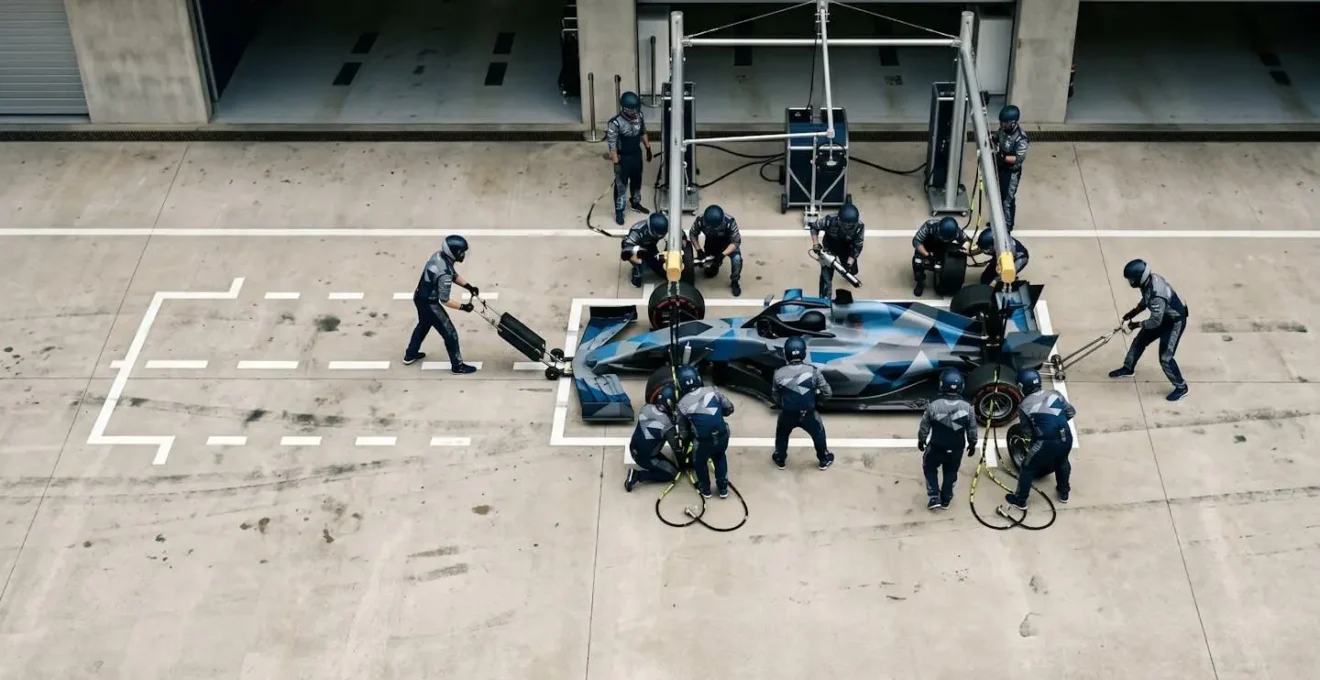
The strategist on the pit wall may be the brain, and the driver the hero, but an undercut is won or lost by the synchronized choreography of the pit crew. A single fumbled wheel nut can undo all the brilliant calculation. Achieving a sub-two-second pit stop is one of the most extraordinary displays of teamwork in all of sport, a fusion of human precision and bespoke technology. A crew of around 20 mechanics descends on the car, each with a single, highly specialized task honed through countless hours of practice. There are three people on each wheel: one operating the high-torque wheel gun, one to remove the old wheel, and one to position the new one.
This whole process is a marvel of efficiency. Front and rear jack operators lift the car in an instant, while others stabilize it and stand ready with backup equipment. The wheel guns themselves are incredible pieces of engineering, capable of removing a single retaining nut in a fraction of a second. According to official 2024 season data, the fastest pit stops are now consistently below the two-second mark, with the fastest stop so far being a mind-boggling 1.9 seconds, achieved by both Red Bull Racing and McLaren. This relentless pursuit of speed shows how every millisecond is fought for.
The pressure is immense. A driver’s race hangs in the balance, and the world’s cameras are focused on their every move. Yet, through muscle memory and flawless communication—often non-verbal—they execute their tasks in perfect harmony. It is not just speed; it is precision under fire. As the RacingNews365 Analysis Team notes: “A pit stop requires extreme precision and perfect teamwork to get the Formula 1 driver back on the track in the shortest possible time.” Without this human perfection, the mathematical perfection of the undercut is meaningless.
Why a 0.5 Second Delay is Better Than a 5 Second Penalty?
Following the breathtaking speed of the pit crew, there’s a crucial, often overlooked moment of decision-making: the release. The “lollipop” man (now an automated light system) has the final say on when the car leaves its pit box. A half-second of hesitation at this stage can feel like an eternity and could theoretically cost a position. However, that small, controlled delay is infinitely preferable to the race-destroying consequences of an unsafe release. Releasing a car into the path of another vehicle in the fast lane of the pits is one of the most dangerous and heavily penalized infringements in F1.
If the stewards deem a release unsafe, the standard punishment is a five-second time penalty, which is typically added to the driver’s next pit stop or their final race time. In the context of a close battle, a five-second penalty is a death sentence for a track position battle. That half-second of caution from the pit crew, waiting for a clear gap in the fast lane, is a calculated risk assessment. It’s a trade-off: sacrifice a few tenths of a second now to avoid losing five full seconds later.
Furthermore, penalties can also be applied for other errors during the frantic stop. According to pit stop regulations, teams may be assessed time penalties for incorrectly fitted tires or other procedural failures. If a wheel isn’t properly attached, the risk is not just a penalty but a catastrophic failure on track. For the pit crew and the strategist monitoring the stop, the mantra is “smooth is fast.” A clean, secure, and safe stop that takes 2.5 seconds is always better than a chaotic 2.1-second stop that carries the risk of a penalty or a loose wheel. The tiny delay is a form of insurance against a much larger, more definitive loss.
How Can the Leader Protect Against an Undercut Attack?
For the driver leading the race, the threat of an undercut from the car behind is a constant source of pressure. The moment the second-place car dives into the pits, the leader’s pit wall is faced with a critical choice: react or stand firm. The most common and direct way to defend against an undercut is to “cover” the move. This involves the leader pitting on the very next lap. By reacting immediately, the leader minimizes the time their rival has on fresh tyres while they are still on old ones. In theory, if the gap between them was more than the time lost in a pit stop, the leader should emerge from their own stop still ahead.
However, this is a purely defensive strategy and often forces the leader to deviate from their optimal race plan. They might be forced to pit earlier than their tyres or fuel load would ideally dictate, potentially compromising the latter stages of their race. It’s a reactive move, conceding the strategic initiative to their rival. The alternative is to ignore the undercut attempt and try to execute an “overcut.” This involves staying out on the old tyres and trying to use the clean air of the lead to pump in fast lap times, hoping to build enough of a gap to pit and still emerge ahead. This works best on tracks where tyres take a long time to warm up, or when the older tyre is still in a good condition.
Case Study: The Reactive Pit Stop
As seen in countless strategic battles, leaders can defend by ‘covering’—making a reactive pit stop immediately after their rival. This defensive move neutralizes the fresh tyre advantage the attacker hoped to gain. While effective at holding track position, it often means the leader sacrifices their own optimal strategy, pitting earlier than planned and potentially compromising their tyre life for a later stint. It turns the race from a question of ultimate pace to a direct, lap-for-lap chess match of track position.
The decision depends on a huge number of variables: the size of the gap, the rate of tyre degradation, the likelihood of traffic, and the characteristics of the circuit. On a track like Monaco, where track position is everything, a leader will almost always cover an undercut attempt. On a track with easy overtaking, they might be more confident in their ability to regain the position later. It’s a high-stakes poker game where the leader must decide whether to call their rival’s bluff.
Why You Need a Fresh Tyre Advantage to Make the Undercut Work?
The fundamental principle that makes the undercut possible is the performance delta between a new set of tyres and a worn set. This isn’t a minor difference; it can be several seconds per lap. Formula 1 tyres are designed for ultimate performance, not longevity. Unlike the tyres on your road car, F1 rubber is engineered to operate in a very specific temperature window and to degrade over a race stint. This degradation is not linear; after a certain number of laps, the tyre can hit a “performance cliff,” where the lap times drop off dramatically as the rubber loses its chemical grip.
This performance cliff is what the attacking team is looking for. The goal of the undercut is to put their driver on a fresh set of tyres just as the rival’s tyres are falling off this cliff. The result is a massive pace swing. The out-lap on new tyres can be 2-3 seconds faster than the in-lap of the car on old, struggling tyres. This difference, multiplied by the time taken for the pit stop itself, is the “undercut delta.” If this delta is larger than the initial gap between the cars, the position is won. The extreme difference in design is stark when you consider that F1 tyres are built to last less than one race distance, while road car tyres can last for tens of thousands of miles.
The choice of tyre compound is also crucial. A team might fit a softer, faster-gripping compound to maximize the out-lap performance, gambling that the extra pace will be enough to secure the position. This makes the out-lap even more critical, as the driver must push to the absolute limit to extract every millisecond of performance from the new rubber while it’s at its peak. Without this significant, immediate gain in grip and speed, the time lost in the pit lane would never be recovered, and the undercut would simply be a loss of track position.
Why is a Pit Stop ‘Cheaper’ Under a Safety Car?
A Safety Car or Virtual Safety Car (VSC) period can completely upend a race and turn strategy on its head. For strategists on the pit wall, it presents a golden opportunity: a “cheap” pit stop. The term “cheap” doesn’t refer to money, but to time. Under normal racing conditions, a driver making a pit stop loses a significant amount of time to the cars remaining on track—typically around 20-25 seconds, depending on the circuit’s pit lane length. This is the “pit loss” time. During this period, the rest of the field is flying by at full racing speed.
However, when a Safety Car is deployed, the dynamic changes entirely. All cars on track must slow down to a designated pace and line up behind the Safety Car. This means the time lost by diving into the pit lane is dramatically reduced. While the driver is getting their tyres changed, the rest of the field is lapping at a fraction of their normal speed. The total time lost relative to the competition might be halved, perhaps only 10-12 seconds. This is the “cheap” stop. The analysis of safety car procedures shows that by bunching competitors together, it effectively eliminates time and distance advantages built up over many laps, offering a reset.
Case Study: Hamilton’s 2008 German Grand Prix Gamble
During the 2008 German Grand Prix, a mid-race safety car saw almost the entire field dive into the pits for their “cheap” stop. Lewis Hamilton, leading the race, made the bold strategic call to stay out. He inherited a huge lead but was on an older strategy. When he eventually had to make his final stop under green flag conditions, he rejoined in fifth place. However, his tyre advantage over the cars that had stopped much earlier was so significant that he was able to fight his way back through the field to retake the lead and win the race. It was a masterclass in calculating the trade-off between a cheap stop and a strategic tyre advantage.
This makes pitting under a Safety Car an almost irresistible opportunity for teams, allowing them to complete a mandatory stop while losing far less ground. It can bring drivers who were far behind right back into contention and create fascinating strategic dilemmas. Do you pit from the lead and give up track position, or do you risk staying out on older tyres, knowing everyone behind you just got fresh rubber for a fraction of the usual cost?
How to Calculate the Exact Lap to Pit Based on Degradation Curves?
Deciding the perfect lap to execute an undercut is not a gut feeling; it’s a cold, hard calculation. Race strategists and engineers are armed with a wealth of data, and their most important tool is the tyre degradation curve. Before the race even begins, teams use data from practice sessions to model how each tyre compound will perform over a stint. They create a graph plotting expected lap time against the number of laps completed. Initially, the lap times are fast, but as the laps tick by, the curve will show a gradual increase in lap time as the tyre wears out. The key is to identify the “knee” of the curve—the point where the degradation accelerates, and the tyre performance starts to fall off that critical “cliff.”
During the race, this pre-race model is updated in real-time. Strategists compare the driver’s actual lap times to the predicted curve. If the driver is beating the curve, they might extend the stint. If the lap times suddenly start to drop off faster than predicted, it’s a signal that the tyres are gone. This is the trigger point. To initiate an undercut, the team needs to pit their driver just before this cliff, ensuring they still have enough life in the tyre to post a decent in-lap, while knowing their rival is about to hit the point of major time loss. As documented race analysis demonstrates, at races with extreme tyre degradation, this strategic recalculation mid-race becomes the single most important factor in winning.
Action Plan: How Teams Plan an Undercut
- Identify the Target Window: Based on pre-race degradation models, identify the earliest and latest laps a stop is viable for the chosen strategy.
- Monitor Live Deltas: Track the live lap times of your car versus the target car. Look for the moment their pace begins to fade, indicating the tyre “cliff” is approaching.
- Map the Traffic: Scan the track map for a “clean air” window. The out-lap must be free of backmarkers or cars on different strategies. Find a 2-3 second gap to drop into.
- Execute the ‘In-Lap’ Call: Give the driver the “box, box” call at the end of the lap before the target pit lap. The driver’s job is to push to the absolute limit on this lap.
- Confirm and Commit: The pit crew confirms they are ready. The final decision is made as the driver enters the final sector, at which point the plan is locked in.
It’s a complex equation involving tyre wear, fuel load (as the car gets lighter, it gets faster), track temperature, and the driver’s feedback. A single radio message like “the rear is starting to go” can be the final piece of data needed to make the call. The entire process is a testament to how F1 has evolved into a sport won not just on the track, but on the computer screens of the pit wall.
Key Takeaways
- The Undercut’s power comes from the ‘Delta’: The time difference between the attacker’s fast out-lap on fresh tyres and the defender’s slow in-lap on worn tyres.
- Clean Air is Non-Negotiable: The strategy is useless if the car emerges from the pits behind traffic, as “dirty air” negates the fresh tyre advantage.
- It’s a Team Effort: A successful undercut requires a perfect strategic call, a blistering driver out-lap, and a flawless, sub-2-second execution by the pit crew.
Undercut vs Overcut: How Mathematicians Win Races from the Pit Wall?
The undercut is F1’s primary attacking strategy, but its polar opposite, the overcut, is a subtle and often misunderstood defensive weapon. While the undercut relies on the power of fresh tyres, the overcut relies on the power of clean air and a tyre that is still performing well. A team will attempt an overcut when the car in front pits. Instead of following them in, their driver stays out and pushes as hard as possible. The goal is to use the clear track ahead to set lap times that are faster than the car that just pitted, which might be struggling to get its new, harder tyres up to temperature or navigating traffic.
The choice between undercut and overcut is dictated by the track and the tyres. The undercut is most effective at tracks where overtaking is difficult and tyre degradation is high, such as the Hungaroring and Singapore. Here, strategy is the main way to gain positions. The overcut, on the other hand, is more effective on circuits where tyres are difficult to warm up, or in changing conditions like a drying track, where staying out on a used intermediate tyre can be faster than pitting for new slicks. It’s a strategic choice based on a deep analysis of performance data, where mathematicians on the pit wall are the real heroes.
This strategic battle is a game of probability and execution. A team like Red Bull Racing, for example, can be more confident in an undercut because they have proven their pit crew’s consistency. When detailed 2024 season analysis reveals that 62.6% of their pit stops are exceptionally fast, it gives them a reliable weapon. They know the time lost in the pits will be minimal, increasing the chances of a successful undercut. This is how races are truly won and lost—not always in wheel-to-wheel combat, but in the calculated, data-driven decisions made seconds before the car ever enters the pit lane.
Next time you watch a race, keep an eye on the pit window and listen for the radio calls. You are now equipped to see the hidden race unfold on the strategist’s dashboard, appreciating the subtle genius behind every “Box, box” call.