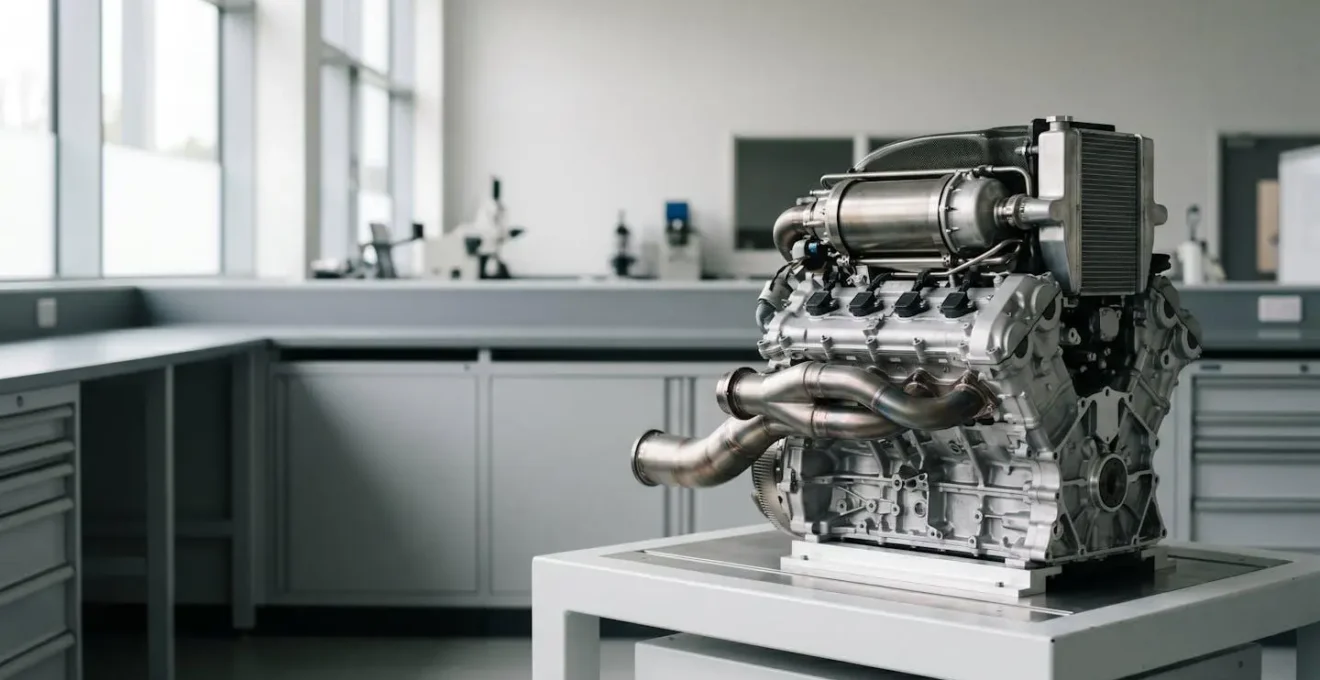
Contrary to the belief that modern F1 reliability has made things less exciting, the engineering truth is the exact opposite: making a power unit last seven races is a far greater achievement than building a fragile, one-lap “qualifying grenade.”
- The modern challenge isn’t just raw power; it’s a silent battle against invisible forces like heat, electrical stress, and software integrity across an entire interconnected system.
- Performance is now unlocked through software and thermal efficiency, where a single line of code or a one-degree temperature difference can be the margin between victory and a catastrophic failure.
Recommendation: Instead of lamenting the loss of explosive engine failures, appreciate the genius of “graceful degradation”—the art of designing systems that perform at the absolute limit for thousands of kilometers without self-destructing.
There’s a certain nostalgia for the screaming V10s and V12s of a bygone Formula 1 era. We remember the qualifying specials—engines pushed so hard they were nicknamed “grenades,” designed to last just a handful of laps before dramatically letting go. For many fans, the modern hybrid era, with its strict limits on power unit components, feels sterile by comparison. The requirement for a power unit to endure seven or more race weekends seems to stifle the very essence of pushing to the absolute limit. It’s a common sentiment, but from a chief designer’s perspective, it fundamentally misunderstands the modern engineering challenge.
The truth is, the battle for performance has not disappeared; it has merely shifted from the visible to the invisible. The fight is no longer just against mechanical friction and stress, but against a far more subtle and complex set of adversaries: heat, software glitches, and the intricate dance of electrical energy. Building a power unit that produces over 1,000 horsepower is one thing. Building one that can do it reliably for over 5,000 kilometers, while managing its thermal budget to the single degree and its electrical systems to the millivolt, is an engineering feat that eclipses anything we did in the past. This isn’t about limiting performance; it’s about sustaining it under conditions that are actively trying to tear the car apart from the inside out.
This article will take you inside the design office to explore this silent battle. We won’t just look at the components; we will examine the systemic symbiosis between aerodynamics, mechanics, and software. We’ll explore why today’s reliability is not a sign of conservatism, but the result of winning a hidden war on the laws of physics.
To understand this complex interplay of forces, this guide breaks down the core engineering challenges that define modern Formula 1. We’ll explore how each system is pushed to its absolute limit while being forced to cooperate with every other part of the car.
Summary: The Modern F1 Engineering Battleground
- Why Following Another Car Overheats Your Engine?
- How Do Gearboxes Change Gear Without Losing Drive to the Wheels?
- Why is Porpoising Such a Hard Problem to Fix Mechanically?
- How Do Drivers Feel the Brakes When a Computer Controls the Rear?
- Which F1 Technologies Actually Make it to Your Hatchback?
- Why Your Car Needs a Software Update Instead of a New Gearbox?
- Why the Turbo is Often the First Part to Fail in Hot Races?
- Thermal Efficiency: How F1 Engines Extract 50% Energy from Fuel?
Why Following Another Car Overheats Your Engine?
When a driver complains about “dirty air,” they aren’t just talking about a loss of aerodynamic grip. They are fighting a thermal battle. Following another car creates a wake of turbulent, low-energy air. This disturbed airflow is significantly less effective at cooling. The radiators for the engine’s water and oil, the intercoolers, and crucially, the delicate cooling circuits for the Energy Recovery System (ERS) all rely on a clean, high-velocity stream of air. When that stream is disrupted, the entire car’s thermal budget is thrown into chaos. It’s not just the engine that gets hot; the batteries and control electronics start to cook, too.
The impact is immediate and dramatic. Following closely can cause an estimated 15-20% loss in downforce, which hurts cornering speed, but the thermal effect is just as damaging. The MGU-K and battery, key components of the hybrid system, have strict operating temperature windows. If their dedicated cooling systems can’t reject heat due to poor airflow, the ECU will automatically reduce or cut hybrid power to prevent a catastrophic failure. This is a perfect example of systemic symbiosis: an aerodynamic problem instantly becomes a powertrain and electrical problem. The driver loses power not because the engine is failing, but because the car’s cooling system, choked by dirty air, can no longer maintain thermal equilibrium.
Therefore, managing the gap to the car ahead is as much about managing temperatures and preserving hybrid power as it is about setting up an overtake.
How Do Gearboxes Change Gear Without Losing Drive to the Wheels?
In a conventional manual car, there’s a brief moment during a gearshift where the engine is disconnected from the wheels, causing a momentary lapse in acceleration. In Formula 1, where hundredths of a second matter, this is unacceptable. The solution is the “seamless shift” gearbox, an engineering marvel that executes a gear change in just a few milliseconds with no perceptible interruption in torque. This is achieved through a combination of hyper-precise mechanical design and intelligent electronic control.
The magic happens thanks to the integration of the hybrid system. As Race Sundays Technical Analysis explains, the system relies on a principle called ‘torque fill’ to smooth the power delivery. This is what they say:
the control unit momentarily trims combustion engine torque and commands the MGU‑K to ‘fill’ or smooth the torque
– Race Sundays Technical Analysis, What is the Role of the Gearbox in an F1 Car?
In simple terms, as the gearbox mechanically disengages one gear and engages the next, the internal combustion engine’s torque is momentarily reduced by the ECU. In that exact instant, the MGU-K—the electric motor connected to the crankshaft—acts as a motor, delivering a precisely calculated burst of electric torque. This “fills the gap” in power delivery, ensuring the rear wheels are always under power. The driver feels a single, continuous wave of acceleration, allowing for maximum stability and performance, especially when shifting mid-corner.
This is not just a fast gear change; it’s a perfectly choreographed ballet between the engine, the electric motor, and the gearbox, all managed by software in milliseconds.
Why is Porpoising Such a Hard Problem to Fix Mechanically?
The reintroduction of ground-effect aerodynamics brought back a phenomenon from the 1980s: porpoising. This violent bouncing on the straights occurs when the car’s floor gets so close to the track that the airflow chokes, causing a sudden loss of downforce. The car’s suspension then pushes it back up, the airflow reattaches, downforce is regained, and the car is sucked down again, repeating the cycle. From a designer’s perspective, this is a nightmare because the most obvious solution directly contradicts the primary goal of ground-effect design.
The fundamental trade-off is simple: the lower you run the car, the more downforce you generate from the underfloor tunnels. However, a lower ride height also makes the car more susceptible to porpoising. As Top Gear’s technical team notes, “By running a car (and the edges of its floor) higher off the ground you can prevent porpoising, but it also means you’ll create less downforce.” To combat the issue, the FIA mandated a 15mm increase in minimum floor edge height for the 2023 season. This forced designers to sacrifice some peak downforce for a more stable aerodynamic platform. The challenge is finding the ‘sweet spot’—a ride height low enough to be competitive but high enough to prevent the vicious cycle from starting.
Fixing it purely mechanically is difficult because it’s a dynamic problem. Stiffening the suspension can help prevent the car from being sucked down so aggressively, but this compromises the car’s ability to ride curbs and handle bumps, destroying mechanical grip. It’s a classic case of “robbing Peter to pay Paul,” where a solution in one area creates a significant problem in another. The constant search for this balance is what makes it such a persistent headache for engineering teams.
Ultimately, there is no single “fix”; there is only a continuous, agonizing compromise between aerodynamic performance and mechanical stability.
How Do Drivers Feel the Brakes When a Computer Controls the Rear?
In a modern F1 car, the driver’s brake pedal is not directly connected to the rear brake calipers in the traditional sense. It’s the primary input for a complex “Brake-By-Wire” (BBW) system. When the driver hits the pedal, they are essentially telling an ECU how much total braking force they want at the rear axle. The ECU then becomes the real driver, deciding how to achieve that retardation by blending three different systems: the conventional hydraulic rear brakes, engine braking, and, most importantly, the energy harvesting of the MGU-K.
During braking, the MGU-K acts as a generator, converting the car’s kinetic energy into electrical energy to recharge the battery. This process creates a powerful braking effect on the rear axle. In fact, under the regulations, the ERS can gather approximately 120kW of power during braking, which contributes significantly to slowing the car. The challenge for the BBW system is that the amount of MGU-K braking available depends on the battery’s state of charge. If the battery is full, the MGU-K cannot harvest energy and provides no braking effect. The ECU must instantly compensate for this by increasing the force from the hydraulic calipers and engine braking to deliver the total braking force the driver requested. The goal is to make the pedal feel perfectly consistent and predictable, regardless of what the hybrid system is doing.
This is the ultimate “digital twin” in action. The driver’s foot provides a request, and the software translates that request into a seamless, blended output from three separate systems, ensuring the braking feel remains constant from the first lap to the last.
This consistency is what gives a driver the confidence to brake just meters later than their rivals, which is often where a race is won or lost.
Which F1 Technologies Actually Make it to Your Hatchback?
The phrase “F1 technology for the road” is often used in marketing, but the most direct and impactful transfer of technology is undoubtedly in the field of hybrid systems. While your family SUV doesn’t have an MGU-H, the principles behind the Motor Generator Unit-Kinetic (MGU-K) are now a cornerstone of almost every hybrid and electric vehicle on the market. This technology is better known by its common name: regenerative braking.
F1 was the ultimate laboratory for this technology. The challenge was to create a system that was incredibly lightweight, powerful, and efficient enough to harvest and redeploy huge amounts of energy lap after lap under extreme thermal and physical stress. Engineers had to solve problems of thermal resistance, reliability at high rotational speeds, and seamless integration with the combustion engine. The lessons learned in making an MGU-K survive a Grand Prix directly informed the development of the compact, efficient electric motors and control systems found in today’s road cars.
When your hybrid car’s battery recharges as you brake, you are using the direct descendant of an F1 KERS system. The software that blends the regenerative braking with the traditional friction brakes for a smooth pedal feel is a simpler version of the complex Brake-By-Wire systems we just discussed. So, while you may not have carbon-carbon brakes or a DRS flap, the very thing that makes your hybrid efficient—recovering energy that would otherwise be wasted as heat—was perfected in the crucible of motorsport.
This is not just a marketing gimmick; it’s a tangible legacy of F1’s relentless pursuit of efficiency.
Why Your Car Needs a Software Update Instead of a New Gearbox?
In the past, improving a car’s mechanical performance meant changing its physical parts—a new camshaft, a different gear ratio, or a modified cylinder head. Today, in both F1 and high-performance road cars, some of the most significant performance gains come from a software update. This is because modern vehicles are no longer purely mechanical; they are mechatronic systems where a “digital twin” of the hardware is controlled by software, allowing its behavior to be fundamentally transformed without touching a wrench.
The F1 gearbox is a prime example. The physical components are designed for durability, but it’s the software that unlocks their ultimate performance. The control unit uses telemetry and GPS data to know exactly where the car is on track. As a driver brakes for a tight hairpin at the end of a long straight, the software can pre-emptively select second gear while the gearbox is still physically in eighth. This reduces the final mechanical actuation time to an absolute minimum when the driver pulls the paddle. This predictive mapping of the power unit, gearbox, and differential is continuously refined for every corner of every circuit. An over-the-air update can completely change how the car behaves in a specific corner by altering how and when the power is delivered.
Your Chief Designer’s Checklist: Thinking Like an F1 Engineer
- Identify System Interactions: List all systems involved in a single action (e.g., braking involves hydraulics, engine, ERS). Don’t view components in isolation.
- Map the “Digital Twin”: Inventory all the software parameters that control the hardware (e.g., throttle maps, ABS sensitivity, shift points). Where can software optimize a physical limit?
- Analyze for Coherence: Check if a change in one system negatively impacts another. Does a more aggressive engine map overheat the cooling system?
- Assess Performance vs. Durability: For any proposed change, evaluate its impact on component lifespan. Is a 0.1-second gain worth a 10% reduction in reliability?
- Plan for Graceful Degradation: Instead of preventing all failures, define how the system should behave when a limit is reached. Should it cut power, issue a warning, or enter a safe mode?
This is the future of automotive performance: hardware defines the potential, but software defines the reality.
Why the Turbo is Often the First Part to Fail in Hot Races?
The turbocharger is one of the most highly stressed components in an F1 power unit. It exists in an environment of extreme temperatures and unimaginable rotational speeds. The turbine side is driven by exhaust gases exiting the engine at nearly 1,000°C, while the whole assembly can spin at up to 125,000 revolutions per minute. In hot ambient conditions, like those at the Bahrain or Qatar Grands Prix, the entire thermal management system is already operating at its limit. This leaves very little margin for the turbo to shed its immense heat load, making it a prime candidate for failure.
Compounding this is its direct mechanical link to the MGU-H (Motor Generator Unit-Heat). The MGU-H sits on the same shaft as the turbo, recovering energy from exhaust gas flow. A failure in one component almost invariably leads to a catastrophic failure in the other. If the MGU-H bearings fail due to thermal stress, the resulting imbalance can destroy the turbocharger in an instant. This was a significant challenge for Honda, whose early power unit development was plagued by MGU-H reliability issues that often led to spectacular turbo failures. Even with its 2026 power unit, Honda has faced issues with abnormal vibrations, demonstrating how a problem in one part of this assembly can force the entire engine to run in a compromised, de-rated state to prevent a total meltdown.
This is where the concept of graceful degradation becomes critical. A well-designed system will detect the onset of a thermal or vibrational issue and progressively reduce power to keep the components within a safe operating window. A poorly designed one will simply fail catastrophically. The turbo is often the first to go because it sits at the intersection of the highest temperatures and highest rotational forces in the entire power unit.
In the silent battle for reliability, the turbocharger is on the front line, and in hot races, it’s often the first casualty.
Key Takeaways
- Modern F1 reliability is not about being conservative; it’s about mastering a “silent battle” against invisible forces like heat, software, and electrical stress.
- Performance is now unlocked through systemic symbiosis, where software acts as a “digital twin” to optimize the behavior of physical hardware like gearboxes and brake systems.
- The greatest engineering challenge is managing the car’s “thermal budget,” as an aerodynamic issue in dirty air can instantly trigger a power loss by overheating the ERS.
Thermal Efficiency: How F1 Engines Extract 50% Energy from Fuel?
Perhaps the single most impressive statistic about the modern F1 power unit is its thermal efficiency. A typical road car engine is lucky to convert 30-35% of the fuel’s energy into useful work, with the rest wasted as heat. Modern F1 engines, however, exceed 50% thermal efficiency, making them among the most efficient internal combustion engines on the planet. This remarkable figure is not achieved through a single breakthrough, but by winning the silent battle of energy recovery.
The key is that an F1 power unit doesn’t just burn fuel; it harvests waste. The MGU-H recovers energy from the heat and pressure of the exhaust gases spinning the turbo. The MGU-K recovers kinetic energy during braking that would otherwise be lost as heat through the brake discs. This recovered electrical energy is then redeployed to assist the combustion engine, meaning less fuel is needed to achieve the same power output. It is this virtuous cycle of recovering and reusing energy that pushes the efficiency past the 50% mark.
However, achieving this efficiency requires every component to operate at its absolute peak. The 2022 Ferrari power unit provides a perfect case study. The team suffered several spectacular engine failures, forcing them to run at reduced power. The weak point, according to an in-depth analysis of the problem, was not a major component but the spark plug within their advanced pre-chamber ignition system—a technology crucial for ultra-lean, efficient combustion. Once this tiny component was re-engineered for reliability, the team could once again run their engine aggressively, unlocking its full performance and efficiency. This proves the central thesis: in modern F1, performance and reliability are not opposing forces. They are two sides of the same coin, forged in the silent battle for efficiency.
Making an engine last seven races isn’t a restriction; it’s the ultimate validation of an engineering philosophy where every single joule of energy is hunted down and put to work.