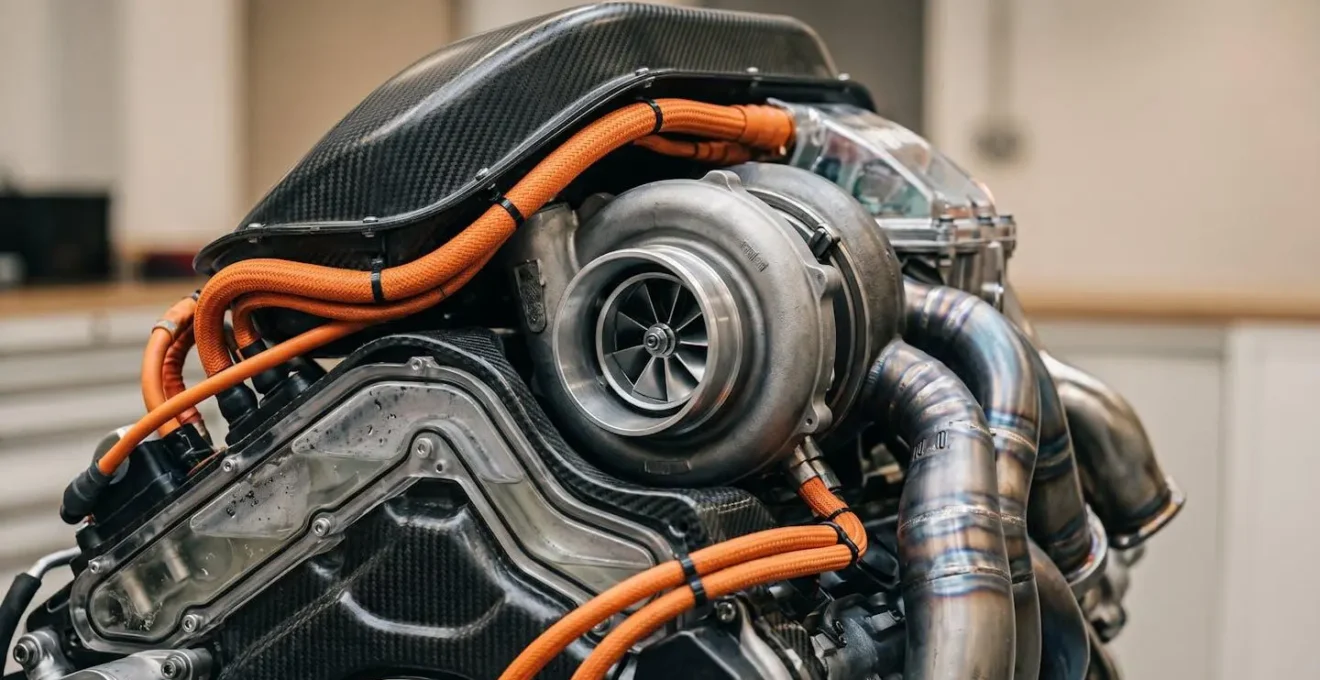
The confusing acronyms MGU-K and MGU-H aren’t just complex engine parts; they are Formula 1’s ingenious solutions to two fundamental problems: wasted energy and turbo lag.
- The MGU-K (Kinetic) acts like a super-powered regenerative braking system, capturing energy when the car slows down to provide a power boost for overtaking.
- The MGU-H (Heat) recycles wasted heat from the exhaust to eliminate the delay (lag) from the turbocharger, providing instant power.
Recommendation: Instead of seeing them as separate, think of them as a single system that makes F1 cars incredibly efficient and brutally fast, turning waste products into race-winning performance.
If you’ve ever watched a Formula 1 race, you’ve seen the acronyms flash across the screen: ERS, MGU-K, MGU-H. They seem impossibly complex, a secret language for engineers in the garage. The common explanation is that they are “hybrid systems” that make the cars more efficient. While true, this misses the point entirely and is why so many fans feel disconnected from the modern sport. The reality is far more exciting and logical. These systems aren’t just for saving the planet; they are weapons designed to solve fundamental racing problems.
The core confusion lies in distinguishing the MGU-K from the MGU-H. The key is in their names. The Motor Generator Unit-Kinetic (MGU-K) deals with kinetic energy—the energy of motion, captured during braking. The Motor Generator Unit-Heat (MGU-H) deals with thermal energy—the immense heat pouring out of the car’s exhaust. One is about slowing down to go faster later, while the other is about preventing a critical performance bottleneck known as turbo lag.
But what if the real secret wasn’t just understanding their definitions, but seeing how they work together as a single, elegant ecosystem? This guide will demystify these components not as abstract pieces of engineering, but as practical tools. We will explore how drivers deploy this harvested energy, why it makes the cars both heavy and incredibly dangerous, and how this pinnacle of motorsport technology is directly influencing the car you might drive tomorrow.
This article breaks down the complex world of Formula 1’s hybrid power units into clear, understandable sections. We will explore everything from the driver’s ‘overtake’ button to the real-world implications for your own hybrid car, providing a complete picture of this fascinating technology.
Summary: Decoding Formula 1’s Hybrid Heart: MGU-K and MGU-H Explained
- How Drivers Use ‘Overtake Buttons’ to Deploy Battery Power?
- Why Must Marshals Wear Rubber Gloves When Touching a Crashed Car?
- Why Are Modern F1 Cars So Heavy Compared to the V10 Era?
- How F1 Cars Recover Energy That Would Be Lost as Heat?
- Why Manufacturers Demand Hybrid Engines to Stay in the Sport?
- How to Charge from 10% to 80% While You Grab a Coffee: The 800V Advantage
- Mild Hybrid vs Full Hybrid: Which One Actually Saves Money in City Traffic?
- Real-World MPG: Why Your Hybrid Isn’t Hitting the Advertised 60 MPG?
How Drivers Use ‘Overtake Buttons’ to Deploy Battery Power?
The most visible and exciting application of the hybrid system is the “overtake button.” While there isn’t one single button with that label, drivers have modes that unleash the stored electrical energy for a significant power boost. This function is almost entirely handled by the MGU-K. When a driver hits the brakes, the MGU-K, connected to the crankshaft, acts as a generator. It resists the car’s rotation, helping it slow down while simultaneously converting that kinetic energy into electricity, which is then stored in a sophisticated battery pack known as the Energy Store (ES).
When the driver needs an extra burst of speed—to attack on a straight or defend a position—they activate a deployment mode. The process reverses: the MGU-K now acts as a motor, drawing power from the battery and delivering it directly back to the crankshaft. This provides an immediate surge of up to an extra 160 horsepower, a massive advantage that can be the difference between a successful overtake and a failed attempt. It’s a strategic game of cat and mouse. Drivers and their engineers decide how much energy to harvest and when to deploy it, making it a crucial element of racecraft.
As the ESPN F1 Analysis Team notes, this shifts the dynamic of racing from simple reactions to proactive strategy. In a recent analysis of future regulations, they highlighted this point, stating:
Drivers must decide when to attack, not simply wait for a detection line.
– ESPN F1 Analysis Team, Formula 1’s new terminology explained
Your Viewer’s Checklist: Spotting Hybrid Tech in Action
- Overtake Button Flash: Watch for the driver’s central rear light flashing. This is a mandatory warning to cars behind that the ERS is deploying energy.
- On-Screen Graphics: Pay attention to the TV broadcast’s “E” or “Battery” gauge. See how it depletes on straights and recharges under heavy braking.
- Engine Note Changes: Listen on the onboard camera. The sound changes when the MGU-K is deploying power (a higher-pitched whine) versus when it’s harvesting.
- “Lift and Coast”: Notice drivers lifting off the throttle before a braking zone. They’re not just saving fuel; they’re extending the energy harvesting phase for the MGU-K.
- Qualifying vs. Race: Compare battery usage. In a qualifying lap, they’ll drain it completely (“Hot Lap” mode). In the race, it’s a strategic game of managing the charge.
Why Must Marshals Wear Rubber Gloves When Touching a Crashed Car?
The immense power of the hybrid system comes with a significant and potentially lethal risk: high-voltage electricity. This is the primary reason you see track marshals approaching a stopped or crashed F1 car with extreme caution, always wearing thick, insulated rubber gloves. The car’s Energy Recovery System (ERS) is a high-voltage direct current (DC) system that can operate at a staggering maximum of 1,000 volts, a level far exceeding that of a standard household outlet and easily capable of causing fatal injury.
Because the chassis and many components are made of highly conductive carbon fiber, any damage to the battery or the high-voltage wiring could energize the entire car. A marshal touching the car without proper protection could inadvertently complete a circuit, with devastating consequences. To mitigate this, Formula 1 cars are equipped with a clear safety light system on the roll hoop, directly in the marshal’s line of sight.
These lights indicate the electrical state of the car. A green light signals that the car is electrically safe to touch. However, a red or amber light is a clear warning that the system is live or there is a potential fault. In this situation, marshals are trained to wait until the system is confirmed safe by team engineers or an FIA official before handling the vehicle. The insulated gloves are the final and most critical line of defense, ensuring their safety even if the warning systems were to fail or be damaged in an incident.
Why Are Modern F1 Cars So Heavy Compared to the V10 Era?
Long-time fans of Formula 1 often lament the weight of modern cars, reminiscing about the light, nimble machines of the V8 and V10 eras. The difference is stark and primarily due to the introduction of the complex hybrid power units. A comparison of technical data shows that a car from the mid-1990s weighed as little as 595 kg, whereas modern cars top the scales at nearly 800 kg without fuel. This massive increase in weight is a direct consequence of the ERS components and the safety structures required to support them.
The main culprits for this added mass are the core components of the hybrid system. The Energy Store (battery) is a dense and heavy unit, weighing around 20-25 kg on its own. The MGU-K and MGU-H, with their powerful electric motors, generators, and associated control electronics, add significant weight. Furthermore, the turbocharger, which is integral to the MGU-H, is a heavy component in its own right. Beyond the power unit itself, the car’s chassis has to be stronger and more robust to handle the increased power and torque, as well as to protect the high-voltage systems in a crash.
This added weight has a profound effect on the car’s dynamics. A heavier car is less agile, slower to accelerate and brake, and puts more strain on the tires. While the power from the hybrid system more than compensates for the weight gain on the straights, drivers have had to adapt their driving styles, particularly in slow corners. It represents a fundamental engineering trade-off: accepting the penalty of increased mass in exchange for the immense power and efficiency gains of the hybrid system.
How F1 Cars Recover Energy That Would Be Lost as Heat?
While the MGU-K’s energy recovery from braking is relatively straightforward, the MGU-H is where the true genius of the F1 power unit lies. It solves two problems at once: it captures energy that would otherwise be completely wasted and it eliminates the dreaded “turbo lag.” A turbocharger uses exhaust gases to spin a turbine, which in turn spins a compressor to force more air into the engine, creating more power. The problem is that at low RPM, there isn’t enough exhaust flow to spin the turbine quickly, causing a delay—or lag—before the power kicks in.
The MGU-H (Motor Generator Unit-Heat) is a sophisticated electric motor connected directly to the shaft of the turbocharger. As hot exhaust gases exit the engine and spin the turbine, the MGU-H acts as a generator, converting this thermal energy into electricity. This electricity can either be sent to the battery for storage or fed directly to the MGU-K for an instant power boost. This is an incredibly efficient way to recycle waste heat. The turbocharger in an F1 car spins at an astonishing maximum of 125,000 rpm, generating immense amounts of thermal and rotational energy for the MGU-H to harvest.
Its second, and perhaps more critical, function is eliminating turbo lag. When the driver gets off the throttle and then back on, the MGU-H can act as a motor. It uses electrical energy from the battery to spin the turbo up to speed *before* the exhaust gases arrive. This means the turbo is already providing maximum boost the instant the driver demands it. This “anti-lag” function gives the car incredible throttle response and is a major contributor to the driveability and performance of modern F1 cars.
Why Manufacturers Demand Hybrid Engines to Stay in the Sport?
The push for complex and expensive hybrid power units in Formula 1 comes directly from the major automotive manufacturers involved, such as Mercedes, Ferrari, and Renault (Alpine). For them, F1 is not just a marketing exercise; it’s a high-speed research and development laboratory. The technology developed for the track has a direct and tangible relevance to the hybrid and electric vehicles they sell to the public. Developing systems that are incredibly power-dense, efficient, and reliable under the most extreme conditions imaginable provides invaluable data and expertise.
The relentless pursuit of efficiency in F1 has pushed thermal efficiency—the measure of how much energy from fuel is converted into useful work—to over 50%, a figure once thought impossible for an internal combustion engine. This knowledge directly informs the design of more efficient road car engines. The 2026 regulations will further emphasize this link, removing the complex MGU-H but dramatically increasing the MGU-K’s role with a mandated 350 kW MGU-K output, a nearly threefold increase that brings the power split closer to 50/50 between the engine and the electric motor.
Case Study: The Mercedes-AMG One Hypercar
Perhaps the most famous example of this “track-to-road” philosophy is the Mercedes-AMG One. This limited-production hypercar uses a modified version of the actual Formula 1 power unit that dominated the sport. It features a 1.6-liter V6 engine combined with both an MGU-K and an MGU-H, adapted for street-legal use. As detailed in analyses of its development, the project demonstrated the immense challenge and commercial value of this technology transfer. The car serves as the ultimate proof that the F1 hybrid development is not just a theoretical exercise; it creates tangible products and reinforces the manufacturer’s image as a leader in high-performance hybrid technology.
How to Charge from 10% to 80% While You Grab a Coffee: The 800V Advantage
While Formula 1 cars recharge their batteries on the track through braking and heat recovery, the technology they pioneered has a direct parallel in the world of electric road cars: high-voltage architecture. Modern high-performance EVs like the Porsche Taycan and Hyundai Ioniq 5 tout their “800V systems” as a key feature. This technology allows for incredibly fast charging speeds, but its roots lie in the high-stakes world of motorsport, where managing immense electrical power is paramount.
Voltage is like electrical pressure. By doubling the system voltage from the more common 400V to 800V, you can deliver the same amount of power with half the electrical current (Power = Voltage x Current). Lower current has two major benefits: it produces significantly less heat in the wiring and components, and it allows for the use of lighter, thinner cables. Both of these are critical concerns in a tightly packaged, weight-sensitive F1 car, where systems are designed to handle up to 1,000 volts.
For road cars, this F1-inspired philosophy translates directly to charging. The lower heat generated by an 800V system means the car can sustain a higher charging power for longer without overheating the battery or the charging cable. This is why 800V-equipped cars can often charge from 10% to 80% in under 20 minutes on a compatible DC fast charger. It’s a perfect example of a principle perfected in the extreme environment of F1—managing high power efficiently—being applied to solve a major pain point for EV owners: long charging times.
Mild Hybrid vs Full Hybrid: Which One Actually Saves Money in City Traffic?
The term “hybrid” in the consumer car market can be confusing, as it covers a wide range of technologies. The two main categories are “mild hybrid” and “full hybrid.” Understanding the difference is key to knowing what you’re actually buying, and Formula 1’s MGU-K provides a perfect high-performance analogy for a “full hybrid” system. A full hybrid has an electric motor powerful enough to propel the car on its own, even for short distances at low speeds, and it can significantly assist the engine during acceleration.
In contrast, a mild hybrid system uses a much smaller electric motor/generator (often called a Belt-Integrated Starter Generator or BISG). It cannot drive the car on its own. Its primary jobs are to enable a smoother engine stop-start function in traffic and provide a very small torque boost during acceleration to reduce the load on the engine. While it does save some fuel, the benefit is marginal compared to a full hybrid, which can shut its engine off completely in stop-and-go city traffic and run purely on electricity.
The F1 MGU-K is the ultimate expression of a full hybrid concept. With a regulated output of up to 120 kW (and a rotation speed of 50,000 rpm), it’s more than powerful enough to drive the car (as seen when cars cruise down the pit lane on electric power alone). In city driving, a full hybrid road car mimics this principle on a smaller scale, using its electric motor to handle the inefficient low-speed crawling, which is where it saves the most money on fuel. A mild hybrid, by comparison, can only assist, meaning the gasoline engine is almost always running.
Key Takeaways
- MGU-K vs. MGU-H: K is for Kinetic energy (braking), H is for Heat energy (exhaust). The MGU-K provides a power boost, while the MGU-H eliminates turbo lag.
- More Than a Boost: The hybrid system is a tactical weapon. Managing its deployment and recovery is a key part of race strategy and driver skill.
- Direct Road Relevance: The extreme efficiency and power management pioneered in F1 directly influence the technology in today’s hybrid and electric road cars.
Real-World MPG: Why Your Hybrid Isn’t Hitting the Advertised 60 MPG?
One of the most common frustrations for hybrid car owners is the gap between the advertised fuel economy (MPG or L/100km) and what they achieve in the real world. The official figures are generated in highly controlled, repeatable laboratory conditions. Real-world driving, with its unpredictable traffic, hills, and individual driving styles, is far less ideal. Formula 1 provides a perfect parallel for this phenomenon: even with the most advanced hybrid system on the planet, performance is governed by strict rules and limitations.
In F1, energy management is a zero-sum game with hard limits. For example, regulations dictate how much energy can be recovered and deployed each lap. The MGU-K is limited to harvesting a maximum of 2 Megajoules (MJ) of energy per lap into the battery. Conversely, it can deploy a maximum of 4 MJ from the battery back to the wheels per lap. This deficit means drivers cannot simply harvest and deploy energy indefinitely; they must strategically choose which corners to harvest from and which straights to deploy on to stay within the legal limits and manage their battery state over a race distance.
This is directly analogous to a road-going hybrid. The advertised MPG figure assumes an “ideal lap” where conditions for regenerative braking and electric-only driving are perfect. In reality, a short trip on the highway with no braking offers zero opportunity for the hybrid system to recover energy, so the gasoline engine does all the work. A spirited drive up a mountain will drain the battery much faster than it can be recharged. Your “real-world MPG” is your personal energy management strategy, dictated by your route and driving style, just as an F1 driver’s lap time is dictated by how they manage their finite energy budget.
Now that you have a comprehensive understanding of how these intricate systems function and interrelate, the next logical step is to apply this knowledge. The true appreciation of this technology comes from actively identifying its impact during a live race, transforming your viewing experience from passive observation to active analysis.