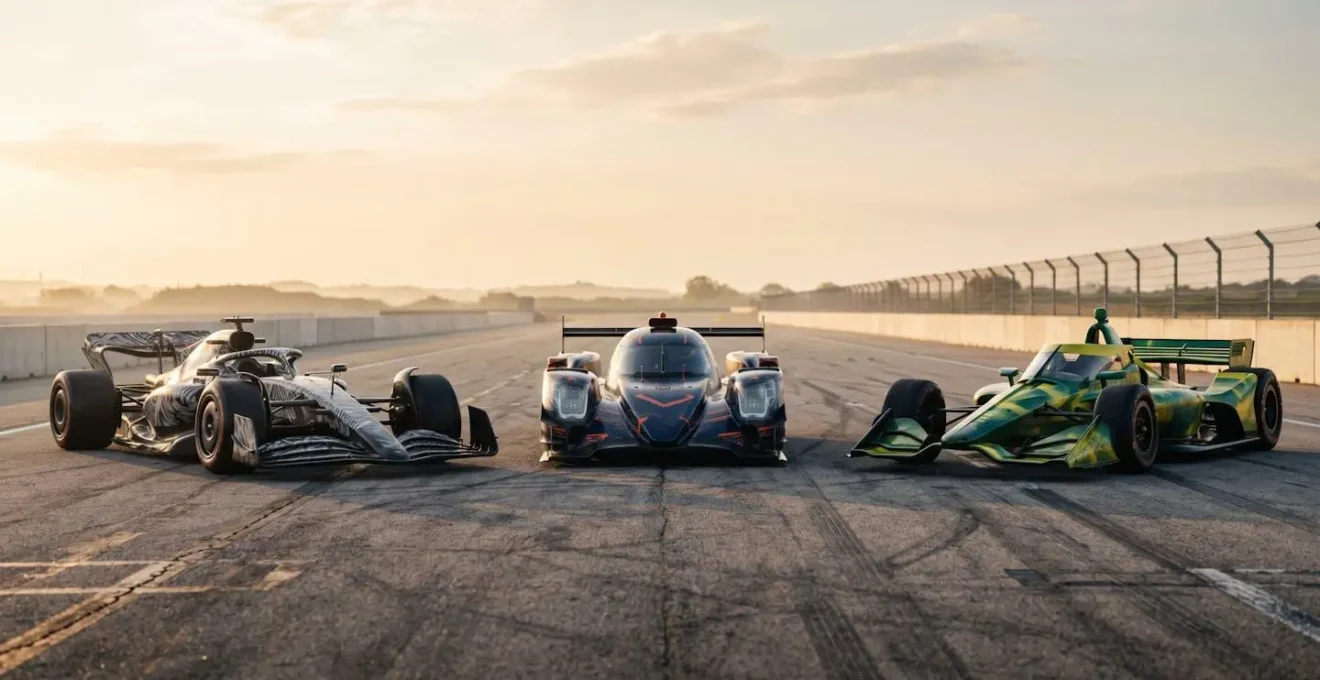
Deciding which series has the “best” racing goes far beyond comparing car specifications; it’s about understanding the core philosophy each championship embodies.
- Formula 1 is a technological arms race, prioritizing constructor innovation and global spectacle, making it the pinnacle of automotive engineering.
- IndyCar champions driver talent and pure competition through largely spec machinery, resulting in incredibly close and unpredictable racing.
- The WEC is a strategic marathon, a test of manufacturer efficiency, teamwork, and reliability over long distances.
Recommendation: Instead of asking which is ‘best’, ask which philosophy aligns with what you value as a fan—technological dominance, raw driver skill, or strategic endurance.
For any motorsport fan whose world revolves around Formula 1, the question inevitably arises: what else is out there? You hear whispers of the Indianapolis 500’s raw speed, the grueling 24 Hours of Le Mans, and the gladiatorial battles in IndyCar. It’s a landscape rich with history, embodied by the legendary Triple Crown of Motorsport—winning the Monaco Grand Prix, the Indy 500, and Le Mans. But comparing these titans of motorsport isn’t as simple as looking at a spec sheet. While many articles will tell you F1 cars have more downforce or IndyCars are faster on ovals, they miss the fundamental point.
The true difference lies not in the “what,” but in the “why.” Each series is a living answer to a set of philosophical questions about the nature of competition. Is the ultimate goal to crown the best driver, the smartest engineering team, or the most resilient machine? Is a race a short, explosive sprint for entertainment or a long, strategic war of attrition? The controversy around sprint races, the debate over bloated calendars, and the constant flux of manufacturers are not isolated issues; they are symptoms of each series’ unique sporting DNA.
This analysis will move beyond the platitudes. Instead of a sterile technical comparison, we will dissect the critical debates shaping modern motorsport. By examining how F1, the World Endurance Championship (WEC), and IndyCar each address these challenges, we can uncover their core philosophies. This will equip you not just with facts, but with a new framework for appreciating what makes each form of racing uniquely compelling. Prepare to explore the business, the technology, and the human element that defines the soul of speed.
Summary: Decoding the DNA of F1, WEC, and IndyCar
- Do Sprint Races Add Excitement or Devalue the Grand Prix?
- Is 24 Races Too Many for Mechanics and Drivers?
- Why Do Manufacturers Enter and Leave Racing Series Every 10 Years?
- Why Are There So Many New Street Tracks Like Vegas and Miami?
- Should Rules Change Often to Shake Up the Order or Stay Stable?
- Why Hydrogen Might Beat Batteries for 44-Tonne Trucks Crossing Europe?
- Does Money Still Buy a Seat in Top-Tier Motorsport?
- The Business of Speed: How Does F1 Make Money?
Do Sprint Races Add Excitement or Devalue the Grand Prix?
The introduction of Sprint races in Formula 1 is a perfect window into its modern philosophy: maximizing entertainment and commercial value. The format, which adds a shorter race on Saturday, is designed to create more “meaningful” track action across the entire weekend, giving broadcasters and promoters more high-stakes content to sell. The data suggests it’s working from a commercial standpoint; F1 has reported significant viewership growth for these sessions. However, this move has been met with resistance from a purist fanbase and even some drivers, who argue it dilutes the prestige of the main Grand Prix, turning a special event into just another “product.”
This approach contrasts sharply with the traditionalism of IndyCar and the WEC. IndyCar’s philosophy is rooted in a straightforward, high-intensity format. Its weekends are built around a single, climactic race, with qualifying setting the stage for one main event. There is no perceived need to add another race because the on-track product, thanks to spec chassis and a focus on driver skill, is already considered action-packed. The WEC’s philosophy is entirely different, centered on endurance. Its shortest race is six hours long. The “excitement” isn’t derived from a short burst of action, but from the slow-burn narrative of strategy, reliability, and teamwork unfolding over a vast timeframe. F1’s sprints are a bet on the attention economy, while its rivals remain committed to their classic, time-tested formats.
Is 24 Races Too Many for Mechanics and Drivers?
Formula 1’s ever-expanding calendar is a direct consequence of its ambition to be a truly global sport. Reaching 24 races represents a massive commercial success, tapping into new markets and securing lucrative hosting fees. However, it also highlights a philosophical tension between commercial growth and the human cost of the sport. The strain on drivers, and especially the mechanics and logistics staff who are the first to arrive and last to leave, is immense. This relentless schedule pushes the human factor to its absolute limit, risking burnout and diminishing the quality of life for thousands of personnel. This reality is often voiced by former insiders, as Ralf Schumacher noted, the situation “must be horrific for them. They don’t even see their families anymore.”
This contrasts with the philosophies of IndyCar and WEC. The IndyCar Series, while demanding, is predominantly North American-based. This regional focus creates a more manageable travel schedule, reducing the logistical and personal burden on teams. The WEC has a global calendar but with far fewer events—typically 7 or 8 races per season. Its philosophy prioritizes the prestige of individual, iconic events (like Le Mans, Sebring, and Spa) over the sheer volume of races. The calendar has grown significantly over the decades, as analysis shows a jump from 17 races in 1997 to 24 races in 2023, underscoring the relentless pace of modern F1. This divergence shows F1 prioritizing global reach, while its counterparts prioritize either regional concentration or event prestige over quantity.
Why Do Manufacturers Enter and Leave Racing Series Every 10 Years?
The cyclical nature of manufacturer involvement in motorsport is a dance driven by two factors: return on investment (ROI) and technological relevance. A brand like Audi or Porsche will enter a series when the rules allow them to showcase their engineering prowess and market their road cars effectively, and they will leave when the costs outweigh the marketing benefits or when regulations no longer align with their strategy. Formula 1 represents the highest peak of this mountain: the marketing exposure is unparalleled, but the cost of entry and competition is astronomical, creating a highly exclusive club.
This is where the WEC’s current philosophy has proven brilliantly successful. The introduction of the LMDh (Le Mans Daytona h) and Hypercar regulations created a cost-effective, technologically relevant platform for manufacturers. It allows brands to compete for the overall win at Le Mans with a budget that is a fraction of an F1 program. This pragmatic approach is why the series has seen a flood of new entrants.
Case Study: Alpine’s Strategic Move to WEC
Alpine’s decision to commit to a four-year factory program in the WEC’s Hypercar class from 2024 is a prime example of this philosophy in action. The manufacturer explicitly cited the lower cost of the LMDh platform and the opportunity to create technical synergies with its F1 engine program as key drivers. This move allows them to fight for overall victories in a prestigious global championship without the colossal financial outlay required for a top-tier F1 effort, joining a grid that, according to official WEC announcements, includes over seven major manufacturers. It demonstrates a clear strategic choice to pursue high-profile motorsport where the ROI is most favorable.
IndyCar operates on a different model entirely. While it has manufacturer involvement from Honda and Chevrolet who supply engines, its spec chassis philosophy means it is not a primary battleground for OEM technical development in the same way as F1 or WEC. Its appeal to manufacturers is in brand presence and association with a highly competitive, driver-focused series in the crucial North American market.
Why Are There So Many New Street Tracks Like Vegas and Miami?
The proliferation of street circuits in Formula 1 is the ultimate expression of its “destination city” business model. Unlike traditional, purpose-built circuits often located in rural areas, street races in glamorous locations like Las Vegas, Miami, and Singapore transform the Grand Prix into a week-long entertainment spectacle. The philosophy is to attract a wealthier, more casual audience and generate massive economic activity for the host city. These events are less about pure racing tradition and more about creating a high-end hospitality and media event. The financial incentive is staggering; a 2024 report confirmed the inaugural Las Vegas GP generated a staggering $934 million in revenue for the area.
This commercial imperative creates a very different on-track product, often on tight, temporary layouts that may not produce the best racing. This is a philosophical trade-off that IndyCar and the WEC approach differently. IndyCar has a rich history of street circuits (like Long Beach and St. Petersburg), but its identity is defined by its incredible diversity of track types, including natural-terrain road courses and, most uniquely, high-speed ovals. The Indy 500 is the jewel in its crown, an event steeped in a century of tradition at a permanent facility. The WEC, meanwhile, is almost entirely focused on classic, permanent road courses renowned for their history and challenging layouts, such as Spa-Francorchamps, Fuji Speedway, and of course, the iconic Circuit de la Sarthe for Le Mans. While F1 chases new urban markets, its rivals remain more anchored to the traditional homes of motorsport.
Should Rules Change Often to Shake Up the Order or Stay Stable?
The debate over regulatory stability is a fundamental crossroads in motorsport philosophy. Frequent rule changes, like F1’s major aerodynamic overhauls, are intended to “shake up the order,” prevent single-team domination, and create new technical challenges. The downside is that this often leads to one team interpreting the new rules best, resulting in a period of dominance anyway, while also driving up costs exponentially. Regulatory stability, on the other hand, allows for performance convergence over time as teams understand and refine their designs, leading to closer competition but potentially a “stale” visual look.
This is where the core sporting DNA of F1 and IndyCar is most apparent. As one technical analysis puts it, “Formula 1 is a constructors’ championship… whereas IndyCar is more of a drivers’ championship.” F1’s philosophy embraces its role as a technological war between manufacturers. The constant rule changes are part of its identity. In stark contrast, IndyCar uses a spec Dallara chassis that remains unchanged for many years. This regulatory stability is a deliberate choice to place the emphasis squarely on driver skill, team strategy, and minute setup differences. It virtually guarantees that any car in the field has a chance to win on any given weekend, creating the close, unpredictable racing it is famous for. Is an F1 car faster? In terms of cornering G-force and lap time on a road course, absolutely. But IndyCar’s philosophy isn’t about the ultimate lap time; it’s about the ultimate competition.
Your Checklist for Analyzing a Racing Series’ DNA
- Car Philosophy: Is it a constructor’s battle with unique designs (F1, WEC Hypercar) or a spec-series focused on driver talent (IndyCar, F2)?
- Competitive Balance: Does the series use tools like a budget cap (F1) or Balance of Performance (WEC) to close the field, or does it rely on spec parts?
- Race Format: Is the focus on a single, traditional main event (IndyCar), an endurance challenge (WEC), or a multi-format entertainment weekend (F1 Sprints)?
- Track Diversity: Does the calendar favor historic permanent circuits, modern street spectacles, or a mix that includes unique challenges like ovals?
- Cost vs. Merit: How high is the barrier to entry? Does the financial demand lead to more “pay drivers” or is there a clear ladder based on talent?
WEC sits in a fascinating middle ground, using a Balance of Performance (BoP) system to equalize the varied machinery in its top Hypercar class, ensuring that cars from Porsche, Toyota, and Ferrari can compete on a level playing field despite their different design concepts.
Why Hydrogen Might Beat Batteries for 44-Tonne Trucks Crossing Europe?
While the logistics of heavy-duty transport seem distant from the racetrack, the underlying question—how to power the future of mobility—is central to modern motorsport’s philosophy of relevance. Every major series is grappling with how to remain a valuable R&D platform in an increasingly eco-conscious world. Formula 1’s chosen path is high-tech hybrid power units running on fully sustainable e-fuels from 2026. This philosophy keeps the internal combustion engine relevant, arguing that developing carbon-neutral fuels has wider applications than electrification alone.
The World Endurance Championship, true to its history of technological diversity, is exploring a different route: hydrogen. The 24 Hours of Le Mans has long featured a “Garage 56” entry for innovative technology, and this has become a testbed for hydrogen power. The MissionH24 project has run a hydrogen-electric prototype for years, and a dedicated hydrogen class is planned for the future. This philosophy sees endurance racing as the perfect laboratory to prove the viability and reliability of hydrogen fuel cells for long-distance travel—a direct parallel to the challenge faced by long-haul trucks.
IndyCar is taking a more conservative step, introducing hybrid technology to its existing engine formula, a move aimed at enhancing energy recovery and providing a power boost without a complete technological overhaul. Each approach reflects a different bet on the future: F1 on saving the combustion engine with e-fuels, WEC on pioneering long-range hydrogen power, and IndyCar on a pragmatic, incremental adoption of hybrid tech. The “winner” in the world of transport may well be determined by lessons learned on the track.
Does Money Still Buy a Seat in Top-Tier Motorsport?
The age-old issue of “pay drivers” is a direct function of a series’ financial philosophy. In any form of motorsport, money is a crucial ingredient, but the degree to which it can influence a driver’s career path varies dramatically. Formula 1, as the most expensive sport in the world, inevitably has the highest barrier to entry. While the FIA Super Licence system ensures a minimum level of talent, the immense cost of junior formulas (F3, F2) and the value of sponsorship a driver can bring to a smaller team means that personal funding can absolutely be a deciding factor in securing a seat, which can cost upwards of $15-20 million per season for a rookie.
The core philosophy of the car itself plays a huge role. An F1 car is a prototype, an engineering masterpiece pushed to its absolute aerodynamic limit. As Open Wheel World notes, while the key term for an F1 car is ‘on the limit’, for an IndyCar, it’s more about ‘robustness’. This “robust” nature of the spec IndyCar chassis makes it more physically demanding to drive but also means the performance is in the driver and the setup, not a billion-dollar R&D budget. This lowers the overall cost of competition. While sponsorship is still vital, IndyCar’s “Road to Indy” ladder system is more affordable, and talent is often the primary currency for advancement. Many of its top drivers reached the series with little to no family wealth.
WEC presents a different picture. In the top Hypercar class, drivers are elite professionals paid by global manufacturers. However, the lower LMP2 and GT classes feature a mix of professional and “bronze” or “silver” rated amateur drivers, who are often gentlemen drivers bringing funding to the team. This is an explicit part of the WEC’s sporting model, creating a pro-am environment that is essential to the financial health of the grid. So, while money buys a seat in all three, the context is different: in F1 it can be a backdoor to the grid, in IndyCar it’s less influential than raw talent, and in WEC’s lower classes, it’s a formalized and accepted part of the system.
Key takeaways
- Philosophical Divide: The core difference between F1, WEC, and IndyCar lies in their guiding philosophies: F1 is a tech-driven constructor’s series, IndyCar is a driver-focused spec series, and WEC is a strategic manufacturer’s endurance test.
- Commercial vs. Sporting: F1’s modern strategy (sprints, street circuits, large calendar) prioritizes commercial growth and entertainment, sometimes at the expense of sporting tradition and human sustainability.
- Cost-Effective Competition: WEC’s LMDh/Hypercar rules and IndyCar’s spec chassis have successfully created highly competitive and manufacturer-rich environments by offering a more controlled and favorable return on investment compared to F1.
The Business of Speed: How Does F1 Make Money?
To fully grasp why Formula 1 makes the choices it does, you have to understand its business philosophy. F1’s revenue model is a powerful engine built on three main pillars: race promotion fees, broadcasting rights, and sponsorship. The most significant of these, and the one driving the calendar expansion and move to street circuits, is race promotion. Promoters (often governments or private entities) pay F1 enormous fees, sometimes exceeding $50 million per year, for the right to host a Grand Prix. This fee is justified by the massive economic impact and global exposure the event brings, including the generation of significant local tax revenue, which was reported as $45 million for the Las Vegas GP.
The second pillar is broadcasting rights. F1 signs multi-billion dollar deals with television networks around the world, who pay for exclusive rights to show the races. The push for more races and more drama, such as through sprint weekends, is directly aimed at increasing the value of these media rights. A larger global audience, like the 56.1 million viewers for the Vegas race, makes the product more valuable to broadcasters. Finally, F1 secures major global sponsorships with brands like Rolex, Pirelli, and Aramco, who want to associate themselves with the sport’s glamorous, high-tech image.
This business model is fundamentally different from IndyCar, which has a much smaller global footprint and relies more on domestic TV rights and series-level sponsorships. Its race promotion fees are significantly lower, making it more accessible for traditional American tracks. WEC’s model is manufacturer-centric, with the health of the series tied to the continued participation of major automotive brands who use it as a marketing and R&D platform. F1’s philosophy is that of a premium entertainment provider, selling a high-octane spectacle to the highest bidder, be it a city, a broadcaster, or a global brand.
Now that you have a clearer picture of the different philosophies at play, the next logical step is to see them in action. The best way to decide which series resonates with you is to experience it firsthand.
Watch one race from each championship: an F1 Grand Prix, an IndyCar race on an oval, and a WEC endurance event. Go in not just as a spectator, but as an analyst, and decide for yourself which philosophy of speed truly captures your imagination.