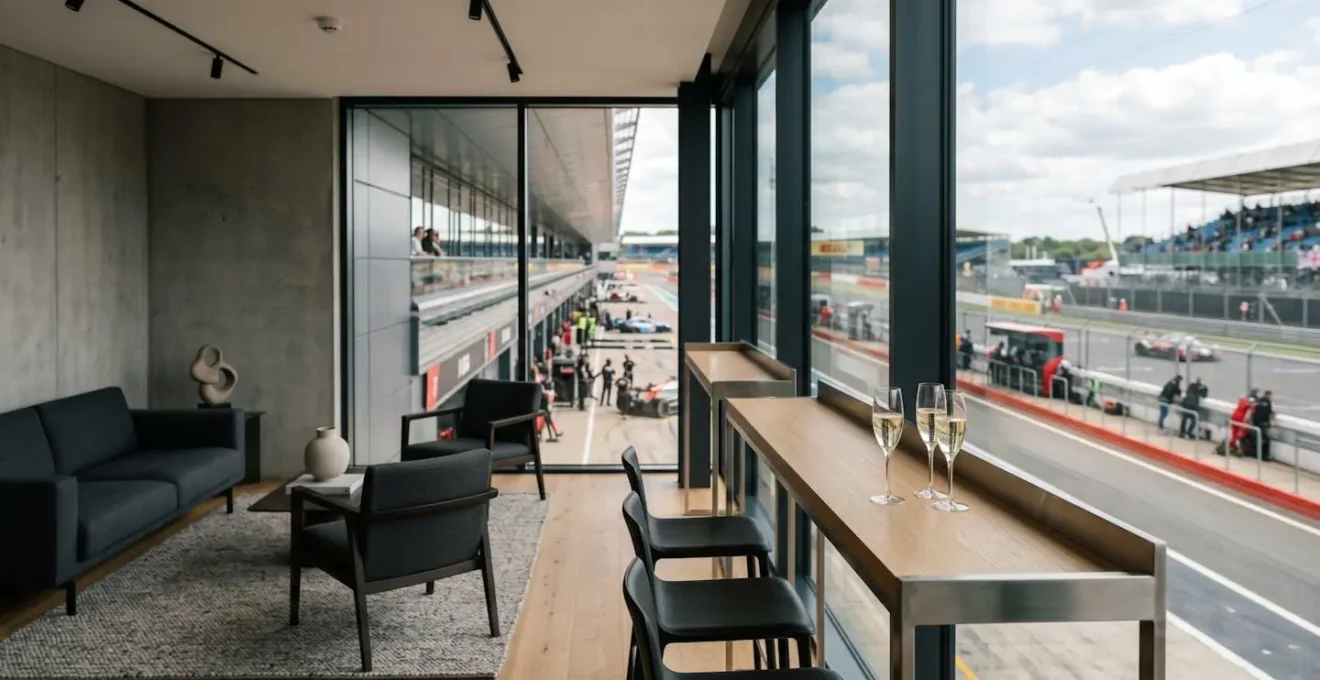
The Paddock Club’s £5,000 price tag buys you access to an exclusive B2B networking ecosystem, not necessarily a superior race-watching experience.
- The food, views, and driver access are highly curated marketing assets rather than spontaneous luxuries.
- The primary value is for corporate hosting and high-level business development, not for the avid motorsport spectator.
Recommendation: Evaluate the ticket as a business investment. If your goal is purely to watch the race, a premium grandstand seat offers better value and a more authentic trackside atmosphere.
The allure is undeniable. For a price that eclipses many luxury holidays, the Formula 1 Paddock Club dangles the ultimate trackside fantasy: champagne on tap, gourmet cuisine, and a privileged vantage point rubbing shoulders with the sport’s power brokers. At Silverstone, this experience commands a fee of around £5,000 per person. For the discerning enthusiast accustomed to quality, the question isn’t whether it’s expensive, but whether it delivers genuine value. Does it transcend the standard sports hospitality to offer a truly exceptional, five-star experience?
The marketing brochures paint a picture of unadulterated glamour. They promise proximity to the action, encounters with legends, and a level of service that justifies the price. Most reviews you’ll find online are breathless accounts from competition winners or first-timers, understandably wowed by the sheer spectacle. But a critical eye, one that expects perfection for this price point, must look beyond the pageantry. Is the food truly Michelin-star quality, or just very good event catering? Are the views genuinely better for watching a race, or just better for being seen?
This analysis moves past the hype. We propose that the Paddock Club is not what it seems. Its primary function is not to provide a superlative spectator experience, but to serve as a high-stakes B2B networking environment. The £5,000 ticket is less about what you see on track and more about who you see in the suite. The entire experience is a meticulously curated product, and its worth must be judged not on its promises of luxury, but on its effectiveness as a corporate tool.
To determine its true value, this article will deconstruct each element of the Paddock Club promise. We will examine the social dynamics, the quality of the dining, the reality of the “exclusive” access, and the strategic purpose of the views. By dissecting the package, you can decide if this investment aligns with your expectations as an enthusiast, a business professional, or both.
Summary: Decoding the Paddock Club Experience
- Why Most Paddock Club Guests Are Not There to Watch the Race?
- Do You Really Get Michelin Star Food at a Race Track?
- What Can You Actually See During a VIP Pit Lane Walk?
- Will You Actually Meet Lewis Hamilton in the VIP Suite?
- Are the Views from the VIP Suites Better than Grandstands?
- Why Do Crypto and Tech Companies Spend Millions on Car Stickers?
- Why Social Sim Racing Venues Are Exploding in London?
- From Sofa to Cockpit: Can Sim Racing Really Get You a Pro Drive?
Why Most Paddock Club Guests Are Not There to Watch the Race?
The first truth of the Paddock Club is that the on-track action is often a secondary concern. The real event takes place away from the windows, in the hushed, carpeted interior of the suites. This is not a gathering of die-hard fans; it’s the pinnacle of corporate hospitality, a temporary ecosystem built for networking. Guests, dressed in smart-casual attire, are there to build relationships, close deals, and leverage the high-octane environment of Formula 1 to reflect positively on their brand. The sound of engines is merely the soundtrack to conversations about mergers, acquisitions, and market strategy.
This focus on business is the fundamental purpose of the venue. As noted by one hospitality expert, the track is almost incidental. ZK Sports & Entertainment’s analysis of F1 hospitality highlights this distinction perfectly, stating that while millions watch the race, inside exclusive environments like the Paddock Club, “a completely different kind of activity is taking place.” This activity is a carefully orchestrated ballet of B2B interactions. The global nature of this business is significant, with F1 Experiences data showing that while European buyers make up a large portion of sales, a full 40% of sales come from North American buyers, underscoring its role as an international business hub, not just a British sporting event.
For an individual enthusiast, this environment can feel isolating. If your goal is to immerse yourself in the race, you may find the prevailing atmosphere of detached corporate schmoozing to be a distraction. The value here is not in shared passion for motorsport, but in access to a powerful room of decision-makers. The £5,000 ticket is the price of admission into this temporary, high-stakes business club.
Do You Really Get Michelin Star Food at a Race Track?
The promise of “gourmet dining” and “Michelin-starred chefs” is a cornerstone of the Paddock Club’s marketing. The implication is an experience equivalent to a top London restaurant, simply relocated to a racetrack. The reality, while impressive, requires a more nuanced understanding. What is provided is an exceptionally high-end, mass-catering operation, designed and sometimes overseen by celebrated chefs, but an operation nonetheless. The logistics of serving hundreds of discerning guests simultaneously means the model is based on delivering consistent quality at scale, not the bespoke, à la minute preparation of a true Michelin-starred establishment.
There are, of course, standout examples. A collaboration with a two-Michelin-star chef like Tom Sellers for a specific team lounge is a powerful statement of quality. As the publication Boardroom noted when describing one such high-roller event, guests enjoyed “the finest food you’ll find at an F1 event — and possibly any sporting event on earth.” This is the peak of the offering, a “halo” experience that elevates the perception of the whole. However, it’s critical to understand that this level of named-chef involvement is often reserved for the most exclusive, team-specific suites within the Paddock Club, not necessarily the standard for every guest.
For the general Paddock Club ticket holder, the offering is more akin to a world-class business lounge. You will find an open bar with premium champagne (often from an F1 sponsor brand), high-quality wines, and an extensive buffet featuring everything from fresh seafood to artisan pastries. The food is excellent, plentiful, and beautifully presented. But it is a curated culinary experience designed for grazing and socializing, not a destination dining event. The value lies in the seamless, all-inclusive luxury, but it should not be benchmarked against a £300 tasting menu at a dedicated fine-dining restaurant.
What Can You Actually See During a VIP Pit Lane Walk?
The “exclusive pit lane walk” is one of the most tangible and heavily promoted perks of a Paddock Club ticket. It offers a chance to step onto the hallowed ground usually reserved for teams and media. The official F1 Experiences guide sets the expectation clearly: guests are given a specific window of time, typically 30 to 60 minutes, to walk the pit lane. During this time, you can get a close-up look into the garages, see the cars being prepped, and, as they state, “There’s a good chance you’ll catch some of the teams practising their pit stops.”
From a luxury reviewer’s perspective, this is an exercise in managed expectations. “Exclusive” refers to your ticket tier, not to having the space to yourself. You will be sharing the pit lane with every other Paddock Club and VIP guest, creating a bustling, and at times crowded, atmosphere. While you are undeniably closer to the machinery than anyone in the grandstands, your view into the garages is often from behind a rope, looking past other guests. The teams are, of course, working; this is a live environment, not a museum exhibit. You might see a frantic tyre change practice, but you are just as likely to see mechanics cleaning parts or staring at data screens.
The experience is less about quiet observation and more about a controlled, high-energy photo opportunity. It’s a chance to capture the “I was there” shot and feel the unique energy of the pit lane. However, it is a scheduled, timed, and crowded activity. It is a fantastic perk, but it is not the leisurely, behind-the-scenes tour one might imagine from the marketing. The value is in the novelty and the fleeting proximity to the heart of the operation, not in a deep, insightful look into a team’s strategy.
Will You Actually Meet Lewis Hamilton in the VIP Suite?
This is perhaps the most delicate of the Paddock Club’s implicit promises. The allure of celebrity, of a chance encounter with a racing hero, is a powerful motivator. The reality is far more structured and transactional. You will not be casually sharing a drink with Lewis Hamilton or any other current driver. These athletes are multi-million-dollar assets on a brutally tight schedule. Their time is their most valuable commodity, and it is not spent mingling with guests.
What you will experience is a carefully managed appearance. As the official F1 ticket store explains, guests may “Hear from some of your favourite F1® personnel” including current or legendary drivers. This typically takes the form of a short Q&A session on a stage within the Paddock Club complex. A driver or team principal will appear for 10-15 minutes, answer a few pre-vetted questions from a host, and then disappear back into the paddock. It’s an appearance, not an interaction. You are in their presence, but you are an audience member, not a conversational partner. This is the definition of transactional proximity.
Furthermore, the world of VIP access is itself stratified. The standard Paddock Club ticket is not the final frontier of exclusivity. The emergence of ultra-premium, invitation-only suites demonstrates this clearly.
Case Study: House 44 and the Hierarchy of Access
The launch of House 44, a partnership between F1, Lewis Hamilton, and the exclusive Soho House brand, exemplifies the tiered nature of VIP hospitality. This initiative created a new, even more premium layer within the Paddock Club. It offers a bespoke experience with curated interiors and special access that surpasses the standard offering. This illustrates that even within the supposedly ultimate VIP area, there are further velvet ropes. The involvement of a current driver like Hamilton is a direct brand partnership, a commercial venture, not a casual social perk for all Paddock Club guests.
The lesson for a £5,000 ticket holder is clear: you are buying access to a specific tier of the F1 ecosystem, but the truly personal interactions with the sport’s biggest stars are reserved for an even more elite, and often commercially linked, clientele.
Are the Views from the VIP Suites Better than Grandstands?
The Paddock Club is almost always located directly above the team garages, overlooking the pit lane and the main start/finish straight. The official description promises a “front-row seat to watch all the key action,” highlighting pre-race preparations and post-race celebrations. This is accurate. From the suite, you have an unparalleled, bird’s-eye view of the team’s operations, the drama of a pit stop, the grid formation, and the chequered flag. It is, without question, the best place to watch the strategic ballet of a Formula 1 race unfold.
However, is it the best place to watch the *racing*? This is a different question. The main straight, while exciting for the start, is often the least interesting part of the circuit for wheel-to-wheel action. The most dramatic overtakes and driver skill showcases happen in the braking zones and tight corners like Brooklands, Luffield, or Stowe at Silverstone. A well-chosen premium grandstand seat at one of these key corners will offer a far more visceral and thrilling view of the cars at their limit. You will see more action, feel more of the speed, and be immersed in the passionate roar of a dedicated fan crowd.
The Paddock Club view is strategic and comfortable; the grandstand view is dynamic and immersive. The choice depends entirely on your priorities. You trade the raw, edge-of-your-seat thrill of a key corner for the air-conditioned comfort and strategic overview of the pits. For many in the Paddock Club, whose focus is conversation and comfort, this is a perfect trade. For a pure racing enthusiast, it may feel sterile and distant from the real heart of the action.
Action Plan: Audit Your Viewing Priorities
- Identify Your Focus: Are you more interested in race strategy and pit stops, or in pure wheel-to-wheel action and dramatic overtakes?
- List Key Moments: Write down the three moments in a race you most want to see live (e.g., the start, a specific corner, the podium ceremony).
- Evaluate Viewing Angles: Research which locations at Silverstone (Paddock Club vs. specific grandstands like Becketts or Stowe) offer the best view of your priority moments.
- Assess Atmosphere Preference: Do you prefer a quiet, climate-controlled environment for conversation or the loud, passionate, and communal atmosphere of a grandstand?
- Make a Value-Based Decision: Compare the cost of a premium grandstand ticket against the Paddock Club ticket. Is the strategic view and luxury worth the significant price premium over a superior action-focused seat?
Why Do Crypto and Tech Companies Spend Millions on Car Stickers?
The presence of crypto, tech, and B2B software company logos on Formula 1 cars can seem perplexing. These companies aren’t selling consumer goods like watches or soft drinks. The answer lies not in brand awareness for the general public, but in the access that sponsorship buys them. A multi-million dollar “sticker on a car” is, in effect, a membership fee to the world’s most exclusive business club: the F1 Paddock. The sponsorship’s primary ROI is not generated by the television audience, but by the business conducted within the hospitality suites.
For these companies, the logo on the car is a key that unlocks the Paddock Club. An analysis by ZK Sports & Entertainment states this explicitly: sponsorship provides a company with “access to the Paddock Club for high-value B2B hosting.” Here, they can entertain C-suite executives from potential client companies, creating an unparalleled impression of success, performance, and cutting-edge technology by associating their brand directly with a Formula 1 team. The ability to use team drivers for content creation further enhances this image.
This B2B function is a cornerstone of the modern F1 business model. While global media rights are the largest revenue stream, the money generated from corporate partnerships is a massive and critical component. An analysis of the Formula 1 business model shows that while media rights make up about 40% of income, sponsorship and hospitality create secondary revenue streams worth approximately $1.2 billion annually. The Paddock Club is the physical nexus where this sponsorship value is realized. The crypto company isn’t just buying an advert; it’s buying a seat at a very exclusive table, and the Paddock Club is the dining room.
Key Takeaways
- The Paddock Club is fundamentally a B2B networking environment, not a spectator zone.
- Luxury perks like food and driver access are highly curated and part of a commercial package, not spontaneous encounters.
- The views are strategic but often inferior to premium grandstands for watching on-track, wheel-to-wheel racing action.
Why Social Sim Racing Venues Are Exploding in London?
While Formula 1 erects ever-higher walls of exclusivity and cost, a parallel trend is exploding at the grassroots level: social sim racing. Venues are appearing across London and other major cities, offering a radically different proposition. Instead of paying thousands for passive viewing, people are paying a fraction of that to actively get behind the wheel—of a high-end simulator. These venues combine motorsport, gaming, and hospitality into a single, accessible package.
The appeal is rooted in a major cultural shift towards “competitive socialising.” As one trend analysis puts it, these venues succeed because they “tap into a desire for experience-based socialising with a competitive edge, low barrier to entry, and high ‘Instagrammability’.” Unlike the real world of motorsport, which requires immense financial investment and physical commitment, anyone can walk into a sim racing venue and be competing within minutes. It’s about participation, not observation.
This model democratizes the thrill of racing. It strips away the financial barriers and physical risks, distilling the experience down to its competitive essence. The focus is on shared fun and friendly rivalry. Groups of friends can book a bank of simulators, order food and drinks to their rig, and spend an evening battling for bragging rights on a virtual Silverstone or Monaco. It offers the adrenaline of racing in a social, comfortable, and affordable setting—a stark contrast to the formal, high-stakes atmosphere of the Paddock Club. It’s an active experience for the many, versus a passive one for the few.
From Sofa to Cockpit: Can Sim Racing Really Get You a Pro Drive?
The ultimate dream for any fan is to make the jump from spectator to competitor. For decades, this path was prohibitively expensive, starting with karting and demanding a seven-figure budget to even reach the junior formulas. Sim racing, however, has emerged as a potential, if narrow, alternative pathway. It has the power to democratize practice and identify raw talent in a way that was previously impossible. A motorsport training analysis notes that sim racing allows aspiring drivers to “hone racecraft, track knowledge, and mental stamina for a fraction of the cost.” It is a genuine, meritocratic talent incubator.
The most famous example of this “sim-to-pro” pipeline remains the story of Jann Mardenborough, whose journey from a Gran Turismo player to a Le Mans driver is legendary. His story, however, serves as both an inspiration and a cautionary tale.
Case Study: Jann Mardenborough and the Limits of Simulation
Jann Mardenborough’s success after winning the GT Academy in 2011 proved that the skills learned in a simulator could translate to the real world. He competed successfully in GP3 and the gruelling Le Mans 24 Hours. However, his path remains an outlier. The GT Academy program that discovered him has since been discontinued, highlighting the difficulty in scaling such initiatives. His story proves that while simulation can identify talent and teach racecraft, the transition to a professional career still requires immense financial backing, intense physical conditioning, and extensive real-world testing—elements that a simulator cannot provide. It is a powerful tool, but not a replacement for the traditional motorsport ladder.
For the vast majority, sim racing is not a direct path to a pro drive. It is, however, the most accessible way to experience the mental challenge and skill required to compete at a high level. It offers a deeper appreciation for what the drivers are doing on track than any VIP suite ever could. It provides the “experience” of racing, a satisfaction that passive viewing, no matter how luxurious, cannot replicate.
Ultimately, the £5,000 Paddock Club ticket is not a simple purchase; it’s a strategic decision. If your goal is to immerse yourself in a world of corporate influence and experience a seamless, all-inclusive luxury service while the race happens in the background, it may be a sound investment. But if your heart lies with the raw, visceral thrill of wheel-to-wheel combat, your money and your passion might be better served in a premium grandstand, right at the heart of the action.