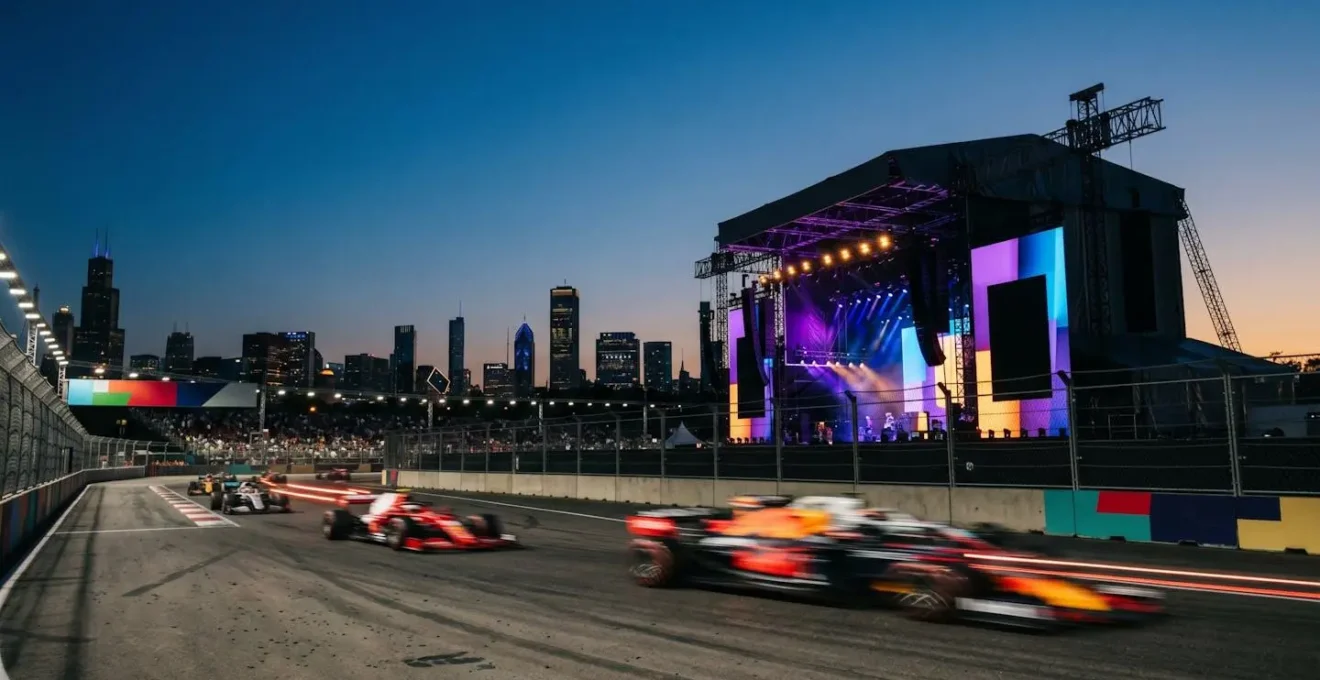
A Grand Prix is no longer a motorsport event; it’s a high-production music festival where the race serves as a spectacular, high-octane opening act.
- The fan experience, from A-list concerts to interactive zones, is now engineered to be a primary attraction, not a secondary bonus.
- The entire weekend ecosystem—from celebrity-packed grids to £60 team caps—is meticulously designed to create cultural currency and a festival-like atmosphere.
Recommendation: Judge the weekend by its lineup and vibe, not just its starting grid. It’s worth staying for, but for reasons a traditional race fan might not even notice.
The roar of twenty engines fades, the scent of hot rubber and high-octane fuel hangs in the twilight air, and a different kind of energy starts to build. For a music fan attending a Formula 1 Grand Prix, this is the pivotal moment. The race is over, but is the event? You’ve heard whispers of post-race concerts and a festival-like atmosphere, but the question lingers: is it worth staying for, or is it just a corporate-sponsored afterthought for the die-hard motorsport crowd?
For years, the conventional wisdom was simple: F1 needed to broaden its appeal. Promoters added concerts, expanded fan zones, and courted celebrities. But what if this transformation is no longer about simply adding value? What if this is a fundamental reinvention? This analysis argues that the Grand Prix has completed its metamorphosis. It is no longer a race with a concert tacked on; it’s a meticulously engineered, multi-day festival experience that uses a motorsport competition as its globally televised, adrenaline-fueled opening act.
We will deconstruct this new breed of sporting spectacle from an event critic’s perspective. We’ll examine the strategy behind the music, the purpose of the celebrity-filled grid, the curated chaos of the fan zones, and the business model that underpins it all. By the end, you won’t just know if the concert is worth it; you’ll understand the Grand Prix for what it has become: one of the most ambitious and expensive live entertainment packages on the planet.
To fully grasp this shift, this article breaks down the key elements that transform a racetrack into a festival ground. The following sections explore everything from the strategic value of concerts to the economics of a team cap, providing a complete picture of the modern F1 experience.
Summary: The Grand Prix as a Live Entertainment Spectacle
- Do Concerts Distract from the Racing or Add Value?
- Why Are There So Many Bodyguards on the Starting Grid?
- Where is the Best Place to Hear Drivers Speak at the Track?
- Why Does a Team Cap Cost £60 at the Track?
- Is the Woodlands Campsite Party Atmosphere Too Much for Families?
- Why the Fan Zone is Now a Festival rivaling the Race Itself?
- How American Ownership Changed F1 from a Sport to a Media Brand?
- The Business of Speed: How Does F1 Make Money?
Do Concerts Distract from the Racing or Add Value?
From an event critic’s perspective, the question of whether concerts “distract” from racing is obsolete. The concerts don’t distract; they redefine the entire value proposition of a Grand Prix ticket. For the new target audience—the music fan, the casual spectator, the corporate guest—the race and the concert are inseparable parts of a single entertainment package. The strategy isn’t to hope a race fan enjoys a concert; it’s to guarantee a music fan has a compelling reason to buy a ticket in the first place. The race provides the daytime spectacle, while the concert delivers the headline-worthy finale.
This strategy is a deliberate and calculated business move designed to de-risk the event’s success from the unpredictability of the on-track action. A boring race can be saved by a stellar headline act. As GPDestinations Formula 1 Analysis notes in their “Formula 1 Concerts Evolution Report”:
Staging concerts by internationally recognized artists have helped F1 race promoters to attract a broader, more diverse audience, including music fans who may not traditionally follow motorsport.
– GPDestinations Formula 1 Analysis, Formula 1 Concerts Evolution Report
The results of this strategy are undeniable. The goal is to maximize attendance across the entire weekend, not just on race day. This “festivalization” has turned circuits into magnets for a demographic that values experience and entertainment above sporting purity. Liberty Media’s financial reports confirm the success of this approach, with overall attendance hitting 6.5 million attendees in a recent season, a 9% increase that reflects the appeal of this expanded offering. The concerts don’t just add value; they multiply the event’s potential audience and revenue.
Why Are There So Many Bodyguards on the Starting Grid?
The pre-race starting grid used to be a bustling, but functional, space for engineers, media, and team principals. Today, it more closely resembles the red carpet at the Met Gala. The proliferation of bodyguards is a direct and visible symptom of F1’s successful pivot into a high-status cultural event. The security personnel are no longer just protecting drivers; they are managing the logistics of a space now crowded with A-list actors, music moguls, supermodels, and tech billionaires. The grid has become the ultimate “see and be seen” location, and its security has scaled accordingly.
This isn’t about sporting access; it’s about generating cultural currency. Every photo of a global celebrity posing next to a car, every Instagram story from the paddock, reinforces the message that F1 is the epicenter of cool. As one sports analysis put it, F1 circuits are “now graced by A-list actors, musicians, and fashion icons,” transforming the sport’s image from a niche interest to a mainstream luxury brand.
Case Study: The Las Vegas Grand Prix Celebrity Phenomenon
The recent Las Vegas Grand Prix served as the ultimate proof of this concept. The event’s unprecedented celebrity attendance, featuring icons like Beyoncé, Jay-Z, and Naomi Campbell, transformed the paddock into an environment observers likened to Fashion Week. According to a report on the event’s cultural shift, the presence of such high-profile figures and live concerts by artists like T-Pain completely blurred the lines between a race weekend and a music festival. As documented by media covering the cultural shift, the security infrastructure had to evolve rapidly to manage this influx of high-net-worth guests, proving that F1 is now as much in the business of celebrity hospitality as it is in motorsport.
For the music fan, this means the vibe of the entire event is elevated. It’s not just a sporting event; it’s a curated gathering of the influential. The bodyguards are simply the most visible evidence that you are now part of an exclusive, high-stakes social affair.
Where is the Best Place to Hear Drivers Speak at the Track?
For a newcomer drawn in by the festival atmosphere, wanting to “hear the drivers speak” is a natural impulse. However, in the modern F1 ecosystem, access is a carefully tiered and monetized product. The answer to “where” depends entirely on your ticket price and willingness to navigate the circuit’s “experiential hierarchy.” Gone are the days of casual, unscripted encounters. Today’s interactions are scheduled programming, delivered across multiple stages with varying levels of polish and exclusivity. This is no different from a music festival offering standard general admission versus a platinum VIP package with artist meet-and-greets.
The most accessible interactions in the Fan Zones are often highly polished Q&A sessions. Here, drivers deliver media-trained soundbites and engage in sponsor-friendly activities. While entertaining, this is the public-facing, sanitized version of the driver’s personality. To get a more candid experience, you have to move up the food chain to brand activation zones or, for the ultimate price, the exclusive Paddock Club. There, in a more relaxed and private setting, the true, unfiltered conversations happen—far from the general admission crowds. The post-race grid celebration is a notable exception, offering a moment of mass, chaotic joy, but it’s not a place for conversation.
Your Action Plan: Navigating the Hierarchy of Driver Access
- Fan Zone Oases: Head to the main stages located near grandstands. This is your best bet for seeing the drivers with a general admission ticket. Expect polished, crowd-pleasing content.
- Brand Activation Zones: Keep an eye on the schedules for tech partners or major sponsors. Drivers make obligated appearances here, and the atmosphere can be slightly more relaxed and interactive than the main stage.
- Post-Race Grid Celebrations: If you want to feel the collective energy, join the rush onto the track after the race. Gates are opened to all ticket holders for a massive on-grid party. It’s about atmosphere, not access.
- Paddock Club/Team Hospitality: This is the premium tier. If your ticket gets you here, you have access to private Q&A sessions and potential one-on-one opportunities. This is where the most direct and unfiltered access is found.
Ultimately, understanding where to hear drivers speak is to understand the event’s business model. Every level of access is a product, and the most valuable conversations are reserved for the highest-paying customers.
Why Does a Team Cap Cost £60 at the Track?
To question why a team cap costs £60 at the track is to miss the point of what you’re actually buying. You’re not just purchasing headwear; you’re acquiring a token of belonging. In the festival-like ecosystem of a modern Grand Prix, official merchandise serves the same function as a band t-shirt at a concert or a wristband at Glastonbury. It’s a visible, tangible signal that you are part of the tribe. The price is not based on the cost of cotton and embroidery; it’s based on the value of that social signal within a captive market of passionate consumers.
This is a classic example of “experiential pricing.” The cap’s value is inflated by the environment in which it’s sold—an immersive, high-energy weekend where emotional connection to teams and drivers is at its peak. Promoters understand that in this context, purchasing merchandise is an emotional, impulse-driven part of the overall experience, not a rational, price-sensitive decision. You’re paying for the memory and the identity associated with the item.
The premium quality, intricate stitching, and advanced materials of modern merchandise are used to help justify this price point, positioning the item as a premium product worthy of a premium brand. But the core driver is the desire to participate fully in the event’s culture. When a fan spends hundreds or even thousands on tickets and travel, the marginal cost of a £60 cap to complete the “look” feels less significant. This is supported by data on fan spending, with a 2026 cost analysis of F1 attendance showing that a budget-conscious fan can expect to spend around $300 on miscellaneous items, while the average is closer to $550 for the weekend. The cap is just one piece of a much larger economic puzzle.
Is the Woodlands Campsite Party Atmosphere Too Much for Families?
The short answer, from an event critic’s standpoint, is: yes, it absolutely can be, and that is entirely by design. The question presupposes a single, monolithic “atmosphere,” when in reality, modern Grand Prix circuits like Silverstone have embraced the festival model of zoned experiences. The “party atmosphere” is a curated product for a specific demographic, just as “family-friendly” is for another. The potential for the two to clash is not a flaw in the planning; it is an inherent characteristic of any large-scale music festival, which F1 weekends now emulate.
The idea is not to tone down the party, but to manage it. Promoters have learned from the festival industry that you can cater to both hardcore partiers and families with young children, as long as you provide clear physical and audial separation. The existence of designated “Lively” and “Quiet” campsite zones is the most obvious example. It’s an admission that the event is trying to be everything to everyone, and the only way to achieve that is through careful spatial planning. The campsite is no longer just a place to sleep; it’s an extension of the festival ground, with its own distinct neighborhoods and social codes.
Action Plan: A Family’s Survival Guide to the Grand Prix Festival
- Research Campsite Zoning Policies: Before booking, look for circuits that explicitly offer designated ‘Family’, ‘Lively’, and ‘Quiet’ zones. This is your first and most important decision to control your environment.
- Invest in Proper Hearing Protection: This is non-negotiable. The combination of car engines (which can exceed 140 decibels) and concert sound systems makes certified ear protection essential for every member of the family.
- Utilize Designated Family Zones: Modern circuits feature vast entertainment areas with specific family-friendly sections that have controlled sound levels and appropriate activities. Use them as your home base.
- Plan Around the Schedule: Concerts and DJ sets typically fill the downtime between on-track sessions. Use the official schedule to strategically enjoy the music or retreat to quieter areas during peak entertainment programming.
- Leverage Fan Zone Amenities Early: The bars, food stalls, and F1 Fanzone activities are often quieter and less crowded during the daytime. Use these amenities before the evening concert crowds arrive in full force.
For a family, a successful Grand Prix weekend is no longer about simply showing up. It requires a strategic approach to navigation, scheduling, and equipment—the same kind of planning needed to tackle a major music festival.
Why the Fan Zone is Now a Festival rivaling the Race Itself?
The modern Formula 1 Fan Zone is the clearest evidence that the Grand Prix has transcended sport and become a full-fledged destination entertainment event. It is no longer a peripheral area with a few merchandise stalls and a burger van. It has been deliberately engineered to be a festival within a festival—a high-energy, immersive environment packed with enough attractions to be a headline draw in its own right. For a growing number of attendees, particularly those in general admission, the Fan Zone is the primary location for their weekend experience.
These zones are designed as self-contained ecosystems of entertainment. They feature multiple stages for driver Q&As and live music, high-tech simulators, interactive displays from team sponsors, e-sports competitions, a vast array of premium food and beverage options, and, of course, massive merchandise superstores. The goal is to capture the attention and spending of fans for every moment they are not watching cars on track. This strategy has been so successful that some events, like the Singapore Grand Prix, have been recognized at the F1 Promoter Awards specifically for their ‘Fan Experience’, proving this is a celebrated and encouraged direction for the sport.
Case Study: The Las Vegas Grand Prix Plaza Model
The ultimate expression of this philosophy is the Las Vegas Grand Prix Plaza. Unlike the temporary fan zones at most circuits, this is a permanent, year-round facility. It functions as an interactive F1 museum, a simulator arcade, and even features a kart track on part of the actual Strip circuit. It’s not an add-on to a race; it’s a permanent theme park. An ESPN Africa report on the venture highlighted its immense profitability, generating substantial revenue and taxes for the local economy. It proved that the “fan zone” concept is so powerful it can be detached from the race weekend itself and function as a standalone, money-making tourist attraction.
When the Fan Zone becomes a permanent, revenue-generating attraction that operates 365 days a year, it’s no longer a supporting act for the race. It is a clear signal that the business of F1 is now firmly in the world of destination entertainment.
How American Ownership Changed F1 from a Sport to a Media Brand?
The seismic shift of Formula 1 from a niche motorsport into a global entertainment phenomenon can be traced back to a single event: its 2017 acquisition by Liberty Media. The American conglomerate didn’t just buy a racing league; they acquired an undervalued media property. Their approach was not that of a sports administrator but of a Hollywood studio. They understood that to grow, F1 needed more than faster cars; it needed compelling characters, dramatic storylines, and a narrative that could hook an audience that didn’t know a turbocharger from a diffuser.
Their masterstroke was the Netflix series, Drive to Survive. This wasn’t a dry, technical documentary. It was a character-driven drama that cast team principals as cunning strategists and drivers as flawed heroes and bitter rivals. It created narratives where none existed and manufactured tension that kept viewers binge-watching. It gave a global audience emotional access to the personalities behind the helmets, transforming them from anonymous athletes into relatable (or detestable) characters. This media-first strategy was a resounding success, creating a new, younger, and more diverse fanbase, particularly in the previously impenetrable American market.
This philosophy extends beyond a single TV show. Liberty Media opened up social media, encouraged digital content creation, and treated each Grand Prix not as a standalone race but as an episode in a season-long saga. As one business analysis succinctly put it, “Liberty Media didn’t just want more fans. They wanted more races, more sponsors, and more revenue streams.” They achieved this by transforming F1 from a sport you watch into a brand you experience, a story you follow, and a festival you attend. Every concert, every celebrity on the grid, and every interactive fan zone is a direct consequence of this foundational shift from sport to media brand.
Key Takeaways
- The modern Grand Prix is a deliberate business strategy to create a multi-day festival, not just a car race.
- The entire fan experience—from concerts to merchandise—is engineered as a cohesive entertainment package to attract a broader, non-traditional audience.
- Your ticket buys more than a race; it grants access to a high-status cultural event where sport, music, and celebrity converge.
The Business of Speed: How Does F1 Make Money?
From a critic’s viewpoint, the soul of any large-scale event can be found by following the money. The financial structure of Formula 1 under Liberty Media reveals precisely why the Grand Prix has become a music festival. The sport’s primary revenue streams are no longer solely dependent on the purity of the on-track competition. Instead, they are diversified across a portfolio that prioritizes the broader entertainment experience. The business model is the blueprint for the engineered spectacle that fans now attend.
The three largest pillars of revenue are Media Rights, Race Promotion, and Sponsorship. Media rights are supercharged by the narrative drama created for broadcast, turning each race into a must-see TV episode. Race promotion fees, paid by host cities, are justified by the massive influx of tourists drawn by the entire weekend festival, not just the three-hour race. Sponsorship fees, in turn, are at an all-time high because brands are no longer just sponsoring a racing team; they are associating themselves with a global entertainment platform that includes A-list music acts and Hollywood celebrities.
The table below, based on F1’s recent financial reports, breaks down this model. Notice how each stream benefits from the “festival” approach. A growing category, labeled “Other Revenue,” includes things like freight, but also licensing and the direct operation of experiences like the Grand Prix Plaza—a clear sign of the move into direct-to-consumer entertainment. This model, which saw F1’s total revenue grow from $1.8 billion in 2017 to over $3.4 billion recently, is built on a simple premise: the more entertainment value you pack around the race, the more money you can make.
| Revenue Stream | Percentage of Total Revenue | Description |
|---|---|---|
| Media Rights Fees | 32.8% | Broadcast agreements, F1TV streaming subscriptions (15% subscriber growth in 2024) |
| Race Promotion Revenue | 29.3% | Fees paid by host cities/promoters, direct event promotion (Las Vegas), hospitality |
| Sponsorship Fees | 18.6% | Title sponsors, technical partners, team sponsorships (strongest roster in sport’s history) |
| Other Revenue | 19.3% | Freight, licensing (LEGO, Mattel), Grand Prix Plaza experiences, merchandise |
This financial structure is the engine driving the transformation. Every decision is optimized to enhance the overall entertainment package because that is where the growth and profit now lie.
So, is the post-race concert worth staying for? You’re asking the wrong question. The real question is whether the race is worth arriving early for before the main festival begins. To truly decide, you must stop thinking like a sports fan and start evaluating it like any other major festival: check the lineup, read the reviews of the fan zone, and decide if the overall vibe is worth the price of admission.